In a recent episode of the EdTech Situation Room, host Jason Neiffer made a very brief observation that educators could improve the effectiveness of AI-generated multiple-choice questions by adding a list of rules the AI tool should apply when writing the questions. This made sense to me. I understood the issue that probably led to this recommendation. I have written multiple times that students and educators can use AI services to generate questions of all types. In my own experience doing this, I found too many of the questions used structures I did not like and I found myself continually requesting rewrites excluding a type of question I found annoying. For example, questions that involved a response such as “all of the above” or a question stem asking for a response that was “not correct”. Taking a preemptive approach made some sense and set me on the exploration of how this idea might be implemented. Neiffer proposed an approach that involved making use of an online source for how to write quality questions. I found it more effective to maybe review such sources, but to put together my own list of explicit rules.
My approach used a prompt that looked something like this:
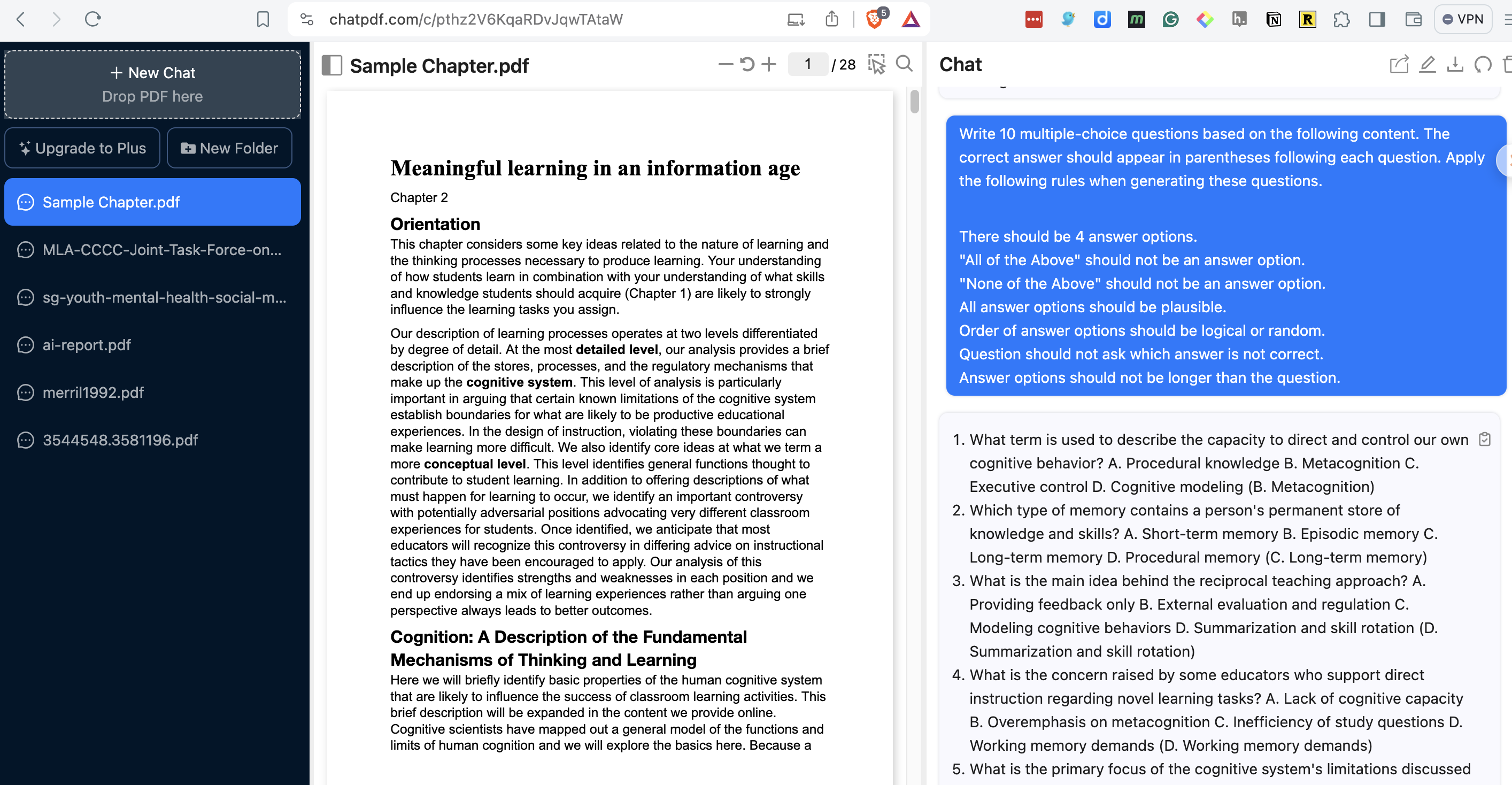
Write 10 multiple-choice questions based on the following content. The correct answer should appear in parentheses following each question. Apply the following rules when generating these questions.
There should be 4 answer options.
“All of the Above” should not be an answer option.
“None of the Above” should not be an answer option.
All answer options should be plausible.
Order of answer options should be logical or random.
Question should not ask which answer is not correct.
Answer options should not be longer than the question.
I would alter the first couple of sentences of this prompt if I was asking the AI service to use its own information base or I wanted to include a content source that should be the focus of the questions. If I was asking for questions generated based on the large language content alone, I would include a comment about the level of the students who would be answering the questions (e.g., high school students). For example, questions about mitosis and meiosis without this addition would include concepts I did not think most high school sophomores would have covered. When providing the AI service the content to be covered, I did not use this addition.
Questions based on a chapter
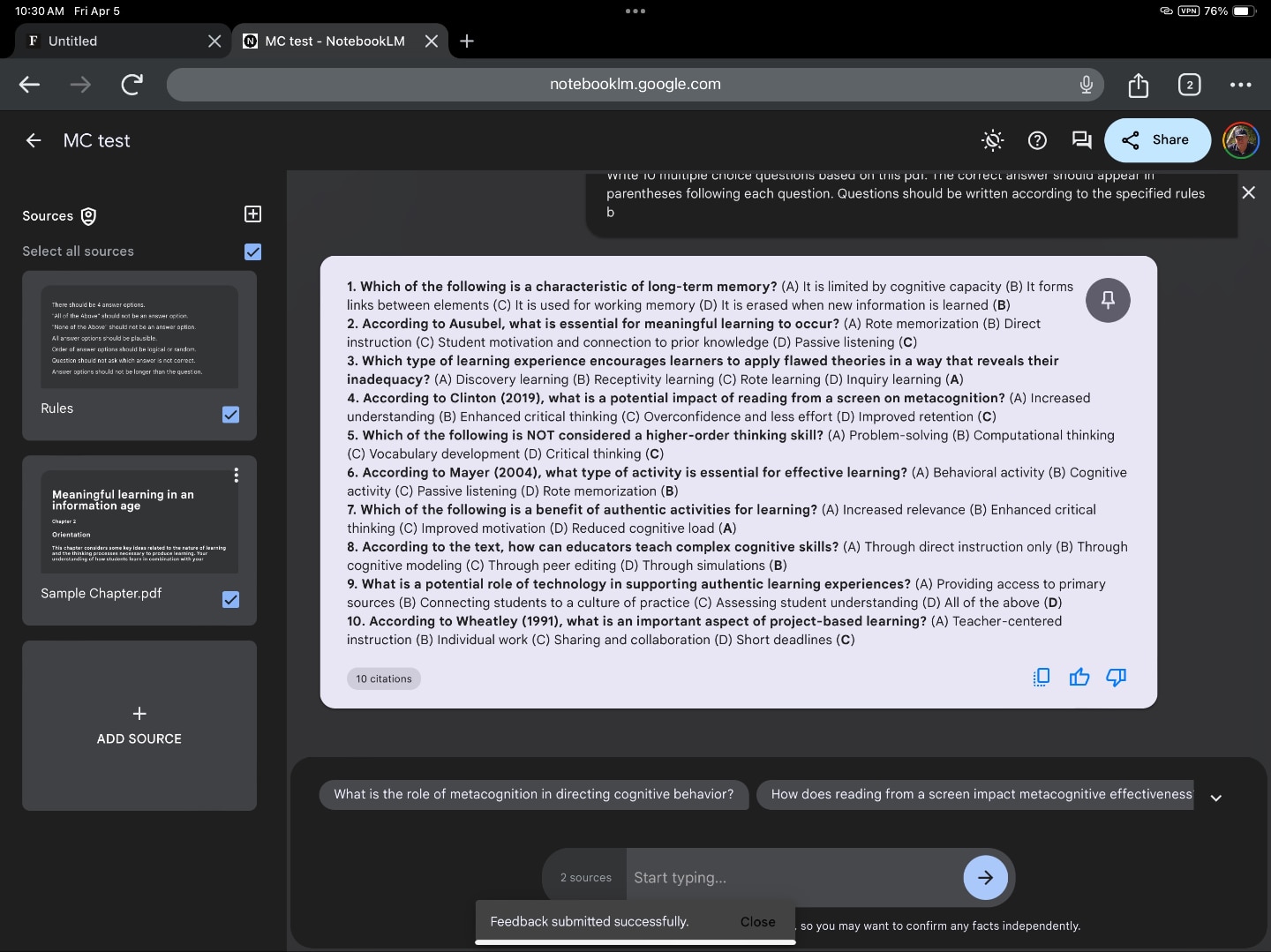
I have been evaluating the potential of an AI service to function as a tutor by interacting with a chapter of content. My wife and I have written a college textbook so I have authentic content to work with. The chapter is close to 10,000 words in length. In this case, I loaded this content and the prompt into ChatPDF, NotebookLM and ChatGPT. I pay $20 a month for ChatGPT and the free versions of the other two services. All proved to be effective.
ChatPDF
NotebookLM
With NotebookLM, you are allowed to upload multiple files that a prompt uses as a focus for the chat. For some reason rather than including my entire prompt, I had better results (suggested by the service) when I included the rules I wanted the system to apply as a second source rather than as part of the prompt.
ChatGPT
The process works a little differently with ChatGPT. I first copied the text from the pdf and pasted this content into the prompt window. I then scrolled to the beginning of this content and added my prompt. I could then ask the service to produce multiple question samples by asking for another 10 or 20 questions. I found some interesting outcomes when asking for multiple samples of questions. Even the format of the output sometimes changed (see the position of the answer in the following two examples).
**4. According to Clinton (2019), what is a potential impact of reading from a screen on metacognition?**
(A) Increased understanding
(B) Enhanced critical thinking
(C) Overconfidence and less effort
(D) Improved retention
(**C**)
**7. Which skill is considered a “higher order thinking skill”?**
(A) Word identification
(B) Critical thinking (**Correct**)
(C) Fact memorization
(D) Basic calculation
From sample to sample, some of the rules I asked ChatGPT to use were ignored. This slippage seemed unlikely in the initial response to the prompt.
What is an important consideration when designing project-based learning activities?**
(A) The amount of time available to students
(B) The availability of resources
(C) The level of student autonomy
(D) All of the above
(**D**)
Summary
The quality of multiple-choice questions generated using AI tools can be improved by adding rules for the AI service to follow as part of the prompt to generate questions. I would recommend that educators wanting to use the approach I describe here generate their own list of rules depending on their preferences. The questions used on an examination should always be selected for appropriateness, but the AI-based approach is a great way to easily generate a large number of questions to serve as a pool from which an examination can be assembled. Multiple choice exams should include a range of question types and it may be more efficient to write application questions because an educator would be in the best position to understand the background of students and determine what extension beyond the content in the source material would be appropriate.
This is an erratum in case my previous posts have misled anyone. I looked up the word erratum just to make certain I was using the word in the correct way. I have written several posts about AI tutoring and in these posts, I made reference to the effectiveness of human tutoring. I tend to provide citations when research articles are the basis for what I say and I know I have cited several sources for comments I made about the potential of AI tutors. I have not claimed that AI tutoring is the equal of human tutoring, but suggested that it was better than no tutoring at all, and in so doing I have claimed that human tutoring was of great value, but just too expensive for wide application. My concern is that I have proposed that the effectiveness of human tutoring was greater than it has been actually shown to be.
The reason I am bothering to write this post is that I have recently read several posts proposing that the public (i.e., pretty much anyone who does not follow the ongoing research on tutoring) has an inflated understanding of the impact of human tutoring (Education Next, Hippel). These authors propose that too many remember Bloom’s premise of a two-sigma challenge and fail to adjust Bloom’s proposal that tutoring has this high level of impact on student learning to what the empirical studies actually demonstrate. Of greater concern according to these writers is that nonreseachers including educational practitioners, but also those donating heavily to new efforts in education continue to proclaim tutoring has this potential. Included in this collection of wealthy investors and influencers would be folks like Sal Kahn and Bill Gates. I assume they might also include me in this group while I obviously have little impact in compared to those with big names. To be clear, the interest of Kahn, Gates, and me is really in AI rather than human tutoring, but we have made reference to Bloom’s optimistic comments. We have not claimed that AI tutoring was as good as human tutors, but by referencing Bloom’s claims we may have led to false expectations.
When I encountered these concerns, I turned to my own notes from the research studies I had read to determine if I was aware that Bloom’s claims were likely overly optimistic. It turns out that I had read clear indications identifying what the recent posters were concerned about. For example, I highlighted the following in a review by Kulik and Fletcher (2016).
“Bloom’s two sigma claim is that adding undergraduate tutors to a mastery program can raise test scores an additional 0.8 standard deviations, yielding a total improvement of 2.0 standard deviations.”
My exposure to Bloom’s comments on tutoring originally had nothing to do with technology or AI tutoring. I was interested in mastery learning as a way to adjust for differences in the rate of student learning. The connection with tutoring at the time Bloom offered his two-sigma challenge was that mastery methods offered a way to approach the benefits of the one-to-one attention and personalization provided by a human tutor. Some of my comments on mastery instruction and the potential of technology for making such tactics practical are among my earlier posts to this site. Part of Bloom’s claim being misapplied is based on his combination of personalized instruction via mastery tactics with tutoring. He was also focused on college-aged students in the data he cited. My perspective reading the original paper many years ago was not “see how great tutoring is”. It was more tutoring on top of classroom instruction is about is good as it is going to get and mastery learning offers a practical tactic that is a reasonable alternative.
As a rejoinder to update what I may have claimed, here are some additional findings from the Kulik and Fletcher meta-analysis (intelligent software tutoring).
The studies reviewed by these authors show lower benefits for tutoring when outcomes are measured on standardized rather than local tests, sample size is large, participants are at lower grade levels, the subject taught is math, a multiple-choice test is used to measure outcomes, and Cognitive Tutor is the ITS used in the evaluation.
However, on a more optimistic note, the meta-analysis conducted by these scholars found that in 50 evaluations intelligent tutoring systems led to an improvement in test scores of 0.66 standard deviations over conventional levels.
The two sources urging a less optimistic perspective point to a National Board of Educators Research study (Nickow and Colleagues, 2020) indicating that human tutoring for K-12 learners was approximately .35 sigma. This is valuable, but not close to the 2.0 level.
Summary
I have offered this update to clarify what might be interpreted based on my previous posts, but also to provide some other citations for those who now feel the need to read more original literature. I have no idea whether Kahn, Gates, etc. have read the research that would likely indicate their interest in AI tutoring and mastery learning was overly ambitious. Just to be clear I had originally interpreted the interest of what the tech-types were promoting as mastery learning (personalization) which was later morphed into a combination with AI tutoring. This combination was what Bloom was actually evaluating. The impact of a two-sigma claim when translated into what such an improvement would actually mean in terms of rate of learning or change in a metric such as assigned grade seems improbable. Two standard deviations would move an average student (50 percentile) to the 98th percentile. This only happens in Garrison Keeler’s Lake Wobegon.
References:
Bloom, B. S. (1984). The 2 sigma problem: The search for methods of group instruction as effective as one-to-one tutoring. Educational researcher, 13(6), 4-16.
Kulik, J. A., & Fletcher, J. D. (2016). Effectiveness of intelligent tutoring systems: a meta-analytic review. Review of educational research, 86(1), 42-78.
Nickow, A., Oreopoulos, P., & Quan, V. (2020). The impressive effects of tutoring on prek-12 learning: A systematic review and meta-analysis of the experimental evidence. https://www.nber.org/papers/w27476
In so many areas, the potential of the Internet seems subverted by the design decisions made by those who have built businesses on top of what seemed an innovation with so much potential. My focus here is on the political division and animosity that now exists. Since the origin of cable television, we have had a similar issue with an amazing increase in the amount of content, but the division of individuals into tribes that follow different “news” channels that offer predictably slanted accounts of the news of the day to the extent that loyal viewers are often completely unaware of important stories or different interpretations of the events they do encounter.
The Internet might have seemed a remedy. Social media services are already functioning as an alternative with many now relying on social media for a high proportion of the news individuals encounter. Unfortunately, social media services are designed in ways that make them as biased and perhaps more radicalizing than cable tv news channels.
Social Media and Internet News Sources
Here is the root of the problem. Both social media platforms and news sources can use your personal history to manipulate what you read. Social media platforms (e.g., Facebook, X, Instagram) use algorithms that analyze your past behavior, such as the posts you’ve liked, shared, or commented on, as well as the time you spend on certain types of content. They use this information to curate and prioritize content in your feed, including news articles, which they predict will keep you engaged on their platform. You add the way algorithms work on top of the reality that those we follow as “friends” are likely to have similar values and beliefs and what you read is unlikely to challenge personal biases you hold. To reverse the Rolling Stone lyric, you always get what you want and not what you need.
News sources are different from social media in which you identify friends and sources. However, news sources can also tailor their content based on the data they gather from your interactions with their posts or websites. These practices are part of a broader strategy known as targeted or personalized content delivery, which is designed to increase user engagement and, for many platforms, advertising revenue.
Many major news organizations and digital platforms target stories based on user data to personalize the news experience. Here are some examples:
Google News: Google News uses algorithms to personalize news feeds based on the user’s search history, location, and past interactions with Google products. It curates stories that it thinks will be most relevant to you.
Apple News: By using artificial intelligence, Apple News+ offers a personalized user experience. Publishers can adapt content based on readers’ preferences and behavior, leading to stronger engagement and longer reading times.
The New York Times: The New York Times has a recommendation engine that suggests articles based on the user’s reading habits on their website. If you read a lot of technology-related articles, for example, the site will start to show you more content related to technology.
Are Federated Social Media different?
Federated social media refers to a network of independently operated servers (instances) that communicate with each other, allowing users from different instances to interact. The most notable example of a federated social media platform is Mastodon, which operates on the ActivityPub protocol. On Mastodon, you can follow accounts from various instances, including those that post news updates. For example, if a news organization has an account on a Mastodon instance, you can follow that account from your instance, and updates from that news source will appear in your feed. This system allows for a wide range of interactions across different communities and servers, making it possible to follow and receive updates from diverse news sources globally.
Your Mastodon timeline is just a reverse chronological feed of the people you follow, or the posts from people on your instance only (and not across all of Mastodon). There’s no mysterious algorithm optimized for your attention. So, with Mastodon, a news source you follow may have a general bias, but you would get the stories they share without prioritization by an algorithm based on your personal history.. This should generate a broader perspective.
With Mastodon, you can join multiple instances some of which may have a focus. For example, I first joined Maston.Social which at the time was that instance most users were joining. I have since joined a couple of other instances (twit.social & mastadon.education) that have a theme (technology and education), but participants post on all kinds of topics. An interesting characteristic of federated services is that you can follow individuals from other instances – e.g., you can follow me by adding @grabe@twit.social from other instances.
This brings me to a way to generate a news feed the posts from which will not be ordered based on a record of your personal use of that instance. Many news organizations have content shared through Mastodon and you can follow this content no matter the Mastodon instance you join. Some examples follow, but you can search for others through any Mastodon account. You follow these sources in the same way you would follow an individual on another account.
@npr@mstdn.social
@newyorktimes@press.coop
@cnn@press.coop
@wsj@press.coop
@bbc@mastodon.bot
@Reuters@press.coop
Full access may depend on subscriptions. For example, I have a subscription for the NYT.
So, if a more balanced feed of news stories appeals to you. Try joining a Mastodon instance and then follow a couple of these news sources.
This post is a follow-up to my earlier post promoting digital flashcards as an effective study strategy for learners of all ages. In that post, I suggested that at times educators were anti rote learning assuming that strategies such as flashcards promoted a shallow form of learning that limited understanding and transfer. While this might appear to be the case because flashcards seem to involve a simple activity, the cognitive mechanisms that are involved in trying to recall and reflect on the success of such efforts provide a wide variety of benefits.
The benefits of using flashcards in learning and memory can be explained through several cognitive mechanisms:
1. Active Recall: Flashcards engage the brain in active recall, which involves retrieving information from memory without cues (unless the questions are multiple-choice). This process strengthens the memory trace and increases the likelihood of recalling the information later. Active recall is now more frequently described as retrieval practice and the benefits as the testing effect. Hypothesized explanations for why efforts to recall and even why efforts to recall that are not successful are associated not only with increased success at recall in the future but also broader benefits such as understanding and transfer offer a counter to the concern that improving memory necessarily is a focus on rote. More on this at a later point.
2. Spaced Repetition: When used systematically, flashcards can facilitate spaced repetition, a technique where information is reviewed at increasing intervals. This strengthens memory retention by exploiting the psychological spacing effect, which suggests that information is more easily recalled if learning sessions are spaced out over time rather than crammed in a short period.
3. Metacognition: Flashcards help learners assess their understanding and knowledge gaps. Learners often have a flawed perspective of what they understand. As learners test themselves with flashcards, they become more aware of what they know and what they need to focus on, leading to better self-regulation in learning
4. Interleaving: Flash cards can be used to mix different topics or types of problems in a single study session (interleaving), as opposed to studying one type of problem at a time (blocking). Interleaving has been shown to improve discrimination between concepts and enhance problem-solving skills.
5. Generative Processing: External activities that encourage helpful cognitive behaviors is one way of describing generative learning. Responding to questions and even creating questions have been extensively studied and demonstrate achievement benefits.
Several of these techniques may contribute to the same cognitive advantage. These methods (interleaving, spaced repetition, recall rather than recognition) increase the demands of memory retrieval and greater demands force a learner to move beyond rote. They must search for the ideas they want and effortful search activates related information that may provide a link to what they are looking for. An increasing number of possibly related ideas become available within the same time frame allowing new connections to be made. Connections can be thought of as understanding and in some cases creativity.
This idea of the contribution of challenge to learning can be identified in several different theoretical perspectives. For example, Vygotsky proposed the concept of a Zone of Proximal Development that position ideal instruction as challenging learners a bit above their present level of functioning, but within the level of what a learner could take on with a reasonable change of understanding. A more recent, but similar concept proposing the benefits of desirable difficulty came to my attention as the explanation given for why taking notes on paper was superior to taking notes using a keyboard. The proposal was that keyboarding is too efficient forcing learners who record notes by hand to think more carefully about what they want to store. Deeper thought was required when the task was more challenging.
Finally, I have been exploring researchers studying the biological mechanism responsible for learning. As anyone with practical limits on my time, I don’t spend a lot of time reviewing the work done in this area. I understand that memory is a biological phenomenon and cognitive psychologists do not focus on this more fundamental level, but I have also yet to find insights from biological research that required I think differently about how memory happens. Anyway, a recent book (Ranganath, 2024) proposes something called error-driven learning. The researcher eventually backs away a bit from this phrase suggesting that it does not require you to make a mistake but happens whenever you struggle to recall.
The researcher proposes that the hippocampus enables us to “index” memories for different events according to when and where they happened, not according to what happened. The hippocampus generates episodic memories. by associating a memory with a specific place and time. As to why changes in contexts over time matter, memories stored in this fashion become more difficult to retrieve. Activating memories with spaced practice both creates an effortful and more error-prone retrieval, but if successful offers a different context connection. So, spacing potentially offers different context links because different information tends to be active in different locations and times (note other information from what is being studied would be active) and involves retrieval practice as greater difficulty involves more active processing and exploration of additional associations. I am adding concepts such as space and retrieval practice from my cognitive perspective, but I think these concepts fit very well with Ranganath’s description of “struggling”.
I have used the term episodic memory in a little different way. However, the way Rangath describes changing contexts over time seems useful as an explanation for what has long been appreciated as the benefit of spaced repetition in the development of long-term retention and understanding.
When I taught educational psychology memory issues, I described the difference between episodic and declarative memories. I described the difference as similar to the students’ memory for a story and the memory for facts or concepts. I proposed that studying especially trying to convert the language and examples of the input (what they read or heard in class) into their own way of understanding with personal examples that were not part of the original content they were trying to process was something like converting episodic representations (stories) into declarative representations linked to relevant personal episodic elements (students’ own stories). This is not an exact representation of human cognition in several ways. For example, even our stories are not exact and are biased by past and future experiences and can change with retelling. However, it is useful as a way to develop what might be described as understanding.
So, to summarize, memory tasks, even what might seem to be simple ones such as might be the case with basic factual flashcards can introduce a variety of factors conducive to a wide variety of cognitive outcomes. The assumption that flashcards are useful only for rote memory is flawed.
Flashcard Research
There is considerably more research on the impact of flashcards that I realized and some recent studies that are specific to digital flashcards.
Self-constructed or provided flashcards – When I was still teaching the college students I say using flashcards were obviously using paper flashcards they had created. My previous post focused on flashcard tools for digital devices. As part of that post, I referenced sources for flashcards that were prepared by textbook companies and topical sets prepared by other educators and offered for use. I was reading a study comparing premade versus learner-created flashcards (description to follow) and learned that college students are now more likely to use flashcards created by others. I guess this makes some sense considering how digital flashcard collections would be easy to share. The question then is are questions you create yourself better than a collection that covers the material you are expected to learn.
Pan and colleagues (2023) asked this question and sought to answer it in several studies with college students. One of the issues they raised was the issue of time required to create flashcards. They controlled the time available for the treatment conditions with some participants having to create flashcards during the fixed amount of time allocated for study. Note – this focus on time is similar to the retrieval practice studies using part of the time in the study phase for responding to test items while others were allowed to study as they liked. The researchers also conducted studies in which the flashcard group created flashcards in different ways – transcription (typing the exact content from the study material), summarization, and copy and pasting. The situation investigated here seems similar to note-taking studies comparing learner-generated notes and expert notes (quality notes provided to learners). With both types of research, one might imagine a generative benefit to learners in creating the study material and a completeness/quality issue. The researchers did not frame their research in this way, but these would be alternative factors that might matter.
The results concluded that self-generated flashcards were superior. They also found that copy-and-paste flashcards were effective which surprised me and I wonder if the short time allowed may have been a factor. At least, one can imagine using copy and paste as a quick way to create the flashcards using the tool I described in my previous flashcard post.
Three-answer technique – Senzaki and colleagues (2017) evaluated a flashcard technique focused on expanding the types of associations used in flashcards. They proposed their types of flashcard associations based on the types of questions they argued college students in information-intensive courses are asked to answer on exams. The first category of test items are verbatim definitions for retention questions, the second are accurate, paraphrases for comprehension questions, and the third are realistic examples for application questions. Their research also investigated the value of teaching students to use the three response types in comparison to requesting they include these three response types.
The issue of whether students who use a study technique (e.g., Cornell notes, highlighting) are ever taught how to use a study strategy why it might be important to apply the study in a specific way) has always been something I have thought was important.
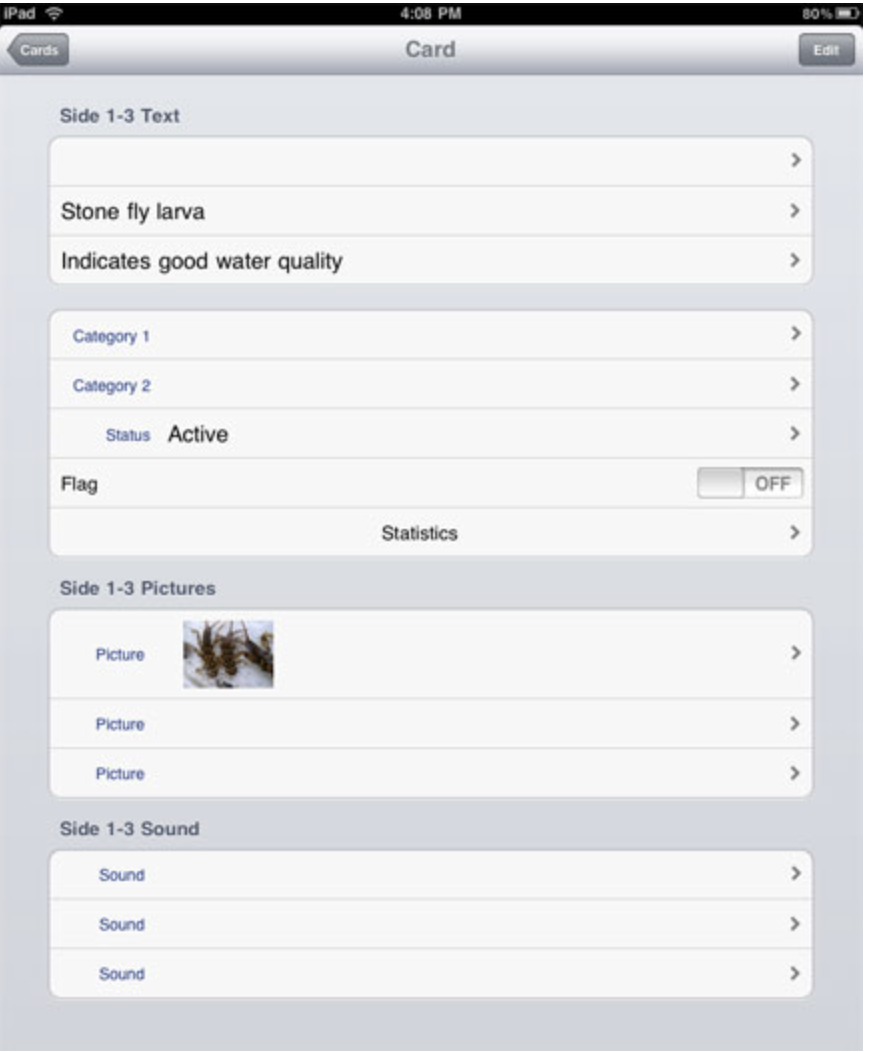
The Senzaki and colleagues research found their templated flashcard approach to be beneficial and I could not help seeing how the Flashcard Deluxe tool I described in my first flashcard post was designed to allow three possible “back sides” for a digital flashcard. This tool would be a great way to implement this approach.
AI and Flashcards
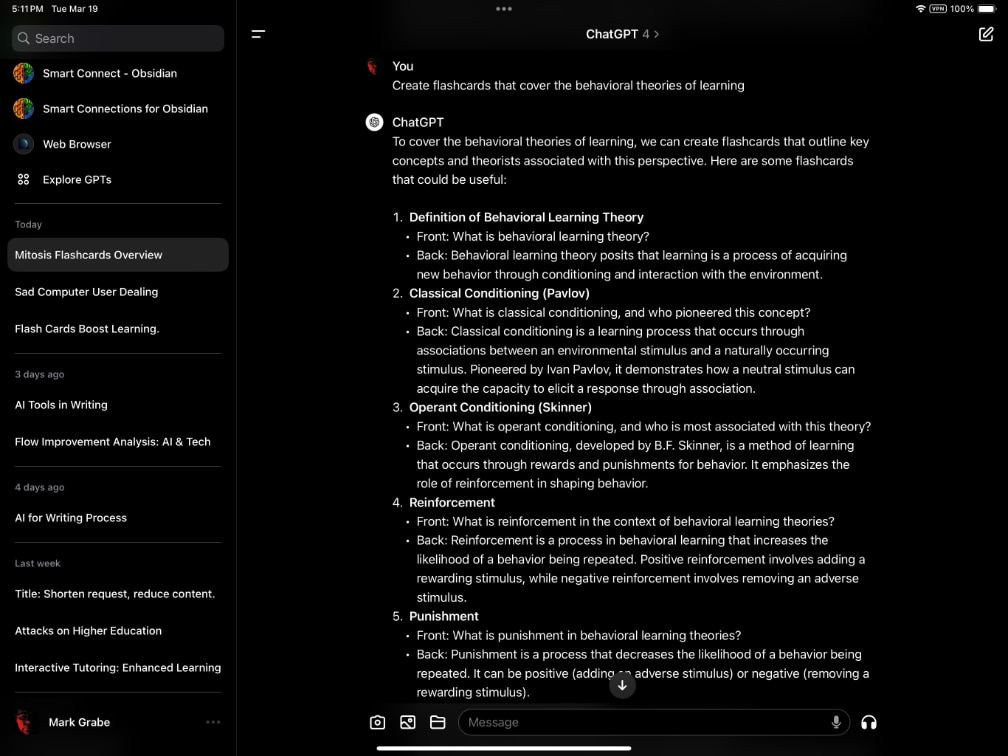
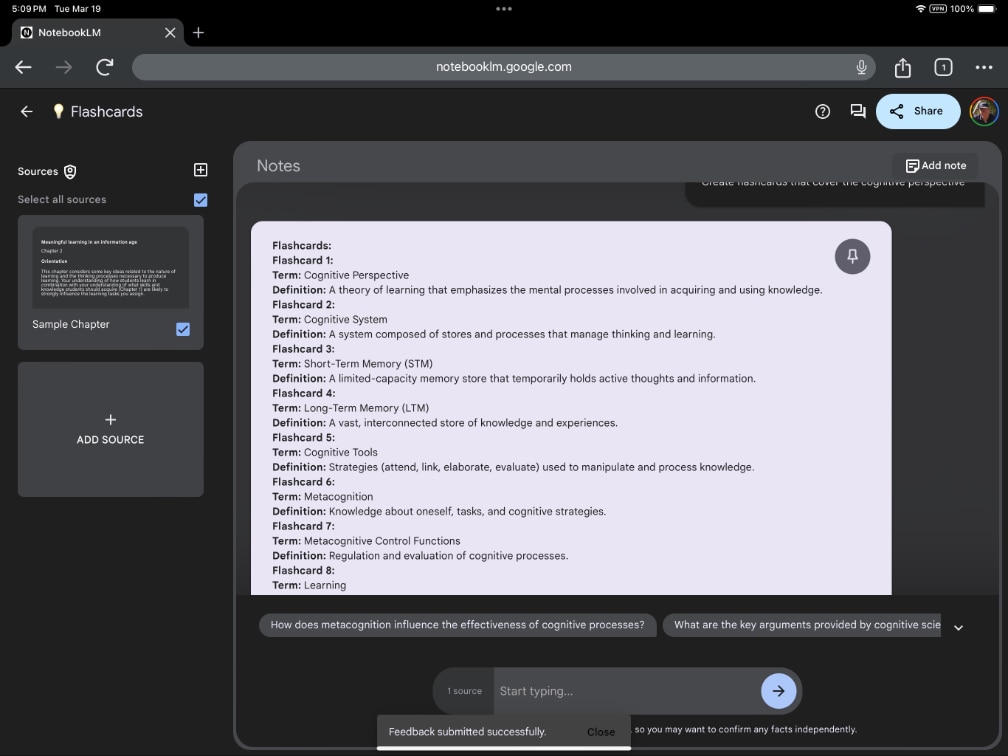
So, while learner-generated flashcards offer an advantage, I started to wonder about AI and was not surprised to find that AI-generated capabilities are already touted by companies providing flashcard tools. This led me to wonder what would happen if I asked AI tools I use (ChatGPT and NotebookLM) to generate flashcards. One difference I was interested in was asking ChatGPT to create flashcards over topics and NotebookLM to generate flashcards focused on a source I provided. I got both approaches to work. Both systems would generate front and back card text I could easily transfer to a flashcard tool. I found that some of the content I decided would not be particularly useful, but there were plenty of front/back examples I thought would be useful.
The following image shows a ChatGPT response to a request to generate flashcards about mitosis.
This use of AI used NotebookLM to generate flashcards based on a chapter I asked it to use as a source.
This type of output could also be used to augment learner-generated cards or could be used to generate individual cards a learner might extend using the Senzaki and colleagues design.
References
Pan, S. C., Zung, I., Imundo, M. N., Zhang, X., & Qiu, Y. (2023). User-generated digital flashcards yield better learning than premade flashcards. Journal of Applied Research in Memory and Cognition, 12(4), 574–588. https://doi-org.ezproxy.library.und.edu/10.1037/mac0000083
Ranganath, C. (2024). Why We Remember: Unlocking Memory’s Power to Hold on to What Matters. Doubleday Canada.
Senzaki, S., Hackathorn, J., Appleby, D. C., & Gurung, R. A. (2017). Reinventing flashcards to increase student learning. _Psychology Learning & Teaching, 16(3), 353-368.
I thought you might appreciate a different example from the type of thing I tend to focus on explaining how a study technique used by students at all levels might be improved through the use of digital technology. When I taught educational psychology I included presentations on what I considered the classic recommended techniques – e.g., SQ3R, Cornell Notes. As I have explained in other things I have written on this general topic I would also ask how many of the students were aware of these strategies and then how many were using them in our class. Most were familiar with at least these two, but I can’t remember anyone ever saying they were using these approaches. Most took notes, but not Cornell notes and then they studied these notes. They tended to highlight the assigned reading content.
A topic I mentioned because I knew the strategy, but did not spent a lot of time on was flashcards. I have thought about why the use of flashcards was not a topic I discussed more since. I think at the time this was because there seemed a stigma associated with learning methods that were considered rote and not the way to develop understanding and a long term benefit. I kind of see a similar attitude surfacing from time to time now and it is often in the context of “why would you expect someone to store that in memory when they can just look it up with Google”?
I have changed my mind about flashcards. I think the students had a more realistic perspective than I did. They knew flashcards worked for them. I also think my perspective on effective learning has also changed some as I have read more about how humans learn. I have to decided to generate at least two posts on digital flashcards. I will being with what is mostly a tutorial describing a digital flashcard system I like. Eventually, I will provide additional content explaining what research has to say about study strategies that can be implemented with flashcards.
Elementary students have used flashcards to drill on math facts for decades and I commonly see university students studying for anatomy or geology examinations using nearly the same procedure. Flashcards provide individuals or individuals within small groups a way to systematically practice retrieval and evaluate understanding both of which are important and documented ways to improve performance and retention (Rohrer, & Pashler, 2010). I assume you understand how flashcards are traditionally used from observation if not from personal experience. In a typical approach a student has a stack of cards with a question on one side of each card and a response on the other side. Elementary math fact cards may have been purchased commercially, but the review material used by college students was probably generated by the learner. When a few minutes are available, a student brings out the cards and begins going through the stack. Do you know the answer to the math problem? Do you remember the origin and insertion for the muscle listed? You flip the card over to see if you were correct. Perhaps you developed a variant of this approach you thought improved the process. You may have discarded each card after initial consideration into a “I know that” pile or a “I don’t know that pile” and then spend more time with the “I don’t know that pile” instead of going through the entire stack a second time.
Researchers have considered how the use of review techniques of this type might be optimized. These techniques might involve how frequently you view cards with information you do not know versus cards with information you do know or on how many different days you review material. Some of these findings and other inherent advantages of digital media are now incorporated in free or low-cost software or services you can find and use online or download to your personal device.
So, I might begin by asking the question, How might flashcards on the computer, a smartphone, or tablet offer advantages in comparison to the standard paper variety? I don’t think this is another version of the paper versus screen debates that now seem common, but some could see it that way.
What follows is an example of a flashcard application and then a consideration of the unique opportunities this and similar applications offer. These examples makes use of Flashcards Deluxe (information about this application and a few other flashcard options appears at the end of this segment); an app for the iPad or iPhone.
Flaschards Deluxe. A classroom example I sometimes use to explain that technology is not confined to the classroom we call the Turtle River Water Quality Project. One aspect of this project involved the collection and identification of macroinvertebrates. The prevalence of different macroinvertebrates (organisms without a backbone that can be viewed without aid of a microscope) can be used to evaluate water quality. Some macroinvertebrates can tolerate poor quality water and some cannot. So the collection and identification of macroinvertebrates allows a way to evaluate the “health” of a body of water.
Before making the trip to collect specimens, a teacher might want to prepare students by familiarizing them with the set of organisms they might encounter. This task involves learning to associate the name and whether an organism is tolerant of pollution with an image of the organism. Imagine a three-sided flash card – if there was such a thing. One side might contain an image of the organism, the second side would contain the name of the organism, and the third side would indicate whether the organism was pollution tolerant. If this were possible to create as a physical, paper card, the student would look at a picture, attempt to remember the name and tolerance of the organism, and then flip the card to check the information recalled or view the correct information. The student would then move to the next card and repeat the process.
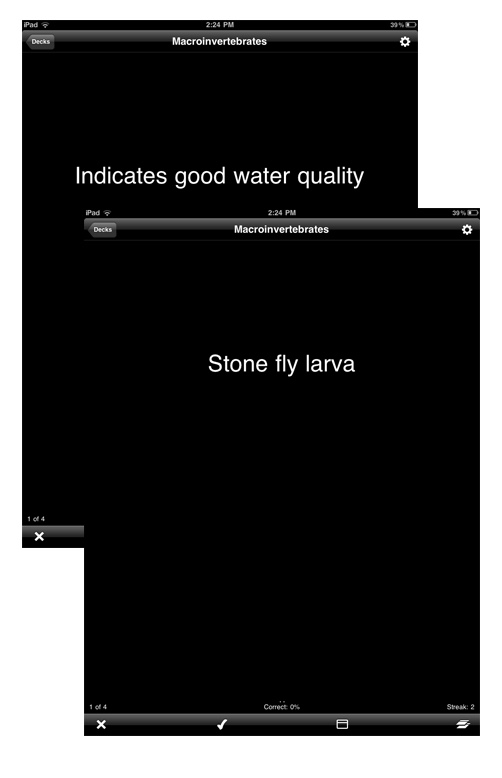
The digital equivalent, created with Flashcards Deluxe, would work like this. The student would view the image appearing on the first card trying to remember the name of the organism and whether or not the organism is an indicator of healthy water (see Figure Front View). The student would then “tap” the image to flip the card and reveal the name of the organism and would tap the card a second time to reveal whether or not the organism is associated with healthy water (see Figure Composite Feedback). Selecting the “check mark” or “X” appearing at the bottom of the card would indicate whether the student had judged performance to be adequate or not and would move the student to the next image. When the student reached the end of the deck, all cards associated with a judgment of inadequate recall would automatically be repeated.
Front view of Flashcard Deluxe Card
Back views of Flashcards Deluxe Card
Individual flashcards are created using the following template. Text, images, and sound are added to the slots on this template representing the three sides of a card.
This video provides more details on this tool.
Digital Advantage
What case can be made for the digital version of flashcards? Here are some thoughts on potential advantages. All of these characteristics are available in some products or services, but not necessarily in all so you would want to review the capabilities of a given product before investing a lot of time.
A) Multiple media – Some digital flashcards can incorporate images and sounds (e.g., our example). If the value in multimedia flashcards is not obvious, consider situations in which the study task involves identification of orchestra instruments by the sound the instruments produce, recognition of vocabulary in a foreign language class based on listening rather than reading, or the identification of molecular structures in biochemistry. These would be study situations that would be difficult or impossible to address with paper index cards. You can create multimedia resources yourself. For example, you can collect images with your phone and use these images to create study materials. Would this be useful in preparing for biology or anatomy lab practicals?
B) Existing and shareable review materials – There are massive collections of existing review materials already available for a wide variety of academic areas. There appear to be basic standards or at least common formats for exporting sets of cards so that many of the resources developed through one service can be used on the software provided by other vendors. These collections can be downloaded, combined, and edited by individual students to best address personal study goals. It will often be more efficient to take a large existing collection and delete the cards not appropriate for your class than to create a new stack from scratch. A teacher can do the same thing and then share a set of cards optimized for a specific class with students. We include links to several vendors who store and share collections at the end of this section.
C) Data and suggested review strategies – It might be best to consider what we are describing here as study systems rather than just study materials. In addition to the information to be learned, these systems can keep track of performance on individual items and data such as the last date a given card was reviewed. If the student is so inclined, some systems can present items that cause the student difficulty more frequently or even schedule which content should be reviewed on a particular day within a designated time period. This is where our previous reference to what research can tell us about optimized review and rehearsal comes into play. Computers are good at keeping track of and applying numerical performance data. So, it turns out that free or low-cost digital resources offer more than the option of thumbing through the stack of cards you carry in your backpack. If you presently make use of “flashcards” or see such resources as having a use in classrooms that are or will be your responsibility, we encourage you to explore the following resources. I have included some resources that can be used from a computer and some from a tablet.
Student access to AI has created a situation in which educators must consider when AI should and should not be used. I think about this question by considering the difference between what skill or skills are the focus of instruction and whether AI will replace a skill to improve the efficiency of the writing task or will support a specific skill in some way. It may also be useful to differentiate learning to write from writing to learn. My assumption is that unless specific skills are used by the learner those skills will not be improved. Hence when AI is simply used to complete an assignment a learner learns little about writing, but may learn something about using AI.
Writing Process Model
The writing process model (Flower & Hayes, 1981) is widely accepted as a way to describe the various component skills that combine to enable effective writing. This model has been used to guide both writing researchers and the development of instructional tactics. For researchers, the model is often used as a way to identify and evaluate the impact of the individual processes on the quality of the final project. For example, better writers appear to spend more time planning (e.g., Bereiter & Scardamalia, 1987). For educators and instructional designers, understanding the multiple processes that contribute to effective writing and how these processes interact is useful in focusing instruction.
Here, the writing process model will be used primarily to identify the subskills to be developed as part of learning to write and writing to learn and I will offer my own brief description of this model. It is worth noting that other than composing and rewriting products, other uses of technology to improve writing and increase the frequency of writing experiences seldom receive a lot of attention (Gillespie, Graham, Kiuhara & Hebert, 2014).
The model
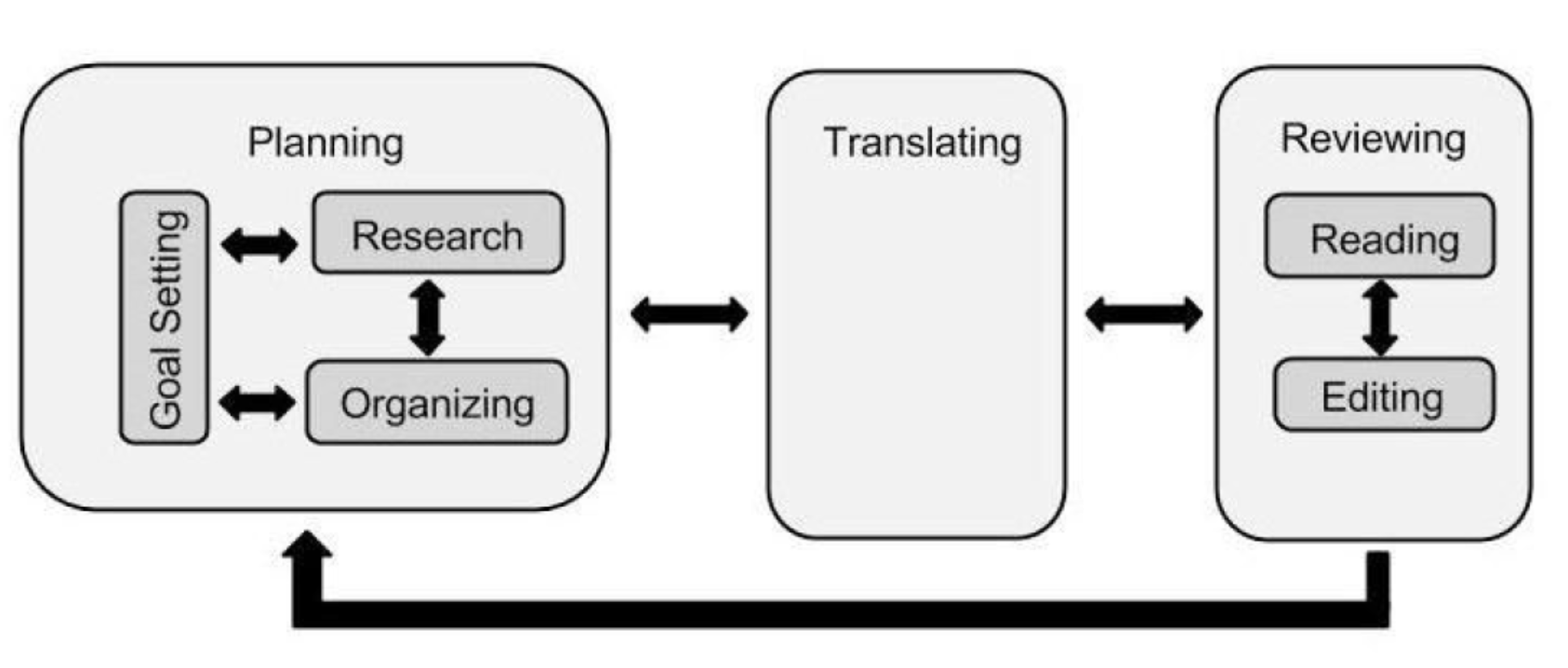
The model identifies three general components a) planning, b) translation, and c) reviewing.
Planning involves subskills that include setting a goal for the project, gathering information related to this goal which we will describe as research, and organizing this information so the product generated will make sense. The goal may be self-determined or the result of an assignment.
Research may involve remembering what the author knows about a topic or acquiring new information. Research should also include the identification of the characteristics of the audience. What do they already know? How should I explain things so that they will understand? Finally, the process of organization involves establishing a sequence of ideas in memory or externally to represent the intended flow of logic or ideas.
What many of us probably think of as writing is what Flower and Hayes describe as translation. Translation is the process of getting our ideas from the mind to the screen and this externalization process is typically expected to conform to conventions of expression such as spelling and grammar.
Finally, authors read what they have written and make adjustments. This review may occur at the end of a project or at the end of a sentence. In practice, authors may also call on others to offer advice rather than relying on their own review.
One additional aspect of the model that must not be overlooked is the iterative nature of writing. This is depicted in the figure presenting the model by the use of arrows. We may be tempted, even after initial examination of this model, to see writing as a mostly linear process – we think a bit and jot down a few ideas, we use these ideas to craft a draft, and we edit this draft to address grammatical problems. However, the path to a quality finished product is often more circuitous. We do more than make adjustments in spelling and grammar. As we translate our initial ideas, we may discover that we are vague on some points we thought we understood and need to do more research. We may decide that a different organizational scheme makes more sense. This reality interpreted using our tool metaphor would suggest that within a given project we seldom can be certain we have finished the use of a given tool and the opportunity to move back and forth among tools is quite valuable.
Tech tools and writing
Before I get to my focus on AI tools, it might be helpful to note that technology tools used to facilitate writing subprocesses have existed for some time. For example, spelling and grammar checkers, outline and concept mapping, note-taking and note-storage, citation managers, online writing environments allowing collaboration and commenting, and probably many other tools that improve the efficiency and effectiveness of writing and learning to write. Even the use of a computer allows advantages such as storage of digital content in a form that can easily be modified rather than the challenge of making improvements to content stored on paper. The digital alternative to paper changes how we go about the writing process. I have written about technology for maybe 20 years and one of the bextbooks offered the type of analysis I am offering here not about AI tools, but about the advantages of writing on a computer and using various digital tools.
A tool can substitute for a human process or a tool can supplement or augment a human process. This distinction is important when it comes to writing to learn and learning to write. When the process is what is to be learned, this substitution is likely to be detrimental as it allows a learner to skip needed practice. In contrast, augmentation often allows the opposite as a busy work activity or some incapability is taken care of allowing more important skills to become the focus.
Here are the types of tools I see as supporting individual writing processes.
Planning – Organization and Research
Prewriting involves developing a plan for what you want to get down on paper (or screen in this case). A writer goes about these two subprocesses in different ways. You can think or learn about a topic (research) and then organize these ideas in some way to present. Or, you can generate a structure of your ideas (organize) and then research the topics to come up with the specifics to be included in a presentation. Again, these are likely iterative processes no matter which subskill goes first.
One thing AI does very well is to propose an outline if you are able to generate a prompt describing your goals. You could then simply ask the AI service to generate something based on this outline, but this would defeat the entire purpose of learning about the topic by doing the research to translate the outline into a product or developing writing skills by expanding the outline into a narrative yourself.
Since I am writing about how AI might perform some of the subskills identified by the writing process model, I asked ChatGPT to create an outline using the following prompt.
“Write an outline for ways in which ai can be used in writing. Base this outline on the writing subprocesses of the writing process model and include examples of AI services for the recommended activity for each outline entry.”
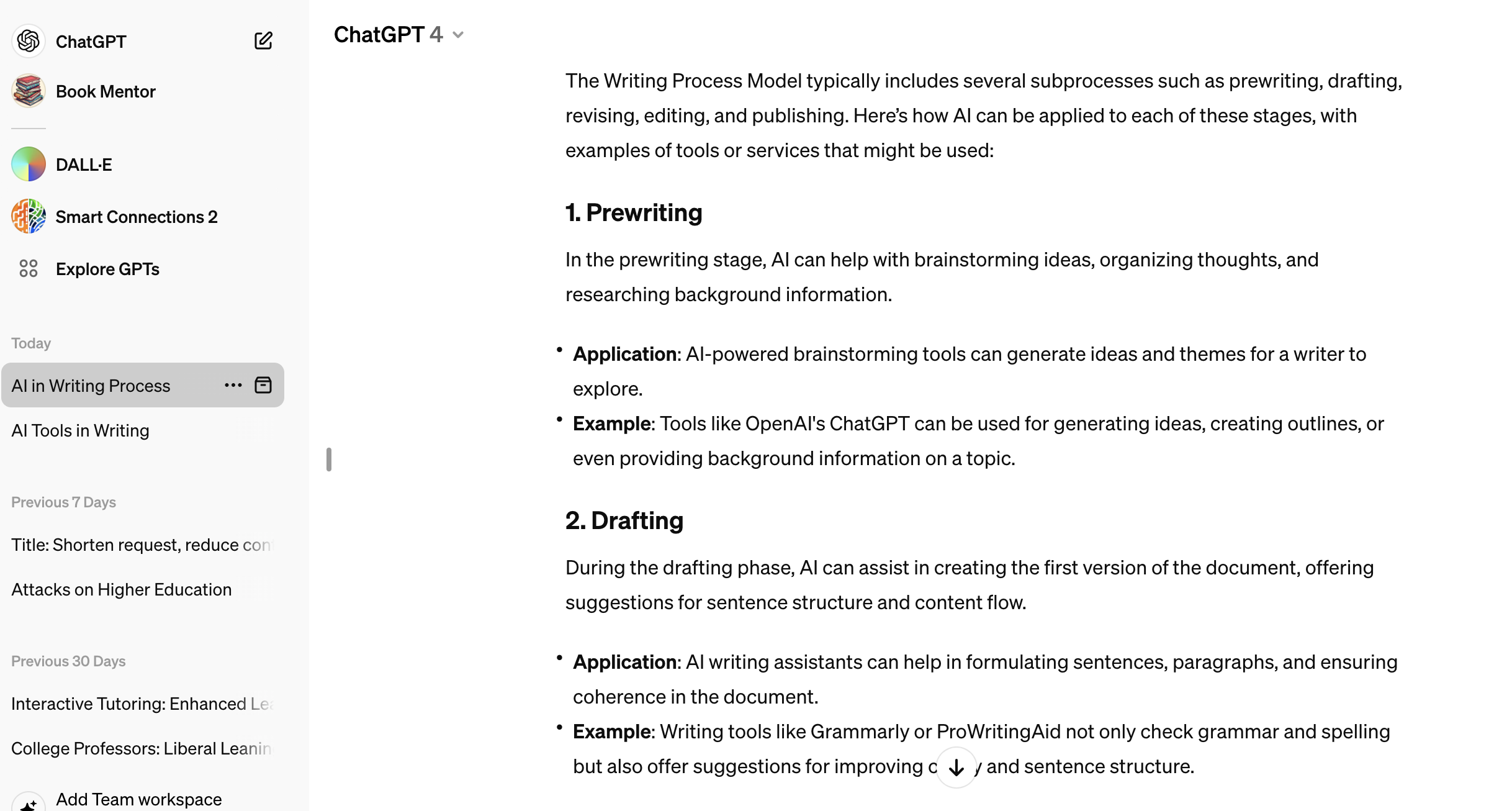
The following shows part of the outline ChatGPT generated. I tend to trust ChatGPT when it comes to well established content and I found the outline although a little different from the graphic I provided above to be quite credible and to offer reasonable suggestions. As a guide for writing on the topic I described, it would work well.
I had read that AI services could generate concept maps which would offer a somewhat different way to identify topics that might be included in a written product. I tried this several times using a variety of prompts with ChatGPT’s DALLE. The service did generate a concept map, but despite making several follow-up requests which ChatGPT acknowledged, I could not get the map to contain intelligible concept labels. Not helpful.
Translation
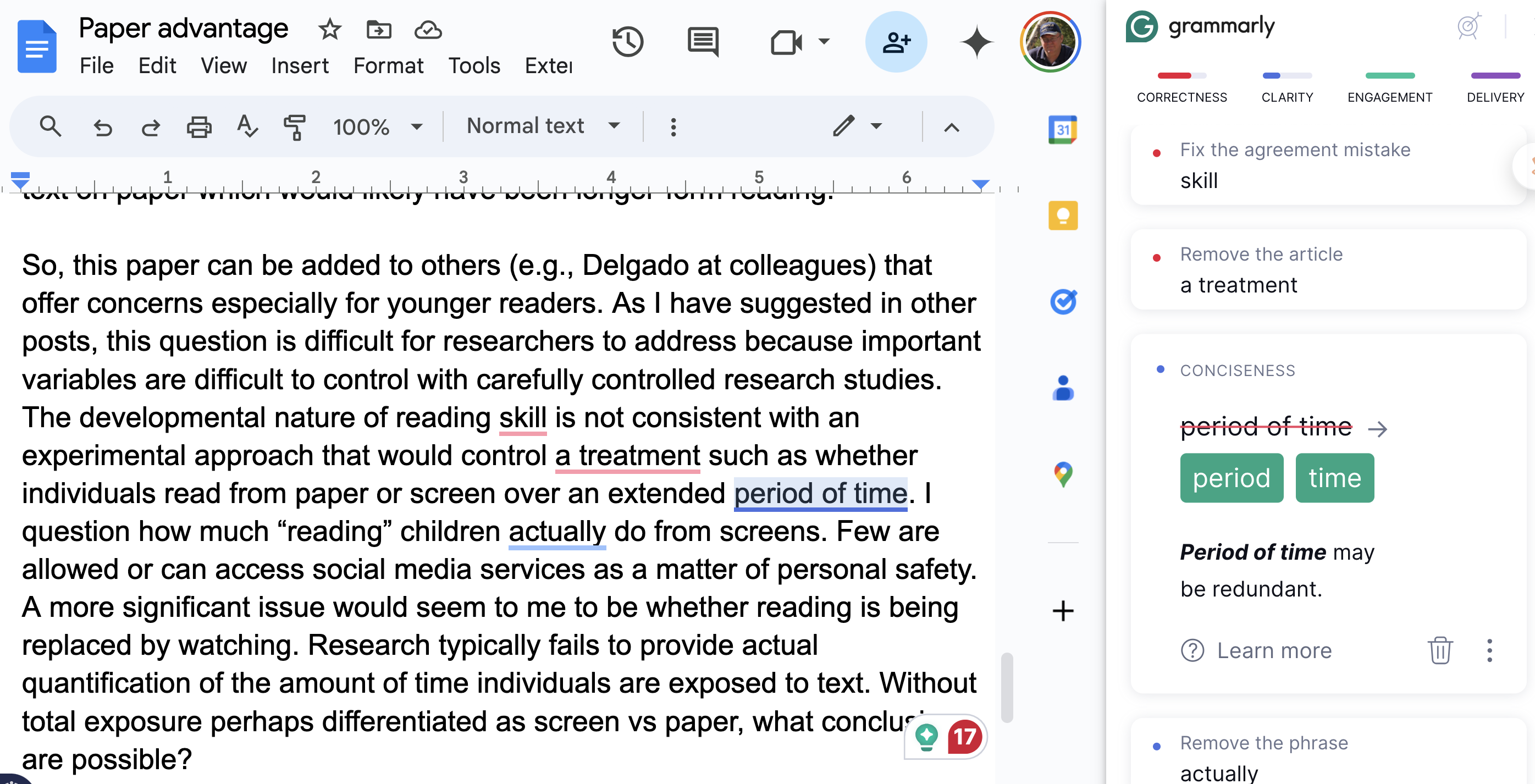
Tools for improving the translation process have existed in some form for a long time. The newest versions are quite sophisticated in providing feedback beyond basic spelling and grammatical errors. I write in Google docs and make use of the Grammarly extension.
I should note that Grammarly is adding AI features that will generate text. Within the perspective I am taking here I have some concerns about these additions. Since I am suggesting that writing subskills can be replaced or supported, student access to Grammarly could allow writing subskills the educator was intending students to perform themselves to be performed to some degree by the AI.
If you have not tried Grammarly, the tool identifies different types of modifications the tool proposes different modifications the writer might consider changing (spelling, missing or incorrect punctuation, alternate wording, etc.) and will make these modifications if the writer accepts the suggestion. The different types of recommendations are color-coded (see following image).
Revision
I am differentiating changes made while translating (editing) from changes made after translating (revision). Minor changes such as spelling and grammar would seem more frequently fixed as edits by this distinction and major modifications made (addition of examples, restructuring of sections, deletion of sections, etc.) while revising. Obviously, this is a simplistic differentiation and both types of changes occur during both stages).
I don’t know if I can confidently recommend a role for AI for this stage. Pre-AI, one might recommend that a writer share their work with a colleague and ask for suggestions. The AI version of Grammarly seems to be moving toward such capabilities. Already, a writer can ask AI to do things like shorten a document or generate a different version of a document. I might explore such capabilities out of curiosity and perhaps to see how modifications differ from my original creations, but for work that is to be submitted for evaluation of writing skill would that be something an educator would recommend?
I have also asked an AI tool to provide an outline, identify main ideas or generate a summary of a document I have written just to see what it generates. Does the response to one of these requests surprise me in some way? Sometimes. I might add headings and subheadings to identify a structure I thought was not as obvious as I had thought.
Conclusion:
My general point in this post was that questions of whether learners can use AI tools when assigned writing tasks should be considered in a more complex way. Rather than the answer being yes or no, I am recommending that learning to write and writing to learn are based on subprocesses and the AI tool question should be considered in response to a consideration of whether the learner was expected to be developing proficiency in executing a subprocess. In addition, it might be important to suggest that learning how to use AI tools could be a secondary goal.
Subprocess here were identified based on the Writing Process Model and a couple of suggestions were provided to illustrate what I mean by using a tool to drastically reduce the demands of one of the subprocesses. There are plenty of tools out there not discussed and my intention was to use these examples to get you thinking about this way of developing writing skills.
References:
Bereiter, C., & Scardamalia, M. (1987). An attainable version of high literacy: Approaches to teaching higher-order skills in reading and writing. Curriculum inquiry, 17(1), 9-30.
Flower, L., & Hayes, J. R. (1981). A cognitive process theory of writing. College composition and communication, 32(4), 365-387.
Gillespie, A., Graham, S., Kiuhara, S., & Hebert, M. (2014). High school teachers use of writing to support students’ learning: A national survey. Reading and Writing, 27, 1043-1072.
I use Obsidian plus the plugin Smart Connections to inform my blog writing activities. I write for educational practitioners and academics so I try to carefully base my content on sources that I have read and in many cases intend to cite in the content I generate. With this goal, Obsidian represents an archive I have developed over several years to store and organize notes from hundreds of books, journal articles, and websites. I explore my collection in different ways sometimes seeking notes on a specific article I want to emphasize and sometimes exploring to locate what I have read that is relevant to a topic that I might want to include but perhaps do not recall at the time.
In some cases, I want to use an AI tool to support my writing. I seldom use AI to actually generate the final version of content I post, but I may explore the possible organization of material for something I want to write or I might use an AI tool to generate an example of how I might explain something based on the notes I have made available to the AI tool.
The combination of Obsidian augmented by the Smart Connections plugin allows me to implement a workflow I have found useful and efficient. I have several specific expectations of this system:
I have already read the source material and taken some notes or generated some highlights now stored in Obsidian. I want to write based on this content.
I may not recall relevant sources I have stored in Obsidian because of the passage of time and the accumulation of a large amount of material. I want the AI system to understand my goals and locate relevant content.
I want the AI system to identify specific sources from the content I have reviewed rather than the large body used to train the LLM. I want the system to identify the specific source(s) from this material associated with specific suggestions so that I am aware of the source and can cite a source if necessary.
When a specific source has been identified I want to be able to go directly to the original document and the location within that document that is the location for the note or highlight that prompted the inclusion in the AI content so that I can reread the context for that note or highlight.
Obsidian with the Smart Connections plugin does these things and is to some extent unique because all of the material (the original content) is stored locally (actually within iCloud which functions as an external harddrive) allowing the maintenance of functioning links between the output from Smart Connections, the notes/highlights stored in Obsidian, and the original documents (pdfs of journal articles, Kindle books, web pages).
I do not know for certain that the Obsidian-based approach I describe is the only way to take the approach I take. I am guessing my approach works in part because I am not relying on an online service and online storage. I also use Mem.ai because it allows me to focus on my own content, but linking back to source documents does not work with this service. Mem.ai does include the AI capabilities as part of the subscription fee, but I don’t know when this might be an advantage. The Smart Connections plugin does require the use of an OpenAI API (ChatGPT) and there is a fee for this access.
Example:
Here is an example of what working with the Obsidian/Smart Connections setup is like. I am working on a commentary on the advantages and disadvantages of K12 students having access to AI in learning to write and writing to learn. I propose that writing involves multiple subprocesses and it is important to consider how AI might relate to each of these subprocesses. My basis for the list of subprocesses is based on the classic Flower and Hayes Writing Process Model. I had written a description of the Writing Process Model for a book I wrote and this section of content was stored within Obsidian as well as notes from multiple sources on AI advantages and disadvantages in the development of writing skills. I have not read a combination of the writing process model with ideas about the advantages and disadvantages of AI so this is the basis for what I think is an original contribution.
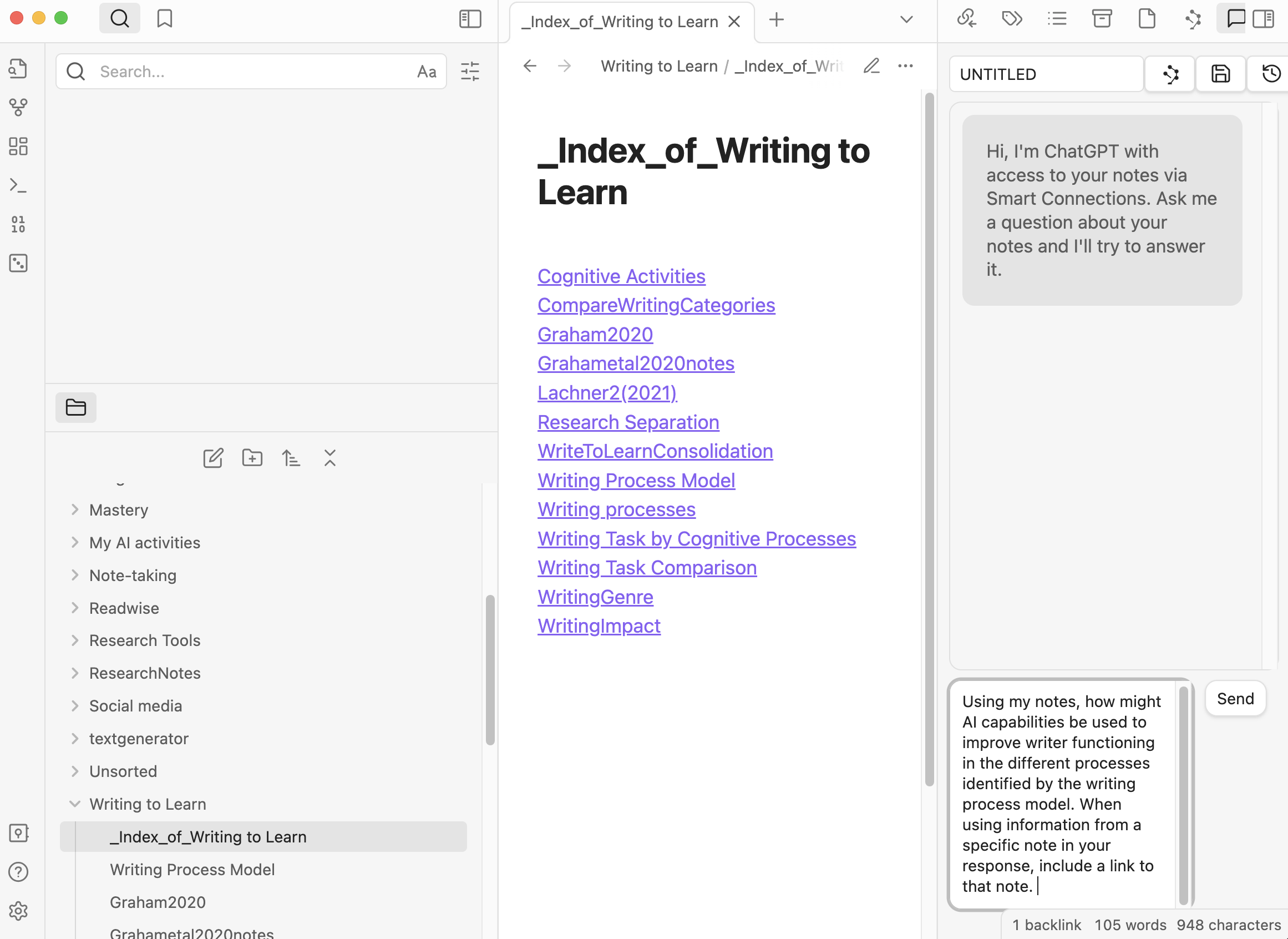
The following is a screenshot of Obsidian. The Smart Connection appears as a panel on the right side of the display. The left-hand panel provides a hierarchical organization of note titles and the middle panel provides access to an active note or a blank space for writing a new note.
In the bottom textbox of the Smart Connections panel, I have entered the following prompt:
Using my notes, how might AI capabilities be used to improve writer functioning in the different processes identified by the writing process model. When using information from a specific note in your response, include a link to that note.
Aside from the focus of the output, two other inclusions are important. First, there is the request to “use my notes”. This addition is recommended to ensure a RAG (retrieval augmented generation) approach. In other words, it asks the AI service use my notes rather than the general knowledge of the AI system as the basis for the output. The second supplemental inclusion is the request to include a link to that note which is intended to do just what it says – add links I can use to to see where ideas in the output came from.
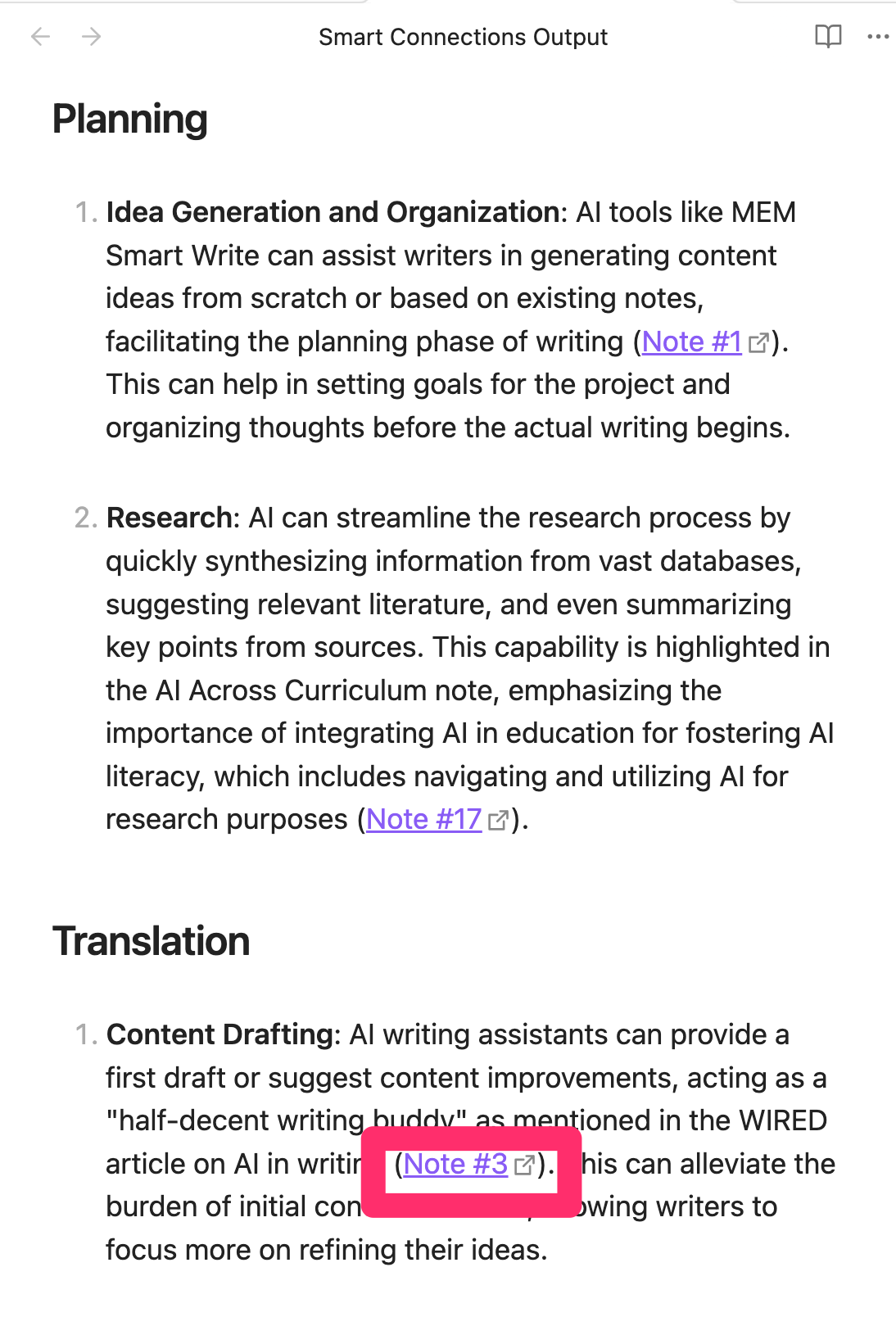
The output from Smart Connections is in markdown. I copied this output into a new blank note and the links included are now active.
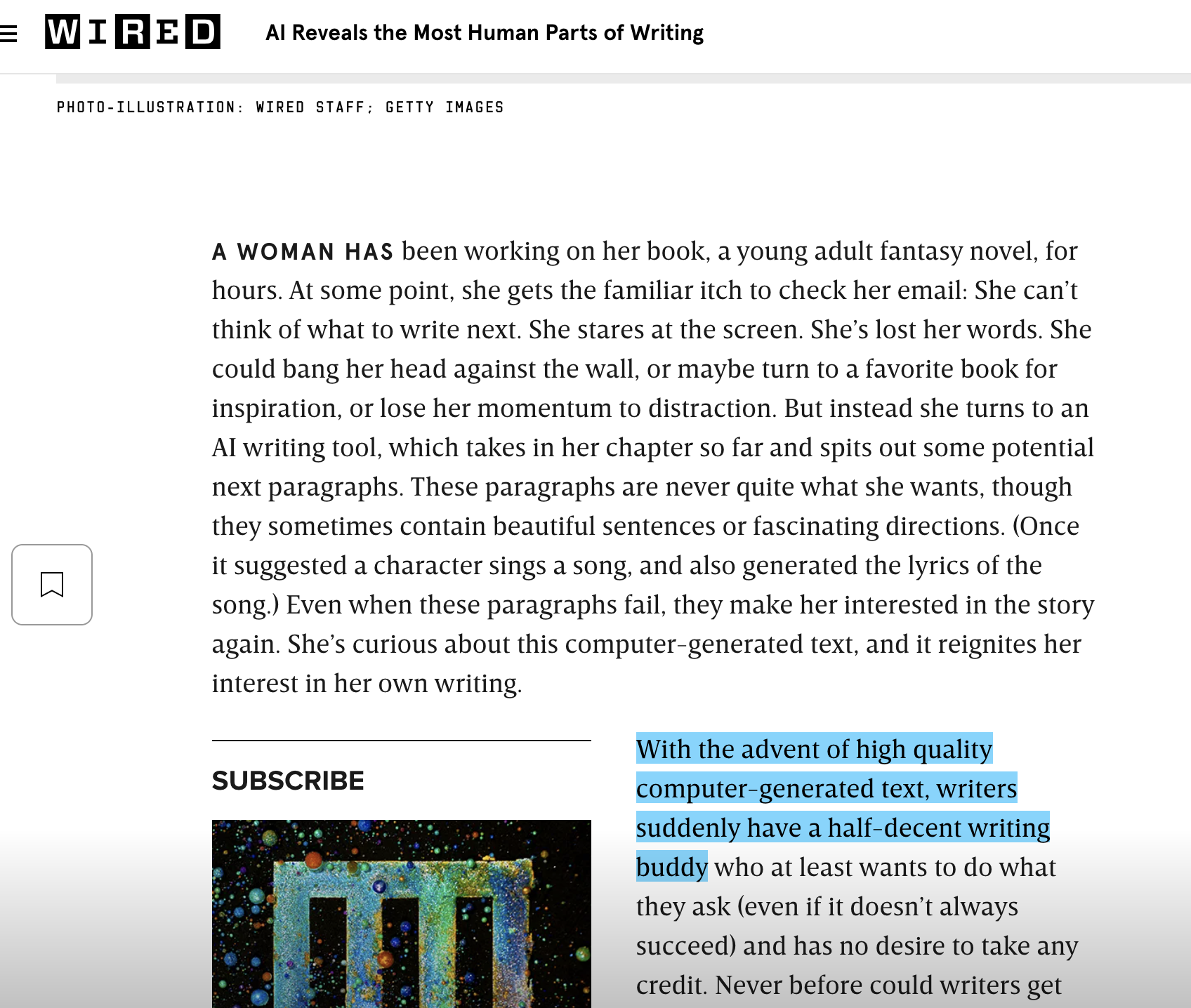
I purposefully selected a note that initially was part of a web page for this final display. I had originally used a tool that allowed the annotation of web pages and then the exporting of the annotated and highlighted content as a markdown file I added to Obsidian. This file included the link from the note file back to the online source. As you can see, the link from Obsidian brought up the web page and with the assistance of the activated service added as an extension to my browser displays what I had highlighted within this web page. Interesting and useful.
Conclusion:
We all have unique workflows and use digital tools in different ways because of differences in what we are trying to accomplish. What I describe in this post is an approach I have found useful and I have included related comments on why. I hope you find pieces of this you might apply yourself.




You must be logged in to post a comment.