AI (Grammarly) and Writing: Good or Evil?

I am interested in the potential of AI in developing writing skills. I am presently focused on Grammarly, having used the tool for years, and am now considering how it might play a productive role in secondary and higher education efforts to develop writing skills. Exploring what those writing about Grammarly on Medium have to say about Grammarly, I have come away with the impression the majority argue the tool is overpriced, less effective than tools with a similar purpose, and generally a bad idea when applied in an educational setting. I don’t agree. 

Writing in the classroom

I like to draw a distinction between learning to write and writing to learn. This distinction is artificial, as classroom instructional strategies such as “Writing Across the Curriculum” argue that both goals can be addressed when writing assignments in other disciplines are evaluated both for the quality of the writing and for what the writing suggests about students’ understanding of a given topic. My argument here focuses on the potential value of AI in learning to write. 

When and why is AI a problem when learning to write

In situations where the development of writing skills is the emphasis, an AI tool is argued to be problematic because students cheat by using AI to avoid doing work that requires them to practice the skills they are expected to master. In addition, by turning in work for evaluation that students did not actually perform, they do not receive feedback on the skills they are supposed to be learning and are credited with achievements they have not actually earned. 

AI and writing: A different take on the actual problem?

Many educators, aware of the possibility of cheating, have resorted to approaches such as short, handwritten in-class assignments that eliminate the possibility of using AI. There are limitations to this approach, especially for the unique skills required to create longer arguments or other lengthier projects. 

As adults with reasons to write and without worrying about the need to prove everything that appears in a written product is based on our own knowledge and writing skills, we may take advantage of AI in many different ways. One real question is how, and perhaps if, we are preparing students to transition from a focus on learning new skills or the graded demonstration of one’s knowledge to a combination of AI and personal knowledge and writing skills. In addition, some are suggesting, and again rightfully so, that AI can benefit students’ efforts to learn to write and write to learn. Here, I want to emphasize the potential assistance in learning to write more effectively. 

I tend to react to what I think are naive expectations of teachers and the reality of working in classrooms is important here. For example, I support the exploration of AI as a tutor, not because I think AI is equivalent to a human tutor, but because human tutoring is costly and many students who need help do not receive sufficient human attention as a consequence. I have a similar opinion about learning to write. It would be great if each student could write a lot and receive rapid feedback, as well as an individual conference related to their effort. Neither immediate, consistent feedback nor frequent individual attention is practical. Just having an AI writing tool, such as Grammarly, that can provide immediate feedback on what has been written seems like a practical improvement.

So Much Depends on Personal Motivation

Grammarly and asking pretty much any AI tool to evaluate specific attributes of your writing quality will provide you with feedback to consider. The issue is really whether you take the time to ask for this feedback and to consider the feedback that is produced. Here is what I mean. I use Grammarly while I write, and it constantly provides feedback. In reflecting on my own behavior, I almost always quickly accept the suggestions for what I have written (these appear as underlines in various colors) by clicking to have Grammarly fix the problem. I don’t stop to figure out what was wrong with what I wrote. Was that an actual error of grammar or spelling, and if so, why? The fixes always seem better, but they also remove what may just be my voice or personal preference in how I say something. I avoid the opportunity to learn and also allow Grammarly to “standardize” my writing. At this moment, admitting this has made me self-conscious. 

This reminds me of the experience I had providing comments on many of my grad students’ theses and dissertations. In later years, I liked to use the comments feature in Google Docs to leave comments and identify actual errors. I started to realize that some students were simply allowing me to rewrite their papers, when what I wanted was for them to consider something different. Often, I had to remind them of the difference between my thoughts about their work and the actual errors I pointed out. 

If you use a tool such as Grammarly, you probably recognize my observation in your own behavior. It is so easy to accept proposed changes based on a kind of “that sounds pretty good thinking” and trust in the assumption that the “system knows the rules better than I.” Taking this approach is quick, painless, and “good enough.” The problem is that this approach fails to take advantage of at least some of these situations to learn. Why were these changes recommended? Is my way of expressing myself flawed or just unique? Grammarly will help you consider which is most likely. 

What was wrong with what I wrote?

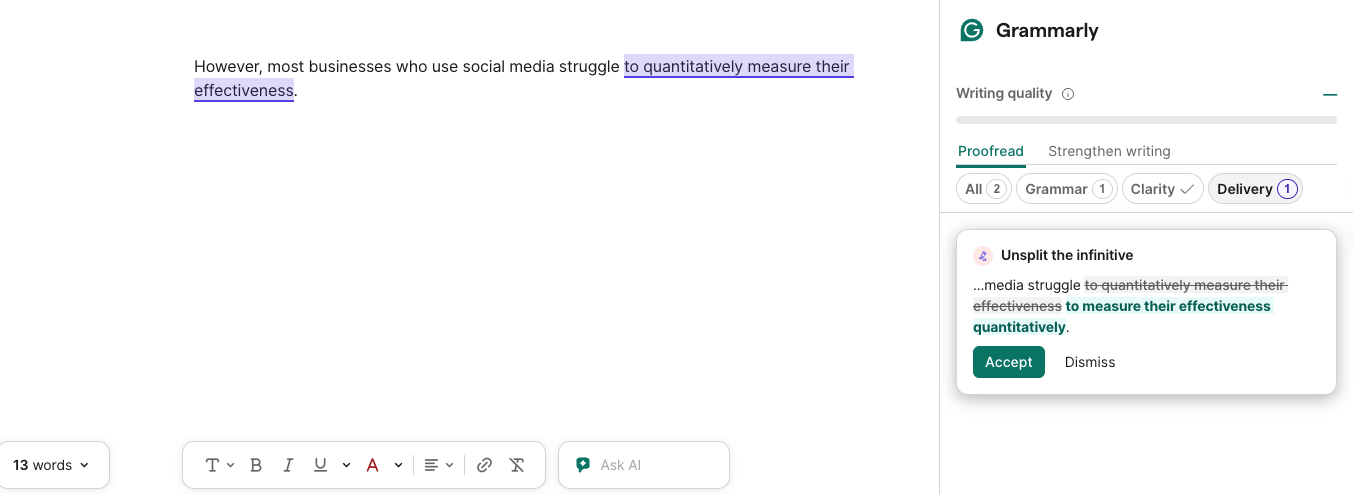
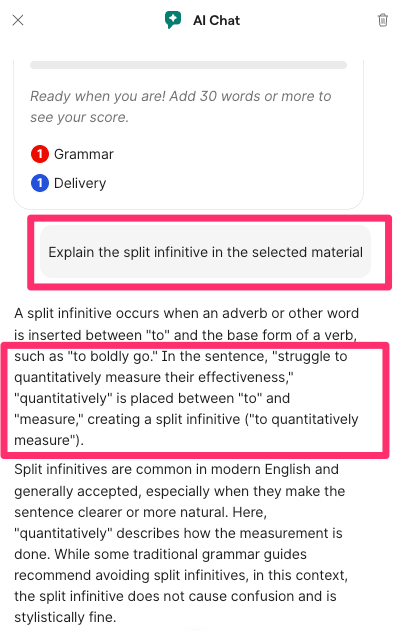
Grammarly has always allowed you to pause when suggesting a change. There was no time limit on the opportunity to consider what you wrote in comparison to what was recommended. As the tool was improved and with the more recent integration of AI, efforts were made to explain why a change was recommended. At first, the tool offered a general reference to rules. Here is what a split infinitive is, and here are some examples of sentences containing a split infinitive and improved versions of the same sentences. Here is an example of passive voice, and here are some examples. The most recent advance offers similar information, but specifically related to your own words rather than just generic examples. 

One note – I have encountered descriptions of this newest capability from others, but I haven’t been able to replicate the same output on my own computer with the latest version of Grammarly. I have had this difficulty even though I input exactly the same text used in the other demonstrations I have encountered. My setup will identify the error and provide generic examples, but it won’t explain based on the text I have entered. I can generate explanations specific to my written text, but I have to use the AI window to enter a prompt asking for this information (see examples below). 

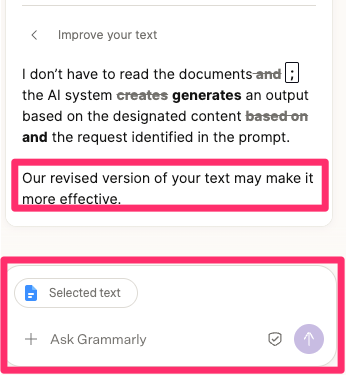
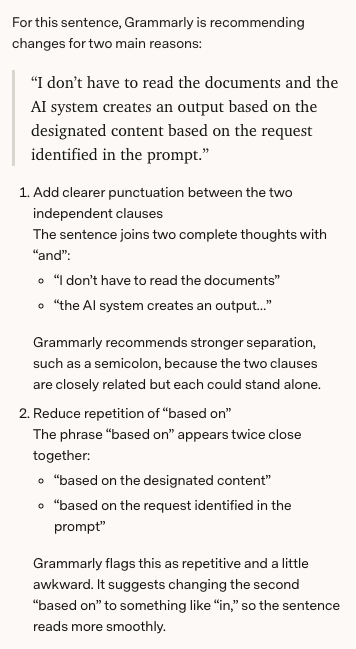
Here are a couple of examples. In the first, you see a sentence with three components underlined in blue (I highlighted it in blue so you can find it). In the associated column on the right you see the proposed alternative with the changed words or punctuation bolded. The red box identifies the button to get additional information. The second image shows the result of making use of this button. The explanation for the proposed changes – Our revised version of your text may make it more effective. – is Grammarly’s explanation. As I said, this offers little of value to me. However, if I use the AI prompt box (Grammarly calls this Superhuman Go), which appears at the base of the right-hand column, I can ask for an explanation, and I receive the lengthy explanation shown in the third image. 

Here is a second example that explains a split infinitive. Again, if I ask for an explanation related to the limitation in my writing, I get both a general and a targeted explanation of the split infinitive (second image).
Improvements at multiple levels

Improvement in writing happens at multiple levels. There are spelling errors and grammatical failures. These are the easiest for a digital tool to identify, and spelling correction has been around for decades. These might be described as superficial errors. There are deeper levels of good writing that any of us who critique others’ work find much harder to evaluate and that are the most difficult proficiencies to teach and learn. Grammarly’s AI capabilities provide a way to address these proficiencies. The easiest way I can describe this capability is to list some of the prompts Grammarly suggests. 

  • “Critique the logic and reasoning in this text.” 
  • “Are there any gaps in my argument here?” 
  • “Does this conclusion follow from my premises?” 
  • “Point out any weak points in my reasoning.” 
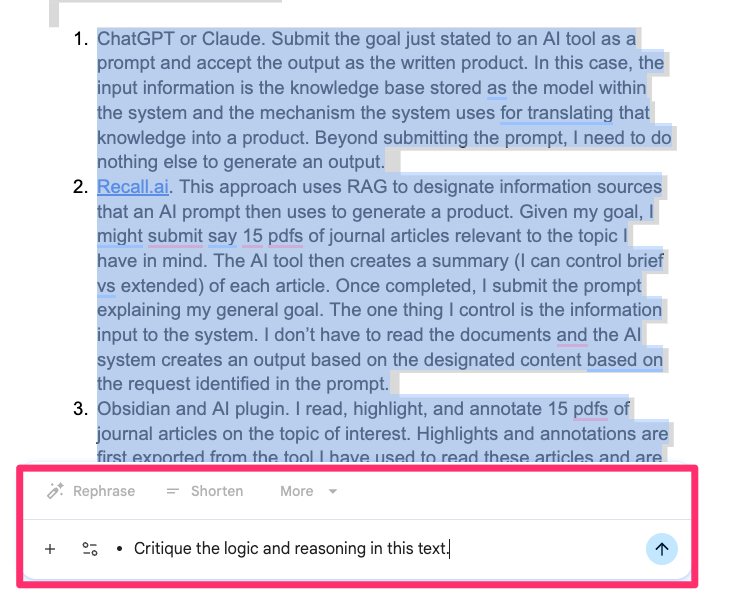
I will append Grammarly’s extensive analysis of a recent post based on one of these prompts (see Appendix). I have extensive experience as an academic writer with two published textbooks. These works involved feedback from a dedicated editor and input from multiple paid professors regarding both the content and communication style. The detail in Grammarly’s feedback is easily as detailed. 

Summary

The point I am trying to make here is not that AI cannot be used to cheat. My point is that Grammarly and other AI tools can also provide feedback more quickly and consistently than is practical for educators. This seems to be another example of the constant dilemma with AI, it can be used for good or for evil. In this case, when a writer is working on their own, they decide which it will be. 

Addendum

Grammarly’s analysis of AI Processing Options

Prompt: Point out any weak points in my reasoning

A few places in the reasoning could be stronger or more precise:

  1. The continuum needs clearer criteria
    You describe a continuum from “total AI” to “total human,” but the dimensions of that continuum are a little mixed. Sometimes the distinction is about who selects the source material, sometimes who reads it, sometimes who organizes it, and sometimes who writes the final text. You might strengthen the piece by naming the dimensions explicitly, such as:
  • control over source selection
  • depth of human engagement with sources
  • human contribution to interpretation
  • AI role in organization
  • AI role in final wording
  1. “Information input” may be too narrow
    In the Recall.ai example, you say the main thing you control is the information input. But choosing 15 PDFs is not just supplying information; it also frames the argument by deciding what evidence counts. That choice may involve substantial judgment, even if you do not read the documents closely.
  2. The quality question needs more defined standards
    You ask which approach produces the highest-quality product, but “quality” could mean many things: factual accuracy, originality, usefulness, writing style, source integration, depth of understanding, efficiency, or ethical acceptability. The argument would be stronger if you noted that different approaches might score differently depending on the quality standard.
  3. The “total AI” end may not be truly total AI
    Even in the ChatGPT/Claude example, the human still defines the topic, purpose, and prompt. So it may be more accurate to call this “minimal human input” rather than “total AI.”
  4. The “total human” end still includes tool-mediated thinking
    The Obsidian-only example is described as having no AI use, which makes sense if the point is AI involvement. But it still involves a digital tool that shapes organization, retrieval, linking, and thinking. If your continuum is specifically about AI involvement, that is fine—but you may want to clarify that it is not a continuum from tool-free writing to machine-written writing.
  5. The RAG example may understate verification
    You note that you do not have to read the documents, but that raises an important issue: without reading them, you may not be able to evaluate whether the AI’s summaries are accurate or whether the final product fairly represents the sources. This is an important weakness in that approach and could be made more central.
  6. The Karpathy Wiki stage could use more explanation
    This is the most complex example, but the reasoning around why it is distinct could be clearer. Is the key difference that AI creates a reusable knowledge structure? That it separates source processing from final generation? That it mimics a human note system? Stating the main conceptual difference directly would help.
  7. “Parallel to how human writers function” is promising but underdeveloped
    You suggest that identifying themes and concepts before drafting may parallel human writing. That is an interesting claim, but it needs a bit more support. Human writers do not just extract concepts; they evaluate, synthesize, prioritize, and sometimes change direction. You could strengthen this by explaining exactly which parts of the AI process resemble human writing and which do not.
  8. The ethical/authorship issue is implied but not addressed
    Your categories raise questions about authorship, responsibility, and acceptable AI assistance, but those issues are not directly discussed. If this is meant to help readers evaluate AI writing practices, you may want to include a brief note about where responsibility for claims and interpretations resides.
  9. The examples could be labeled more consistently
    Some category labels name tools, while others name processes. For example, “ChatGPT or Claude” names tools, while “Obsidian to Karpathy Wiki to Product” names a workflow. You might make the structure more analytical by using labels like:
  • Prompt-only generation
  • Source-constrained generation
  • Human-annotated source generation
  • AI-organized knowledge-base generation
  • Human-authored synthesis

Overall, the central idea is strong: you are not treating “AI writing” as one thing, but as a range of workflows with different levels of human involvement. The main improvement would be to make the continuum’s criteria explicit so readers can see exactly what changes from one category to the next.

Loading

RSS – Be Your Own Content Platform

Tim Wu, in his recent book, The Age of Extraction: How Tech Platforms Conquered the Economy and Threatened Our Future, examines the timeline of a variety of platforms and the manner in which they consistently morph from being initially attractive, innovative, and genuinely helpful resources into systems that become confining, controlling, and ultimately draining for their users. Using examples that range from Facebook and Amazon to UnitedHealth he argues that this transformation, from open utility to extractive gatekeeper, is not an accidental side effect, but rather a predictable, structural characteristic of platform business models as they achieve scale and market dominance.

In considering the examples from Wu’s book it occurred to me that while he emphasized the major players a wide variety of people use, the same issues apply to smaller platforms. Those of us who write and use platforms to share our work (e.g., Substack, Reddit, Medium) have likely experienced the same timeline. 

Many authors who write books with a similar message to The Age of Extraction do a great job of explaining the problem and its history, but even though they make an effort offer little as a remedy. I have read many such books. I typically find myself contemplating but failing to generate suggestions to augment what the author was able offer.

Like Wu, I bought into the original promise of the Internet as a leveling platform that would give content creators, sellers, and the “little guy” in general greater opportunities. In the early days (2002), I started a blog and did so from a server that was also my desktop computer (I worked at a University and had a dedicated IP which was more of the challenge than the ease with which any Mac could be used as a server). Things change. I now pay a hosting company a couple hundred dollars a year to allow me to run blog software and the related backend database and register my domain name. Still, as a hobby, once I pay for the space, I can function independently.

I believe the way we create and share content has changed. You can still do it, but it seems you have fewer and fewer regular readers. I have noticed a change that suggests more and more of my posts are read through search rather than by readers who regularly view the blog. I track hits out of curiosity and find little immediate interest in most posts. I check say a year or six months later and find that some posts have been read hundreds of times. Logically, I interpret this to mean I have written something that people found through search. I shouldn’t complain about this, but the switch from pure search to AI search now being developed by the big platforms means there will be far less attention to source material when an AI summary based on this homogenized and integrated material is made available. This is an emerging but I think obvious issue and a perfect example of what Wu means by platform extraction. 

The big switch (another book) to focus on extractive platforms has resulted from a) integrative platforms such as those I have already mentioned hosting multiple content creators and b) a related move away from the use of RSS readers by individual consumers. I certainly understand the benefits of single-stop platforms that provide a convenient way to reach a wide audience. My complaint is based on the history of these platforms. The pattern of extraction is evident. Start by offering a service in which the platform and content creators share in the risk and the rewards, and once a critical mass for a network effect is achieved, reduce the benefits to the producers and to the consumers. Wu suggests Amazon makes a familiar example of this approach.

I do post my content to one of these community platforms and continue to post the same content to my own blog. Yes, this means I pay twice and I continue to be frustrated by this situation. One approach allows me to own my content and the other to reach a larger audience – for a price.

My solutions:

I do have suggestions for an alternative approach, but I understand that each requires an effort that most consumers are unwilling to invest. You can be your own platform with easy-to-use tools.

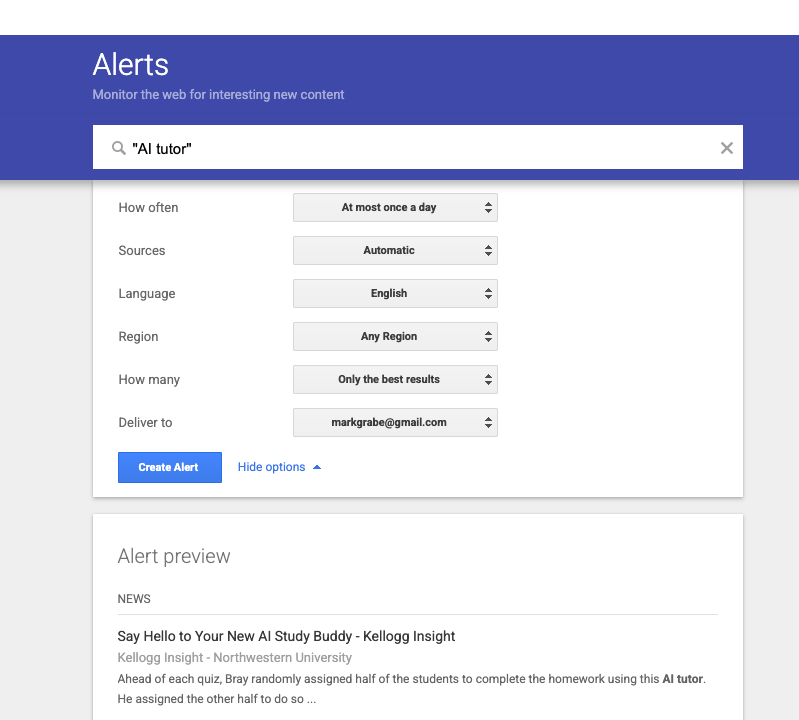
Use Google Alerts – Yes Google is a big company, but it does offer some beneficial services. Google Alerts might be imagined as a period search process based on specific interests you specify. You provide a typical search request, then select how often you want to receive the results. Updates are sent to you in an email periodically according to the time intervals you request. I have multiple alerts that generate a week list of new content. In this approach, you are following a topic rather than specific content creators.

RSS is still around and modern readers make the process easy to implement. With RSS, you designate the sources (e.g., specific blogs) you want to follow, and an RSS reader accumulates new content generated by these sources. You check in to your reader when you have time and see what is new. Some contend that Google’s abandonment of its very popular Reader in 2013 signaled the end of this tool category, but more modern alternatives have since emerged. 

Yes, RSS readers do offer a subscription level and any provider realistically has costs. While the pro level offers great features, most users will find the free level meets their needs.

My preference is for web-based readers – the service is accessed through a browser rather than standalone apps. Feedly is my recommendation. I like Inoreader and Reeder (Apple) as apps. 

I have written more detailed descriptions elsewhere (Feedly, Inoreader) and you could consult these sources if you need more information. 

Summary

I didn’t really intend this post as a book review, but Tim Wu’s book is interesting and informative. As I suggested, the book identifies the typical timeline of extraction consumers should recognize and use to guide their decision making. Again, solutions, should that be what you are seeking, are not easy to imagine.

I think we have a classic “chicken and egg” problem with platforms versus independent sources. Content creators will go where their content is more likely to be consumed. Tools for sharing will exist and be improved where there are content creators and content consumers. 

For the great majority of creators and consumers, the motivation of income is deceptive and a trap. Most writers would seem better off thinking of their goal as visibility rather than profit. Writing for a platform for the vast majority should be treated as a hobby, recognizing the reality of being trapped by the network effect. 

Loading

Peer editing: Better to give than receive

I became interested in the development of writing skills through feedback focused on alternatives to the teacher or professor as editor. I worked with educators who developed writing skills and was acquainted with the time demands of providing feedback and had my own experience reviewing students’ theses and dissertations. When you have read the 200+ page dissertation of a Ph.D. candidate through a couple of drafts, you have put in some hours. I felt sorry for the English department English composition adjuncts paid a few thousand for each of 4 sections of 25 students and the time it would take to review multiple writing assignments. Still, you learn to write by writing, and feedback and rewriting in response to feedback are essential. 

There are ways to provide an acceptable alternative source of feedback. Peers and now AI can critique writing, and while some more expert involvement is important, the quantity and diversity of learning activities required for skilled performance cannot consistently be monitored by instructors. 

I began reviewing the research on peer editing because I was aware of the time issue faced by instructors, but also because I was interested in the role digital word processing tools could play in the feedback and revision processes. For example, Google docs offers a great way to add comments at precise locations in a document and to exchange related remarks as a document is passed back and forth between the writer and reviewer. Revision is efficient and can be explained if the editor wants to take a second look. I thought that Goodle docs offered an example of a tool that would improve the efficiency with which learners could interact with peers and then rewrite efficiently in response to comments. 

As I reviewed the research literature, I came across some studies that changed my thinking on how I should advocate for peer feedback. These studies (see Cho references at the end of this post) demonstrated that peer editing also had an impact on the writing performance of the editors, and this benefit might be more important than the feedback a writer received from others. The Cho research focused on a specific population of writers generating a particular type of writing product, and understanding the focus of such research is always important in considering how and if findings might generalize to other situations. Cho focused on college students writing lab reports, i.e., the description and results of experiments performed in the lab. I know my own profession has an undergraduate course (Research Methods) with a core focus on the same type of writing task. Cho conducted several studies in which peer editing was a component. Students could either review their lab reports without feedback, with feedback, or with feedback after providing feedback on the same task to other students. The greatest difference was found when writers also provided feedback to others. When it came time to revise their own original drafts, the product they produced was judged to be superior, on average, to the products generated by those in the other groups. Moreover, statistical analysis showed that editing had a more powerful impact than having the edits of others to review.

The researchers offered two possible explanations for their findings. First, they proposed that the process of editing provides a perspective on how others might view a written product (audience effect). Writers are always told to consider their audience, but perhaps serving as the audience might provide insight into what that means for a specific written product. The other explanation involved what I would describe as a generative effect. Serving as an editor has some similarities to the research topics of writing to learn and teaching to learn. When you must externalize a position you take, this forces a concreteness and specificity you may fail to generate when just thinking about something. Having to put a position into words can lead to the understanding that you really can’t explain yourself or make you work to come up with a concrete way to express what you think. 

This notion that working to improve understanding and develop proficiency seems to be raised repeatedly as educators grapple with the role AI should play in educational settings. For all of the ways AI might reduce “busy work,” there seems to be a related potential that AI provides a way to avoid the cognitive work so necessary in developing a cognitive skill. So, while AI may provide a way to provide feedback to students, there is also evidence that the work of providing feedback to others involves work that is productive both for others and for yourself. Educators face a significant challenge in communicating this reality to learners and other stakeholders. 

References:

Cho, Y., & Cho, K.. 2011. Peer Reviewers Learn from Giving Comments.” Instructional Science, 39 (5),  629–643. doi:10.1007/s11251-010-9146-1

Cho, K., & MacArthur, C. (2011). Learning by reviewing. Journal of Educational Psychology, 103(1), 73-84.

Loading

Word processing: Desirable difficulty or  opportunities get taken

When it comes to how we use technology, familiarity can limit analysis and exploration. I started thinking about this challenge when encountering the work of an academic who has examined the history of word processing. When I first wrote about word processing in the 1990s, the issues were similar to current topics of whether students should read from paper or screen and whether it was better to take notes on paper or on a laptop. There were comparisons of which method was more productive and efforts to account for the advantages that were identified. It was once similar with word processing. Should students learn to write on paper or using a computer? What were the advantages and disadvantages of each approach? How might the instruction of writing skills with computers be modified to take advantage of the unique capabilities of a digital approach? My thought is that many are now no longer aware of these questions and conclusions and that personal practice and instructional emphases may ignore key findings. This concern seems especially relevant given the new issues raised by the use of AI in writing and learning to write.

I decided to write again about this topic after listening to an interview with Matthew Kirschenbaum on the “This Week in Tech” network’s “Intelligent Machines” podcast focused on Kirschenbaum’s recent focus on the role of AI in writing and learning to write. The podcast guest was a member of the  Modern Languages Association (MLA) panel, generating what are likely to become several influential position papers on learning to write and AI. This interview, which makes up maybe the first half hour of the podcast, is worth the attention of any educator trying to make sense of how AI will impact schools and universities. As part of the brief introduction of the podcast guest, Krischenbaum it was noted that the guest had recently written “Trach Changes: Literary History of Word Processing”.As I suggested, word processing had been a personal interest so I did purchase and read the book.

It wasn’t that the book wasn’t well written, but I did struggle to get through it. The podcast focus resulted in my misunderstanding of the topic of the book. The history of the transition from writing on paper and typewriter was of some interest, because I lived through that transition and the mention of technology hardware and software and the required skills involved in writing with a computer brought back plenty of memories. I was less interested in which noted author had made his or her transition from a notepad or typewriter to a word processor during their career. Concerns of the reading community related to how technology might influence literature likely offers similar insights into what some think about AI. A better example might be how Bob Dylan’s fans reacted when he switched from acoustic to electric guitar. What I had falsely anticipated was that the author would examine how digital storage and revision changed writing and the teaching of writing. 

I imagined I would encounter an analysis of changes in personal revision, educator feedback and learner revision, peer revision, and possibly even AI as a sounding board for a writer’s efforts. These are the topics in what I see as the evolution of writing and writing education. I decided to generate a post that would offer my own thoughts about the role of word processing in the writing process. The podcast and the book on word processing are still worth your time. 

Will digital tools change our writing?

I assume you complete many of the writing tasks you take on using a word processing application. Do you do this because you assume this approach makes you more efficient or do you assume this approach makes you a better writer? Maybe you have never even thought about these questions. However, when functioning as a teacher and asking your students to engage in activities in a particular way, it may be helpful to consider why the approach you expect students to use will be productive. Often, to realize the full potential of an activity, the details matter and some insight into why an approach is supposed to be productive may be helpful in understanding  which details to track and emphasize. The following comments summarize some ideas about the value of word processing and of learning to write using word processing applications.

In learning, as in other areas of life, you seldom get something for nothing. Still, a logical case has been proposed for how simply working with word processing for an extended period may improve writing skills and performance. Perkins (1985) calls this the “opportunities get taken” hypothesis. The proposal works like this. Writing by hand on paper has a number of built-in limitations. Generating text this way is slow, and modifying what has been written comes at a substantial price. To produce a second or third draft requires the writer to spend a good deal of time reproducing text that was fine the first time, just to change a few things that might sound better if modified. Word processing, on the other hand, allows writers to revise at minimal cost. They can pursue an idea to see where it takes them and worry about fixing syntax and spelling later. Reworking documents from the level of fixing misspelled words to reordering the arguments in the entire presentation can be accomplished without crumpling up what has just been painstakingly written and starting over.

With word processing, writers can take risks and push their skills without worrying that they may be wasting their time. The capacity to save and load text from some form of storage makes it possible to revise earlier drafts with minimal effort. Writers can set aside what they have written to gain new perspectives, show friends a draft and ask for advice, or discuss an idea with the teacher after class, and use these experiences to improve what they wrote yesterday or last week. What we have described here are opportunities—opportunities to produce a better paper for tomorrow’s class and, over time, opportunities to learn to communicate more effectively. 

Do writers take the opportunities provided by word processing programs and produce better products? The research evaluating the benefits of word processing (MacArthur, 2006; Wollscheid, Sjaastad, & Tømte, 2016) is not easy to interpret. Much seems to depend on the experience of the writer as a writer and familiarity with word processing, and on what is meant by a “better” product. If the questions refer to younger students, it also seems to depend on the instructional strategies to which the students have been exposed. It does appear that access to word processing is more beneficial for older learners and some even interpret this difference as having a neurological basis (Wollscheid, Sjaastad, & Tømte, 2016). General summaries of the research literature (e.g., MacArthur, 2006) seem to indicate that students make more revisions, write longer documents, and produce documents containing fewer errors when word processing. However, the spelling, syntactical, and grammatical errors that students tend to address and the revision activities necessary to correct them are considered less important by many interested in effective writing than changes improving document content or document organization. The natural tendency of most writers appears to be to address surface-level features. 

Writers appear to bring their writing goals and habits to writing with the support of technology. Beginning writers and perhaps writers at many stages of maturity may not have the orientation or capabilities to use the full potential of word processing, and their classroom instruction may also emphasize the correction of more obvious surface errors. Thus, there are typically improvements in the products generated when working with word processing tools, but the areas in which younger writers seem to improve are not necessarily the most important ones

Many of the potential educational advantages of word processing appear only as students acquire considerable experience writing with the aid of technology and some question whether using a keyboard is better than a pencil for young writers (Wollscheid, Sjaastad, & Tømte, 2016). Perkins’s (1985) argument that writing with word processing programs will improve writing skills because word processing allows students to experiment with their writing makes sense only in situations in which students have written a great deal and experimented with expressing themselves in different ways. The fact that most research evaluating the benefits of word processing has examined performance over a short period of time, with students having limited word processing experience, thus represents a poor test of the potential of word processing (Owston, Murphy, & Wideman, 1992). Research based on a three-year study following elementary students as they learned to write with and without access to word processing opportunities has demonstrated a significant advantage for students with ready access to technology (Owston & Wideman, 1997). A recent study (Yamaç, et al., 2020) examining the benefits of consistent writing on laptops found a similar advantage in contrast to paper and pencil writing tasks for early elementary learners. These researchers point to social media activities such as blogs and multimedia writing with tablets as expanding the writing opportunities available in classrooms. 

The National Assessment of Educational Progress (NAEP) demonstrates that in the U.S. greater experience writing with technology is predictive of schools with more proficient writers (Tate, Warschauer & Abedi, 2016). Studies such as this are still controversial as it is difficult to parse out other variables such as the income levels of the majority of students in different schools that may influence both access to technology and writing proficiency. Overall, the role of word processing in developing writing skills depends on the goals of the teacher and individual students, the social context provided for writing, and the amount of writing that students do with the assistance of word processing. 

Summary

Many of the posts I write concern the cognitive processes involved in learning, thinking, and academic behavior. Often, I focus on how these processes are impacted for good or bad by involving technology. We seem to be past the point at which educators question writing on a computer, but the distinction I raised between opportunities get taken and desirable difficulty have yet to be resolved with writing. This is clearly the case when educators debate the role AI should play. My suggestions related to the opportunities get taken hypothesis should also be approached would even be that we examine whether the opportunities (often called affordances) of revision are actually employed. Do students get useful feedback from which they might learn to improve what they have written? Despite the likely benefit of revision, do students quantitatively do much revision? Perhaps like other ideals (tutoring, personalizing learning) that are impractical for one reason or another (e.g., cost, teacher time), AI might find a productive role in guiding revision experiences. 

References:

MacArthur, C.A. (2006). The effects of new technologies on writing and writing processes. In C.A. MacArthur, S. Graham, & j. Fitzgerald (Eds.) Handbook of Writing Research, pps. 248-262. New York: Guilford.

Owston, R., Murphy, S., & Wideman, H. (1992). The effects of word processing on students’ writing quality and revision strategies. Research in the Teaching of English, 26 (3), 249–276.

Owston, R., & Wideman, H. (1997). Word processors and children’s writing in a high-computer-access setting. Journal of Research on Computing in Education, 30 (2), 202–220.

Perkins, D. (1985). The fingertip effect: How information-processing technology shapes thinking. Educational Researcher, 14, 11–17.

Tate, T. P., Warschauer, M., & Abedi, J. (2016). The effects of prior computer use on computer-based writing: the 2011 NAEP writing assessment. Computers & Education, 101, 115-131.

Wollscheid, S., Sjaastad, J., & Tømte, C. (2016). The impact of digital devices vs. Pen (cil) and paper on primary school students’ writing skills–A research review. Computers & Education, 95, 19-35.

Yamaç, A., Öztürk, E., & Mutlu, N. (2020). Effect of digital writing instruction with tablets on primary school students’ writing performance and writing knowledge. Computers & Education, 157, 1-19.

Loading

Writing down a crisis

I began working on a post about the similarities of expressive writing and writing to learn some days ago. In the meantime, the stock market and the general attitude of the country took a decided nosedive. I could not ignore a possible interaction between this dramatic negative mood swing and the original focus of expressive writing so I will just recommend writing to those struggling to deal with our present political crisis and encourage you to read the rest of the post to learn why.

Dr. Jamie Pennebaker found a use for writing that produces both consequential and fairly consistent results. His results relate to clinical psychology which is somewhat outside my own background as an educational psychologist, but I at least can appreciate the impact of an intervention that can be classified as both consequential and fairly consistent as such outcomes are less common than others might imagine when it comes to impacting human behavior. Pennebaker asked college students to think of a traumatic experience from their own lives. His instructions – think about your feelings and emotions related to this experience. I want you to write about this experience for 15 minutes. I will have you do this for three straight days. What you write will be confidential – no one will read what you write. A control group (randomly assigned) was asked to write about their daily routine for the same periods of time. The researchers conducting this study then followed the number of student visits to student health in the following months and found that what Pennebaker eventually described as the expressive writing group had significantly fewer visits. Writing appeared to have an impact on mental health.

I know this seems on the level of magic or weird as I can imagine many reasons this connection might not materialize. Even if the treatment had an immediate consequence on the “problem” why would it follow that the results would be related to medical issues? What if the “problem” was an issue they experienced in their childhood? Why would such a random task during their college days have an impact?

I can’t answer these questions, but hundreds of follow-up studies have produced related results. Pennebaker and other researchers found that expressive writing could enhance immune function, lower blood pressure, reduce muscle tension, and even decrease doctor visits. These benefits were observed across various studies involving participants with both physical illnesses (e.g., arthritis, asthma) and mental health challenges. There has to be something to the benefits of writing.

I first encountered the concept of expressive writing not through my prior work as a psychologist, but because of an interest in the benefits of keeping a notebook. Pennebaker’s work was described in one chapter of Allen’s book “The notebook: A history of thinking on paper”. Once I became interested, I conducted literature searches that might point to an explanation for what about writing might produce this impact. Meta-analytical papers are relevant to the goal of why things work as they do because such papers examine many studies on a given topic, successful and successful experiments, and attempt from this variety of studies to determine what are the factors that contribute to successes and failures. The logic in this approach is that the differences are key to understanding why a technique might be successful and what are the boundary conditions. 

The following are the suggested explanations for the benefits of writing.

  1. Catharsis without social risk. You have likely heard of an LBGTQ+ individual “coming out”. This decision when public provides a release from feelings that you have to hide who you are and what you feel. Perhaps expressive writing works in a similar way even though writing is private. This is my example of how catharsis works and I hope this comparison is appropriate.
  2. Cognitive-processing theory. Writing requires concreteness as the abstract and fuzzy ideas in your mind must be made concrete as the ideas are put down on paper. Pennebaker built a digital tool for identifying keywords and concepts in what was written (not in the original study promising anonymity). Those participants with more positive outcomes made greater use of causation words (e.g., because, cause, effect) and insight words (e.g., consider, know) in the content they produced. Perhaps writing helps work out why something happened to you and how significant long term consequences might actually be.
  3. Self-regulation theory. Being able to label stressors and challenges may give the writer a greater sense of understanding and control reducing negative affect leading to greater confidence in better outcomes in the future.

Generative processing as a general explanation for the benefits of writing

I have tried to translate some of these clinical concepts into something more familiar to me. I see similarities in learning and study techniques described as generative learning. In past posts on generative activities, I have explained that the use of a self-imposed or assigned external task encourages productive mental activities. In other words, a learner has the capacity to apply process productively, but for one reason or another does not. The external task (e.g., answering questions, writing summaries, explaining to a peer) encourages these productive thinking behaviors in order to perform the external task and better understanding and retention is produced as a consequence. The cognitive processing of emotional issues may similarly be manipulated by a concrete external task (i.e., expressive writing). This way of thinking seems to fit with the theoretical proposals in the meta-analyses I listed and I think offers a tangible approach that is easier to understand and communicate.

I can’t help thinking about AI as I write this post. How might one encourage tangible “externalization” and processing of life experiences? You may have heard of ELIZA which while not AI could carry on a conversation of a sort through the use of some clever programming that used language patterns built on the input from a user to generate responses and encourage further input on their part. The Wikipedia link in the previous sentence offers more detailed information. Current large language models can now do far more. AI therapy exists and is controversial, but how different is chatting with CHATGPT and writing something you know no one will read? 

What about Trump and the stock market? I will write something and put it on Facebook and I do hope someone reads it. 

Sources:

Allen, R. (2024). The Notebook: A History of Thinking on Paper. Biblioasis. (Chapter 24)

Frattaroli, J. (2006). Experimental disclosure and its moderators: a meta-analysis. Psychological bulletin, 132(6), 823-865.

Fiorella, L., & Mayer, R. (2016). Eight Ways to Promote Generative Learning. Educational Psychology Review, 28(4), 717-741.

Guo, L. (2023).  The delayed, durable effect of expressive writing on depression, anxiety and stress: A meta-analytic review of studies with long-term follow-ups. British Journal of Clinical Psychology,  62,  272–297. https://doi.org/10.1111/bjc.12408

Pennebaker, J. W. (1997). Writing About Emotional Experiences as a Therapeutic Process. Psychological Science, 8(3), 162-166. https://doi.org/10.1111/j.1467-9280.1997.tb00403.

Loading

Considering AI in Writing and Reading

This is a personal exploration of what I think about the role of AI in writing and reading. Once you begin exploring these topics I think you discover how nuanced they are. I do understand outlets for written content are being pressured or have decided on their own to take positions on what is allowed. I will offer a suggestion at a later point. 

Writing

We all make observations based on personal experience. I am a writer and as an academic wrote research papers and a couple of textbooks. This writing was before AI and there were strict rules of personal accountability that applied that were severe enough that your career would be at stake if these expectations were violated.

As an educational psychologist I followed the literature on learning to write and the benefits of writing to learn. Writing is a procedural skill and as such requires the use of the skill to develop proficiency. I believe that this proficiency transfers to speech so there is no way I can imagine of developing important communication skills without spending time using the skill. In academic situations writing is a more efficient group activity than individual presentations so time must be invested. Writing to learn seems an efficient way to develop writing skills and has unique benefits as a way to process all experiences. Many of my posts focus on generative activities – external tasks that encourage productive cognitive skills – and writing makes a great example. Organization, integration, personalization all are required in writing and in understanding and application. Again, writing assignments are an efficient way of encouraging personal cognitive activity within a group setting.

These personal benefits aside how important is it that I write without assistance. “Without assistance” is key here as I can simply provide a prompt to an AI tool to create a product based on fairly basic expectations. This is one extreme of the AI in writing continuum. At the other end are spelling checking and the types of structural improvements I can apply with the assistance of Grammarly. In the middle are various strategies I might use to request AI to offer suggestions for topics and broad organizational ideas I might then implement myself. Closer to the “write it for me end” are requests for a product I might then paraphrase. My guess is that the line of acceptability is drawn somewhere within this continuum and will likely shift over time.

Reading

The basic question I am asking here is does it matter that the content I read was written unaided by a person? First, I should acknowledge that while I read a lot, I seldom read fiction. I seldom read content that depends on the creativity of the writer. I understand that is reasonable to recognize the beauty or creativity in much the same way different musicians can express the same underlying composition. I seldom focus on such skill in the authors I read. I want to understand why things are as they are whether it be history, science, economics, or politics. If facts are available, I want to know the facts. If opinion and logic are all we have, I want to understand the logic behind the valued opinions. Good writing is important in my ability to understand and process this content, but I am not certain that the human touch is required for a quality product.

Clearly, what AI is doing is summarizing massive amounts of content that was generated by humans and I do think that this source material is essential, but I am not certain that the translation process requires a human writer. Human writers will continue to be necessary to make the observations and run the experiments and explain what they have observed, but this type of communication is several steps down the food chain from my consumptions.

Why post this here?

I think outlets are making decisions about what role AI will be allowed to play. I think some outlets will opt for human writing only and I think this is fine if the goal is to focus on human unaided creativity. 

I think there is a middle ground that has just recently occurred to me. I write based on a tradition that requires careful source citation. I still do that in some of posts here when what I write had its origin in a book or journal article. Why not indicate when a segment of what is posted was written by AI? 

Out of curiosity I asked Perplexity if there were conventions for citing AI as a source. It turns out there are formal ways to cite AI content. I think there are ways to make AI content more obvious. One might indicate it as quotations that appears in an obvious way such as the italicized and indented style used in WordPress. Or, one could do something like the following. This is what Perplexity had to say about AI sourcing.

————————————————————————————————

To attribute AI-generated text in your writing, follow these guidelines:

1. **Explicit Mention**: Clearly state that AI assistance was used. For example, “This section was generated with the help of OpenAI’s ChatGPT” or “Drafted in collaboration with ChatGPT”[2].

2. **Citation Styles**:

   – **MLA**: Format as: *”Description of chat” prompt. Name of AI tool, version, company, date, URL*. Example: “Explain how to bake a cake” prompt. *ChatGPT, Mar. 2025 version, OpenAI, 2 Mar. 2025, chat.openai.com/chat*[1][2].

   – **APA**: Include the tool name, date, and URL. Example: *OpenAI. (2025). ChatGPT (Mar 2025 version) [Large language model]. https://chat.openai.com/chat*[2].

   – **Chicago**: Example: *Text generated by ChatGPT, OpenAI, March 2025, https://chat.openai.com/chat*[2].

3. **Placement**: Place attribution prominently in an introduction, acknowledgment personal section, or footnote to ensure transparency[2].

4. **Accurate Language**: Use terms like “assisted by,” “enhanced with,” or “generated using” to describe the AI’s role without overstating its contribution[2].

This approach ensures ethical transparency while crediting AI appropriately.

Sources

[1] Citation and Attribution – Generative Artificial Intelligence https://libguides.brown.edu/c.php?g=1338928&p=9868287

[2] Demystifying Attribution: Giving AI Credit – LinkedIn https://www.linkedin.com/pulse/demystifying-attribution-giving-ai-credit-donna

[3] Used a AI-Detector on my own text that I have writen … – Reddit https://www.reddit.com/r/ChatGPT/comments/14cls37/used_a_aidetector_on_my_own_text_that_i_have/

[4] Using the AI Autofill Feature for Text Attributes – Help Center https://help.plytix.com/en/ai-autofill

[5] A Comparison of Several AI Techniques for Authorship Attribution on … https://www.mdpi.com/2227-7390/10/23/4589

[6] Is there any tool which can detect AI writing. Because ChatGPT itself … https://www.reddit.com/r/SEO/comments/13s5zb0/is_there_any_tool_which_can_detect_ai_writing/

[7] How To Identify AI-Generated Text? – Originality.ai https://originality.ai/blog/identify-ai-generated-text

[8] Measuring Attribution in Natural Language Generation Models https://direct.mit.edu/coli/article/49/4/777/116438/Measuring-Attribution-in-Natural-Language

——————————————————————————————-

Summary

These are my personal thoughts about AI in writing and reading. I don’t see AI going away so I believe it is important to work out what is appropriate and what not. These are nuanced decisions, but a rationale for individual decisions should be stated. I propose that attribution is important when using AI to be read by others and provide and example of how this might be handled. 

Loading

How many AI tools?

It’s not that I don’t find AI to be useful. I generate a half dozen images a month to embellish my writing. I search for journal articles I then read to examine an educational issue I want to write about. I examine what I have written to identify errors in grammar or syntax or even identify my use of passive voice which I still can’t figure out. My issue is the monthly subscription fees for the multiple tools that best suit these and other uses. It is simply difficult to justify the $20 a month fee which seems to be the going rate for each of the services and the level of use I make of each service

I regard my use of AI as both a benefit to personal productivity, but also a subject matter I explore and write about. Writing about the intersection of technology and education is a retirement hobby and I don’t need to do what I do on a budget. However, I don’t think this is true for everyone and I can set as a personal goal an exploration of the financial issues others might need to consider. AI tools differ in how flexible they are. Often, the less flexible tools are optimized to accomplish a specific set of tasks and this narrow range increases ease of use. Users can find themselves evaluating the cost-effectiveness of options based on ease of use versus total cost.

Grammarly as an example

As someone who spends a great deal of time writing, it is worth my time to consider how AI tools can be used to improve the productivity of the time I spend writing and the quality of what I write. Grammarly is a tool suited to such goals. I have relied on both the free and pro versions of Grammarly for a quick way to edit my writing. This is a great product I find helpful. Again, the issue is the Pro version adds another $12 to the total of my monthly subscriptions bill. The free version is great for basic errors, but the pro version is necessary for complete sentence rewrites. It is helpful to compare what I said with the suggested rewrite to decide whether I want to accept the alternate version. 

What I have been exploring lately is the use of more general-purpose AI tools (e.g., ChatGPT, Abacas.ai) as an alternative. I understood that many others were using such tools in this matter, but because I had already been using Grammarly I had not invested the time to explore how more flexible tools might be used to achieve similar goals. Here is the approach I have settled on. I use a multi-level prompt to specify what I want to learn from an evaluation of something I have written. I keep this prompt in a note app so that I can copy and paste the prompt at the beginning of the content I want to evaluate. The prompt appears below. The prompt is written to be flexible so that I can adapt it to different circumstances by adding or removing specific guidelines. For example, I realize I often write in passive voice and some tasks should not include text expressed in this way. The guideline “write in active voice” can be included when I think this approach is important. If writing for a specific age group might be a goal, a guideline related to this goal can be inserted. 

To demonstrate what this prompt accomplishes, I will take what I written here to this point and apply the prompt. 

Evaluate the following content using the following guidelines:

  • Correct spelling errors
  • Correct grammatical errors
  • Correct punctuation errors
  • Write in active voice
  • Suggest corrections
  • Only list the lines containing errors and the proposed corrections
  • Add an explanation for the need for a correction

[Insert content to be evaluated here]

Response from Abacas.ai.

1. **Original:** I examine what I have written to identify errors in grammar or syntax or even identify my use of passive voice which I still can’t figure out.  

   **Correction:** I examine what I have written to identify errors in grammar or syntax and even identify my use of passive voice, which I still can’t figure out.  

   **Explanation:** Added a comma before “which” to correctly punctuate the non-restrictive clause.

2. **Original:** It is simply difficult to justify the $20 a month fee which seems to be the going rate for each of the services and the level of use I make of each service.  

   **Correction:** It is simply difficult to justify the $20-a-month fee, which seems to be the going rate for each of the services and the level of use I make of each service.  

   **Explanation:** Added a hyphen in “$20-a-month” to correctly form a compound adjective and a comma before “which” to punctuate the non-restrictive clause.

3. **Original:** I regard my use of AI as both a benefit to personal productivity, but also a subject matter I explore and write about.  

   **Correction:** I regard my use of AI as both a benefit to personal productivity and a subject matter I explore and write about.  

   **Explanation:** Replaced “but also” with “and” to correct the parallel structure.

4. **Original:** Writing about the intersection of technology and education is a retirement hobby and I don’t need to do what I do on a budget.  

   **Correction:** Writing about the intersection of technology and education is a retirement hobby, and I don’t need to do what I do on a budget.  

   **Explanation:** Added a comma before “and” to separate two independent clauses.

5. **Original:** Grammarly as an example  

   **Correction:** Grammarly is an example.  

   **Explanation:** Added “is” to form a complete sentence.

6. **Original:** Again, the issue is the Pro version adds another $12 to the total of my monthly subscriptions bill.  

   **Correction:** Again, the issue is that the Pro version adds another $12 to the total of my monthly subscription bill.  

   **Explanation:** Added “that” for clarity and changed “subscriptions” to “subscription” for correct singular form.

7. **Original:** What I have been exploring lately is the use of more general-purpose AI tools (e.g., ChatGPT, Abacas.ai) as an alternative.  

   **Correction:** What I have been exploring lately is the use of more general-purpose AI tools (e.g., ChatGPT, Abacus.ai) as an alternative.  

   **Explanation:** Corrected the spelling of “Abacas.ai” to “Abacus.ai.”

8. **Original:** I understood that many others were using such tools in this matter, but because I had already been using Grammarly I had not invested the time to explore how more flexible tools might be used to achieve similar goals.  

   **Correction:** I understood that many others were using such tools in this manner, but because I had already been using Grammarly, I had not invested the time to explore how more flexible tools might be used to achieve similar goals.  

   **Explanation:** Changed “matter” to “manner” for correct word usage and added a comma after “Grammarly” to separate clauses.

The feedback I have received would normally have resulted in my making several adjustments. I have not done so for you to consider both the original and the suggestions. The feedback makes specific suggestions and I either copy and paste the suggestions to the original source material or simply retype what needs to be fixed. This is clumsier than just clicking on the recommendation offered by Grammarly and it often requires that I use the search function in a longer text to locate the offending sentence. When writing on my desktop machine I simply open a second window and move between one window with the AI feedback and the original document to make adjustments. 

Loading