
Lately, I seem to encounter a great deal of advice warning against reading and note-taking on a device. Paper and a pencil are argued to be better. In a recent post, I argued that I found these complaints ill-advised. This is a second attempt to present the same argument and a different way to justify my position.
Most simply put, I don’t think the researchers and I are talking about the same thing, even though it seems the anti-tech types would make the case that we are. The research frequently cited reading and taking notes tend to focus on more focused and short-term processes than what I have in mind. My focus, and I think the actual focus of most learners, is more on what I might describe as studying or the use of notes as imagined by the PKM/Second Brain aficionados. When I read a fiction book for pleasure, I might have a better understanding of that book if I read the content on paper. This is very different from how I would best get from reading a textbook to doing well on an exam a couple of months from now. A similar comparison might be made with taking notes during a lecture. I would seldom be taking notes for an exam the same day, but more likely for one week away.
Process Models
I write a lot about process models relevant to understanding and developing both learning skills and the knowledge that results from applying those skills. The process model of writing (Flower & Hayes) makes a good example. These researchers proposed that a process model of writing was useful to researchers because the model identified subskills that could be studied to see how these contributing skills might explain the performance of more and less effective writers and to educators trying to understand what contributing behaviors might be isolated for practice and development.
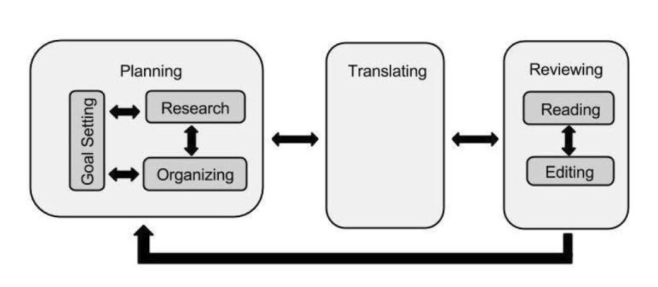
I suggest that the same type of process model would be helpful for developing study skills and for taking a different look at the possible advantages of using digital devices for reading and note-taking. The argument in this second case is that research comparing tech vs. traditional approaches has overlooked important processes in studying and note-taking applications.
Processes in tasks involving the collection and eventual application of information
There have been efforts to identify the processes involved in translating a presentation (e.g., a lecture or book chapter) into intended applications. Several researchers (e.g., Cojean & Grand, 2024; Flanigan et al., 2023; Luo et al., 2016) have extended the original two-stage model (note-taking and external storage) to emphasize the importance of revision. Returning to the importance of multi-process models in understanding the potential issue of whether it matters if one takes notes on paper or using a device, the studies differ. Flanigan and colleagues engaged the unusual practice of inserting pauses during a presentation to allow for revision and found that those taking notes by hand created more revisions. In contrast, Cojean and Grand found that after class those taking notes on a device made more revisions. Systems of taking notes, for example Cornell Notes (Pauk & Owens, 2011) and recent PKM systems (Ahrens, 2022; Forte, 2022), differentiate revision as a separate process in the use of notes.
In the spirit of the writing process model, I have created my own identification of note-taking and note-using processes listed as a sequence with the recognition that notetakers frequently revisit earlier processes after finding a limitation in what a later process makes available. The sequence of descriptors for these processes follows.
- Collecting
- Considering
- Elaborating
- Exporting
Collecting – creating a representation of content (presentations, videos, text material) for use in the future
Examples – creating annotations, notes, highlights
Considering – offline processing of the information collected for personal understanding and to evaluate gaps in understanding
Examples – rewrite existing notes based on comparison of personal collection with that of peers, return to source material to fill in gaps
Elaborating – speculation based on personal understanding of original information for fit within existing knowledge and potential application
Examples – links to existing notes on similar topics, Internet searches to locate and augment existing notes with additional examples of key concepts
Exporting – use of cumulative stored content to meet personal or assigned goals
Examples – test performance, assigned writing tasks, personal writing projects
The Processes and The Question of Handwriting vs. Digital
My contention is that when tasks involve all of the processes I have identified, digital tools offer advantages in the efficiency of collection, storage, search, and manipulation. These advantages are magnified when the task’s time frame is extended and initial goals are unclear. I have written at length on these topics and I have tried to organize some of these posts, organized by process, below. I have avoided considering how AI might be used in these processes, but such engagement would be far easier if working in a digital environment.
Collecting
Take digital notes for best lecture performance
Note and highlight extraction for efficient review and storage (Readwise for books, Highlights for PDFs)
Considering
Note and highlight extraction for efficient review and storage (Readwise for books, Highlights for PDFs)
The Power of Collaboration: Enhancing Your Note-Taking Experience
Preserving context in digital writing
Elaborating
Smart Connections finds note connections
Highlighting in the age of digital content
Notes and the Translation Process
The Space Between Encountering Information and Application
Digital for serious reading tasks
School and Professional Note-Taking
Exporting
School and Professional Note-Taking
Resources
Ahrens, S. (2022). How to take smart notes: One simple technique to boost writing, learning and thinking.
Cojean, S., & Grand, M. (2024). Note-taking by university students on paper or a computer: Strategies during initial note-taking and revision. British Journal of Educational Psychology, 94, 557–570. https://doi.org/10.1111/bjep.12663
Flanigan, A. E., Kiewra, K. A., Lu, J., & Dzhuraev, D. (2023). Computer versus longhand note-taking: Influence of revision. Instructional Science, 51(2), 251-284
Forte, T. (2022). Building a second brain: A proven method to organize your digital life and unlock your creative potential. Simon and Schuster.
Luo, L., Kiewra, K. A., & Samuelson, L. (2016). Revising lecture notes: How revision, pauses, and partners affect note-taking and achievement. Instructional Science, 44(1), 45-67.
Pauk, W., & Owens, R, (2011). How to study in college. Boston, MA: Wadsworth, Cengage Learning.
