The U.S. and China AI Competition

The very recent summit involving Presidents Trump and XI Jinping dealt with many political controversies of the day, which included AI and related issues such as intellectual property. The mention of AI brought to mind a book by Kai-Fu Lee, which I think I read in 2019. I remembered some of the comments Lee made about China, computer science, and AI at that time. Lee, who has held both U.S. and Taiwanese citizenship, wrote that China would have important advantages in the development and application of technology, which surprised me at the time but made some sense given what I knew about China. Lee was educated in the U.S. (Carnegie Mellon Ph.D.), worked for Apple, then returned to Taiwan and later worked for Google in China. I explored my notes and highlights from that book and also from The Big Nine. My interest in the role of AI in education and its application across different countries led me to another article in my personal archive (Hao, 2019). The following comments are mostly based on Lee’s ideas, with some expansion using the other two references I have mentioned. All sources are a bit dated, given the rapid pace of AI developments, but I still find the core ideas worth considering. 

According to Lee, China’s advantages in AI come from scale, data, industrial capacity, talent, and state coordination.

Scale equals more data

China’s 1.4 billion people give it control of “the largest, and possibly most important, natural resource in the era of AI: human data”—and that its huge number of internet users gives it both data quantity and quality for training models. This resource is roughly the equivalent of the combined resources of the United States and Europe. Lee offered this perspective some years ago when finding content seemed more a priority for U.S. companies who encountered push back when scrapping the web and books without permission. 

Industry integration

Chinese companies share. For example, Tencent’s ecosystem is noted as perhaps the single richest data ecosystem of all the giants and combines multiple services, say, in contrast to X and Amazon. Concentration of data and services in a few massive platforms offers a related quantity and quality advantage.

Quantity of Talent

There is a Thomas Friedman quote I have always remembered. “Remember in China if you are a one in a million talent, there are 1400 others just like you.” Lee offers a different assessment of the talent situation specific to AI. He claims that the U.S. has more superstars, but China has the advantage in the number of engineers and computer scientists working in on AI and related fields. Aside of the great difference in population, engineering, programming and science are simply fields of advanced study that are seen as more of an opportunity in China. My own way of thinking about this difference is that in the U.S., business and finance attract many and in China these fields are less of a draw. 

State Coordination and Standards

A “big advantage for China: it doesn’t have the privacy and security restrictions that might hinder progress in the United States”. The commitment to the massive surveillance of its own population is known focus of the Chinese government and a means of control and manipulation of its population. We rightfully consider the use of technology to probe the personal lives and values a violation of basic human rights and bristle internally at the collection of information about us by companies and the government. Simply put, China doesn’t have the privacy and security restrictions that might hinder progress in the United States. Despite tolerated abuses, the commitment to collecting and analyzing this type of information is a source of funding and a focus of experimentation in China. 

” Move fast and break things” was the original Google creed, but a value system that has come under increasing criticism in China. Without the pressure to curb potential negative aspects of AI, China moves faster. Related to this is the greater top down decision making of the Chinese system. In the U.S., you have multiple businesses trying to raise huge sums of money and are often isolated from each other, often duplicating similar approaches. We historically value competition and assume the motivation has advantages. While true, I wonder about the “business model” sucking up a large share of the available investment money in this sector in the US. The amount of money required has to a great degree squeezed out university researchers who either leave universities or work around the edges of AI innovation. While AI research is a high priority in China, the U.S. has cut funding for NSF funding for AI and cybersecurity. 

AI in China and Education

The personal interest that has driven my own interest in AI has been potential opportunities in education. This has been a messy issue in this country with pushback due to legitimate concerns for cheating, failure to address skill development, and lack of interest in instruction presented by a computer. China has committed to exploring AI-facilitated education. 

Academic competition in China is tense. Millions of students a year take the college entrance exam, the gaokao. Your score determines whether and where you can study for a degree, and it’s seen as the biggest determinant of success for the rest of your life. Parents willingly pay for tutoring or anything else that helps their children get ahead. The options tech can provide outside of classrooms offer opportunities to sell experiences to well-meaning parents. (Hao)

Two companies that are likely unfamiliar to most U.S. educators,  Squirrel AI and Alo7, make good example. Since the Hao article was published both services became available in the U.S.  

Squirrel AI uses an “adaptive learning” model that breaks subjects into thousands of “knowledge points”—far more granular than traditional textbooks. The system diagnoses a student’s specific gaps and provides targeted video lectures and practice problems. The teachers are intended to act like “pilots,” stepping in only for emotional support or complex issues while the algorithm handles the core instruction. Educators will likely recognize similarities to the Kahn Academy

In contrast, Alo7 emphasizes a “quality-oriented education” focusing on creativity and the liberal arts. This “intelligent classroom” use AI to analyze student engagement, pronunciation, and even “joy” through facial and vocal recognition 

The interest in AI in education seems to be a combination of the emphasis of standardized test performance for advancement and opportunity, the larger population, and the greater risk tolerance within the context of exploration for improvement. 

Summary

This post is not a value judgment comparing U.S. AI policies, but rather an attempt to summarize what some experts have said about the differences. My personal issue concerns the economic pressure in the U.S. based in our trust in competition among corporations to drive innovation. While this is an approach that has worked in many areas, the huge investments that are required have to this point sucked a great deal of capital from the economy and seem largely and unnecessarily redundant. I personally also find the focus of interest in AI in education (personalized and adaptive instruction) interesting as this emphasis has appealed to me based on my interest in mastery learning

Sources

Hao, K. (2019). China has started a grand experiment in AI education. It could reshape how the world learns. MIT Technology Review, 123(1), 1-9.

Lee, Kai Fu. 2018). AI Superpowers: China, Silicon Valley, and the New World Order. Boston, Mass: Houghton Mifflin.

Webb, A. (2019). The big nine: How the tech titans and their thinking machines could warp humanity. PublicAffairs.

Loading

Ignoring The Instruction Option Of EdTech

When I first began writing professionally about K-12 use of technology in the mid-1990s, a popular approach was to organize content around the tutor, tool, tutee model. This model proposed that technology in the hands of students could deliver instruction (tutor), facilitate the activities of being a student (tool), and program/code (tutee). While AI now blurs the lines between these roles, this simple organizational scheme still seems useful. 

This post was prompted by what I sense to be dissatisfaction with the instructional component of this model and a recent paper entitled the “5% problem. This paper challenged the positive benefits of commercial instructional offerings (e.g., Kahn Academy, CK-12) as misrepresenting what the data on achievement they have collected demonstrate. Ignore my descriptor of such programs as commercial when I know you can use at least many of the features of such offerings at no cost. How these efforts are funded is a different issue. The relevance of “5%” lies in the hidden expectation that only those who use the learning system as intended are included in the analyzed data.  Some studies reporting high effectiveness are based on 5% of those provided access and this important factor is not highlighted in the reporting of results. 

Such assertions make me uncomfortable. Despite what to me seems a backlash against screen time, cautions related to AI allowing learners to offload the experiences intended by learning tasks, and concerns classroom circumstances associated with technology have caused educators to limit meaningful social contact with students and students with each other, now I am feeling I must question the studies I have explored on the benefits of AI tutoring and the personalization of the rate of progress through instructional materials allowed by computer supported instruction (e.g., Kulik & Fletcher). 

Teacher Commitment

As I have considered this recent challenge, it has occurred to me that I have encountered a variant of it throughout my career.  In 2019, I wrote a blog post titled “There is a reason teachers don’t use the software provided by their districts.”  At the time, this issue caught my attention because my wife and I were serving on an advisory group for our local school district and the tech director reported on a monitoring software used to track the use of software the district had purchased to make decisions about which license access packages could be dropped so funds could be reallocated to other requests. I noticed some researchers were using what seemed like a similar system to examine the use of instructional technology and to consider why it was underutilized. These scholars reached a conclusion nearly identical to that of the more recent, in-depth examination of online instructional tools. “One of the other primary findings of this report is that usage of apps is generally lower than might be expected. Most apps are used only for a limited time, and most purchased by districts go unused. This has an impact on efficacy – an app cannot be effective if it is not used” (p.25). 

At that time, it seemed the issue was explaining teacher commitment. Thomas Arnett has weighed in on the issue of school-funded software being seriously underutilized, speculating, based on his Jobs to be Done Theory, that educators simply don’t perceive that the software they have access to helps them satisfy the jobs they perceive as expected of them, relative to more traditional approaches. These jobs are described as 1) Help me lead the way in improving my school, 2) Help me find practical ways to engage and challenge more students, and 3) Help me replace a broken instructional model so I can help each student. From my perspective, many technology-based instruction systems seem purposefully designed to address individual learning speeds and existing knowledge, but perhaps this is how these resources by educators. In a more detailed version of this only online description, these authors propose that educators might respond if a greater effort were made to engage educators with data and anecdotal accounts of the success of peer educators. 

What about the learners? 

As I explored this history and what seems a frustrating pattern for those of us who have been influenced by the seeming promise of personalized progress systems and intelligent tutoring systems in a carefully controlled context, when turned loose in the complexity of schools and classrooms. The challenge of matching key elements of the controlled setting in which concepts are developed in applied settings is termed fidelity and is an issue in many fields (e.g., Trustschel and colleagues). I have struggled with this challenge in my own research, which has often focused on creating technology-facilitated study environments for college students enrolled in large introductory classes. 

Cognitive research has accumulated a massive amount of evidence demonstrating the effectiveness of retrieval practice and the challenge that less capable learners are often much less aware of their specific knowledge gaps and a false sense of understanding (i.e., metacomprehension). In other words, less capable learners often don’t know what they don’t know and thus are very inefficient at remediating their problem areas. One way to provide retrieval practice and address poor metacomprehension is to provide practice tests. More sophisticated applications that make use of technology can also track weak areas so that these areas can be emphasized, link the student to remedial content when individual elements of information are not known or misunderstood, and even request students to predict the accuracy of their performance in an effort to increase awareness of strengths and weaknesses. 

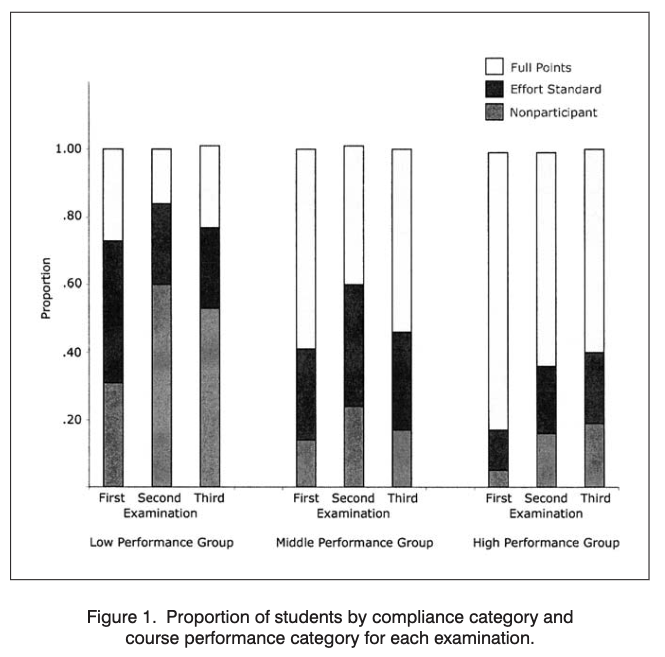
If you are interested in the details of this study, I have provided a citation below. The relevance of this study for the present post concerns the willingness of learners, college students in this case, to take advantage of a resource designed to improve their performance. The following graph is an easy way for me to make my point. Learners were divided into three groups based on course performance. For each of the three exams, the percentage of learners in each performance group who satisfy the stated goal of the study task, use but do not meet this standard, or do not use the study task is identified. There is a clear pattern: those performing the worst do not meet the study goal. Most persuasively in keeping with the other data reported in this post is the data on those who made no effort to use the system. It is possible trying but failing to reach the stated standard is related to understanding or aptitude, but failing to try, which should still be beneficial, is not.  

As was the case in the 5% paper, those less in need of assistance participated more in a likely beneficial activity. In fairness, the “perceived suitability” of a learning opportunity proposed while vague offers a second possible explanation. 

Summary

In this post, I consider the persistent “underutilization gap” in educational technology, where instructional tools—from commercial platforms to AI tutors—frequently fail to achieve their promised impact because they are either ignored by teachers or avoided by the students who need them most. It is true that the “5% problem highlights how efficacy data is often skewed by only including the small fraction of users who follow the system as intended, while struggling learners consistently participate the least in these personalized systems. Ultimately, I suggest that EdTech’s potential for personalized progress remains stalled by a lack of “fidelity” in real-world settings and a failure to align software with the practical “jobs” educators and students actually prioritize.

Citations:

Grabe, M., & Flannery, K. (2010). A Preliminary Exploration of Online Study Question Performance and Response Certitude as Predictors of Future Examination Performance. Journal of Educational Technology Systems, 38(4), 457-472.

Kulik, J. A., & Fletcher, J. D. (2016). Effectiveness of intelligent tutoring systems: a meta-analytic review. Review of educational research, 86(1), 42-78.

Trutschel, D., Blatter, C., Simon, M. et al. (2023). The unrecognized role of fidelity in effectiveness-implementation hybrid trials: simulation study and guidance for implementation researchers. BMC Medical Research Methodology, 23, 116. https://doi.org/10.1186/s12874-023-01943-3

Loading