I spent my career working in higher education and securing external funding was a fact of life in this environment. Making the effort to write grant requests and occasionally secure a grant was a part of our merit pay process. As the pressure to find funding sources to support research and research-related infrastructure and to reduce student tuition has increased, expectations have increased. In some institutions, it is a requirement to secure a certain type of grant (translate as – a grant that provides lots of overhead which is money that goes to the institution to support institutional needs, in addition, to support for the researcher) to be granted tenure or perhaps to be promoted to full professor. The differences across disciplines in the amount of this type of money that is available makes this a very unfair practice, but this is a topic for a different discussion. Let be sufficient to just state that profs in higher ed are frequently expected to secure external support for their work.
What about K-12? While the pressure is far less, K12 administrators and educators may search for funding sources beyond those available through their schools. There are grants. Most of these grants target specific goals and depending on the needs that exist within a given school, the likelihood of being funded is heavily influenced by whether a school has the need the grant was designed to address. Most grants at this level are far less competitive than the grants in higher education, but someone must do the work to apply and there is no guarantee that funds will be available for all who might qualify. Larger districts often have an individual responsible for responding to this type of opportunity and it might be an administrative responsibility in smaller districts.
There is a second type of external funding that might be described as “crowdsourcing”. In higher education, the crowd being approached tends to be the alumni of the institution. In K12, it is likely to be community members and even others interested in supporting needs which they find important. The Internet provides an increasing number of ways in which such appeals might be launched. Again, my experience with crowdfunding has been in higher education and I know that any efforts we might want to make to solicit funds from our alumni required that we go through the alumni association. Our efforts had to first be cleared with university officials to assure that our requests were consistent with university priorities.
K12 educators have multiple online services that provide a way to solicit funds (this article from EdSurge offers an in-depth summary of this issue in K12). This article identifies issues related to crowdsourcing and the opportunities for educators. Many public K12 institutions are underfunded and crowdsourcing offers individual educators a way to secure additional resources for their classrooms. Whether or not requests made by individual teachers meet district priorities is an issue similar to what I have described in higher education. Individual differences in opportunities for learners created by such funds across classrooms is another issue. Are educators expected to secure funds to create needed circumstances in their own classrooms? From a broad view, do the successful crowdsourcing efforts of some teachers relief the public of their responsibility for public education.
Some of the following content first appeared on my travel blog – grabetravels.blogspot.com. Here I have appended additional content explaining the educational potential of using identification keys and apps for identification of plants and animals.
———–
For anyone from the midwest, photographing the flowers of Hawaii becomes a constant activity. The flowers are everywhere even this time of year and they are truly beautiful. At some point, you exhaust yourself on the artistic value of your growing photo collection and you start to think beyond the vibrant colors and the huge blossoms. You begin with simple questions. I wonder what this plant is called? You may wonder about other things as well. How does this flower grow in the crook of this tree without having roots in the soil?
I started mixing tech with photography a long time ago. My biology background even plays a role in both my plant photography and my interest in technology. I began exploring apps on my phone that claimed they could be helpful in plant identification. Point your camera at a plant and the app would tell you what that plant was and direct you to additional information about the plant. I have read about face recognition and the role artificial intelligence plays in making this possible. It made some sense that the same technology might be applied to plant identification.
During last year’s visit to Kauai, I explored an app called PlantSnap. This year I added iNaturalist to my app collection. Both work in a similar way. You take a photo and the app makes a guess as to what appears in the photo. The app also offers some other possibilities and relies on you to evaluate the first choice and the alternatives. If nothing makes sense, the app farms out your photo to the public that follows the app to see if anyone has an idea. Selecting a choice offers a way to get additional information.
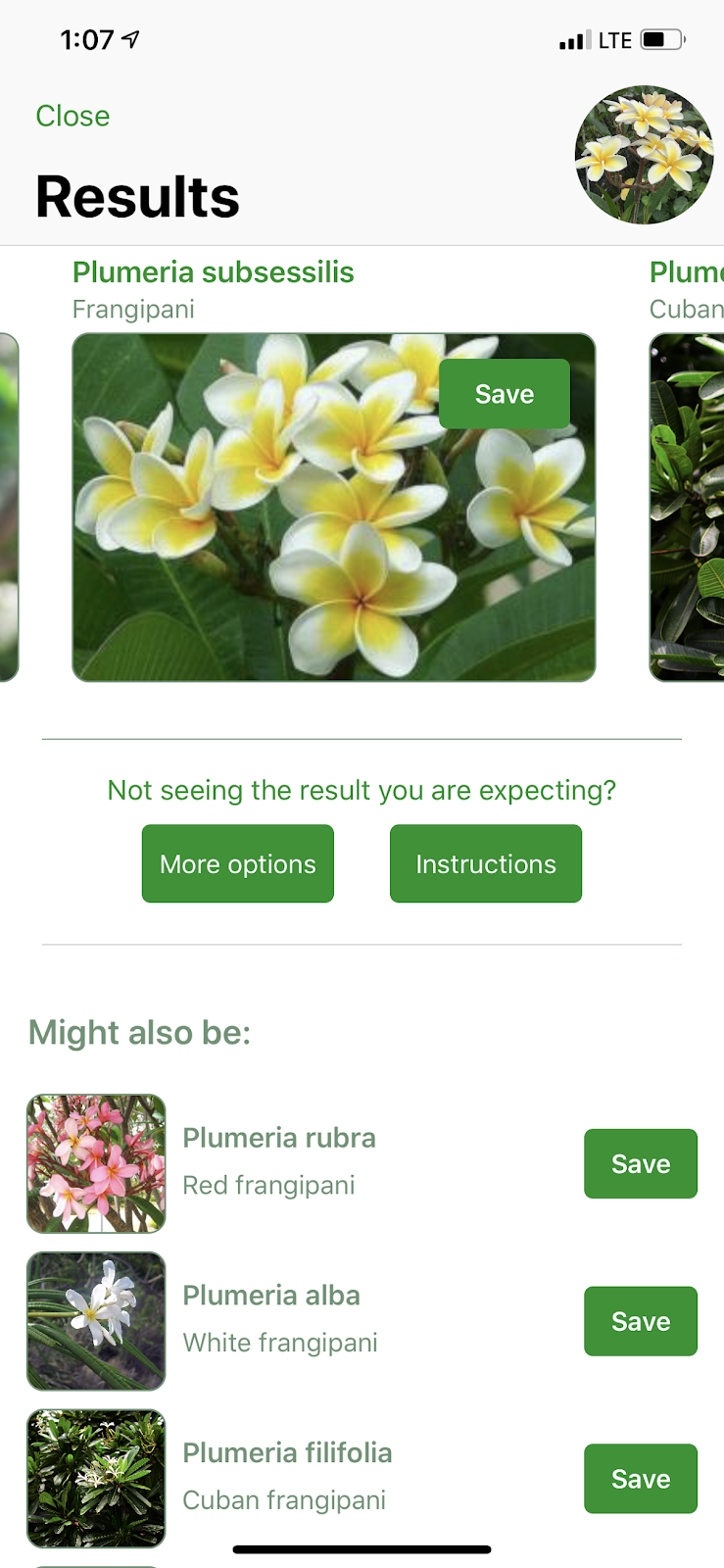
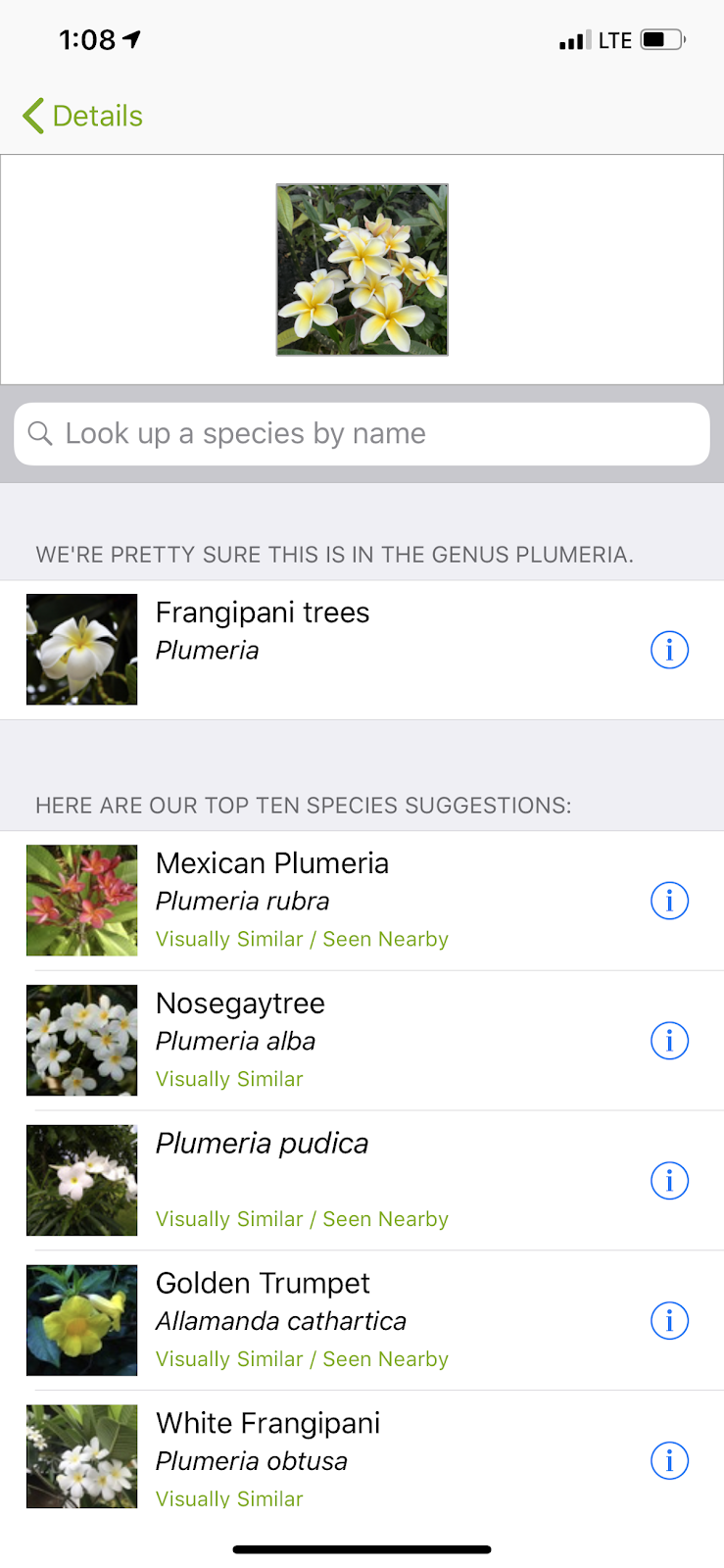
Evaluating these apps presents a problem. You must know what you are looking at in order to determine if the app made a correct identification. Here are three photos I took walking home from the coffee shop and the top choice offered by each app.
[PlantSnap]
[iNaturalist]
[PlantSnap]
[iNaturalist]
[iNaturalist]
I know both apps were correct with the genus. I am not capable of evaluating the accuracy at the species level.
There are other ways to do this. You can purchase a plant identification book. There are even online keys that offer an identification approach based on color. I have decided the flowers are probably easy, but I wonder what happens when the app is asked about a plain green plant. I don’t have any examples and I am not certain I would be able to check the responses, but I have a few more days here and plenty of specimens I can photograph.
There may be no post tomorrow. We have to move out of our condo and into a hotel. Two of our kids and their families did not have a Spring break option during the two months we originally booked so we had to find a way to extend our stay. I hear there is still snow and flooding in the midwest so this has worked out well.
I started my career as a biology major and the preparation to teach biology in high school. My interest in science education and learning (and the army) led me another direction. Many of my original interests remain and pop up in some of the things I write.
Some of my zoology, entomology, and botany courses required that I identify specimens in the field or lab. To make these identifications, we were taught to rely on dichotic keys. A key works something like a “choose your own adventure” story. Instead of a segment of text that ends with a decision point offering options and the option selected determines the next segment of text read. In an identification key, the key asks the user to make an observation to answer a dichotomous question – do smaller branches appear along a larger branch opposite each other or from alternating sides of the larger branch? Depending on the option that applies to the specimen to be identified, the user is sent to different follow-up questions. Eventually, the process arrives at what the key assumes is the species to be identified. Creating such a process would obviously be a tremendous challenge, but for the user a key offers a practical way to make an identification. Note that a key works in a different way from the identification resources you might purchase to identify birds, wildflowers, insects, etc. A key is supposed to be an algorithmic as opposed to a heuristic approach to solving a problem.
Identification of an unknown is a skill one learns in several sciences (e.g., geology). Exploring the process of identification using several approaches would make a great biology lab. Bring in several “mystery” specimens and have students use a key, an identification book, and maybe an app to see what they can accomplish (here is a simple online botany key). A good related exercise is to consider what the might be the advantages and disadvantages of the approaches I have identified.
Over the past few years, I have tried several different online tools to support my blogging and other writing tasks. Especially for blogging, I now pay for a subscription to Evernote. I have also tried OneNote, Google Keep, and Zoho Notebook. I find Evernote perfectly suited to what I do and find the subscription price reasonable. My subscription price is $43 a year at least according to the feature within iOS that keeps track of my subscriptions and what each costs. As I will explain in a bit, this amount is kind of confusing as the public subscription price seems to be $8 a month and I am not sure if I have an educator’s discount or am grandfathered in. I pay through Apple, but I doubt that would give me a lower rate.
I do keep track of similar services as a way to communicate to educators just what options are available within what I think of as a category of services – those allowing collection, organization, and annotation. I assume most educators have a need to collect online resources to support their instruction. Occasionally, this could also involve sharing resources with students and it would be nice if the same service could support both tasks.
I have been exploring the free level of Notion. To simply my explanation, I will outline one process for using Notion in this way and then explain some of the steps in greater detail. Notion is very flexible and this is just one simple strategy for how it might be used.
The process.
Create an account
Add the web clipper if working from a desktop machine. Set up sharing if working on a phone or tablet. With iOS this just means you activate the setting associated with sharing that allows the connection to the Notion app.
Create a page in Notion
Use the clipper or the app sharing technique to bring a page into the page you have created (think of this as a sub-page)
Highlight content imported if desired
Turn on sharing for a page and set desired permissions. Copy the share link and send it to those you want to provide access
This image shows what Notion might look like after you have it set up and have been using it. Several things can be noted here. You can see two panels – the panel of the left shows existing pages and allows them to be moved about and embedded within other pages. I have used a red box to highlight several pages I have collected in preparation to describe Notion. One of these pages appears in the larger panel. You would highlight and read the content in the larger panel.
At the bottom of the left-hand panel you see a button for creating a new page (red box at bottom). This would be the button used if you wanted to first create a page within which other pages would appear.
At the top of this image, you see the “share” button within a red box.
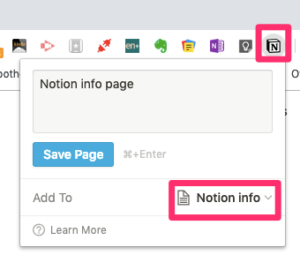
Content from other web sites is moved into Notion in different ways depending on whether you are working on a laptop or a mobile device. On a laptop, you will need to add the Notion extension to the Chrome browser. Only Chrome is supported as of this date. When the extension is added, the Notion icon appears in the browser menubar. You select this icon when you are browsing a web page you want to copy to Notion. A dropdown box will appear (see image) and you select the page on Notion within which you want to add the new content. On a mobile device (at least iOS devices), you use a browser to find the content you want to store and then use the share icon to share to the Notion app. On iOS, you must first add Notion to the share options iOS will access.
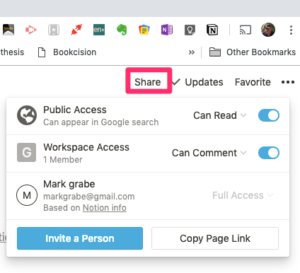
This image shows the share options within Notion (see first image to see the positioning of this icon). When the share icon is selected, you get this dropdown window for the to be shared page. You can set permissions from this window and also get the link to provide others access.
If you are interested, here is a link for a page I have shared publically.
Surveillance capitalism, a term popularized by economist Sashona Zuboff, describes the collection of information about people for the purpose of economic gain. Zuboff’s work focused on surveillance capitalism as it was practiced by social media companies paying particular attention to a) user lack of understanding that information about their online behavior was being collected and integrated to the extent that was the case and b) the effort of companies to provide online services in such a way that users would be more committed to the service and provide more behavioral data in the process.
I have no training as an economist and I likely misunderstand many of Zuboff’s interrelated arguments involving economics, the psychology of confirmation bias and behavior modification, legal issues associated with informed consent, and factors such as the “network effect”. I do have some experience offering online content complete with ads and I have some experience applying both ad blockers and coding that enables the identification of ad blockers. I also have some experience making use of online services that are attempting to implement other approaches to collecting and sharing revenue for online services.
I would describe the question I am attempting to answer as this – Can capitalism offer an effective alternative to surveillance capitalism or will the greed of some online companies eventually lead to government intervention? I suppose the answer to the question could be other than the two options I identify, but I am betting things will go one way or the other.
The use of an online social media service involves the interaction of 3 and perhaps 4 parties: you as the user, the content creator, the service (e.g., Google, Facebook, Blogger), and possibly the company offering an ad (actually a combination of the company advertising and the ad delivery service). Each party has costs and benefits in the interaction of these agents. In the most common present model, a user makes the attempt to use a service – e.g., read a blog post on Blogger. The user reads content on this service for the cost of providing personal information collected by the service (Google). This is the cost to the user. The service (Blogger a service of Google) has the potential of receiving revenue for the cost of providing the infrastructure through the collection of personal information and possibly through ad revenue generated from clicks of ads. The ad company the infrastructure company for ads clicked is compensated by those who want ads to be viewed. The content creator is compensated for their work (their cost) in creating content when an ad associated with their content is clicked. This is a balanced system or at least it is proposed to be so.
Consider what happens to the present system when one of the parties involved finds a condition as it exists unfair or devious. This would be the case when users (viewers) of content within this system object to surveillance capitalism because they find the cost to them of revealing their personal information out of balance with what they receive. They might decide to deploy an ad and cookie blocker to reduce the personal information that is revealed. This does prevent the infrastructure provider from receiving the benefit of the information harvested and any funds provided from ad clicks. This means the infrastructure company is providing a free service and still must pay the costs of providing the infrastructure. Likewise, the content provider continues to spend the time (a resource) involved in generating content and receives no compensation for this labor and the ad company receives no income because no ads are viewed and clicked. In solving the problem of unwanted surveillance, the user has defunded all of the other parties involved and in the long run this will likely have consequences. For example, the infrastructure company could block the reveal of requested content to users blocking the accompanying ads. Content creators could look for other outlets for their content or at least reduce the amount or quality of the content they produce.
Are there solutions existing or new companies can apply to bring these parties into some fair balance? I think some serious efforts are starting to emerge.
First, there is the subscription model that has been successful with streamed music. Some of the same companies now focused on music are expanding their model to include podcasts. To access podcasts affiliated with a service, users will have to pay the price of subscription. In some cases, this could mean the subscription they pay for music would also include podcasts. Content creators would be paid a small amount for each time their podcasts were served. This model could be extended to other content types – e.g., Medium for written material. What seems to be happening at present is that the more popular creators are compensated and those who receive less attention can offer content but are not compensated.
A second service I think has great potential is the Brave browser [https://brave.com/]. You can download this software for pretty much any device. The browser is really part of a service that involves three capabilities. First, the browser blocks cookies and scripts. This capability can be controlled by the user as a general approach (everything is blocked) or as a blocking capability turned on and off depending on the site. Second, the more general service associated with the browser allows users to commit an amount of money that is distributed to content providers/services in proportion to the amount of time allocated to the sites visited. Content creators must enroll (no cost) to be compensated in this manner. Each month, the sites visited are listed for the user and the user can drop for compensation any site from the list. Money is not forwarded to sites until they register. Finally, the service is just rolling out a potential compensation opportunity for users. This approach substitutes ads through the Brave browser service for ads normally accompanying the content when viewed with other browsers. So, users are paid to view ads, but the data normally collected via cookies and scripts are not allowed to pass. This final component of the Brave model is just being tested at this time. Brave takes part of the ad revenue when users offer compensation for content/service and when companies offer ads through Brave. These funds provide compensation for the infrastructure and company.
So, there are multiple opportunities here (as I understand the possible combinations). Users could use Brave to block ads. Users could contribute and block ads. Users could receive compensation for viewing ads and block ads. Users could blocks ads, contribute, and receive compensation for ads viewed via Brave.
Again, it is possible to consider how the user, content creator, and infrastructure provider are compensated when thee different combinations are implemented. If a user blocks ads and nothing else, the user receives content or uses a service at no cost, but the content creator or service provider is not compensated. If the user blocks ads and submits a voluntary contribution, the user receives access to the content or service and the provider is also compensated. If the user blocks ads, but accepts user ads and offers no compensation, the user benefits in multiple ways (content and revenue) and views ads and the providers receive some compensation. The difference in this final combination from the most common existing experience is that the user views ads, but does not provide personal information that can be shared.
I hope that I am understanding the Brave long-term view appropriately in claiming that the content creator potentially receives revenue from both contributors and from ads shown by Brave. It would be possible to compensate users, but not content creators when ads are displayed.
If Brave gets their approach off the ground and attracts sufficient users, I predict the model will change such that content contributors will make an exclusive commitment to have their content viewed through Brave and users will have to accept viewing ads for these sources unless they are contributors. This would guarantee a revenue source for users and content creators. Note – I am guessing at a long term model here. If this should happen, I would also predict that a similar model would then be adopted by other sites such as Facebook and Twitter. Google would be most harmed by this model because they would then be in competition with Brave to make money by selling and displaying ads.
In summary, I see alternatives to surveillance capitalism should these competitive models take hold. The present surveillance capitalism model is still much more popular, but public awareness of the collection and sharing of their information is encouraging ad/cookie blocking. Should ad and data collection blocking become common, the lack of opportunities for certain categories of content and service creators will eventually extinguish their willingness to work without compensation.
If capitalism doesn’t take on surveillance capitalism, government intervention seems very likely.
Salman Kahn was the featured speaker at this year’s Future of Educational Technology Conference. I had hoped that his FETC presentation would be available, but I have not been able to locate it online (I did find this interview). The conference in Orlando was a direct flight from Grand Forks and probably the ed tech conference I found most informative. It was also in late January which was a great time to escape from North Dakota for a few days.
I have been following Kahn and his Kahn academy since I first saw his TED presentation. At some point during the process of developing his online resources, Kahn began describing what he was doing as supportive of a mastery approach. I am fairly certain this realization came sometime after his work became popular and I appreciated his association with the mastery learning research that guided my own early thinking about individualization in the 1980s. Too many innovators seem to want to give new names to older concepts.
For me, technology provided a practical way to apply mastery concepts in classrooms. The work from the 70s-80s explored the potential of core ideas, but this form of personalization was very difficult for educators to implement.
My own thinking about “personalization” assumes there are two issues that should be individualized – a) interests and b) existing knowledge and speed of learning. Neither variable can be addressed with a group-based approach. When the individualization of instruction to address differences in existing knowledge and speed of learning are implemented via a system such as is available through the Kahn Academy, what is happening is unfairly described as students being drilled by a computer. This perception misrepresents how a teacher’s time is intended to be applied. Technology is being applied to individualize information presentation and performance evaluation on an individual basis providing data that allows educators to recognize where their mentorship and tutoring can most usefully be applied. This is a type of interaction that does not happen often enough in most classrooms.
Google Keep offers an efficient and free way to archive content as you spend time on the Internet. I have described this service before, but did not offer an explanation of how it works on different devices. This post deals specifically with the iPad.
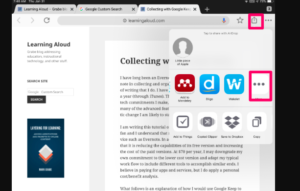
If you have Keep on your iPad, sending content to your Keep archive makes use of the “share” feature. The one tricky thing about sharing on the iPad is that you must activate “share” for specific apps. Here is the process.
The share icon (top red box) opens a display of the options. At the right-hand end of the existing options, a series of three dots (see red box) offers the opportunity to activate other share possibilities.
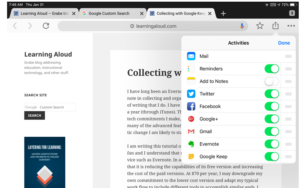
The three dot icon opens up the apps that can be coordinated with the active app. You use the slider associated with a given app to make it available. Once activated, this app will be available as an outlet for selected content when the share option is used.
The following comments are based on a recent book by Lee McIntyre – Post-Truth. I suggest it as a useful read for any educator interested in information literacy, science denial, and similar topics. I think it supports my observation that teaching students to evaluate the credibility of the online resources they encounter is not enough to assure they develop an accurate representation of their world. A broader approach to online literacy is required. This book offers some suggestions, but it is possibly more useful in identifying the multiple factors that have created the present information environment in which we presently function.
I will not attempt to write a summary of the multiple issues McIntyre’s book identifies. The resulting text would be far too long for a blog post. I will attempt to identify some of the key factors the book identifies as I interpret them. The result is more an outline of factors than a complete description. When I offer my own observations or comments, I will do so within brackets so my ideas can be differentiated from by summary of the author’s comments.
Factors creating the Post Truth environment:
Personal factors – Asch conformity [influence of group position], confirmation bias [Author seems to propose a brain predisposed to support existing personal perspectives – I see as a constructivist model of learning.]
Decline of mainstream media due to decline in ad revenue and readers/viewers going elsewhere, financial difficulties result in decline in number of actual reporters, decline in shared information experience as readers/viewers do not have a common information experience.
Rise of 24/7 news, much more time spent on opinion relative to actual news, embrace of a perspective/bias, encourage interest/viewers through promotion of conflict. Presenting both sides of a story when one side has little credibility confuses viewers and feeds personal biases – objectivity should not be confused with objectivity.
Social media – selection of friends, bias in what friends share, bias in what service feeds reader to suit their values
Weak approach of formal science – science is always questioning and suggesting more research would be helpful. Misleads public as to what is known because of this cautious approach.
Generation of purposeful falsehoods likely to be embraced by target group. Falsehoods given greater reach by sympathetic audience and bots.
Some ideas regarding what can be done
One remedy is heterogeneous group interaction – develop an appreciation for the scrutiny of others [This fits the value of argumentation]
Important to call out, rather than ignore lies no matter how obvious the falsehood.
Invest in a quality news source. Free is not free and not suited to meaningful learning.









You must be logged in to post a comment.