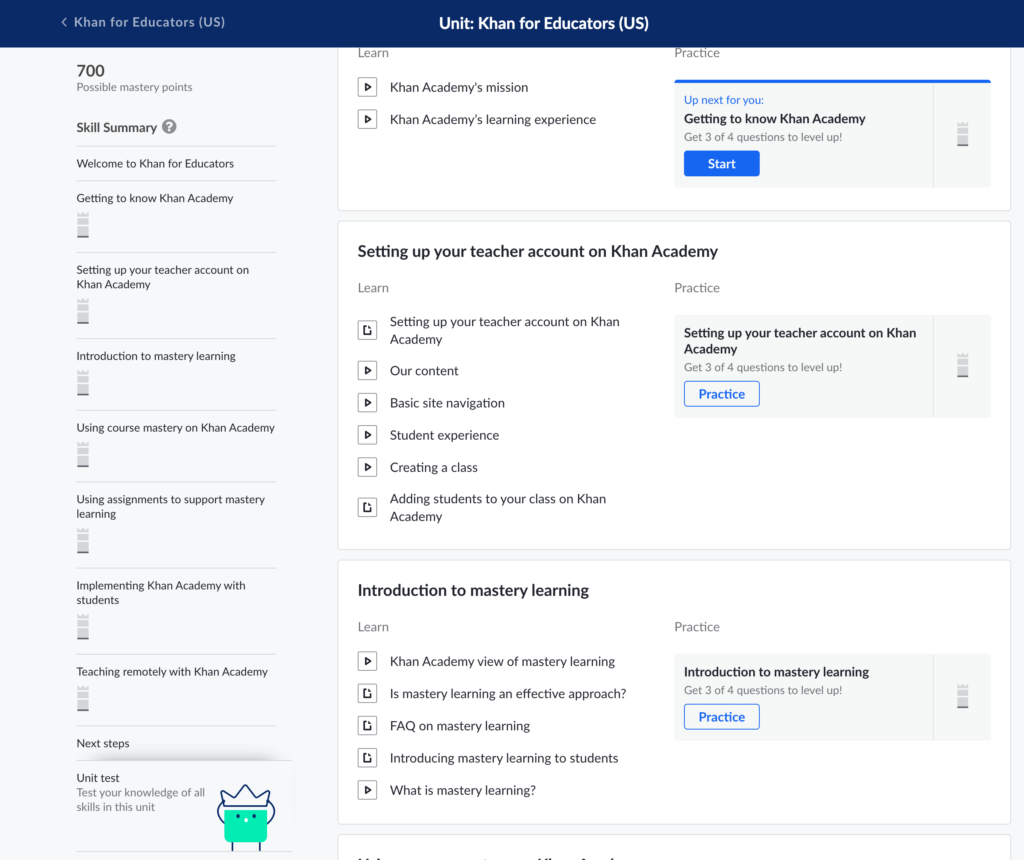
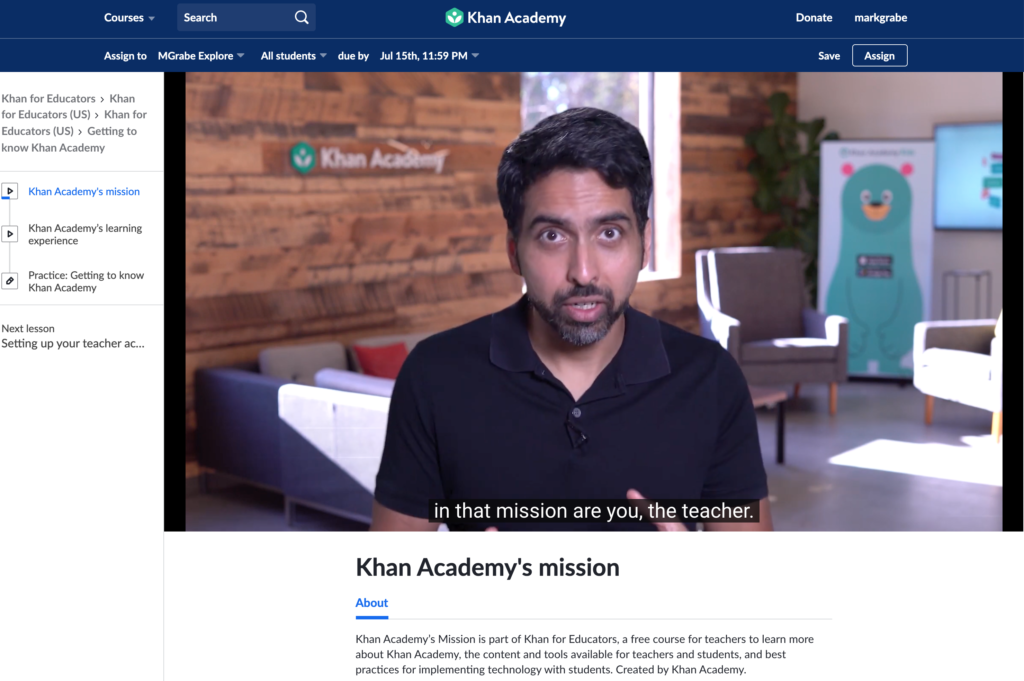
The Kahn Academy has created a summer course for educators. The proceed at your own speed course (what else would you expect from the Kahn Academy) takes you through how the Kahn Academy works, what the teacher does, what the student sees, the principles that guide the full approach, mastery learning, and using analytics to improve instructions. The course is a combination of videos and activities.
I have been a fan since first watching Kahn’s TED talk and assigning his book (One World Schoolhouse) in a class. I was a fan of mastery learning long before Kahn had anything to do with education. As Kahn’s efforts have matured, his content and delivery system have advanced to the point of becoming a bit intimidating. This course is well worth the time if you are interested in using the system with your students.
Today, I watched the first three panels from a White House event focused on the importance of opening schools in the Fall. Other then the session consisting of the President and wife, I have been unable to locate video of the other sessions for sharing [summary].
Many of the sessions relied on a recent report from the Academy of American Pediatricians which argued that school plays many important functions in the lives of the young and the health risk to children and adolescents is quite small. Given the health benefits of face to face education (activity, food, identification of out of school problems such as abuse, mental health benefits related to being with peers and adults outside of the home) and the terrible educational performance of online education, it was important that the young experience face to face education.
There is a conflict between optimal academic and social/emotional learning in schools and strict adherence to current physical distancing guidelines. For example, the Centers for Disease Control and Prevention (CDC) recommends that schools “space seating/desks at least 6 feet apart when feasible.” In many school settings, 6 feet between students is not feasible without limiting the number of students. Evidence suggests that spacing as close as 3 feet may approach the benefits of 6 feet of space, particularly if students are wearing face coverings and are asymptomatic.
The statement on social distance is similar to the position taken on other guidelines. I would describe this position as “it will be difficult to implement many of the suggestions familiar to most aware of CDC guidelines so take these guidelines as recommendations and not requirements”. The report from the pediatricians acknowledges that it has focused on young people and not the adults (teachers, school personnel, parents, etc.).
The issue I have with the presentations made by the WH panels and the AAP is that the positions taken did not involve discussion/interaction with other experts who might have different opinions or represent different populations. I have many questions: Did the short period of learning from home most schools experienced in the Spring represent a fair test of distance education and the role of technology? Certainly, distance education is the means by which many now learn (including many programs for educators) and what about these programs is different from what students experienced in the Spring? Would more schools and educators be able to offer a more productive approach if given more training and time to prepare? My understanding of plans for implementation offers a fuzzy picture of what resources will be available and I know in some situations schools are cutting and not adding human resources I would think would be essential to deal with the new reality (health care experts in schools, mental health experts in schools, additional personnel to handle the added requirement for those who cannot or will not participate in face to face learning).
My expertise is more in considering educational issues, but I also wonder about what seem to be inconsistencies, many recently surfaced, that seem to contradict the AAP position. For example, the notion that the danger of the illness and the spread are not a significant issues for young people. I am seeing reports that the age issue recently has been moving to younger and younger individuals. For example, this from Edina, MN, as reported in the Minneapolis Star Tribune [I live near the boundary between Richfield and Edina].
So far in Edina, the city has reported 35 COVID-19 deaths and 393 cases, including 98 cases involving people 19 and younger. Edina is unusual in that children and teenagers make up its largest age block of COVID-19 cases.
Another recent medical issue concerns the distinction between the danger of spread via droplets vs aerosol. The concern regarding aerosolized transmission has implications for the danger of spending extended time in a confined area and the importance of air circulation which may be inadequate in many school classrooms. [Scientific American]
I simply don’t like the President, Secretary of Education, and Governors making demands that are tied to financial incentives for schools. While these are difficult decisions and the AAP did take a definitive position, there are other categories of experts with different perspectives that need to be considered. I am not yet convinced that a model that rotates students between Face to Face and online instruction does not make the most sense and would be the best solution when it comes to the health of all concerned. Political pressure can be exerted on different entities and educators make a target that is simply too convenient.
As always, I encourage your review of the sources I have summarized to reach your own conclusions.
Google photos has a great new feature that allows a search of your collection using a map that offers a heat map based on photos that contain GPS data. This video explains how this work and offers a way to use this feature to locate photos by location not stored with GPS data stored in the EXIF.
As the COVID pandemic resurges I am growing more convinced K12 education will look a lot different in the fall. I encountered this post offering some new proposals for models that cut classroom attendance in half in order to allow distancing. For whatever reason, my imagination had become stuck on a model in which half of the students came to the physical school on one day and the other half came on the next. I had imagined that Wednesdays would be devoted to teacher time for planning and going through student written assignments, projects, maybe a few personal contacts. The major downside I saw with this model was the double duty teachers would have to serve when half of the students were face to face and half were joining for at least part of the time online.
One of the ideas in the content I reviewed described a different approach in which half of the students attending in the morning and half in the afternoon one day and then all students were working remotely on the next. Again, Wednesday might be a time for planning and the other teacher tasks I mentioned above. The advantage in this divided day model would be the elimination of the double duty load each day. My perspective which I admit probably imagines working with older students would focus on more intense instruction for a shorter amount of time which I tend to see as more tolerable than what would seem feasible when engaged with students for an entire day.
Diigo is a social bookmarking service. The company offers the powerful service to educators and their students at no cost. The idea of an online bookmarking system is to allow a user to collect and organize links to online resources. Most of us probably started with a bookmarking system built into a browser. These systems became more powerful as the browser providers synchronized bookmarks across a user’s browsers on different devices. An online system tends to be even more powerful allowing bookmarks to be accessed using different browsers and allowing bookmarks to be stored with additional information (notes, highlights, tags) that improve search and may eliminate the need for search because of the information stored.
A social bookmarking system extends the capabilities of an online bookmarking system by allowing the sharing (collaboration) of bookmarking.
I have written previously about my use of Diigo. You can view my public bookmarks if you are interested. This post is intended to offer additional information about the classroom opportunities Diigo provides educators and students.
I would think an educator could pay for a pro-tier version of Diigo and set up groups for students. This would provide a reasonable level of security. However, the education version offers a couple of advantages and is free.
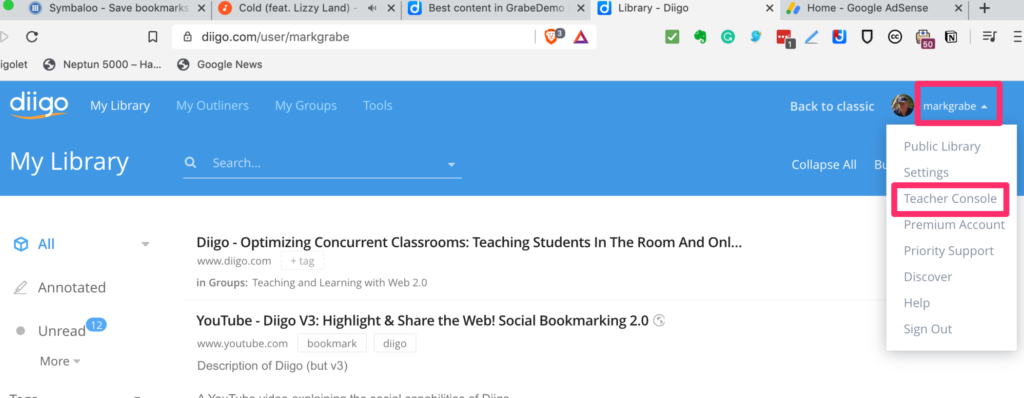
The first thing to do if you want to use Diigo with a class is to declare yourself an educator. The request page can be found at https://www.diigo.com/education. Once your request has been granted, access to the Teacher Console appears under the personal controls header.
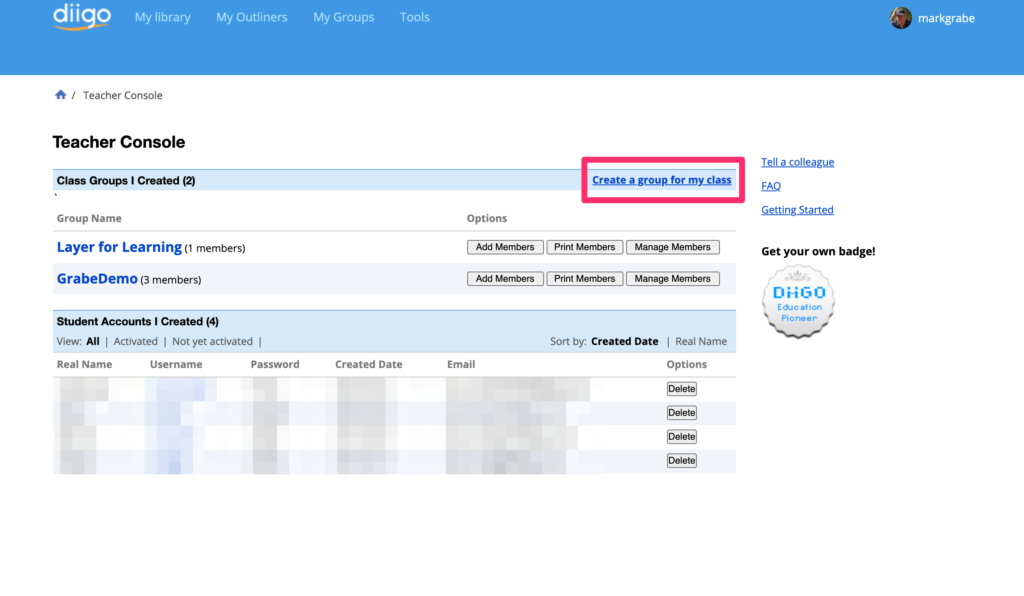
The teacher console is displayed below. From this display you can see I have two existing classes and multiple students (blurred out). The red box indicates the link to create a new class.
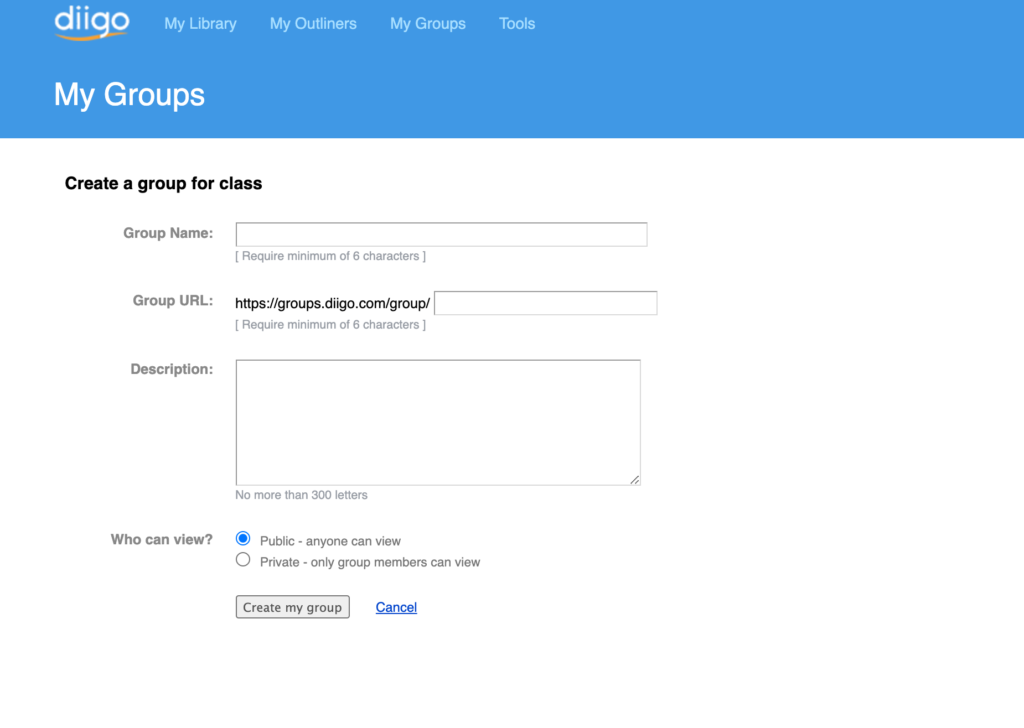
The page for creating a group is displayed below. Give some thought to what group name will prove useful over time.
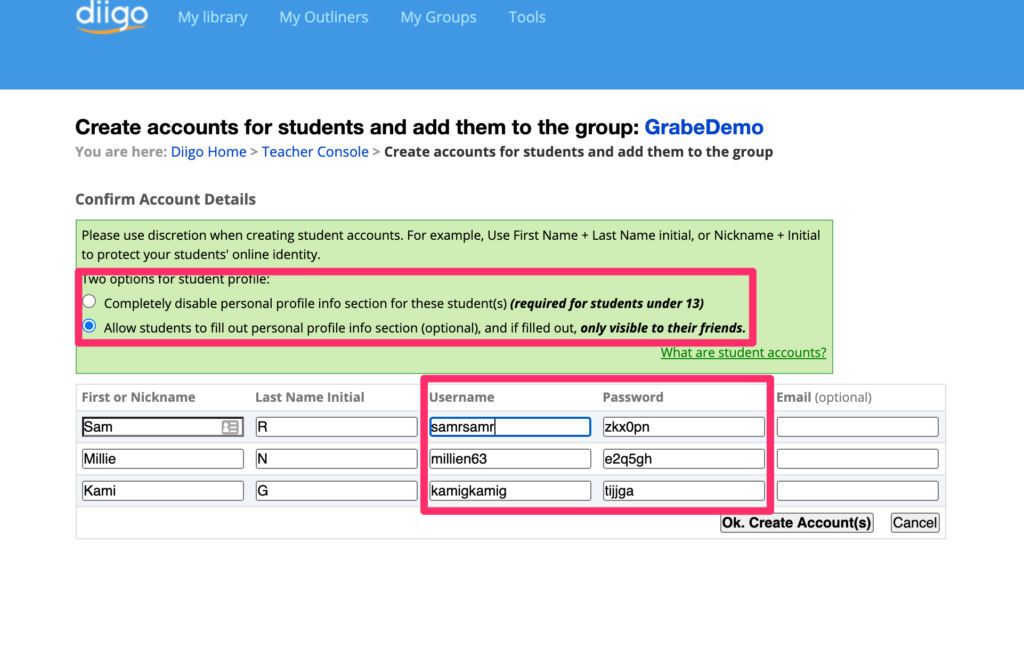
There are two ways to add students to a group. You can send out invitations to student emails (the system used with groups in the open Diigo system) or you can list students and the system will generate names and passwords.
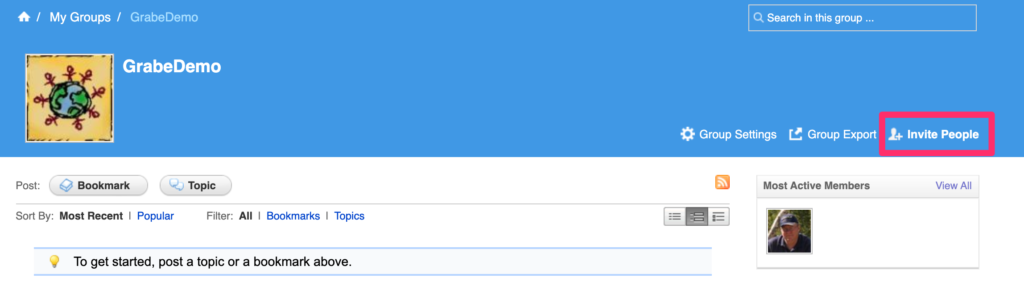
The email invite system requires you first open the group and then use the external email textbook to add the addresses of those you want to include.
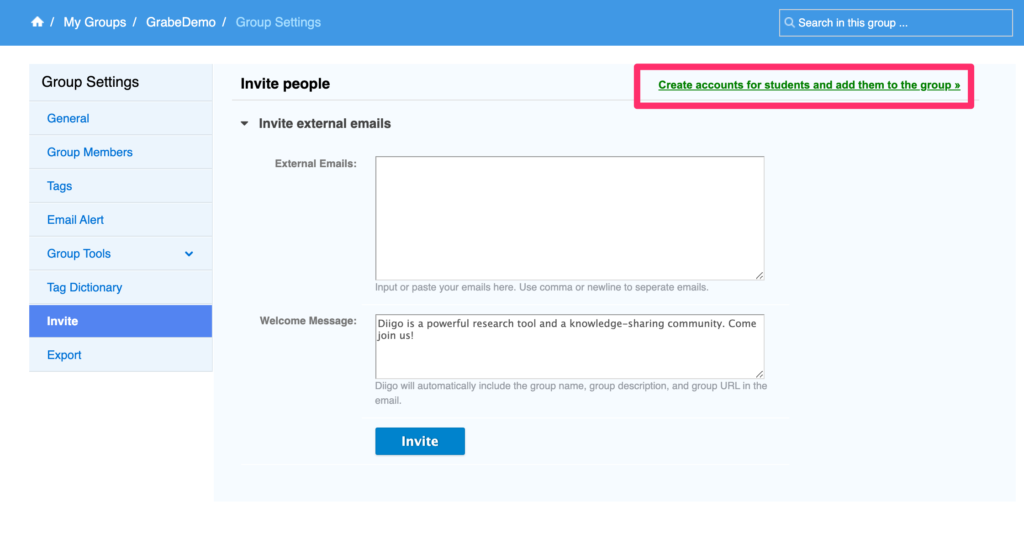
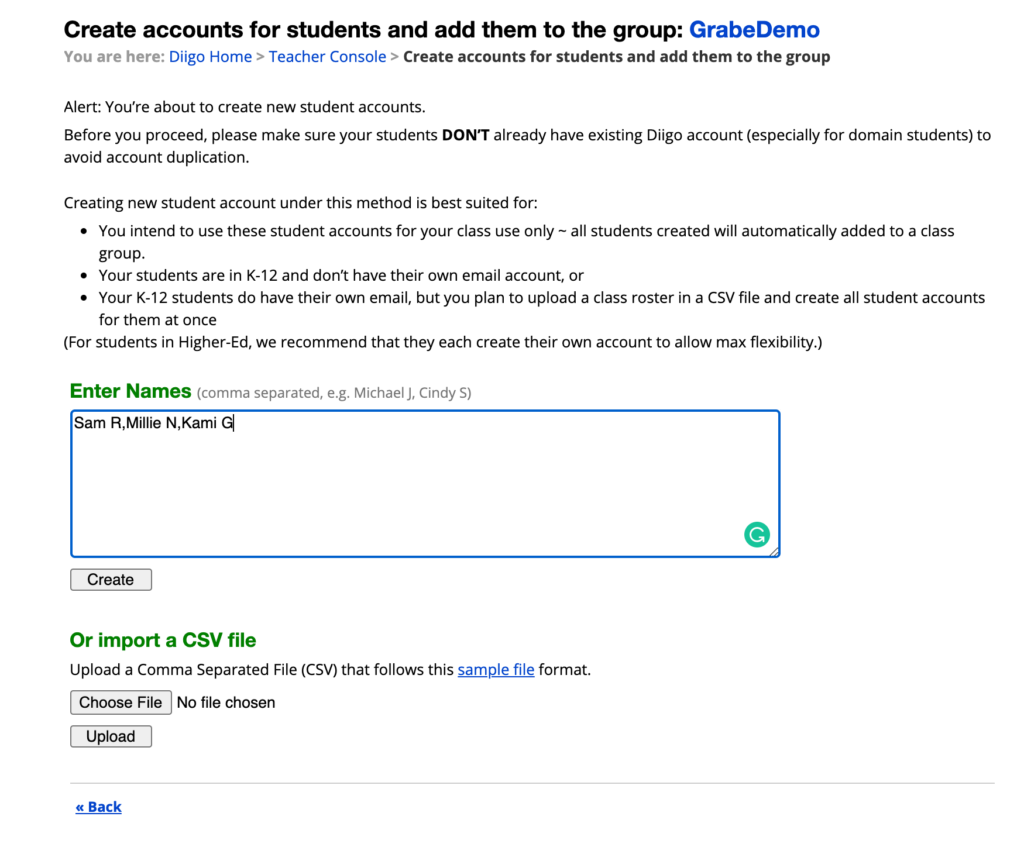
The list names without emails option continues from the page used to list the emails (see red box in the image above). This opens another page allowing the listing of student identifiers (probably not full names).
Diigo will create names and passwords from this list, but you want to modify them before assigning the names and passwords to students.
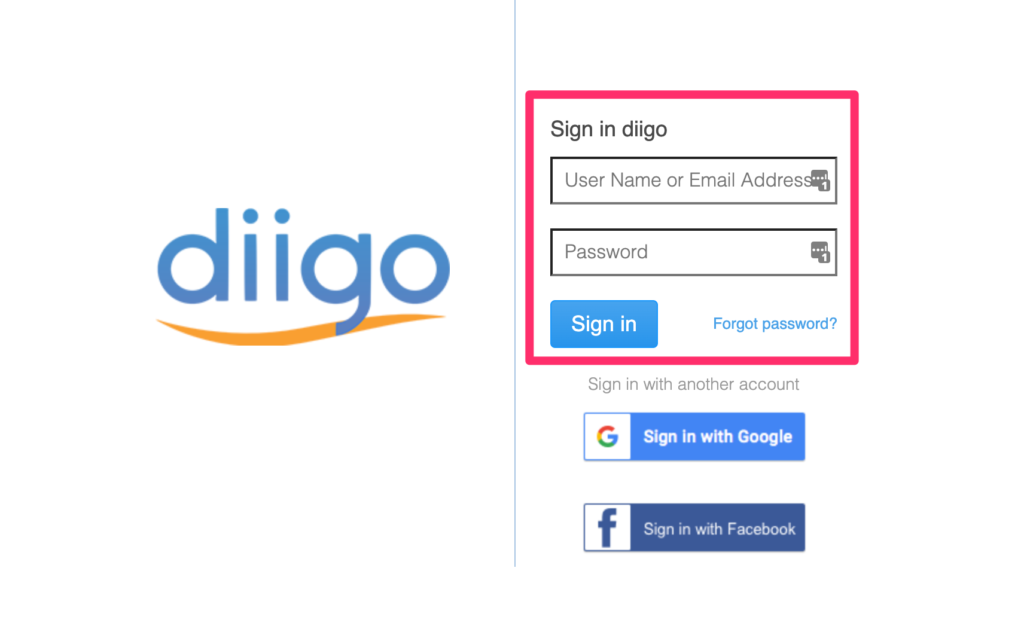
Students then sign in by responding to an invitation (email system) or using the assigned name and password.
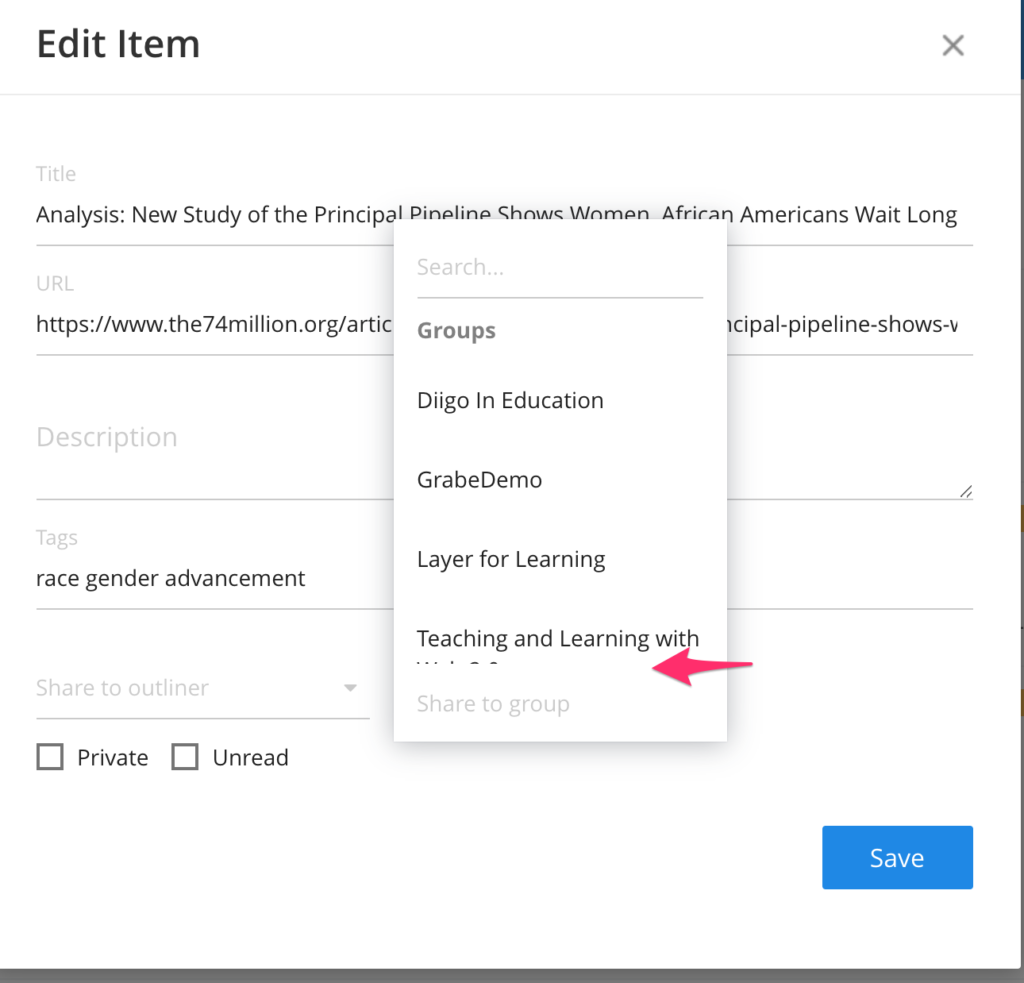
Bookmarks are added to Diigo using a browser extension (see my original post about Diigo at the beginning of this post). Bookmarks can be private or public. Public for students is the way a bookmark is added to a class. Adults with a general account can designate the group to which a bookmark will be added.
Social bookmarking offers many opportunities. At a basic level for the classroom, the teacher might create a list of bookmarks to be reviewed by students. A group of students might also accumulate bookmarks related to an assigned topic. Those responsible for the pro and con positions in a debate might collect resources with information relevant to the position they are defending. etc.
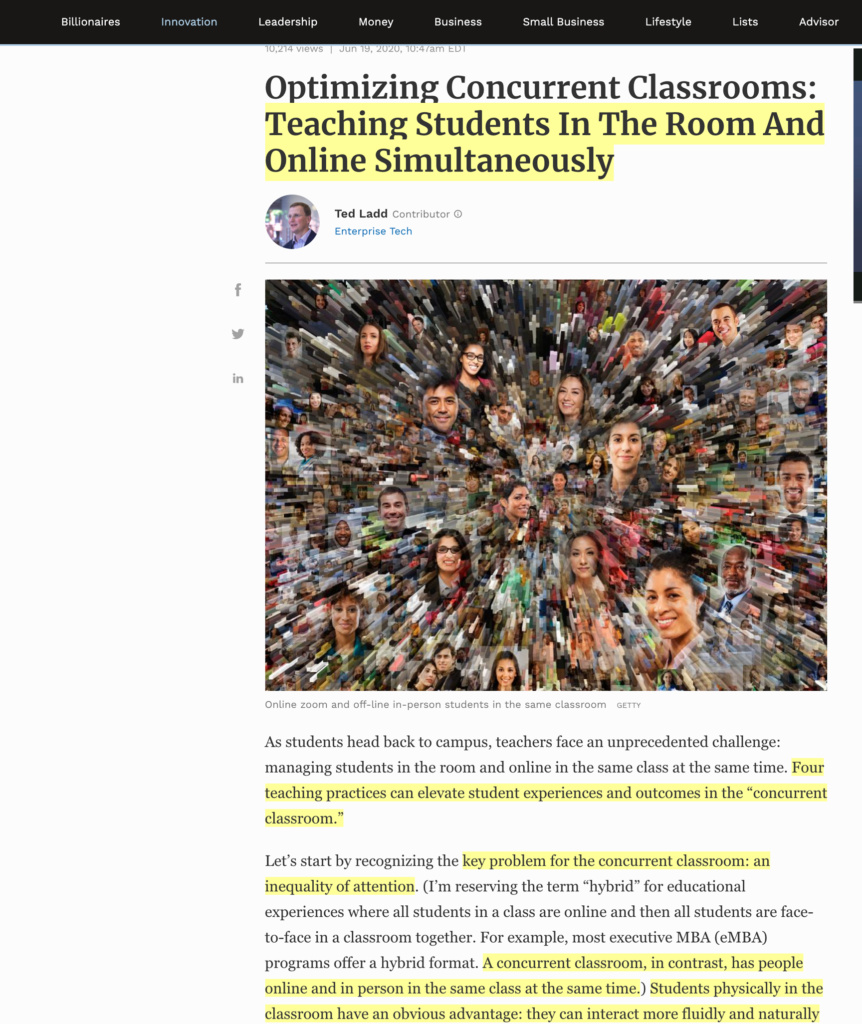
I found this resource from what I think is an unusual source – Forbes. The article identifies the challenges of teaching in a concurrent classroom. As I understand what is meant by concurrent as compared with a hybrid classroom, in a concurrent situation some students are always FTF and some always online. This would be the way I have taught my Instructional Design and Technology grad classes and I admit I never thought about the unique challenges of this arrangement. Concurrent can be contrasted with hybrid which means students rotate between being FTF and online. This arrangement seems what many K12 schools are planning for the Fall in order to reduce the number of students present in the physical classroom. Some issues are likely the same so it is worth reviewing the Forbes article for educators facing a hybrid arrangement in the Fall.
Problems:
The major problem in a concurrent arrangement is described as inequality of attention. This results from the limitations and predictable failures of being online (forgetting to mute, sound dropping out) and educator failures (tendency to focus on students in front of you, drifting out of the view of the camera).
Solutions:
Use a flipped classroom approach for any block of teacher presentation longer than 10 minutes. So students receive information presentation and demonstrations via video. The author then describe what happens with working synchronously as talk less and smile more.
Make frequent use of output-oriented breakout tasks. Students both in the FTF and online work in teams (learn how to do this in your video environment) on short duration tasks with the requirement of reporting a solution of position
Alternate gaze – Remember to focus both on the camera and students in front of you. I know this is an issue from personal experience. The article recommends even finding ways to remind yourself to do this. Calling on students is another way to do this. Call on students both FTF and online.
Asynchronous presentations – have student groups create short presentations on assigned topics/issues. Store links to these presentations in Google docs (note skills that would have to be developed). Assign students to these different presentations and ask that they add questions after reviewing the content.
The article notes that these could also be argued to be reasonable ideas for traditional classroom instruction.
P.S. – I use a social bookmarking system called Diigo. An interesting feature (the social part) is that you can designate entries for access by the public. There is a way to offer access to a specific entry in this collection and that is what I have added below. The free Diigo extension must be installed to see the annotations of another Diigo user.
I have been waiting to generate this post until I felt certain educators would be providing at least some instruction at a distance this Fall. I have decided Fall instruction will not be like the Fall of 2019 and tools for teaching online are worth considering.
I understand that educators have been overwhelmed by suggestions for teaching at a distance. I want to limit what I add to one concept. I call this concept “layering” (explained here) which is my way of suggesting that educators should learn how to take existing online content (web pages and video) and add elements that guide the learner. Informational rich content is not necessarily prepared as learning resources. Adding elements such as questions and annotations to remember something already learned can improve understanding and application. Help the learner process the information to increase understanding and retention.
I am making some assumptions about the tools educators already have mastered. I assume that educators have learned to use a tool for managing learning and reaching students (a course management system of some type – Google classroom, SeeSaw) and video communication tools (Zoom, Google Meet). I would then suggest educators spend time with the type of tool I suggest here. The tools I suggest are versatile so that the investment of time educators and students commit translates into frequent applications. It makes sense to spend time on such tools before exploring other tools that might be used now and then.
There are several different layering tools and you need to learn a different one for video and for web pages. Here are my two suggestions.

You must be logged in to post a comment.