The generation and utilization of educational content has long been a personal interest. We have been lucky enough to have a book available since the mid-90s. We split with our publisher a couple of years ago because we wanted to explore a smaller and less expensive book in combination with more online content. We were able to implement our plan by securing our copyright and updating our material as a Kindle ebook and online content.
We selected Kindle because it was cross platform with the iBook being limited to the iPad at that time. However, the flexibility of the iBook is attractive and iBook Author appears to be a great platform for generating content.
While I really like the iBook author platform, I do not get the Apple ibook plan. It does not seem suited to those of us who write for higher education courses because while you can expect students to have some type of device, you cannot really assume it will be an Apple product (now iPad or a system running Mavericks).
There is also the matter of price to the reader. I did a quick comparison of Kindle and iBook prices for the books I have finished within the last two months and the Kindle version is always a little lower. While I do most of my reading on an iPad, I read none of these books as an iBook.
Making thinking visible – 18.96, 19.99
Invent to learn – 9.99, NA
Reign of error – 11.99, 14.99
Teaching minds – 14.55, NA
One Click – 7.99, 9.99
The everything store – 10.99, 10.99
The mushroom hunters – 11.84, 11.99
The circle – 6.50 6.99
Higher cost and fewer hardware options for experiencing the content seems a bad combination to me.
A book that goes beyond text must be where Apple sees this going. Clearly, the present Kindle books are far more limited as far as this potential goes. However, none of the books I just listed here would have benefited from a more flexible format.
The kind of product that would really take advantage of the iBook format would be very expensive to generate for the college market. Multimedia content requires more sophistication involving multiple experts and typically requires a careful approach to the acquisition of permissions. It was the issue of permissions in combination with our desire to generate a far less expensive book that let to our break with our publisher. Even if an individual could generate a more complex product there are always those issues that require lawyers in a commercial venture. An approach that primarily relies on text is just easier to generate. Professional help such as a good editor can greatly improve the work of any author, but that is about all you need with a Kindle book.
Our plan is to revise our present book this summer for both platforms. If you tell yourself this is about exploring and not about money or time, it is sufficient to enjoy the creative process. The plan is to offer a Kindle plus online content version and an iBook version that incorporates more of the content we presently provide online. We will see how it goes.
It seems to me that there are a whole bunch of Twitter-based edchats being launched. I don’t get it. My attitude will likely be attributed to various things including being out of date, stuck in the past, inflexible, etc., but I think I have reasonable objections. I do not see Twitter suited to carrying on group conversations.
While I certainly applaud the commitment and the intent, I have two objections. I do not see the real-time, group-based communications value in Twitter and I think the chats introduce unproductive clutter into the Twitter stream for nonparticipants. Given the available options, the interest in Twitter chats seems more a focus on the tool or the trend rather than on the goal of effective communication.
Unproductive communication
As evidence for the suitability of Twitter to group discussion, I would encourage any interested party to examine the transcript from such a discussion. Do you really think the accumulated comments indicate deep thinking or even a reasonable volume of ideas for the collective time invested?
Typically, a Twitter discussion is controlled by one of the participants who posts some predetermined questions intended to generate comments and who makes decisions when to move on from one question to the next. Even with the short responses that are allowed, participants seem to be at different levels when it comes to keyboarding skills and existing thinking regarding the questions. What you get as a consequence is a hodgepodge of replies – some to the question, some in reaction to comments made by other participants, some to a previous question, and some for socializing. Responses are often abbreviated to allow quicker reply and to meet the limited space Twitter allows. It also seems to me that the limits on expression generate overuse of platitudes rather than original personal thoughts. What these platitudes are will vary depending on the makeup of the group, but the comments are predictable “in” things to say and add little beyond restating group values.
For some reason, many of the issues here remind me of the research on wait time in classroom discussions. We know that moderating a classroom discussion is more complicated than most might guess and productive discussions require more than posing a series of questions. Participants need time to think (the wait time issue refers to the common counter intuitive problem of not actually providing sufficient time to think and respond). Participants need to be encouraged to evaluate the responses generated by other participants. Some participants need to be encouraged. While wait time is not a pedagogical skill as such, the lack of wait time (perhaps think time would be more meaningful) changes the nature of the discussion process. Pretty much only “low level” thinking is possible when time is not allowed. My point is that it is important to consider how basic variables may shape the goals that can be achieved.
Annoying presence
Clearly, Twitter encourages a lot of inane comments. Remember the original question – what are you doing? Everyone seems enabled to seek their 140 characters of fame. This is not really a problem for me – the tool was designed assuming such goals.
Within the general Twitter environment why would I claim any given activity is particularly annoying? I have the same reaction to viewing part of a conversation on Twitter that I have to being forced to listen to one side of a cell phone conversation. I think we all have developed some level of tolerance, but beyond some point the partial conversation becomes annoying. We may expect the person on the cell phone to step out of the coffee shop if the conversation is going to be continued for some time. Likewise, we may expect Twitter users to move to some other means of conversation if many back and forth comments are essential.
Alternatives
It is not really fair to be critical unless you can also offer alternatives. I am of the opinion that Twitter is fatally flawed for the purpose of meaningful discussion. I do not see this tool as being designed for this purpose.
I do feel other tools make more sense.
The traditional discussion board makes would seem to be more productive if the approach is to consider several guiding questions. With this tool, there is no time limit allowing for individual differences in speed of response. The reply and reply to reply features allows a way to organize the output in a way that encourages review and extended interaction – connections among ideas are far more obvious.
For real time conversation, I am a fan of Google+ hangouts. With speech rather than text input, we can express ourselves more easily and we can rely on our experience in conversing to connect our comments. Text comments can be integrated/added if necessary. The use of “circles” allows participants to isolate themselves in a way that does not spam nonparticipants.
If I am correct about the utility of Twitter for chats, this fad will pass and we will move on to other tools.
I have posted a couple of pictures from one of my trail cams before, but I have some new images that are more unusual. A trail cam is a camera that is triggered by motion. Hunters often use these cameras to scout areas for game, but there would seem to be many possible applications including just surveying local wildlife.
Two images I just downloaded follow. The first image shows two grey fox and the second a lynx. This camera set was about 1/4 mile from our lake home in Wisconsin.
Google shut down iGoogle on Nov. 1. This was not a surprise since they told us months ago and for the past month or so those of us who used iGoogle were reminded by a message each time we open the page. Even so with the date of doom finally here, there were many suggestions for alternatives. In September, I recommended Symbaloo as a replacement and this seemed to be the most common recommendation. With several months of experience with Symbaloo and a second look at the alternatives, I think I have a new strategy.
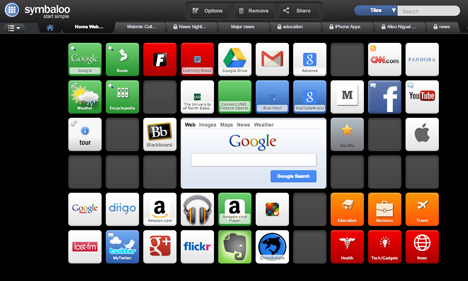
Symbaloo is great way to launch online services. An array of buttons, usually with the icons representing the services, appear as your home page. You can even create multiple pages and share individual pages much like you might create a Pinterest page.
What I missed from iGoogle was information. iGoogle allowed gadgets that embedded other web information services within the page – little feeds representing your email, stock quotes, your calendar, etc. It was combination of links to services and these information feeds that made iGoogle useful. There was a lot there in a small space.
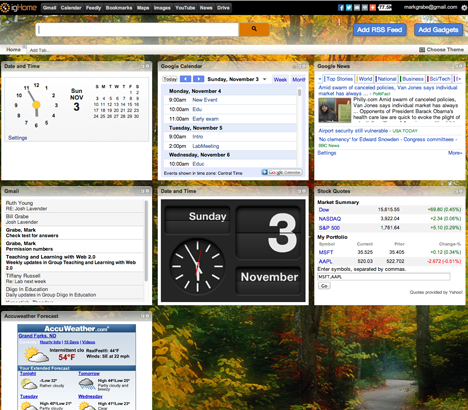
igHome is one of the start pages alternatives I considered, but orginally rejected. It offers the opportunity to create a page using gadgets and most of the information feeds available in iGoogle.
Here is a new strategy I think offers an improvement over any given service. My new strategy takes advantage of the capability of Chrome to specify multiple start pages – each in a separate tab. I now launch both Symbaloo and igHome at the same time and easily switch back and forth. The order in which the pages are listed determines which page appears “on top”.
To create this system, you will need to open “Settings”. Locate the section of the settings that concern startup options.
The set pages options allow multiple pages to be designated.
It is interesting if you are interested – not everyone is.
This is a book report focused on the Martinez and Stager book “Invent to Learn”. My reaction to the book, while quite positive, is captured in my title. I think the book seriously over reaches and makes flawed assumptions regarding what proportion of students would be intrigued by the topics that are the focus of the book. Some students will be very interested. I would have been very interested as a student and am personally an active maker now. At best, I see the topics covered in the book as options among a wider selection of opportunities that might be made available to students.
My wife likes to describe this broader perspective as the 20% plan. This phrase refers to the motivating opportunity Google once offered employees to work on a project of personal interest as part of their commitment to the company. Of course, it was unclear what the 20% represented in real time – 20% of 60 hours still leaves more dedicated and inflexible time than the work week most assume. Google has also backed away from this ideal to focus on a smaller and carefully selected group of projects. I will leave it to you to evaluate the implementation of a similar model in education and to consider whether my observations about Google may also end up applying in educational settings (20% is misleading because it is likely additional rather than reallocated time and Google finally took a look at the bottom line or maybe brought a greater focus to the core business and backed away from encouraging such activity).
Makers do things for themselves. The immerse themselves in projects that to some extent are self defined and self directed. The collection of areas used as examples in Invent to Learn include programming, electronics, robotics, and fabrication. Most examples are technology-based, but a limited amount of attention considers more “old school” construction resources – cardboard, string, springs, and other stuff. If the maker movement interests you, the book does a great job of identifying information sources and physical resources for getting started.
Some reactions and/or related thoughts:
1) The research section of the book was one-sided and weak. I had some experiences working with LOGO and middle school students. I wrote about “programming to learn” and I carefully reviewed the fairly substantial research on the potential benefits of involving younger students in programming. At the time, the move was away from “computers for computers sake” (i.e., programming) and more toward whether programming experiences would develop general cognitive skills (e.g., problem solving). Some of the meta-analyses of these individual studies appear in the most prestigious educational research journals and seem to question the value of programming at the level of commitment that was being made by most middle schools. I have read all of the books mentioned in Invent to Learn written by Papert so I am aware of the arguments that seem so appealing to the authors. Perhaps the focus here is truly on learning to program because programming can be vocational skill. I would accept this position, but then I would return to the question of how many students would be interested (see my title). In my opinion, serious scholarship requires the identification of the existing literature – pro and con. Hence, I see this as a useful “methods” book for what might be an elective area and not a well research justification for a general change in the curriculum.
2) Why these topics? Is it because the areas emphasized are in some way more relevant than other areas of study (technology and new manufacturing methods)? What about options?
I have a long term interest in school-based, field biology projects. I spent some years associated with a program funded by the state Game and Fish Department that focused on the cultivation and study of habitats (OWLS – outdoor wildlife learning sites). The core idea was to develop small areas of land near schools as habitats – most were small patches of native prairie. Some were simply plots including butterfly gardens, bird houses and feeders, etc. and some in more rural settings might be several acres in size that bordered a pond or stream. Such ventures were developed to incorporate local history (state history is required), biology/ecology, communication, data collection and analysis. I was involved as the technology person – probe use, digital photography, web sites developed for communication among program participants and presentation to the general public. This type of project bears some similarity to schools that sponsor a school garden and use this resource to explore biology, nutrition, and exercise.
These experiences taught me some interesting things about changing the curriculum and project based learning. I learned that teacher passions vary and commitments change with personnel. The projects I mention are challenging because they require an investment of time over time and a critical part of the time involved with projects that make use of plants is that these projects do not mesh well with the school calendar. You cannot ignore the plants over the summer as you might equipment stored in the back room. There was typically money for the materials but not for the personnel. If there was not a teacher committed to maintain the garden over the summer, the plot turned to weeds, the administrators were embarrassed by the appearance of the school yard, and the plot was returned to grass because it was far easier to maintain.
I think I can describe hands-on experiences growing things in a way that argues for educational value. A wide variety of experiences have educational benefits. I liked the argument that technology exists all around us and is not limited to the stereotypical notion that technology involves programmers putting in hour after hour in a room relating to a computer. I like the counter-intuitive argument that technology can take us out of the classroom into the world and allow us the means to investigate that world. Students receive far to few of these experiences.
Again, I return to the question of whether the book argues for a specific addition to what schools already do or whether the commitments reviewed are a proxy for the notion of “deep electives” and choice. Can making apply to gardening in the same way it applies to fabrication?
3) It is inaccurate to represent schools as having no opportunities for passion-based learning. I would suggest that athletics and arts (music, theater, etc.) are obvious examples. Such activities are school sponsored extra-curricular activities often involving part of the school day (a scheduled open period). Sports and arts have advocates claiming learning outcomes that warrant the time and resources allocated. Each area also has critics questioning the time allocated to what might be seen as a distraction from a core mission.
Other “clubs” do exist with differing levels of participation from location to location. Is this book about an area of emphasis that is to receive the level of attention focused on athletics or the arts, but with the focus that is more typical of a club?
4) Do students really want to be independent, self-guided, deep learners? The answer from the book would seem to be – “yes, they just are never really given the chance.” I wonder. Existing clubs focused on the topics described in the book do sometimes exist and have a loyal, but small clientele. Anecdotal reasoning is a serious problem in thinking about educational practice. Assuming that the passion of a specific student you may know explains what would interest most students is dangerous. My experience with similar issues comes from higher ed. The university experience actually offers students a great deal of flexibility in selecting courses as long as general requirements are met. Beyond this general flexibility in the selection of courses, the department in which I work offers specific individualized opportunities – readings and special projects – that would allow a student to identify a topic, develop a learning plan, and with faculty supervision generate a product. I can tell you based on my experience as a department administrator that these opportunities are very seldom utilized. I wonder why? Is it possible that these opportunities just come too late and students have long since given in to the notion that education is something done to them and not something they, with assistance, do for themselves,
“A book is never done” is the title of a recent Slate article by Dan Gilmor describing the potential in books that can be constantly updated by authors. Of course, Gilmor is describing the potential in ebooks, and while constant modification is possible, his frustration with the cumbersome tools for creating these updates.
The Gilmor piece reminded of a similar frustration I experienced years ago when I attempted to explain a similar concept to the “business types” of my then publisher. My wife and I had authored several educational technology textbooks and after several editions we thought we be might be trusted to take a somewhat different approach. We proposed that we had proven ourselves and educational technology represented an area in which experimentation was kind of expected. Does it really make sense that the approach taken to convince future teachers to make use of technology in their classrooms should rely exclusively on a traditional textbook? It would seem you were not really committed to your core message. The model for textbook publishing was and probably still is a last minute rush to get out the next edition. If you work as a college prof for a living, you really cannot, in good conscience, drop everything at certain times of the year to work on an update to meet the publisher’s timetable. You have time in small amounts and more time in the summer when you are not on contract.
I thought my proposal would result in a better product. My idea at the time was to put in some amount of effort on a continuing basis at some low level of payment to be applied against future royalties. This approach would allow a more thorough and careful development process potentially resulting in a higher quality next edition. In addition, the new content could be posted to the web immediately offering updated material to those using what was already a dated, hard-copy product. It all made sense to me, but evidently not to those locked into a more traditional approach. I was willing to take the risk of investing the time for a limited guarantee, but the company was not willing to take the corresponding risk as an experiment. Perhaps they were concerned that other authors would expect the same treatment.
Interesting how things change. I now publish through Amazon and am free to experiment to whatever extent I like. I miss the editorial review and the sales force supplied by the company book reps, but I find the freedom stimulating. Our previous company has recently declared bankruptcy and is trying to find a way to regain a firm financial base. The lawyers have sent us letters and forms indicating we can request to be considered for payment for the amount owed from recent sales. It is a very small amount so I did not bother. Perhaps the buyers could be given my portion of the sales price. Anyone willing to buy an educational technology textbook that has not been updated in six years deserves a break.
Technology in education is often associated with several stereotypes. One of specific interest to me is the assumption that technology ties a learner to a computer in a classroom in a way that reduces social interaction and physical exploration of the world. I believe I can make the case for exactly the opposite position. K-12 learners actually have few opportunities under existing circumstances to explore their world and technology can bring learners into connection with people and settings outside of the classroom. I am particularly interested in recording data and this translates into opportunities involving audio, images, and the forms of information that can be captured with probes. Think of this as capturing experiences that may always have been there, but that were not previously processed very effectively.
Part of my model for processing experiences involves the significance of context (I understand this is getting a little abstract). One aspect of context in our daily lives is location. Objects and experiences exist in physical space and where things are located can have important implications. Do you know that supermarkets are less likely to be located in areas of economic poverty? Who cares? You might if you had to walk some distance to get fresh vegetables which are seldom available from convenience stores. The broad application of GIS/GPS across disciplines allows investigations of the role of location.
In this post I am particularly interested in associating images with locations. Perhaps these images result from photographs taken of full service supermarkets in your community. I have written previously about the unique capacity of phones to capture GPS info, described how to upload images to Flickr in a way that would assure the GPS data were included, and offered examples (images in Google Earth). I feel like I am reversing course here – instead of explaining that you can do interesting things with a phone in place of a camera, I want to explain how you can now geotag camera images.
Unless you have purchased a special camera, your images are not geotagged. This is the case even with expensive cameras. Ironic isn’t it, my Canon 7D does not know where a photo I take comes from, but my phone does. Anyway, most of us have cameras and use them. Whatever the convenience of a cell phone as a camera, dedicated equipment has special advantages. I am never going to get the closeup of an eagle in flight with my phone.
A reasonable way to tag camera images makes use of a phone and an app (Geotag Photos). The concept is simple. Cameras time stamp images, but do not have gps capabilities (using satellite or cell tower data). Phones have gps capabilities and an app can time stamp these data. A second app can match the gps data and photo by time and rewrite the exif metadata of the photo to include these location coordinates. This is the way the Geotag Photo works. You put an app on your phone and you download software to your computer. The phone app records the GPS data and the computer app uses these data to modify the exif of the image files offloading from the camera.
The phone app is displayed here with a second image representing the route taken while collecting the images.
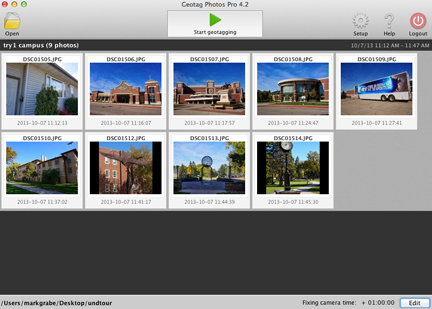
Here is the computer software that merges the data from the phone with the individual images.
The final product might be generated using the map feature in iPhoto (the pins here represent the location of the images). Clicking a pin reveals the image.








You must be logged in to post a comment.