Think like a practitioner – the generalization of an idea


I would suggest that educators have become familiar with an example of the concept of thinking like a practitioner but may be missing the bigger picture. The example presently in vogue is coding (programming) as in proposing that computational thinking represents a generalizable set of thinking skills (procedural skills) applied by programmers and possibly developed through learning to program at an age/experience appropriate level.

Before schools dive in head first, it might be prudent to explore comparable areas of practice that could develop important knowledge and thinking skills (I like to use the term procedural skills). What would be the most productive and efficient uses of this concept in classroom settings? If time and resources are limited, what types of practice (as in the activity of a category of practitioner) should be prioritized?

Do we have other practitioner experiences in classrooms? I have been thinking about this question for some time. In my thinking, I have found it useful to differentiate knowledge from skills. What is it a programmer knows? What is it a programmer has to do to program? Substitute a different practitioner for programmer and consider the knowledge and skill distinction I have identified. Do students exploring these other areas of practice develop important knowledge and procedural skills?

I started thinking about this when exposed to the training of a group of practitioners I knew little about – historians. I was not a fan of the study of history even though I had experienced high school. At a later point in life, I learned a little about the training of historians and became familiar with what I as a trained research psychologist would call a “methods” course. Future historians took a course I recall being called “The historians’ craft”. Essentially this course developed the skills and expectations by which the historian turns sources or data (photographs, diaries, interviews, etc.) into explanations of historical phenomena. How do you maintain objectivity? How is it you identify trends in causation that can be differentiated from the perspectives of the individuals offering the artifacts that are being examined? Is it possible there are multiple accounts of history that are legitimate? What historians do is more than learn about what other historians have concluded. What others have written might be described as background knowledge. What historians do is acquire background knowledge and combine this through rigorous thinking with careful data acquisition procedures to create more advanced and accurate accounts of the past? I spent my career as an educational researcher (psychologist) and I additional was trained at the undergraduate level as a biologist. I started to appreciate that all of these areas of practice involved considerable overlap when it came to the knowledge base that must be acquired and the practitioner-specific data collection and analysis skills that must be applied.

My point – I think most professions at a core level involve knowledge and skill development. When it comes to generalizability, is computational thinking superior to historical thinking? Since we expect students to take several history courses already, perhaps by including opportunities to “do history” we might develop some very important critical thinking skills. How do you avoid bias in personal thinking? How do you come to a conclusion that reflects multiple perspectives? We could certainly use citizens with skills such as these? How do these skills stack up against skills such as breaking a problem down into subcomponents and algorithmic thinking (claims for the type of thinking developed via programming).

I think the “think like a practitioner” approach works well for some practitioners you might not consider. How about think like an author? Yes, everyone is “taught” to write, but actually writing to communicate is different. Consider that writing to inform often requires that you learn about a topic. For example, I am not making up what I am writing here up. I have learned about topics such as “authentic tasks” and the training of historians in order to communicate through the procedural skills of writing. Writing to communicate also involves higher order thinking skills of multiple types. Like programming, it requires identification and organization of the parts of a whole. It involves the exercise of critical thinking. Given the multiple and often conflicting positions on an issue, what position can I best take and defend.

There is an instructional argument for the value of “writing to learn” that is consistent with both the development of writing, thinking, and cross-curricular content knowledge skills. What ever happened to students spending time writing to learn? Not an “in” approach at the moment, but it will probably resurface when coding to learn fades.

How about teaching? Teachers are certainly a category of practitioners. Teachers must develop both content knowledge and pedagogical knowledge (procedural skills). Some of these procedural skills involve explaining and developing a different type of understanding than is required by just a primitive level of knowing. Teaching to learn is not really that difficult to imagine than writing to learn and offers many of the same benefits. Both have general utility across content areas at a level of frequency of possible use I just don’t see for programming.

This post is getting long, but I hope you can see where I am going with this. What would a scalable level of functioning like a biologist look like? Students do labs, but how closely does a carefully orchestrated lab experience compare to what a biologist actually does? What would “authentic” research look like for any area of practice that can be associated with a course-specific content area?

Etc.

Etc.

I think it possible we have become fixated on programming because it is a new content area for K12, seems directly associated with a profession that is seen as lucrative, and seems to offer unique potential. I don’t see programming as offering unique potential or necessarily developing cognitive skills that are unique. In my opinion, what programming does offer is a ready-made scalable practitioner experience and this is attractive. Kids can code in Scratch, Kids can code simple robots. Students can take complete programming courses at the secondary level. If these opportunities get educators and administrators excited, I wish they would widen their vision a bit, appreciate the similarities of logic I have identified, and recognize the practitioner opportunities that could be associated with many existing courses/content areas.

Note: If this perspective is of interest, some of my original thinking was seeded by the following article.

Brown, J., Collins, A., & Duguid, P. (1989). Situated cognition and the culture of learning. Educational Researcher, 18, 32–42.

Loading

My issues with Brave

I want to be clear about the content that follows. I am a big fan of the Brave browser and what I have taken to calling the Brave ecosystem. If you are unfamiliar with this browser, you might read some of my earlier posts. I believe the Brave ecosystem has the potential to address several of the interrelated issues dealing with the funding of online services and content and personal freedoms. Potential is the key word here and the comments that follow most concern what it will take for this potential to be realized. These comments assume you have some familiarity with what Brave browsers as an alternative to ads and ad blocking.

I find Brave a very interesting Internet company. I have used the Brave browser for some time and I provide funds within the Brave ecosystem to compensate content and service providers when the Brave browser blocks ads. My concerns mostly concern how Brave has allocated time and resources to develop different aspects of its online ecosystem. The priorities are not consistent with what I find to be the most important of the features Brave promotes. Picking among these features will defeat what I think is the potential of Brave.

My present concerns are listed below. I see many of these concerns as interrelated, but I list them individually for greater clarity.

  1. The functioning of the Brave ecosystem (browser and related services) is not well documented either in terms of how things work or by providing descriptive data regarding user activities. I struggle to understand exactly how things work. I understand that some of this information is only shared with investors, but I regard my time and money as an investment and I am frustrated as an early adopter not to be able to learn more. For example, what proportion of Brave users have contributed funds to compensate content providers who have had their ads blocked?
  2. I am unclear on why the underlying exchange of funds within the Brave ecosystem relies on a cryptocurrency. Getting most users to put money into BAT (the cryptocurrency) is not what I would describe as a simple process and this complexity will limit investment that would be used to reward content creators. Is this a reasonable expectation of casual tech users?
  3. Things with the Browser and Browser functions just break and the user experience often requires that users share their concerns through a “community” rather than by directly requesting assistance from the company. Problems I have had are mentioned by the community, but these problems were not resolved and I had to use the developer version for a period of time simply to make certain the funds I had allocated to content creators were actually dispersed. The system claimed funds were not available even when my wallet contained more than $100. I assume this is an allocation of development resources issue, but a buggy experience is not going to attract users.
  4. There is a lack of user integration across devices – some features of Brave (bookmarks) synch, but the most important and unique features do not. What it comes to earning and spending BAT, your identity is associated with one device and this device presently must be a computer (laptop or desktop). Your wallet is associated with this single device and the record of the sites you visit only matters from this device. This means the payment of BAT you have allocated to offset blocked ads and the rewards you receive for viewing Brave ads only happen from a single device. Is the computer really the device most of us spend most of our time using? Even if it is, what proportion of total time spent is expended on this single device? Note that even the use of multiple desktops or a desktop and a laptop involve distribution of viewing time.

Taken together, these issues limit the likelihood Brave will be more than just another option for blocking ads and Brave is not doing enough to take steps to work against this narrow focus. Using the Browser to block ads takes little effort and most will likely stop with this feature. Brave also ignores ways it could interconnect features to offer greater balance in how it supports both consumers and creators. It appears willing to compensate consumers for viewing Brave controlled ads without requiring some part of this compensation being used to reward content creators. My interest in Brave is less about blocking ads and protecting my privacy than it is about addressing the reasons ads exist in the first place. I can block ads and protect my privacy in multiple ways. What makes Brave interesting is the “potential” to assure content creators are compensated while protecting content consumer privacy. It is this combination that is essential for the long-term growth of the Internet.


Loading

Elections have consequences

I am guessing that most educators don’t spend a lot of time scanning the latest educational research. Retired or not, this is what I do. Because educators have reported anecdotes related to this issue, I thought they might be interested in this study.

I would suggest that the election of 2016 had a unique and problematic character. I usually vote for Democrats, but it is not the outcome per se that bothered me. I was troubled by the character and style of the Republican presidential candidate.

In the aftermath of the election, anecdotes surfaced of children using some of the language and behaviors of the Republican Presidential candidate. We all like to share examples to support our perspectives, but anecdotal evidence is regarded as weak because one can find a case for pretty much any argument you want to make.

When I taught advanced students, I often encountered some who did not share my interest in reading the actual research studies. I used to encourage them to consider the creative methods researchers came up with to investigate important topics. How do you go about getting the kind of data you need to answer questions that on the surface are deceptively simple? How do you rule out what others might raise as alternate explanations?

Huang and Cornell (2019) developed this approach. The state of Virginia contains counties reliably voting Democrat or Republican. The difference in the Republican vote varies from 11% to 82% by county. School districts in Virginia tend to be either county or big city districts. Virginia administers a statewide school climate survey in alternate years and has data available from 2013, 2015, and 2017. Several items from the survey deal with teasing and bullying – e.g., Bullying is a problem in this school. Students in this school are teased or put down because of their race or ethnicity. These are what I consider the key characteristics of the study. Of course, the journal article provides much more detail.

The Huang and Cornell research focused on middle school students. The study compared that data on bullying across schools in Republican and Democratic districts in the three target years. The study found significant differences in bullying only in 2017. The researchers tested whether the difference remained after controlling for other variables population density, % of students requiring subsidized lunches, level of education of parents, % of white voters. The study used sophisticated statistical procedures (e.g., path analysis) to test complex models involving multiple variables and test alternative explanations. The researchers concluded that the party prevalence had a unique influence in 2017. There was uniquely more bullying reported in Republican districts in 2017.

Politicians, depending on the election, have recently used to phrase “elections matter” to justify actions they were taking. It appears that some elections do and I am guessing increasing the frequency of bullying is not what the Republican politicians’ use of the phrase is intended to justify.

Huang, F. L., & Cornell, D. G. (2019). School teasing and bullying after the presidential election. Educational Researcher, 48(2), 69-83.

Loading

Escape the trap of the network effect

The definition of network effect argues that the value of a networked service increases as nodes/people are added. Translated – you won’t be happy online unless you are where everyone else is.

Despite what is becoming obvious about “free” internet services, people do not leave. They complain. The threaten. But, they do not leave. They stay despite the known damage to their personal privacy because others also stay.

In general, I just don’t like monopolistic online companies. I can blunt their collection of my private information, but I just as a matter of policy want to see competition in important areas of the economy. I try to diversify my online activity. This reduces the access any given company has to a record of my behavior, but also encourages the development of other companies. Here are some options I use for social media services you may not know exist.

My alternative to Twitter is Mastodon. I have fewer complaints targeted at Twitter than the other two services mentioned here. I am also the most lukewarm in promoting Mastodon. My reluctance has nothing to do with the technology. I just don’t find the substance I am looking for in the audience this service has attracted. Too many cat photos, anime, and meaningless posts. There are also some instances that promote sex work. An instance is like a separate group operating from a separate server. Instances are combined into a federation and it is possible to view the public contributions to all instances. Mastodon is a federated system of instances and I guess would prefer participants find a home with an instance suited to their interests, but this does not seem to have happened.

My alternative to Facebook is Diaspora. I limit my Facebook activity to my political comments and I post other categories on Diaspora. Diaspora works well allowing public, aspect specific (the instances you participate in), and self-assigned categories of posts (family, friends, etc.). I admit that I have not worked hard enough at this service to become part of a group, but the potential is there.

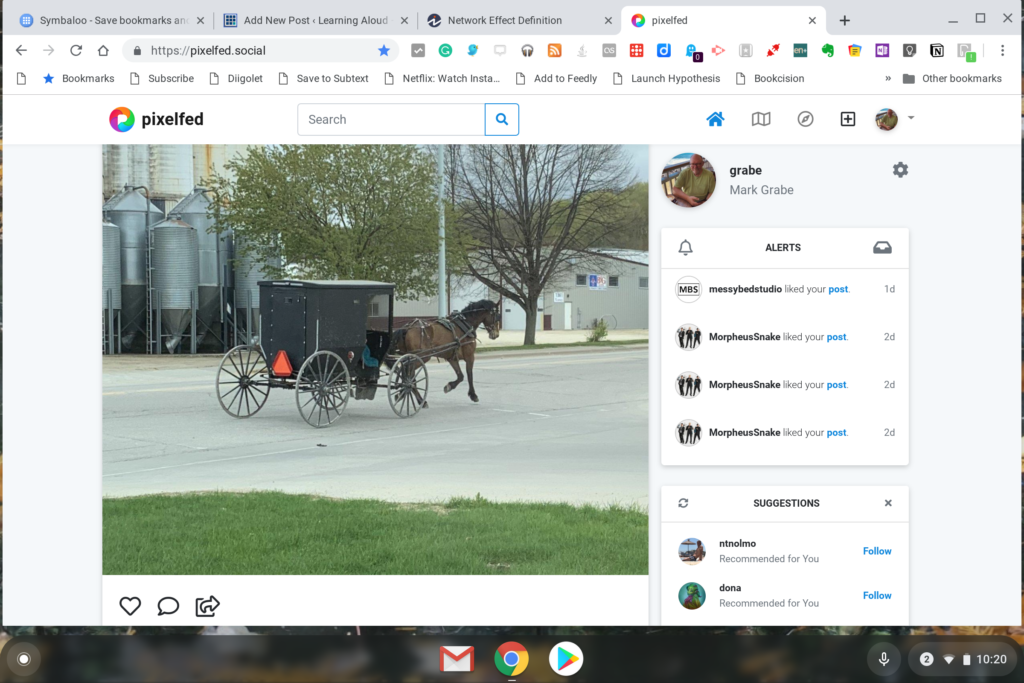
My alternative to Instagram is pixelfed. I tend to think of Instagram is a service you use to share photos with a relatively small group of friends. If you can convince this small group to sign up for pixelfed, you will find the service very easy to use. Again, you either use this service to share with friends who will follow you there or you use this service to meet people based on a common interest in photography. Of the alternatives I have proposed, pixelfed probably represents the easiest transition.

Loading

Adolescent Screen Time

I have been working for a couple of weeks on a lengthy analysis of adolescent screentime, adolescent health issues, and surveillance capitalism. This effort is intended as an addition to our textbook project. My writing focuses on the educational use of technology. Like the topic of cyberbullying, the screentime debate is focused on out of school technology use, but educators may offer opportunities to address these issues. The following is a small segment from the section of this project dealing with research on screentime.

The general public receives alarming messages regarding adolescent use of devices (e.g., Twenge, 2017) and certainly, there is reason for concern. However, simplistically rejecting technology use is not a reasonable response. What we all experience with technology is a combination of good and bad. Realistically, the online world is not going to disappear and will attract young users no matter what adults might believe or desire.

Given the mixed consequences of technology use, it makes the sense to take a deeper look at the relationship between time online and consequences. Przybylski and Weinstein (2017) provide an interesting perspective. These researchers have generated a research project intended to contrast two hypotheses – the displacement hypothesis which proposes that the time spent with media replaces other productive activities – exercise, face to face interaction with friends, etc. and the Goldilocks hypothesis which proposes that the use of technology can lead to advantages at some level of use due to access to information and access to peers. As is the case in the story of Goldilocks and her visit to the home of the three bears, some moderate level is the most pleasing and productive.

Using a sample of more than 100,000, 15 year-olds, the researchers related a measure of technology use to mental well being. Their approach sought to determine whether the measures were related and what was the nature of the relationship. The displacement hypothesis should predict a linear relationship – well being should gradually decline with increasing use of technology. The Goldilocks hypothesis would predict a more complex relationship with some level of use being associated with positive (not neutral) consequences and high levels of use associated should be associated with negative consequences.

It was the Goldilocks hypothesis that best fit the data. The data offered something more. The data allowed the calculation of what were described as inflection points – at what point did the relationship shift from positive or neutral to negative? This could be a way to quantify what could be suggestions for guidelines. The research found this shift at 1 hour 40 minutes for weekday video-game use and 1 hour 57 min for cell phone use. Watching videos and using a computer were shown to be less disruptive as the inflection points more than 3-4 hours. The authors speculated the differences were related to how difficult it was to switch away from a given category of technology activity and then back. In other words, the time spent using a computer and watching videos allows the user to break away and is not a complete escape from other activities.

There would likely be multiple factors found to be involved in the dangers of “screen time”, but research similar to that of Przbylski and Weinstein (2017) represents what will likely become a useful approach in developing guidelines.

Przybylski, A. K., & Weinstein, N. (2017). A large-scale test of the Goldilocks Hypothesis: Quantifying the relations between digital-screen use and the mental well-being of adolescents. Psychological Science, 28(2), 204-215.

Twenge, J. M. (2017). IGen: Why Today’s Super-Connected Kids Are Growing Up Less Rebellious, More Tolerant, Less Happy–and Completely Unprepared for Adulthood–and What That Means for the Rest of Us. Simon and Schuster.

Loading

Exploring solar power

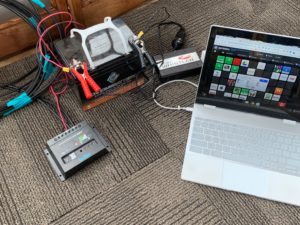
A few years ago I purchased some basic equipment that would allow me to investigate solar energy. I bought a solar panel, a charge controller, a battery, and an inverter for changing the DC stored in a battery to the AC required for many devices. Finding a system of this type on Amazon was easy. It is my impression that such systems are commonly sold to individuals wanting to add a power source to campers for situations in which campers want a setup that allows them to set up a trailor without hookups. Folks must find all kinds of ways to use a source for electricity that most of us do not consider.

My plan was to set this system up at our lake place and just explore what I could do with the “free” electricity I could generate. I got the system to work, but did not really do much with it because I could not find a good location to permanently position the panel. The trees and my own hesitancy to mount the panel on our two-story tall roof limited by progress. I put the equipment out of sight and pretty much forgot about my project.

I did not lose interest in solar energy. We got as far as having an installer come to our home. He took a look at our energy bill and the usable space on our roof. He estimated they could place 7 panels on our roof, but because our consumption of electricity was low it would not be a financial advantage. We heat and cook with gas and we spend a lot of time in other places so we don’t buy much electricity. We decided to go ahead anyway as a matter of principle, but he then said we should first replace our shingles because once you pay for the installation of the panels you don’t want to pay to have them removed and then reinstalled when you upgrade to new shingles. We decided to put off the solar panels for a few years.

A week or so ago, I came up with a way to try my project again. We have a gazebo outside our home. We don’t use it a lot, but it offers some interesting opportunities. I decided I could just lay the solar panel on the small back deck of the gazebo, run the cables through the opening between the French doors into the gazebo, and position the other equipment inside. No climbing on a roof and no drilling holes through walls. No new costs. This arrangement would not be permanent, but it would do for a couple of months or so.

I wish I had some way to measure the amount of electricity I generated. Your house obviously as a meter that quantifies your consumption. There must be some way to do this on a smaller scale, but there is a limit to how much stuff I want to purchase at this point. I decided my goal would be to see if I could keep my devices charged using “free” solar energy. This is what researchers in my profession might call a “proof of concept project”.

I searched online to see if could find a way to estimate just how much my devices might use. I found a source estimating the amount of electricity and the related cost of keeping an iPhone, iPad, and laptop going. I looked up the cost to me for electricity and recalculated what my cost would be using the approach outlined in this source. According to my calculations, I pay about $4.33 a year to keep my laptop charged. Clearly with my battery, panel, and other equipment, I am not committed to a money making deal here. Just to keep a battery capable of storing electricity going over multiple years, I would be spending far more on equipment than I make on the electricity I use.

Still, I think this has been and will continue to be a useful exercise. I cannot help imagine how a classroom teacher or school might duplicate this project and use it with students. The needed equipment is certainly inexpensive enough if viewed at this level. What if you did the same project and used it to charge the laptops for 25 students? What might you learn about energy production? What data could you collect and analyze? Terms such as ohm, watt, and inverter would have meaning.

Loading

Teen data

I have multiple occasions to make use of descriptive data on adolescent online activity. These data can be difficult to obtain because the data describe typical activity and do not directly involve issues of great interest. The Pew Research Center does survey research and is a source I use frequently. This research center did their previous focus on adolescent social media use in 2014 and things change fast enough in this area that I was becoming hesitant to rely on this past study. PEW has just released a replication of that past survey.

There are few findings I would describe as startling but is nice to be able to cite precise numbers. Ninety-five percent of those in the 13-17 age ground report having access to a cellphone which is slightly higher than their reported access to a computer. Access varies significantly with family income level when it comes to a computer, but very little when it comes to a cell phone. Phone access is up from 73% reported in 2014. When adolescents claim to their parents that everyone has a phone, they are making an accurate claim.

PEW tried to assess just how heavily cell phones are being used by asking teens to classify their use into descriptive categories – almost constantly, several times a day, less often. The almost constantly description rose from 24% in 2014 to 45% om 2018.

The most common social media platforms teens use are YouTube, Instagram, and Snapchat. The focus on Facebook has fallen off since 2018.


Loading