I admit this a kind of click-bait title, but I paraphrased it from a source arguing that far too much ELA time is spent on comprehension skills. I did end the title with a question mark.
The article divides the development of reading skill into two pretty much sequential components – decoding skills and comprehension skills. I agree. The article does not argue that attempts to teach comprehension skills should be completely abandoned, but rather claims that these stepping stone skills are emphasized too much because the key to reading comprehension is really the development of existing knowledge. Again, I kind of agree and suggest that this research supported argument is under-appreciated by many teachers and is lacking in the understanding of such important issues as the struggles of lower SES kids in developing core academic skills.
The position taken by the authors reminds me of a post I generated just a few days ago concluding that increasing time spent in social studies at the elementary school level is more important in developing reading proficiency than variations in the time spent on reading instruction. The logic explaining this finding is that of the typical elementary subject areas, social studies is the area that best covers what might be described as general knowledge (e.g., in constrast to the specialized knowledge and vocabulary of science). Understanding what we read is heavily influenced by what we already know about a topic and general knowledge is, as the term implies, general meaning it applies more widely. Hence, it seems wrong, but possibly counterintuitive to many, to steal time from social studies to emphasize STEM. Develop learning skills first and then allow opportunities to turn these proficiencies loose on topics of personal interest.
Given the complexity of the news environment at this moment, even technology enthusiasts may have missed the massive (400+ pages) report focused on alledged anti-competitive practices of Amazon, Apple. Facebook, and Google. Four hundred pages is a lot to read, but there is an executive summary and sections on specific issues and the individual companies that may be of interest.
The report is titled – Investigation of Competition in Digital Markets. To be precise, this is the house majority report (Democrat). Party animus being what it is, the minority members of the committee may offer their own commentary. The minority wanted some issues such as their claim that conservative issues are disadvantaged by algorithms that do not appear in the report of the majority. I am also not certain that this claim can be objectively demonstrated.
I would describe the general tenor of the report as finding specific faults with all of the companies investigated. While each company operates in somewhat independent areas, the general conclusions were that:
Each company functions as a gatekeeper over a category of distribution
The advantages of this gatekeeper position is used to maintain control.
While the companies function as intermediaries, they exploit their advantages to influence opportunities for competitors and take advantage of companies who depend on the intermediary.
The committee pointed to the combined economic power of these companies in justifying potential regulations that may be necessary. The combined valuation of these companies is more than $5 trillion.
The report indicated that Google would probably be the first to face regulation. Without defending Google, I am personally more concerned about the impact of Facebook. Facebook was indicated in the report to have 1.79 billion daily users and if it has reasonable competitors, these competitors would most likely be other services it owns (Instagram). Facebook was reported to be on 74% of U.S. phones (200 million), Messenger on 184 million, and Instagram on 119 million. Facebook was reported to control 95% of time in minutes spent on social media.
Facebook’s advantages include network effects (people want to be where most other people are and as the percentage goes up the power of the network increases out of proportion to the numbers involved), switching costs (lose access to data – photos, posts, friends), and access to data (the more data the more tailored the experience).
I understand these factors, but I am concerned with the influence that Facebook has on users. It limits their capacity to make sound data and factually informed decisions because it manipulates access to facts and data based on personal biases and emotional triggers. To some degree, Google may be moving in this same direction as it has diluted the original page-rank algorithm to take into account personal preferences. How do you explain to people that what we like and what tends to activate us (content with an emotional edge) may not be accurate or good for us?
Data literacy is an educational opportunity I see as commonly overlooked. The collection and analysis of data generalize to many academic areas and the critical thinking involved in evaluating the data collection methodology in combination with the data is key to understanding so many controversial topics.
Here is a unique example which might be useful in some classroom situations. Cornell University has created a feeder watch program that encourages user participation. Cornell provides round the clock access to some of the feeders they have set up and runs a winter citizen scientist feeder watch data collection program.
With plenty of time and limited opportunity for travel, I have been running my own feeder watch program. I feed birds at both my home in a suburb of Minneapolis and a cabin in Northern Wisconsin. Some years ago Cindy gave me a bird cam – a motion-activated camera similar to the type of cameras hunters use to look for the presence of game animals in a given area. The bird cam is a different lens system designed for taking images at a short distance.
Many variables determine the type and frequency of birds you view. At our home in the city we feed safflower seed to reduce the attention our many squirrels pay to our feeder. Evidently squirrels do not like safflower seeds and it seems to work. We have many squirrels because of a large black walnut tree in our yard and squirrels love black sunflower which would normally be the seed I feed most heavily. Varying the type of food is one of the variables you can manipulate to study the quantity and diversity of birds you attract.
The bird cam I use would be great for doing bird counts. It has the advantage of recording the visitors and does not require watching in real time.
Here is a research study from the Fordham Institute that should give all elementary teachers and administrators something to think about. I will say as a preface that I know nothing of the Fordham Institute and I tend to trust studies I find published in scholarly journals more than technical reports. This is because the review process for journal publication requires the review of an article by other scholars who might identify flaws I have not considered. Still, the results of this study seem solid and the deeper question is likely why the results obtained happen. The paper itself (a pdf available for download from the link I provide) may be longer that many want to take on, but the executive summary is easy enough to consume and consider.
The study makes use of a longitudinal design following more than 18,000 k-12 students focused on the development of reading comprehension skills. The basic idea was to predict (a regression statistical approach) differences in 5th grade reading comprehension scores from variations in classroom time focused on different subject areas over the K-5 time span.
Aside from the focus on the study just the data on how student time is allocated and how it varies from school to school is interesting. Over this time span, the average daily academic time is 302 minutes. ELA (language arts) takes up consistently the most time (120 minutes) with math coming in a distant second. ELA time spent is more than the total of all other academic areas combined if math is excluded.
Even with this solid generality, time in different subjects does vary so the regression model attempts to use the time spent to predict variations in reading comprehension in fifth grade based on these variations (controlling for some other variables such as K reading assessments).
The study found that the only variable predicting reading comprehension differences was the time spent in social studies. Note that this includes variations in time spent in ELA. In addition, the researchers broke the data down by SES quartiles and found that this outcome was consistent across the bottom three quartiles, but not in the most affluent quartile.
The interpretation. The authors conclude that social studies offers the best opportunity to develop general knowledge and comprehension itself ends up highly predicted by what one already knows about a content area. I agree with this explanation based on other information I have read. One of the most persuasive study (actually mentioned in this report) involves the description of the play by play from a baseball game. Learners were differentiated based on reading skill and baseball knowledge. So, think of this as four groups – high knowledge/high reading, high knowledge/low reading, low knowledge/high reading, and low knowledge/low reading. In the study high knowledge/low reading demonstrated better comprehension than low knowledge/high reading. If you think about the importance of background knowledge in understanding, this should make sense.
Before I reached their explanation, I wondered about science. Why was time spent studying science not a predictor? The authors thought of this too and proposed that science is more about specialized and not general knowledge.
What about the SES results? Again, I found their explanation quite credible. They suggest that kids from more affluent families simply have far more opportunities to learn about the world – develop general knowledge. Students with fewer opportunities are more dependent on schools to provide background and just focusing on the strategies of reading as a skill does not provide this exposure.
The authors argue that the allocation of school time so heavily to traditional reading misses out on the opportunity to develop general knowledge important to both reading comprehension and life. The authors argue for diversion of some time (they suggest 30 minutes a day) from ELA activities to social studies. As I read this, I thought about the potential of Newsela as a way to do this. Newsela offers reading material on many topics with each article available at multiple reading levels. This would seem the type of activity relevant to both reading skill development and knowledge development.
Back to my general concern. Longitudinal studies lack the manipulated controls of the best research. Hence, longitudinal research is by design correlational and without random assignment to treatments more prone to misinterpretation because of direction of causality or biasing variables. The student attempted to control for such possibilities, but this type of bias always remains a possibility. On the other hand, longitudinal research has a certain type of validity in taking a long term perspective based in actual experiences and while expensive or at least demanding the results are appealing.
I think it will be interesting over the next months to see if this study attracts some attention. It is unfortunate that our present point in time has us focused on so many other issues.
I am a research-based academic writer. Before I retired, I was a researcher who wrote. In both life phases, I read hundreds of journal articles and had to find ways to organize these documents and some record of my work as a precursor to other activities (submitting a grant, writing an article based on my research, writing a book based on research). In the early days, I highlighted in journals I owned and on xerox copies made from journals borrowed from the library. I took notes from these highlighted originals and organized these note cards in some type of filing system. When I wrote, I would often use the notecards to find key items of information and use the citations on the note cards to find the highlighted copies for details. As anyone who has ever used a card catalog in a library realizes, there is a fundamental flaw in such a system. The cards that reference content kept elsewhere must be filed in a given way (actually card catalogs typically had multiple cards for the same source – topic and author). Still, you had to guess when a card was filed what topic you wanted the card to reflect and reality is that relevance often changes such that a given card might be relevant to a different topic at a later time. This system was what we had but it lacked flexibility and power.
Modern systems make use of technology and offer advantages of greater flexibility and power. Organizational systems are more like a database in that a given source can be categorized in multiple ways. Search offers even greater power as search does not require the assignment of categories at all. Old tech users have certain advantages younger users fail to appreciate. We have lived through many transitions and have a deeper understanding of how existing practices are built on older practices and perhaps how these practices actually work. My favorite example of this is understanding how markup works in HTML (or even word processing), but this is a topic for another time.
Anyway, I think in terms of a workflow in getting from information resources to the written products I generate. Thinking in this fashion has some consequences others may not appreciate. For example, I am not convinced by those who point out to me that reading from actual paper is superior to reading digital content. My response is, but I am not reading. Reading for me is integrated with what I would describe as studying. I don’t just read. I read and highlight and take notes. It is extremely wasteful for me to do these different processes using different media. I want to use highlight and annotating to think about what I read and I want to use the highlights and annotations I create to feed into other activities.
What I describe here as studying might not be something a high school or college student thinks of when they say they have to study, but I use the term on purpose. Finding active ways to think as we read is important to academic reading. Finding ways to generate artifacts that can increase the efficiency of review or other later activities is essential in academic reading. Why read/study in an efficient fashion? Why not use a format that allows both activities since studying is usually necessary unless you reading for enjoyment only?
OK – this into has been mostly for others not seeing the relevance in the type of tool use I am describing. What follows is a description of a new tool I have just purchased appropriate to the study of pdfs of any type. The type of pdf I use this tool to process are typically articles from scholarly journals.
Highlights is a tool I can use both on the desktop and my iPad. There is a free version, but the way I use such tools the paid version is essential ($25 a year). Highlights allows highlighting and annotating pdfs as do many other tools. What is unique and valuable to me is the way the tool stores the highlighted and annotations separately from the highlighted/annotated pdf. If you read Kindle books you may appreciate this separation. So, in both Kindle and Highlights you can collect your additions to the original in a separate file which might be useful in search or in organizing ideas for writing. Think of this as reducing a massive amount of content down to ideas you find more essential.
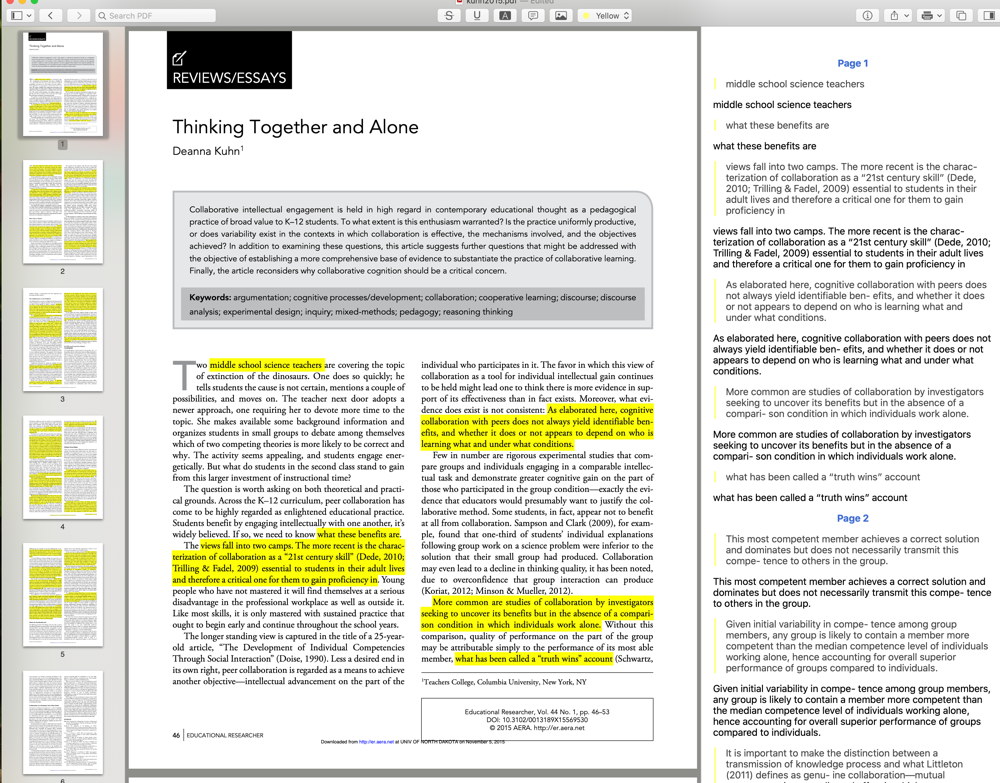
This image shows a pdf loaded into Highlights. This particular pdf I actually highlighted and annotated using a different tool so if you already highlight pdfs you don’t have to start all over. The very right-hand column is the key here. The content in this column is the highlighted and annotated material from the pdf. In the paid version, I can then offload just this material to a different system. No, you can’t just cut and paste this from the version to accomplish the same thing so you really need the paid version to do what I am describing.
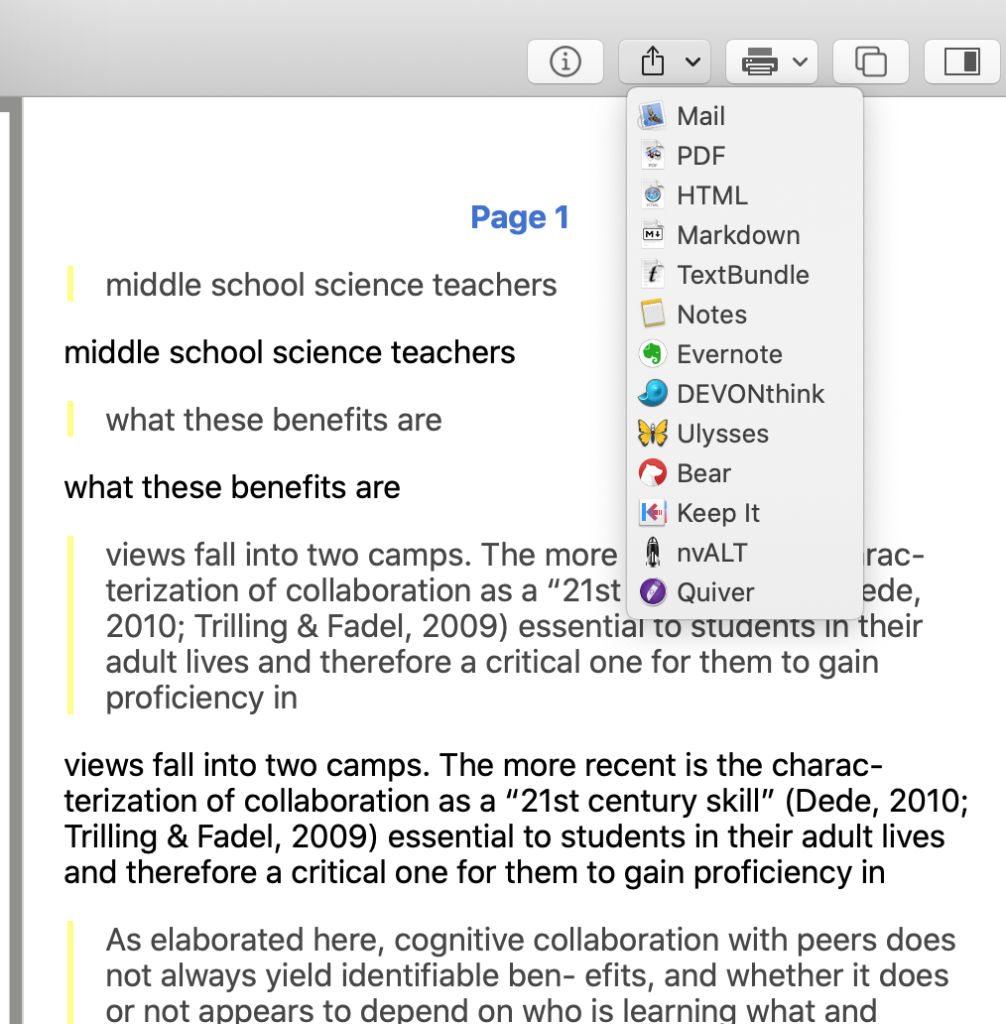
Highlights offers multiple options for exporting this content. I tend to organize collections of such material in an Evernote notebook set up for a given project. When I work on a new project, I just return to the pdfs I want and repeat the process.
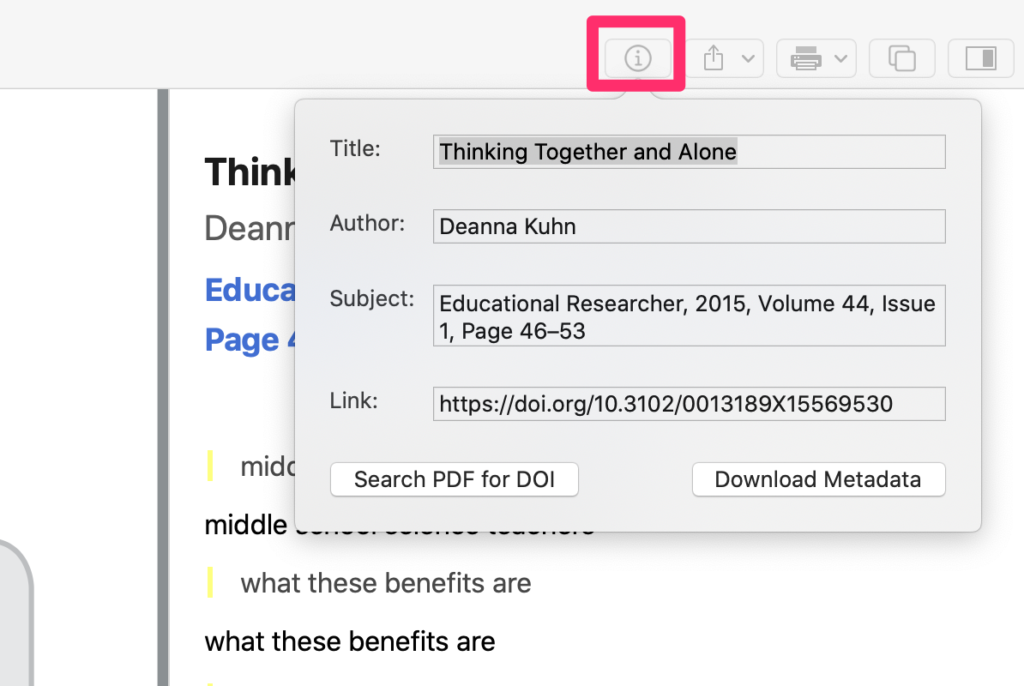
Highlights has one other interesting feature some might find useful. It can collect the metadata associated with a pdf and this can be handy for building a reference section (I would do this in a different way) or just keeping track of the source for a notes file.
Donald Trump has added a new dimension to his complaints and proposals for his reelection. The President of the United States warned of a national education crisis on Thursday: the “ideological poison” of “radical” history education. He has proposed the development of the “1776 Commission” to address what he sees as flawed history instruction. I have seen this movie before.
I am not a great student of history and have often noted with some pride that I got through college without taking a history course. This was a significant challenge as my major professor in graduate school taught the grad course on the history of psychology and was a noted scholar focused on the history of the emergence of “life span developmental” psychology.
The limitations of my formal education aside, I have some insight into the exact issue that Trump raised and I have read a good amount on the topic and the role K12 history courses should serve.
My focus as is so often the way anyone becomes interested in a specific issue originated in a unique way. Much of my early interest in technology (say late 1980s) was focused on how technology tools could play unique roles in the hands of students. I was interested in David Jonasson’s concept of mindtools [https://frank.itlab.us/forgetting/learning_mindtools.pdf] and from this Cindy and I proposed “technology integration”. Our efforts extended Jonasson’s list of technology tools to include other tools such as digital probes and photography. A core concept in Jonasson and our argument was that students at all levels should have opportunities to engage in age-scaled tasks that explore content areas. We adopted “Do …” as a way to explain what we thought was both motivational and would enable authentic learning. For example – Doing biology, Doing writing, and to explain the background for my present focus, “Doing history”.
History seemed perfectly suited to personally authentic tasks as one’s community and family provide a history within which students are embedded and tasks can be created to enable investigations and authoring related to such histories.
Without any formal background in history, I found inspiration in my own personal experiences. I grew up on a farm and for some reason I was allowed to explore the contents for our attic. My father was a radar operator in WWII in the South Pacific and he had old equipment in the attic. Battery operated radios and a ham radio. He helped us string a wire from the house to a nearby tree as an antenna for the ham radio and when he had some time would sit with me and write down the content of Morse coded messages we could find. He also had a shoebox of 620 negatives he had made while stationed overseas. These negatives are large and you can contact print them (you don’t need an enlarger). He would create collections of photos in the field his comrades could send home to their families and make a little money. I became interested in photography.
The connection? At some point, I began creating technology-enabled, exploratory environments and my first prototype created in HyperCard was “Grandma’s Attic”.
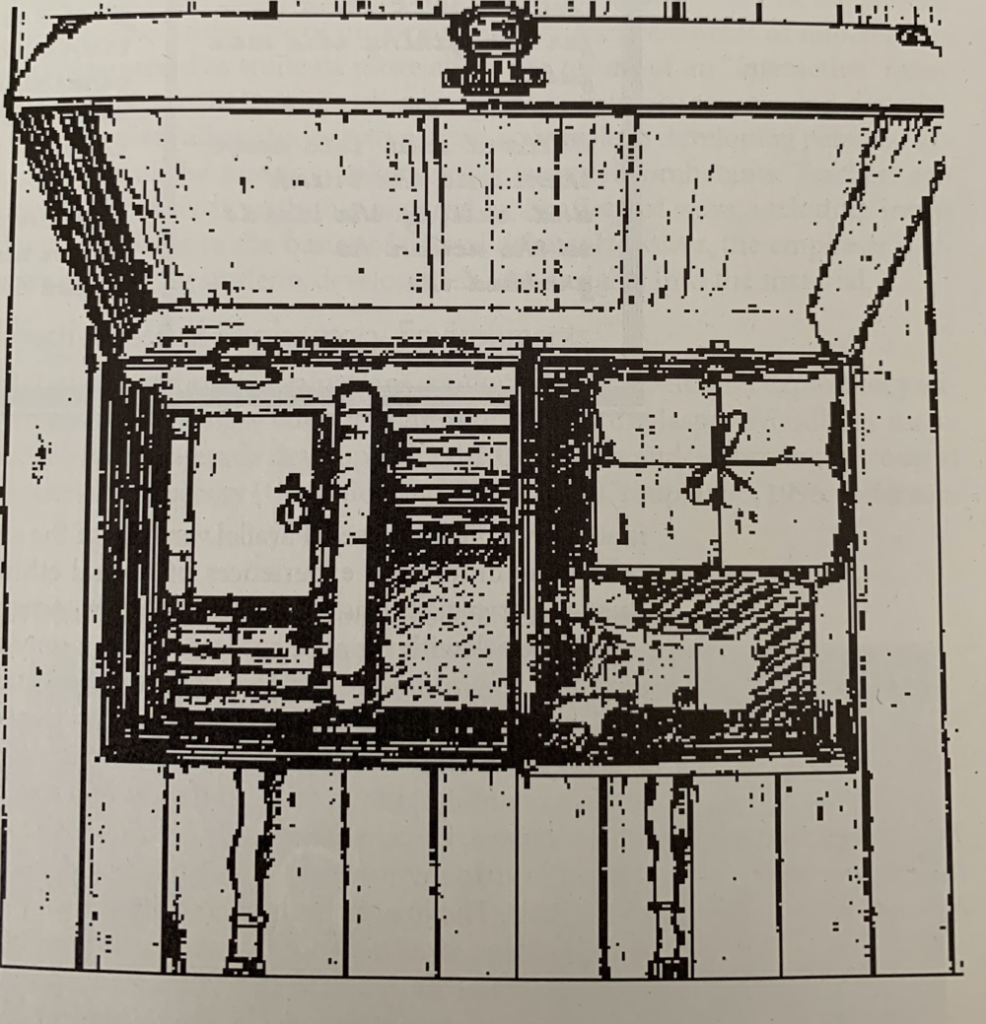
The idea was that learners could have access to a simulated attic providing access to artifacts associated with a family with certain characteristics (e.g., I was working in North Dakota and focused on groups settling the state – e.g., Norwegians, Germans from Russia). The resources of the attic – letters, diaries, photos in a photo album, newspapers, magazines, physical objects such as a spinning wheel – could be examined in an effort to put together impressions about the family. Historians are trained to apply what is often referred to as the historians’ craft (often a college course) which involves techniques for collecting information from the type of resources described here and making objective observations that could be used to make arguments about the lives of people associated with and creating such artifacts. So doing history offers a great opportunity to problem-solve, engage in critical thinking and argumentation, and other potentially generalizable cognitive skills in addition to acquiring the facts and stories of history.
The concepts of doing history and authentic learning tasks scaled to K12 student capabilities resulted in Cindy and my writing and receiving several significant grants – a Technology Innovation Challenge grant and Cindy’s Teaching American History grant.
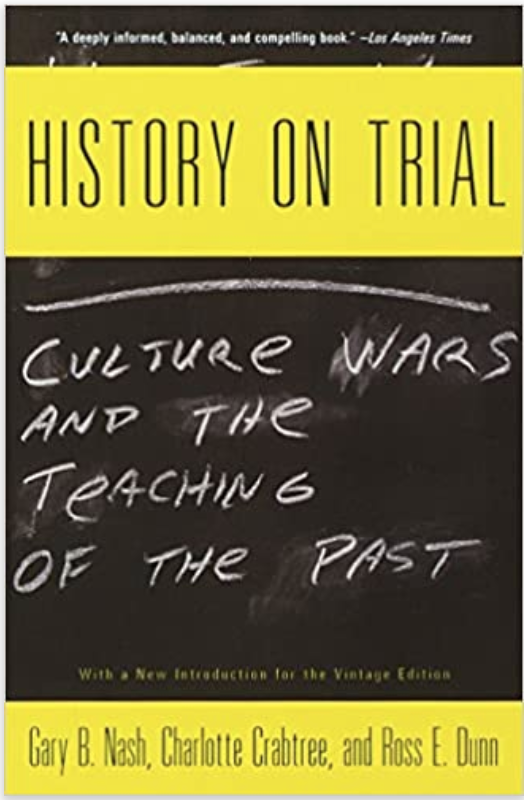
It is the preparation for writing these grants that I connect with Trump’s claims about the failed purpose for all K12 students taking history courses. Educators are expected to accomplish so many things and this list just seems to grow. The great controversy with learning history has been whether it is about teaching what might be called Patriotism and a shared perspective of the cultural background we all share OR whether it should be what I would describe as what historians study and write about – what actually happened in the past and what are the consequences of these past experiences as the American people have moved through time. This difference of opinions has been described in many ways. I remember reading this book as I helped contribute to the others working on these grants. If Trump’s complaints about how students are being influenced by their exposure to our history interests you, I would recommend the book to provide context.
I come down on the side of learning the facts of our history much in the same way I argue we need to understand and act on the facts of science. Certainly, history would be one of the courses in which issues such as slavery and enduring inequalities of all types should be considered. Denial of the facts of our past is not what education should be promoting.
I promote users making use of RSS and a RSS reader to control the blog content they consume. It is the best way to not give control of what you read to the vague algorithms of search and social media. However, I pay some attention to how folks get to my own posts and recognize that search and social media account for a substantial proportion of the page views. If not RSS, I suggest you follow me on Twitter to identify the headlines from posts you may find interesting. Twitter does not select content for you and you see the content of those you follow. Following Twitter link recommendations offers a form of discovery based on your trust in those you follow.
My Twitter posts can be located at @grabe. I do tweet about many topics and some political comments. However, all my blog posts automatically generate a tweet (as did this one).
Manage Consent
To provide the best experiences, we use technologies like cookies to store and/or access device information. Consenting to these technologies will allow us to process data such as browsing behavior or unique IDs on this site. Not consenting or withdrawing consent, may adversely affect certain features and functions.
Functional
Always active
The technical storage or access is strictly necessary for the legitimate purpose of enabling the use of a specific service explicitly requested by the subscriber or user, or for the sole purpose of carrying out the transmission of a communication over an electronic communications network.
Preferences
The technical storage or access is necessary for the legitimate purpose of storing preferences that are not requested by the subscriber or user.
Statistics
The technical storage or access that is used exclusively for statistical purposes.The technical storage or access that is used exclusively for anonymous statistical purposes. Without a subpoena, voluntary compliance on the part of your Internet Service Provider, or additional records from a third party, information stored or retrieved for this purpose alone cannot usually be used to identify you.
Marketing
The technical storage or access is required to create user profiles to send advertising, or to track the user on a website or across several websites for similar marketing purposes.








You must be logged in to post a comment.