Expanding social media options

I have blogged since 2002 and since I have started I have written thousands of posts now organized into three blogs (Learning Aloud, Blurts, and Curmudgeon Speaks). The first two blogs are focused on educational topics and technology tutorials and the final on a range of topics unrelated to my professional interests. I have a sense that the personal blog is becoming less popular. Blogs and podcasts have come to be dominated by commercial backers. There is only so much reading/listening time and it is becoming difficult to keep an audience. Blogs also require more work (relative to social media services) and fewer and fewer folks seem to learn how to use an RSS reader to make the following of multiple blogs easy and efficient. Much of the traffic I get now comes from Twitter (all posts generate a tweet that provides a link), but if I am right about this method of alerting potential readers, the maximum possible readers would be limited to the size of my list of Twitter friends who are interested in education. 

I am not going to abandon blogging mostly because I value having a place where the content I have generated is curated. I wrote regularly on Facebook during the Trump era, but there was always a sense that any effort directed at that outlet was “here today and gone tomorrow”. A service with such characteristics does not seem the place to store content such as tutorials intended to have some long term value.

Sites to which multiple individuals post and comment have obvious advantages for engagement even though the content submitted there eventually fades into the mists of time. Blogs do allow commenting, but the interaction on Facebook or Twitter is obviously far greater and more vigorous. This can be both good and bad, but ignoring the deserved negative attention of recent times, the opportunity to engage a group around a topic on such platforms offers clear advantages if the goal is interaction among participants.

I hope to increase the time I spend in such interaction now that I feel free from the hours I spend engaged in Political arguments on Facebook. I spent this time because I felt it important to the way I wanted to think about the future of this country. I have always been interested in argumentation and I certainly had the opportunity to explore both the positive and negative elements of argumentation in discussing my liberal political views. It is this interactivity I hope to experience around other topics.

I have several reasons to abandon Facebook despite the popularity of this platform. First, I just think the dominance of Facebook is not a good thing. Most folks don’t care, but I have what I consider a professional interest in the long view of online learning and I just don’t think it is a good thing when there is not healthy competition offering alternatives and driving innovation. Second, I disagree with some of Facebook’s methods. I understand the ad revenue model (see the comments that follow), but Facebook uses information collected from users to personalize ads (a useful thing in some circumstances) to tell users what they want to know and to prioritize emotion-provoking content. Being told what you want to hear is not the same as the best information available and encourages confirmation bias. Both promoting this bias and emotion-provoking content increase attention leading to the opportunity to sell more ads leading to the opportunity to collect more information, etc., etc.

Follow the money

I think it fair to argue that the big players in this space must generate a revenue stream to pay for their infrastructure and pay their employees. Of course, there is also the opportunity to make a great deal of money.

If one ignores open-source software which certainly exists and maybe fun to explore, the services that will be able to actually compete seem to fall into three categories (I offer an example for each). 

Ads – Facebook 

General contribution – WT:Social

Focused contribution – rent space – MeWe

With time to spend, I want to explore options to Facebook.

So, Facebook clearly dominates this space and relies on ad revenue which might be interpreted by users as free. If one does not mind viewing ads and we all certainly view ads all of the time, Facebook may seem free. What we are really spending is information about ourselves. Facebook collects this information which is valuable to companies wanting to target ads as effectively as possible. 

We could pay for a social service and receive access without the collection of personal data or the need to view ads. I see two options here. In the first option, one pays a fee to gain access to the service. WT:Social is an example of this approach. You can use WT:Social for free, but the service wants you to subscribe. The second option would like you to rent space as a contributor. MeWe is my example of this approach. You can post a certain amount of content at no cost, but at some point you are expected to pay for additional storage and other services. 

I am exploring both WT:Social and MeWe. Both offer opportunities to create or join groups and the feed you encounter then depends on those you friend or the groups you join. So, the experience in both cases resembles Facebook with a greater emphasis on groups and without the ads. Both services face challenges overcoming what is known as the network effect. 

I have created groups on both platforms attempting to attract participants to a sharing of content associated with a theme of K12 use of technology. The links to these efforts are – https://wt.social/wt/k12-edtech, https://www.mewe.com/join/educationaltechnology-k12. The wt.social group has been active for the longest, but I would not regard this effort as successful. My observation of the wt.social content related to technology has mostly been that there are efforts with many posts by a single individual, but few group members (my example) or groups with many members and only a few posts. I have had far less time invested in MeWe, but I started a group on this site because there were no other groups under the education heading focused on general technology integration. What I can offer based on my experience to this point is that it is very difficult to organically create a group around a specific topic. Clearly, these groups are far smaller than Facebook, but the services argue they are growing. I worry that there is a perception that an individual attempting to create a group intends to use that group as a personal outlet very much in the tradition of a blog. This is not my intention and it is not consistent with the capabilities of social media groups. I will give my efforts a year or so and see what I think at that point.

Loading

Free isn’t forever

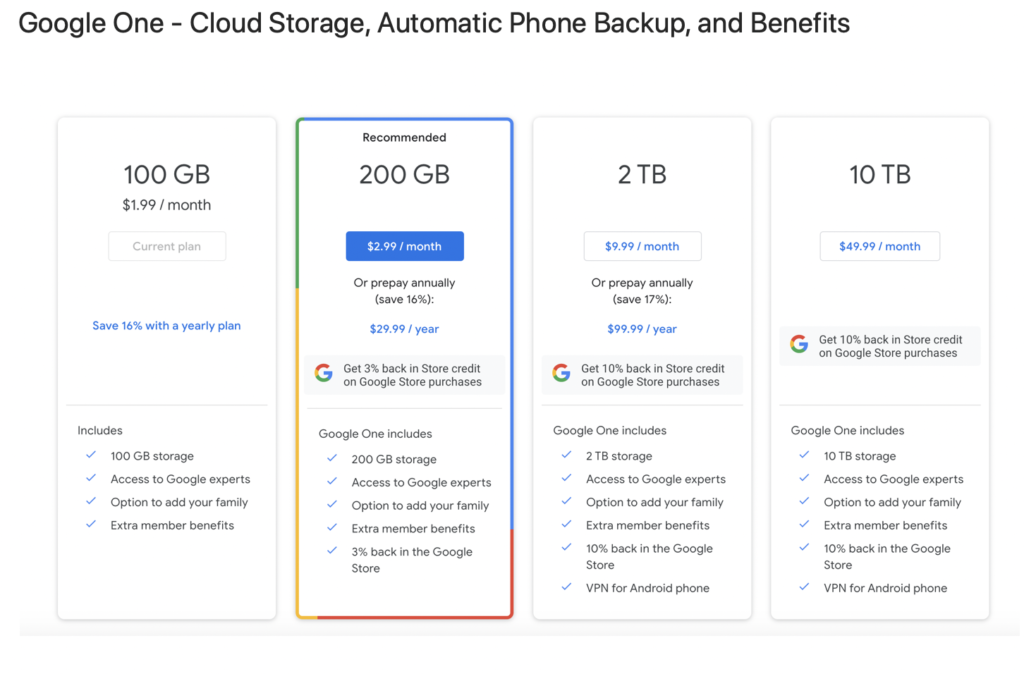
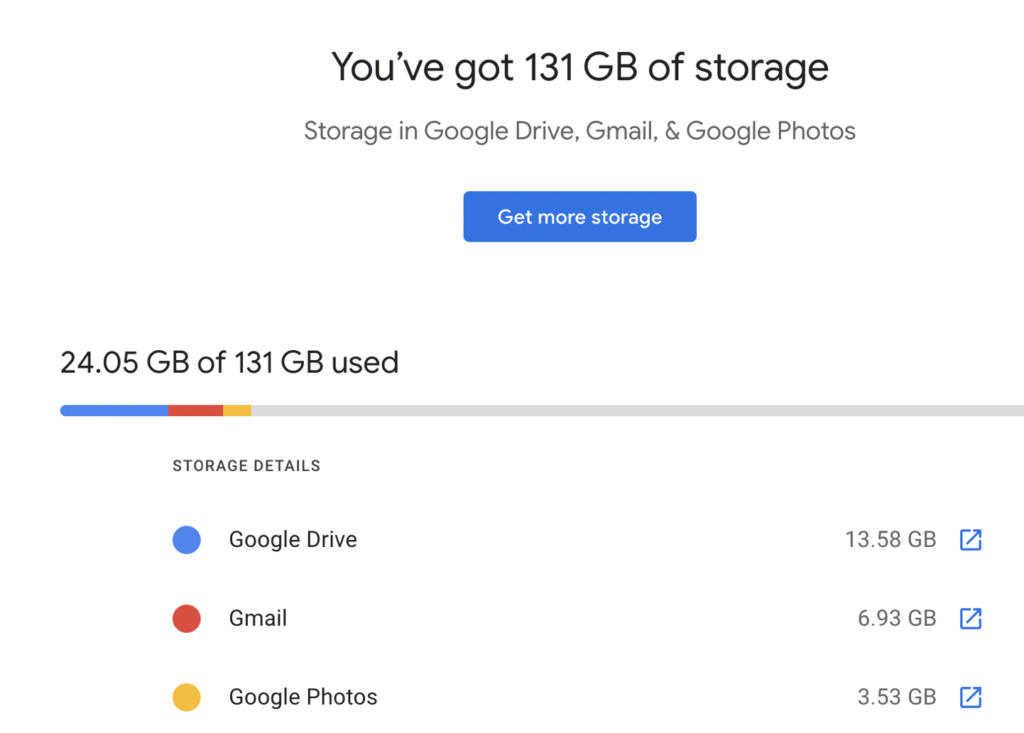
On Wednesday (Nov. 11), I noticed an email from Google. It was a description of the changes to my Google Photos account. At present Google allows you to store as many “high quality” photos as you want for free. I am not certain what high quality is, but it is a compressed version of the original quality of a decent camera. High quality is still great quality. After June 1 of next year, free goes away. Any Google user has 15 gigabytes of storage (mail and drive). Photos added after June will count toward this limit. If you want more space you must pay for a Google One account.

I knew I paid a couple of dollars a month to Google for space and it turns out I already have a Google One account.

I purchased Google One because I was concerned about what I had stored in Google Drive. I was approaching 15 GB of Drive content. I must have the smallest account (100 gb), but I have lots of content stored.

Some thoughts on paying for stuff. In general, I think digital users should pay. The present ad supported model has resulted in problems concerning the collection and sharing of personal data and efforts by tech companies to attract more screen time from users. The mechanisms to increase screen time have manipulated our understanding of the world with the prioritization of attention grabbing mechanisms such as the prioritization of content suited to our personal interests and content more likely to generate an emotional response. Paying for a less manipulative service would probably be a good thing and the tech companies do need to way to generate revenue. The Google price model is reasonable.

From the other perspective, Google has employed typical big company tactics. Very much like Amazon, Google has undercut the price of competitors driving them out of business. I have no idea whether this was the long term intention, but it has worked out this way. Undercut competitors to close them down or buy them out and then raise prices. This is the type of thing the Commerce Department must address if we want to maintain the competition necessary for continued innovation.

Loading

YiNote

I haven’t provided any additions to my “layering” posts for some time, but I have found another option that works very well. Just a review – layering is my way of describing tools that allow a user to add elements (annotations, highlights, questions, prompts) to existing web pages and videos. My Kindle book about this topic is focused on those services that work with online content without the user having to download and store this content. This capability has important copyright implications. I offer a description of several such services you can review without purchasing the Kindle book.

YiNote is a chrome extension allowing the generation of notes associated with online video. It is free.

Here is the process for using YiNote. After connecting to a video source, you activate YiNote from the menubar. The combination is shown in the following image.

In this image, you see the video on the left and the YiNote window on the right. The WyNote window contains a space for taking and saving a note at the top (red box) and links to notes already taken beneath. The export icon (red box above note links) provides access to the full collection of notes and the tools for exporting these notes. The play icons to the left of note links (first one is enclosed in a red box) will return you to the time stamp associated with that note to replay the video from that point.

One suggestion for setting up YiNote (see settings icon which is the typical gear). Set the option that stops the video as soon as you click in the window to add a note. An advantage of taking notes with this tool instead of on paper or with another digital tool is this easy way of stopping the video so you can concentrate on adding a note. No need to dual task overloading working memory.

The page for exporting notes looks like this. At the top of this window are the icons for several different export options (red box).

The saved content includes a screen capture from the video, your note, and the time stamp. The time stamp is active (red box) and clicking this icon will return you to the video at this point. Note that typical behavior would involve taking a note AFTER you have heard material so the time stamp will get you to the approximate location in the video you want, but you would have to scrub back a bit to review.

One of the options for storage is a pdf. I probably wouldn’t store my notes as a pdf, but I included this file here so you can see what stored notes look like. Again, the pdf contains active time stamps that should allow you access to the video.

Loading

Solar project conclusion

Back in April I started a project that I decided to conclude today. The project was an effort to experiment with solar energy and energy consumption. I promoted this project as an example of what educators might find a way to explore both electricity and clean energy.

Here is a brief overview. I have a gazebo outside my house and I like to read and write in this structure when the temperature in Minnesota permits. Some years ago I purchased a solar panel and the equipment necessary to save the power generated from this panel to a battery and convert the DC to AC for use. I did very little with the equipment, but in April I purchased a device allowing the recording of the amount of energy flowing through an outlet. I decided to make use of my solar equipment to power my laptop and Amazon Echo when spending time reading and writing in this gazebo. The details of the equipment are described in the initial post.

Today, I took the final readings to conclude the project. During the 187 hours I spent in the gazebo, I used 3.43 kilowatts of energy. The value of this electricity is about $.35. Laptops and the Echo are inexpensive to operate.

Loading

Failed Vision?

Cindy and I have been writing textbooks since 1996. Our main book “Integrating Technology for Meaningful Learning” was our first effort and we have been updated it since then. When the Internet became a potentially useful opportunity for K12 classrooms we wrote “Integrating the Internet for Meaningful Learning”. This second book was integrated with our first book in the third edition. In between, we wrote a version of the original book as a scaled down Primer that was shrink-wrapped with other educational textbooks for a small increase in price. 

We wrote 5 editions of our textbook with traditional publishing companies – first, Houghton-Mifflin, then RiverDeep, and finally Cengage. The college textbook market has been consolidating for years with collections being sold to other companies and companies specializing in fewer areas. College textbooks are very expensive to develop with editors, market analysis, marketing, etc. and very expensive to sell as a consequence. Our fifth edition was sold for $140. Our books were always successful, but the “technology for teachers” courses are small. Fewer competing books, but a much smaller market compared to large introductory courses (Intro, Developmental, Educational Psychology in my general area of instruction). 

As we were in our fourth edition, we began to imagine a different approach better suited to the niche for our books, insights into the process of writing textbooks in an area that changed very quickly, and what was beginning to build as a backlash to the cost of textbooks. We began pushing a model that consisted of a Primer, online resources matched to the Primer, and something I described as an “interactive syllabus” to tie a course together. I called it the $29 textbook project and argued educational technology would be a great course for a company knowing the future was going to move them away from the traditional book and the traditional development model to learn from a project targeting a market already interested in technology in education. At $29, we would share any risk as the authors’ cut of $29 is very different from $140. 

Our proposal was based on logic aside from just the cost. Because the field of educational technology was moving so fast, the traditional three-year revision cycle was a very real problem. Authors don’t know if another edition will be allowed until maybe the end of the second year of each cycle. The author must then revise the book in approximately 6 months so that the book can go through the revision and review process and be printed to be advertised toward the end of the 3rd year. There are multiple frustrations in such a schedule. The time from the end of the author’s work until the release of a new book is probably nine months and the major periods of adoption are the second semester of the first year and the second year of sales for a cycle. Any advances in the field during this period of time are not part of a book put into the hands of students. We had multiple experiences describing a technology product that was discontinued or renamed and sold by a different company by the time the book was released. 

The wait, wait, rush model does not work for authors and in my opinion results in shallow modifications. The most creativity and deep background research tends to be involved in the preparation of the initial product. I believed authors could continue to work toward additional editions continuously, but our expertise and daily work tend to take on a far narrower focus than is ideal in writing a book for a course covering a broad area. The idea in the $29 model was to pay authors a small amount (similar to the advance for first editions) to write continuously and make this content available immediately online possibly to be integrated in the next edition. This would offer learners an improved and less dated experience and offer authors the opportunity to remain active and keep exploring.

The idea of an interactive syllabus might make the most sense if you imagine it as a web site created with a product such as Google Sites. Google Sites simplifies the development process allowing development with limited learning time. The instructor controlled syllabus created in this fashion would allow the instructor to structure the student experience taking advantage of resources the instructor could piece together and provide access to these resources through links. I tend to see this resource based on the structure of the textbook, but this would not be necessary. If an instructor did use the chapter of a textbook as the base structure, the instructor would then link to any of the online resources provided by the textbook company the instructor felt suited her class and would link to other sources as well. Picking and choosing among web resources allows flexibility and keeps the size and price of the Primer down. There is an efficiency and flexibility here not possible with a large and expensive textbook. 

Anyway, this is getting pretty long but identifies the major components of the commercial model that interested me. We explored the possibility of some version of this model with Cengage during the sales of our 5th edition and for a couple of additional years beyond the normal run of this edition. We never did reach the point at which anything we discussed was actually implemented. We were interested enough in our vision (this was latecareer so I had different motives than might have been the case in a junior faculty member). We finally decided we could not get to a way to implement some version of the $29 plan and Cengage gave us back the copyright for our book (both the company and the authors share copyright for textbooks).

I began implementing a version of the proposed model based on a Kindle ebook (for the Primer). This was not my first experiment in offering a book-type online resource for the undergrad education student. When wikis kind of caught the fancy of the education community, I developed a wiki I called “Meaningful Learning and the Participatory Web”. I was not using the wiki as a collaborative writing space, but I wanted the experience of developing and hosting a wiki (I operated my own server). I made use of MediaWiki the same software used for Wikipedia and used this wiki in a grad course I taught and offered it to other instructors. A more traditional web-based of this project still exists.

We have a functional model of the $29 dollar textbook, but the Primer costs $9 as a Kindle book. The web resources are available from the same server that provides this blog. The Google sites interactive syllabus exists when I teach a course for which the book is appropriate. I have always known that selling a book without the door to door salespeople and the free examination copies textbook companies provide is tough to compete with. College instructors don’t go looking for resources. They wait for someone to come to them or explore the book vendors when attempting academic conferences.

There is a lot of inertia when you have an existing book. The “wiki book” experiment received attention because of our traditional textbook. Web content we developed originally received attention because of our traditional textbook. I had hoped that this same and expanded collection of web content would work in the opposite direction with the Kindle book. It doesn’t seem to have worked in this way. A few instructors seem to have adopted the Kindle book, but are not assigning much of the web content. We also seem to sell singles of the ebook and I had assumed we would get adoptions for more classes. I have never added a traditional paper book to the ebook which Amazon makes fairly easy. We had assumed that a “teaching with technology” resource would make the most sense requiring learners to learn from a digital resource. So, there are a few things I understand about this experience and some things I still don’t.

I intend to continue my little experiment and receive enough attention to keep going. College instruction is difficult to change and I still think the course type I have worked on for so long is likely to play a role in this change. I continue to promote the model I am trying to develop and I do see some movement in the model of traditional publishing companies. Books are still too large and too slow to change, but ebooks options are fairly common. There is some increase in web-based content such as book-related videos and maybe study guides, but the traditional approach still lacks the flexibility I think is quite practical, Textbooks still costs far too much. I don’t intend to work for a textbook company again, but I understand the financial problems that plague the textbook market and I appreciate the level of support you receive (editor, photographer, paid reviewers, marketing) as an author. Part of the impetus for change is going to have to come from educators who in this case are the decision-makers when it comes to making decisions for their courses. There seems more interest in open educational resources (OER) which I just don’t see ever getting very far (have already written free learning resources) than in exploring and pushing for more options from textbook companies. I guess we will see.

Loading

Abandon comprehension skill instruction?

I admit this a kind of click-bait title, but I paraphrased it from a source arguing that far too much ELA time is spent on comprehension skills. I did end the title with a question mark.

The article divides the development of reading skill into two pretty much sequential components – decoding skills and comprehension skills. I agree. The article does not argue that attempts to teach comprehension skills should be completely abandoned, but rather claims that these stepping stone skills are emphasized too much because the key to reading comprehension is really the development of existing knowledge. Again, I kind of agree and suggest that this research supported argument is under-appreciated by many teachers and is lacking in the understanding of such important issues as the struggles of lower SES kids in developing core academic skills.

The position taken by the authors reminds me of a post I generated just a few days ago concluding that increasing time spent in social studies at the elementary school level is more important in developing reading proficiency than variations in the time spent on reading instruction. The logic explaining this finding is that of the typical elementary subject areas, social studies is the area that best covers what might be described as general knowledge (e.g., in constrast to the specialized knowledge and vocabulary of science). Understanding what we read is heavily influenced by what we already know about a topic and general knowledge is, as the term implies, general meaning it applies more widely. Hence, it seems wrong, but possibly counterintuitive to many, to steal time from social studies to emphasize STEM. Develop learning skills first and then allow opportunities to turn these proficiencies loose on topics of personal interest.

Loading

Competition verging on monopoly

Given the complexity of the news environment at this moment, even technology enthusiasts may have missed the massive (400+ pages) report focused on alledged anti-competitive practices of Amazon, Apple. Facebook, and Google. Four hundred pages is a lot to read, but there is an executive summary and sections on specific issues and the individual companies that may be of interest.

The report is titled – Investigation of Competition in Digital Markets. To be precise, this is the house majority report (Democrat). Party animus being what it is, the minority members of the committee may offer their own commentary. The minority wanted some issues such as their claim that conservative issues are disadvantaged by algorithms that do not appear in the report of the majority. I am also not certain that this claim can be objectively demonstrated. 

I would describe the general tenor of the report as finding specific faults with all of the companies investigated. While each company operates in somewhat independent areas, the general conclusions were that:

  • Each company functions as a gatekeeper over a category of distribution
  • The advantages of this gatekeeper position is used to maintain control.
  • While the companies function as intermediaries, they exploit their advantages to influence opportunities for competitors and take advantage of companies who depend on the intermediary.

The committee pointed to the combined economic power of these companies in justifying potential regulations that may be necessary. The combined valuation of these companies is more than $5 trillion.

The report indicated that Google would probably be the first to face regulation. Without defending Google, I am personally more concerned about the impact of Facebook. Facebook was indicated in the report to have 1.79 billion daily users and if it has reasonable competitors, these competitors would most likely be other services it owns (Instagram). Facebook was reported to be on 74% of U.S. phones (200 million), Messenger on 184 million, and Instagram on 119 million. Facebook was reported to control 95% of time in minutes spent on social media. 

Facebook’s advantages include network effects (people want to be where most other people are and as the percentage goes up the power of the network increases out of proportion to the numbers involved), switching costs (lose access to data – photos, posts, friends), and access to data (the more data the more tailored the experience). 

I understand these factors, but I am concerned with the influence that Facebook has on users. It limits their capacity to make sound data and factually informed decisions because it manipulates access to facts and data based on personal biases and emotional triggers. To some degree, Google may be moving in this same direction as it has diluted the original page-rank algorithm to take into account personal preferences. How do you explain to people that what we like and what tends to activate us (content with an emotional edge) may not be accurate or good for us?

Loading