Just to be clear, this post is about the Hemingway writing tool and not a suggestion that I could explain how you can write like Hemingway. The closest I can come to explaining the skills of the great author is to refer you to the recent Ken Burns and Lynn Novick Hemingway documentary. If the Hemingway writing tool is related in any way, it is the preference of the editing tool for simple, straightforward prose.
So, I write a lot. I blog, but my professional writing is focused on textbooks for preservice and practicing educators. Simple and straightforward would seem a good thing when trying to explain things.
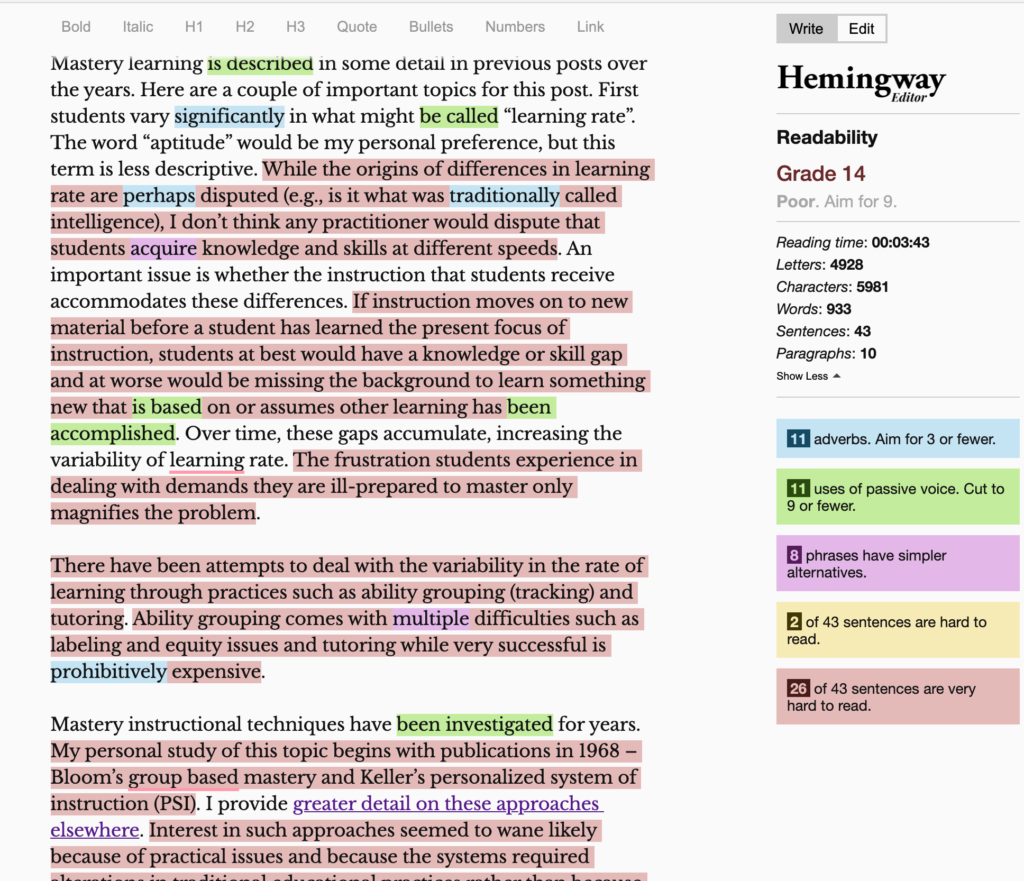
The Hemingway editing tool makes suggestions by highlighting text in different colors corresponding to the recommendations it makes for changes. If your eyes are better than mine, you may recognize the sample I had Hemingway critique as a previous post. Colorful isn’t it. Here is the issue I have with academic writing. I know I am not to use the passive voice. I know what the passive voice is and it sounds better to me. As an academic, I use adverbs to clarify and often soften verbs. I think academics are appropriately humble and hesitate to be too demonstrative. Yes, many of my sentences could be broken up into a couple of simple sentences and Hemingway did write in this grammatically less complicated style. Too many simple sentences to me sounds like an elementary school reader. You can probably tell how fun I am for editors to work with.
Anyway, feedback is good and I suppose it would be a great exercise to see how difficult it would be for me to take something I have written and reduce the amount of highlighted content and the readability grade level (14 in this case).
This post is really about the Hemingway editor. There is a free version (online) and a paid desktop version ($20 with free updates). I have tried free and purchased the desktop version. Just to be clear, the basic editorial features are the same. The paid version offers a few suggestions. Few actually solved the writing issue that the software highlighted. The advantage of the desktop app is really in saving edited work which to me is not particularly valuable. Copy and paste work fine. The service is worth $20 if you write seriously and want an easy to generate critique so I don’t begrudge the developers the money.
The paid version can be downloaded from the free online version and you should explore the free version first to make a decisions about a purchase.
I thought I should make an effort to offer a resource for Earth Day. I have concluded that the most important step for any average citizen is to become informed enough to realize the seriousness of this problem as an initial step to promoting and supporting the political will to take the steps necessary to address the multiple interrelated problems. I have read several sources on climate challenge and recommend a book by Bill Gates as both readable and I believe realistic.
Some important arguments:
This is a global challenge and it would be unfair if the wealthy countries that have had the major role in creating the climate crisis expected the same commitments from poorer countries in addressing the problem. The wealthy countries have built their wealth partly being doing the things that used cheap energy and should not expect those attempting to build a better economy to ignore these same energy sources (e.g., coal, oil) and construction materials (e.g., concrete) as they attempt to do better.
Quote from book – To have any hope of staving off disaster, the world’s biggest emitters—the richest countries—have to get to net-zero emissions by 2050.
Addressing climate change at this point must involve more than reducing doing more damage as the damage done takes so long to dissipate. For example, slowing down carbon dioxide and methane production will not be enough. We need to remove these gases from the atmosphere.
Quote from book – to avoid the worst climate scenarios, at some point we’ll not only need to stop adding more gases but actually need to start removing some of the gases we have already emitted.
Innovation and research are the only ways to solve the problem. These activities require investment and many attempts will not be successful. This means we cannot rely on companies worried about their bottom lines to solve the problem.
Quote from book – When it comes to climate change, I know innovation isn’t the only thing we need. But we cannot keep the earth livable without it. Techno-fixes are not sufficient, but they are necessary.
engaging in the political process is the most important single step that people from every walk of life can take to help avoid a climate disaster.
The cost of better energy sources must be lower than the cost of old energy sources. This may require determining the full cost of old energy sources and adding fees so that cost to the environment can be addressed.
Quote from book – oil is cheaper than a soft drink. I could hardly believe this the first time I heard it, but it’s true. Here’s the math: A barrel of oil contains 42 gallons; the average price in the second half of 2020 was around $42 per barrel, so that comes to about $1 per gallon. Meanwhile, Costco sells 8 liters of soda for $6, a price that amounts to $2.85 a gallon.
Today, when businesses make products or consumers buy things, they don’t bear any extra cost for the carbon involved, even though that carbon imposes a very real cost on society.
Many are frustrated with wealthy tech entrepreneurs proposing and even funding solutions to problems in other areas (e.g., education, climate). Gates recognizes this reaction and admits many proposals have not been successful. However, Gates works hard at becoming knowledgeable and relies on experts who guide the areas explores and invests his money.
The world is not exactly lacking in rich men with big ideas about what other people should do, or who think technology can fix any problem. I think more like an engineer than a political scientist, and I don’t have a solution to the politics of climate change.
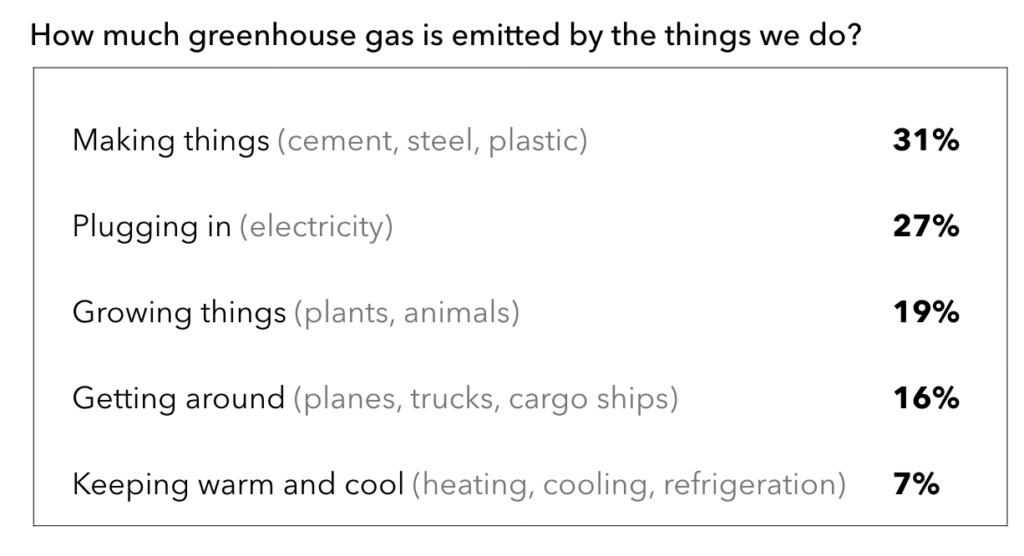
Gates offers a data-based and realistic analysis. He begins by providing data that summarizes the sectors responsible for greenhouse gas emissions arguing all of these sectors must be considered rather than attending only to the the traditional targets (e.g., self driving cars, solar panels). His approach is surprisingly optimistic given the many changes he argues must occur, but he argues that governments must encourage and support the scientific community to develop methods to address these multiple challenges. This is the only way he sees the world taking on what he sees as the massive challenge we face.
My last post regarding the practicality of the use of Google docs to individualize student learning was probably a bit harsh. The core of my position was that to individualize instruction Google forms makes more sense as actions taken within a form (student-constructed responses to tasks and competency checks) are automatically forwarded to a Google spreadsheet making tracking and evaluation by a teacher more practical. While docs are more flexible than forms, student additions to a doc require copies of the doc when it comes to tasks such as competency checks.
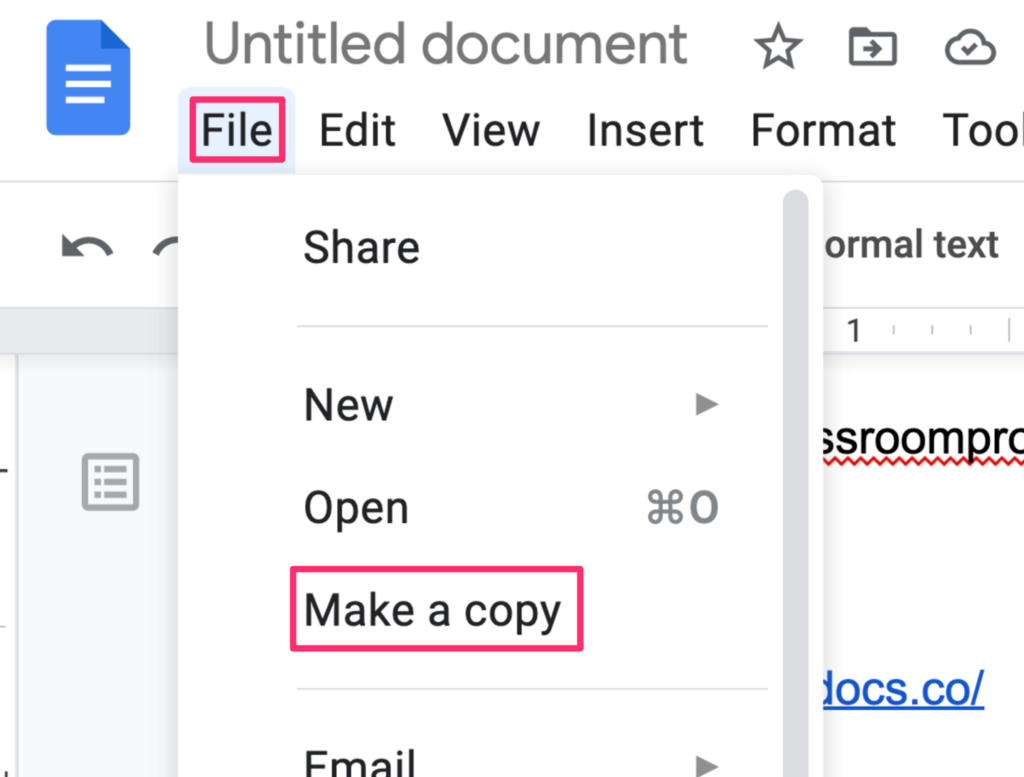
After reviewing sections of the Hyperdoc handbook again, I did come across a strategy the authors recommended to solve this problem. The authors propose that students open a shared Google doc, make a copy that they work on, and then share a link to this copy back to the teacher for feedback and evaluation.
I have been exploring approaches that might be used by teachers and students to individualize student progress through a sequence of learning experiences. I am interested in approaches that might allow a mastery model; i.e., students move ahead at the rate they are able to demonstrate mastery of instructional goals. Recently, I have been exploring a model called the Modern Classroom Project and I have been thinking about some of the practical requirements for implementing this model.
Approaches that individualize student progress need a way to communicate the sequence of tasks to individual students and to locate competency checks within this sequence of tasks. If I were going to do this, I would probably create a document (probably Google docs) that linked to a series of web pages to present content and layer these content pages using InsertLearning. InsertLearning would allow me to add prompts, questions, and discussion items to the content pages (which would consist of text, images, and video). I could use the questions to encourage processing of the content and also as a competency check at the end of each content page. The nice thing about InsertLearning for this type of approach is that it collects student responses to questions and I would use these responses to evaluate understanding of the content presented within a page. These responses would enable me to provide feedback to students telling them if they can move on to the next unit and to identify students I might want to spend time with to help them sort out difficulties they seem to be having.
InsertLearning is not a free service ($8 per class per month or $40 a year) so how else might a similar goal of sequencing learning be accomplished. Many educators have probably heard of hyperdocs. The term hyperdoc was coined to refer to creative use of Google tools (docs, forms, sheets, and slides) to create content delivery, learning experience, and evaluation tasks by teachers for their students. Often, this would be done in place of traditional curriculum materials which I would describe as placing classroom educators into the role of an instructional designer. One of the challenges I see in this approach is creating a simple way to allow multiple students through the sequence of an instructional unit at different speeds. My guess is that the authors of the Hyperdoc Handbook would do this through a combination of Google docs and Google forms. You can do a lot with docs because you can both present content (text, images, video) and require responses within the same shared document. The problem for me if relying on docs would be individualization. You would possibly have to create a unique copy of each doc for each student if you wanted to evaluate performance on tasks with the material to be examined added within the doc.
What follows is my attempt to use Google forms as an alternative. Forms are crude in comparison to docs, but forms have the advantage of writing the response to embedded questions to a spreadsheet. The collection of data is the primary function of a form. The link for the same form can be sent to many different individuals and inputs to questions in the form are stored separately in a spreadsheet. I think of trying to use forms for the task I am interested in as trading data collection for the sophistication of content presentation. I have come up with a few ideas in the use of forms others may find useful.
Here is a summary of the issues and my ideas. You can present text, images, video, and questions in forms, but to combine them you have to be creative. The biggest challenge is to combine text with anything else. I use WordPress as my blog platform (this blog) and WordPress now uses what are called blocks. There are blocks for lists, text, images, embeds, quotations, video, etc. and you create posts by adding blocks and then adding content to each block. Forms works in a similar way, but allows far less flexibility in how blocks can be combined.
With forms, it helps to think in terms of sections. There is the title section and sections that follow. Below each section heading, there is an opportunity to add text. You can add as much text as you want, but this is the only place within a section that text can be added. You can add multiple images, videos, and questions below this body of text. The questions are of many types, short answer, paragraph, multiple choice, etc. The responses to these questions are written to a spreadsheet that will appear in the same Google drive account that stores the form.
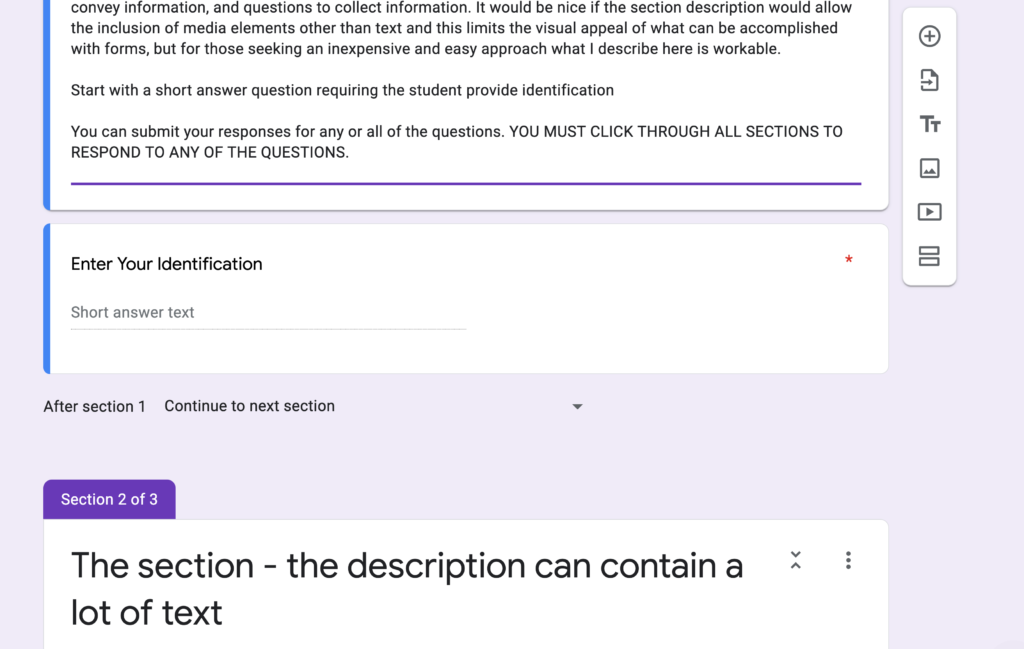
Here are a few images to give you an idea of what this looks like. The following image shows two sections – the title section and a second section. You can see text that has been inserted under the title. Again, this is the only place text can be added to this section. Below, the text you can see a question. You will need to associate an identification (name) with each response from students. So, the form I created begins with the request for a name. Questions either require a response or not. I want students to be able to complete parts of this unit (consisting of multiple sections) in stages and I want to record any input generated during that visit to the site. I require a response to the name question, but not to any questions that follow. A student can then respond to questions associated with other sections or not and I will also store these responses associated with the name or other form of identification. The student must move through all sections for the form to send any data added to the spreadsheet. This is not ideal and I am sure some students will forget to do this and no work they have completed will be recorded. There is no way to change this in a form with multiple sections. The image below shows the beginning of a second section with again allows a heading (title) and then the one opportunity to add text.
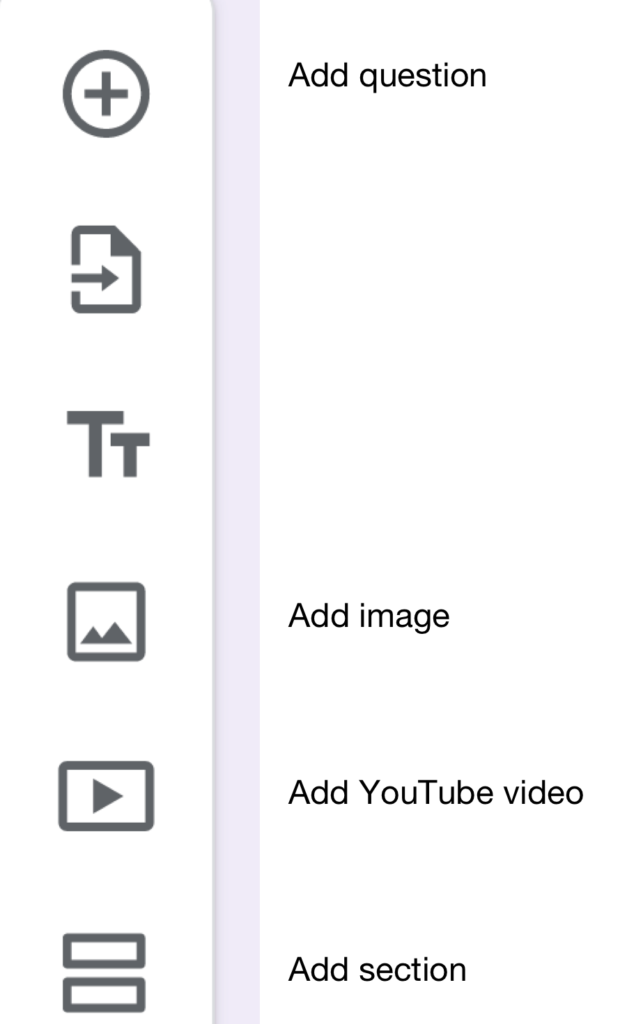
The following image shows the form tools. The tools have been labeled. There are options associated with the different tools (e.g., for questions – what type of question and will a response be required).
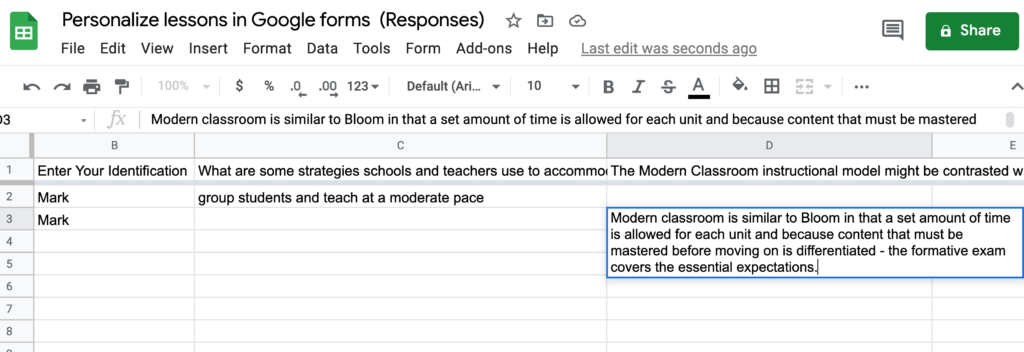
The following image shows what the spreadsheet with responses looks like. Long responses distort the shape of the spreadsheet, but clicking within a cell makes the content submitted far easier to read.
If you are interested in examining the demo form I created for this tutorial, you can view it using this link.
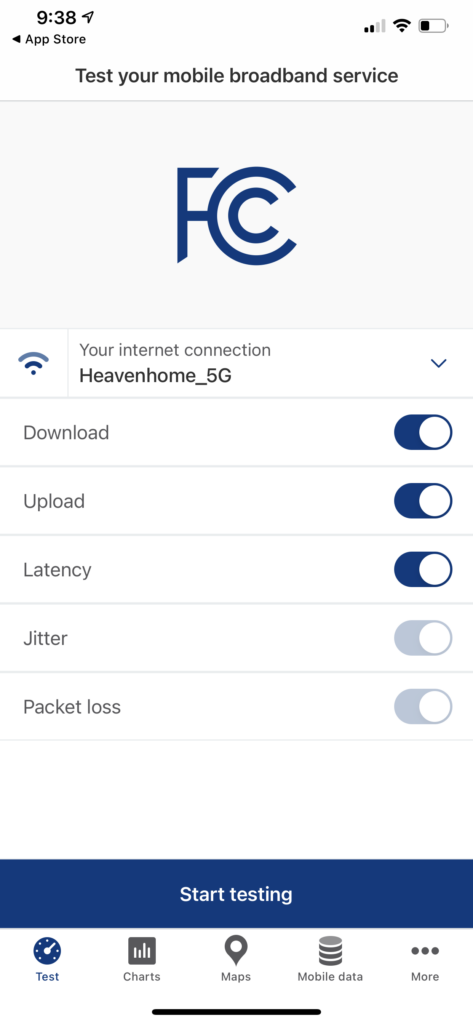
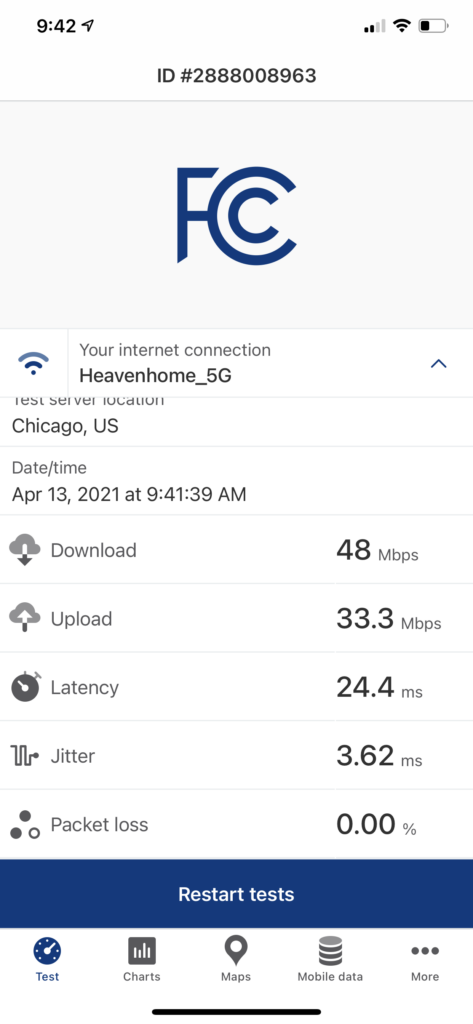
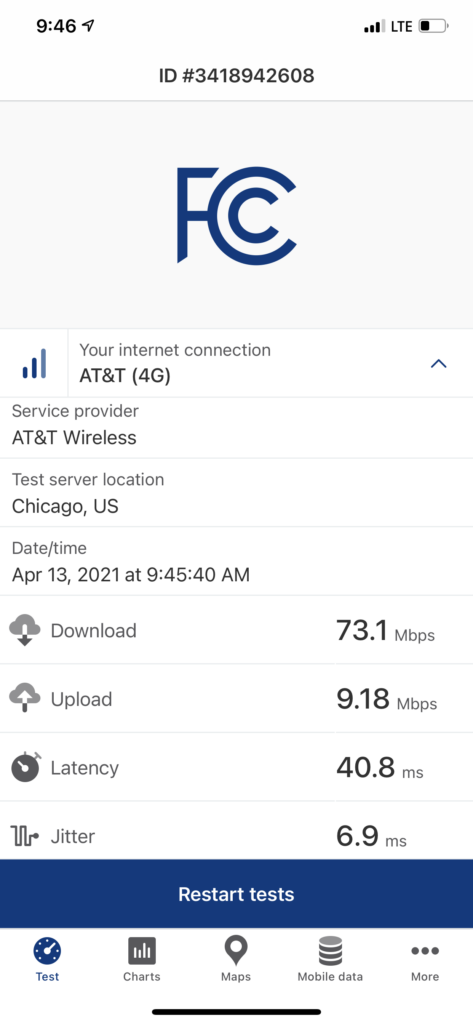
The FCC is offering an app for iOS and android to allow citizens to collect broadband access data for personal information and to support the government organization’s effort to better understand access issues (Verge article). Some screen captures follow. It was unclear to me when the term mobile broadband is used whether I am supposed to test the speed I get through my cable provider or through my phone company. Since the app recognizes both, I decided the FCC can sort out the data they want.
For the education community, I would think it would be very useful for these data to be differentiated by households with K12 students.
This blog has existed since 2002 which makes it about as old as a blog can be. The same goes for me. In this time, I have generated nearly 2000 posts. The oldest posts probably have little value for others unless you are interested in the history of educational technology. As I wrote about what interested me at the time, I was also documenting changes in what has become an important field within educational thinking and practice.
Most folks use blogs by reading content as it appears not making the effort to look at preceding posts unless the author purposeful links to this older content. Blogs provide several ways to explore the entire body generated by a blog author. I will explain the ways that come to mind as made available within this blog, but most of these options exist for other blogs as well.
If you look along the left-hand sidebar of this blog (unless you are reading this on a phone, then you will likely find an icon – three lines – that provide access to the sidebars and main window), you should find most all but one of these options.
First, most bloggers will display a link to the archive for their work. This should allow a user to identify the content published by year and month.
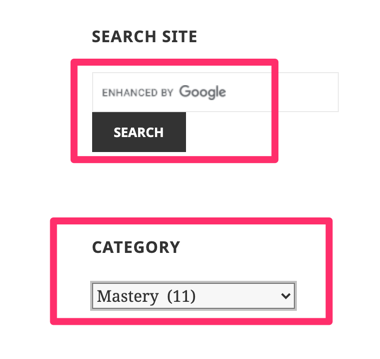
The other two opportunities that appear in the sidebar include search and categories. A blog author may or may not add these opportunities to his/her blog. Both options are identified below.
I use a Google search service that returns hits for a search term specific to my blog and also allows more general search for the same term
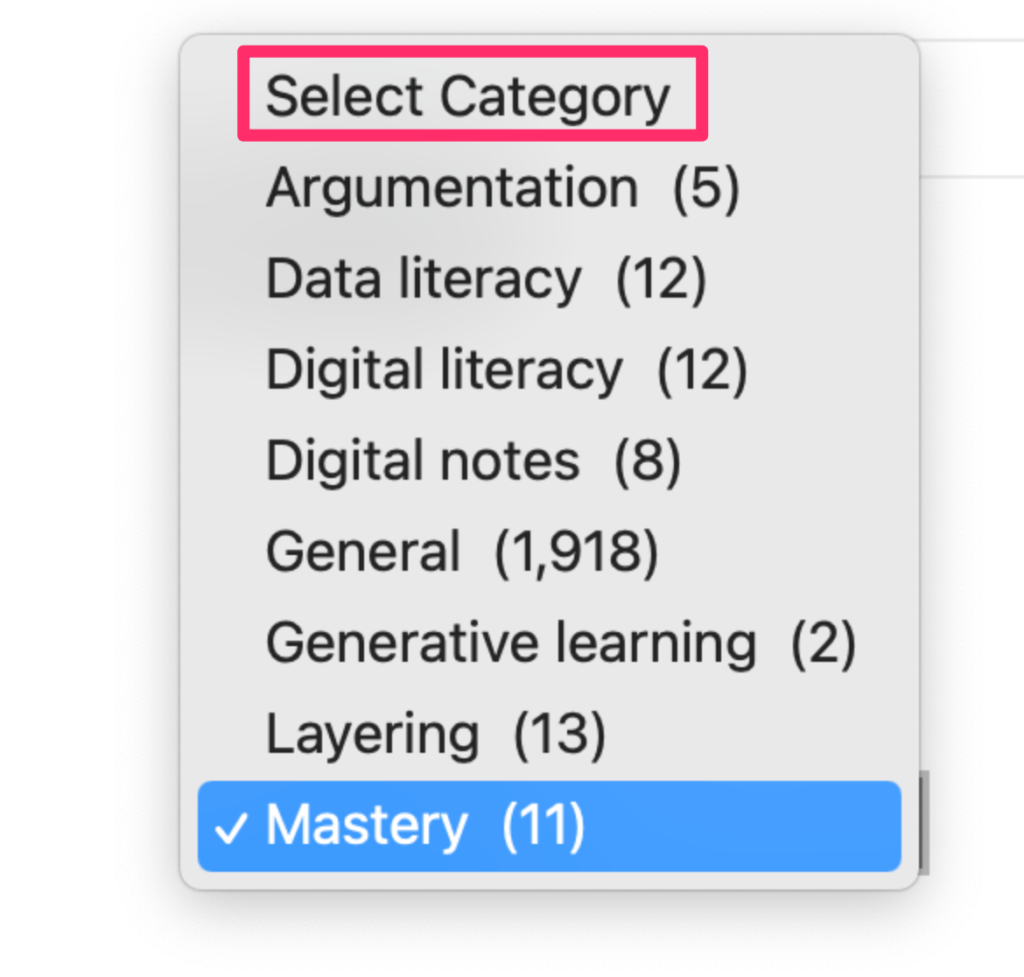
The second approach identifies categories the author has identified as areas of emphasis in posts. I started using this system recently and have applied the category labels to the posts generated for the past 3-4 years.
Selecting a category will provide access to all posts associated with that category and will provide the blog author’s explanation of what that category represents.
Finally, an author may “tag” individual posts. These tags appear at the bottom of posts. Clicking on a tag will general past posts that have been tagged with the selected tag. The success of this technique in locating related content depends on how systematically the author has added tags to identify topics.
I encourage your use of these search options in this blog and in others you visit. When you find a post that interests you, see what else the author has to say about the topic.
Hypothes.is was the first online service I explored when learning about what I came to describe as a “layering” technology. The descriptive term, layering, I decided to apply was based on the fact that the original content (a web page in the case of Hypothes.is) was not modified when a layering service was used to review and extend that content. However, the composite as experienced by the student is a combination of the content created by the author and the additions contributed by others (e.g., students, teacher). My interest in the benefits of generating and continuing to use these contextualized contributions. By contextualized, I mean that the original and added content is related in space unlike say notes taken in a notebook while viewing the same web content.
Educators and researchers interested in the application of Hypothes.is offer various suggestions for those considering use of the service. Some of these efforts have resulted in a series of videos. The one I am focused on here considers social annotation. Most of us have long annotated as a personal study tool. We highlight and if we read digital content such as ebooks from Amazon we annotate as part of studying or preparing to use notes for writing. In contrast, social annotation involves sharing annotations with other students and possibly with a teacher. The author of the video talks about “making thinking visible” which I like. More traditionally, I would describe the likely benefits of social annotation as generative processing.
The layering options in Hypothes.is include highlighting and note-taking. In a social situation, these additions can be used in many different ways. An educator can highlight for emphasis, add comments to extend the information provided by the original author, and ask questions. Students can answer such questions, ask questions of peers or the teacher, and make personal observations. The annotated material can make thinking visible as a source of modeling or as a type of “show your work” others can use to evaluate your understanding.
Look for these ideas and suggestions for application in this video.
Here is a video I created some time ago to describe the basics of using hypothes.is.



You must be logged in to post a comment.