Research on mastery instruction is extensive

I have decided to write several posts focused on mastery learning. My motivation for doing this comes from a recent Chalkbeat article claiming that mastery approaches are receiving greater attention since the COVID pandemic, but “evidence remains thin”. Having followed instructional approaches labeled mastery learning since the 1970s, I am troubled by the message this title offers. There have been hundreds of studies evaluating mastery strategies using achievement data. The Chalkbeat article is focused on technology-enabled approaches and this happens to be my own interest. Perhaps less is known about mastery approaches that put technology in a central role, but the underlying concepts of mastery instruction are well researched (see citations at conclusion of this post). 

So, my effort here will be to offer a broader background on what mastery learning is and to describe some of the original models similar to more recent technology-enabled approaches.

Mastery learning has always intrigued me because the underlying assumptions make so much sense. I would describe the most basic argument of mastery learning to be that learners master content and skills at different rates. I understand these differences in learning rate as the consequence of a combination of aptitude and existing knowledge. These factors are interrelated in practice.

I would describe aptitude as similar to what others might think of as intelligence. As an individual difference, I don’t think it matters much if intelligence is a biologically based variable. This is a different topic. I think it is obvious that the rate at which learners can learn differs from individual to individual. Label this difference as you see fit. I call this capacity to learn “aptitude”.

Aside from aptitude, existing knowledge plays an important role in learning rate. Differences in existing knowledge have been demonstrated in some circumstances to play a more important role than aptitude (e.g., studies of reading comprehension based on reading skill and topic-related knowledge). These two variables are related because education does not assure that learning has occurred when the system of instruction moves on. This means that learners move ahead differing in aptitude and also differences in the existing knowledge and skills that may be necessary for new learning. Variability increases over time in a system that does not adjust to the needs of the individual increasing both the difficulty of learning new skills or knowledge AND the motivation to deal with the personal circumstances that new learning involves. 

Individualization does not make the rate of learning equal, it makes the differences more determined by aptitude than the combination of aptitude and existing knowledge. For many content areas, most individuals would learn what is being taught if the learning environment allows them sufficient time. Addressing the “IF” is the key.

Some major reviews of mastery versus traditional instruction:

Kulik, C., Kulik, J. & Bangert-Drowns, R.L. (1990). Effectiveness of mastery learning programs: A meta-analysis. Review of Educational Research, 60, 265-299.

Kulik, C., Kulik, J. & Bangert-Drowns, R.L. (1990). Is there better evidence on mastery learning? A response to Slavin. Review of Educational Research, 60, 303-307.

Kulik, J. A., Kulik, C. L. C., & Cohen, P. A. (1979). A meta-analysis of outcome studies of Keller’s personalized system of instruction. American psychologist34(4), 307- 318

Slavin, R. (1987). Mastery learning reconsidered. Review of Educational Research, 57(2), 175-213.

Loading

Research Rabbit

I was by trade a research-focused academic in the fields of educational psychology and educational technology. I conducted research and generated publications based on the data my studies generated. I also wrote and continue to write instructional materials (books, blog posts) for educators based mostly on the research of others. Scientific research builds on itself and you fashion the explanation of your findings from your data, your methodology, and the positions and findings of other researchers. Writing to educate relies heavily on the analysis of existing research and you make your case by summarizing and referencing multiple articles authored by others. There is a tremendous amount of reading that is involved in both types of activity.

Aside from the reading, this type of work requires the storage, organization, and retrieval of information. There is also the challenge of searching the nearly limitless trove of existing work for publications that are relevant to your specific interests. You have to do the work of reading and understanding content, but you can use technology to make the related tasks (storage, search, organization, retrieval) easier. Many of us who do this work are constantly searching for such tools and this quest also ends up being an area of investigation. I have written multiple posts on this blog about tools for taking and organizing notes.

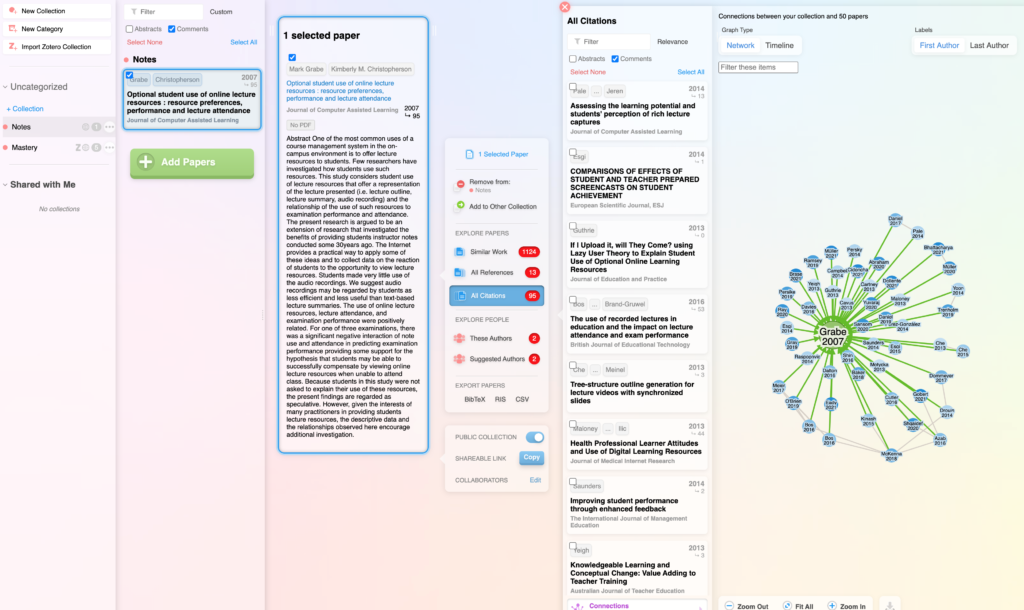
This post is focused on a tool for locating relevant content I should read. There are lots of ways to search (e.g., Google Scholar) for relevant content, but Research Rabbit goes further and builds on the web of citations that exists among published research. Rather than being limited to the citations included as part of a given source, Research Rabbit reveals the web of sources that spread among individual papers – the citations in one paper point to other papers and the citations in these papers point to other papers, etc.

This web is interesting to explore. As is often the case with search, I started by searching myself. Quite a few years ago, I was conducting research on the consequences of distributing lecture notes in large lecture classes. There are interesting related questions. Do students skip class if notes are available? Do students who use these notes perform better than students who use only their own notes? These topics have received more attention lately as educators consider what online resources to make available to students. I began my search with a paper on this topic I published in 2007. From this paper, I can locate papers that cited my work. I can collect the information I need to locate and read papers that offer abstracts that interest me. I can see what papers these authors cited and who now cites them. I can build topical collections of papers and I can offload these collections to another tool better suited to generating and organizing my personal notes after having read some of these papers (see second image showing a collection of papers on Mastery Learning brought into Zotero).

Here is a link to a YouTube video on the use of Research Rabbit.

These tools are free and available online. You don’t have to be a researcher to use such tools (see the YouTube video). Find the title of a paper that interests you and you can then locate related content by entering the title of this paper in Research Rabbit.

Loading

First and second brain interaction

Perhaps you are familiar with the new jargon describing Personal Knowledge Management (PKM) and second brain. These ideas may have not filtered down to educators yet, but the practices that are related to these terms certainly would apply to educators as knowledge workers. I have followed and explored these ideas as they relate to my long-term interest in developing and applying effective annotation practices (e.g.,note-taking). I will likely eventually write more about the tools and tactics of PKM as they might apply to secondary and students. For now, I want to offer a related proposal.

The core idea of a second brain is that learners can create and cultivate an external record of what they have learned to augment what they retain internally at some later point in time. These tactics can be implemented on paper, but for me make more sense when applied with technology. 

As I have several books on the concepts and explored and used several different tech tools for applying proposed approaches, I have what I think is a useful insight. The guiding principles of an effective second brain seem remarkably similar to core ideas from cognitive psychology about what learning is and how a learner can improve the effectiveness of the time devoted to learning.

Here are what I consider overlapping themes. Both an effective second brain and effective learning encourage:

  1. The storage of big ideas / core concepts / personal concepts
  2. The linkage of personal concepts with other personal concepts and with stored examples
  3. The reexamination of stored concepts to activate these ideas and maybe connect them with newly stored information.

The proposal of the components and tactics of a second brain require that these themes be concrete and actionable. Having something to look at and explore can be useful in understanding similar ideas that are more abstract or even invisible.

A personal concept (my term) might be described as a personal summary of an important concept or an idea that can stand alone so that it can be understood in the future without additional context and could be understood by another individual with a good background. 

In a digital second brain, linkages can be links among concepts or to examples, citations for context or support, or questions yet to be answered. Links are links that might be the familiar connections among web pages or tags that can be added to indicate a commonality with different elements of information. 

The physical store of linked content is intended to be reexamined regularly. This process has some of the same goals as what cognitive psychologists call the testing effect (retrieval practice). Attempts to recall what has been learned strengthen future retrievability and the effort involved can identify new linkages as a by-product of the search for the desired information.

Exploring the techniques and components of an effective second brain makes concrete some of the same mechanisms important in learning and applying these techniques externally may provide practice for the related cognitive skills that are difficult to explain and develop.

Just a couple of examples that may help with the idea of a second brain. After exploring several options, I have settled on the use of a tool called Obsidian. The following images show a couple of features of this tool that illustrate the ideas mentioned here.

This image shows what is called a graph view. The image shows the linkages I have created among individual notes (personal concepts). Individual notes can be accessed by clicking on a node within the graph.

This is an example of an individual note. I have selected an example that shows a personal summary of key ideas, links, and tags.  

Loading

Inoreader

Independence for creators and readers has become a significant issue with online media. Creators want to retain control of the content they create rather than giving their content to a social media site like Facebook or Medium. Readers want control of the content they consume rather than having the content prioritized by an algorithm the reader cannot control.

The RSS system provides a way for a reader to locate the multiple content providers they want to follow and to make the process of having new content from these providers identified so they can access this content without visiting many individual sites. When enough readers use RSS, content creators can be assured that the good content they create will be accessed while they retain full control of this material.

Inoreader is a powerful RSS reader that is easy to use. It is free with limited features and capacity that should meet the needs of most readers. With experience and commitment to the product, it is easy enough to switch to a paid version.

The following video demonstrates the basic features of Inoreader.

Loading

Depolarization

I became interested in the work of the Polarization Lab after reading “Breaking the social media prism”. They propose that social media tools like other tech tools are potentially neutral, but do have great power for negative outcomes. It depends on how tools are used.

The lab is interested in studying social media polarization and testing ways to fight the trend toward polarization. How might more moderate positions be viewed and considered and how to fight the tendency to spiral toward extremism. One of the experiments involves the use of Twitter bots relaying tweets from moderate “opinion leaders” of different orientations toward participants identified as having an opposing perspective. The logic is that such content may moderate disagreements.

It is easy enough to follow these bots yourself. I thought that signing up for both bots and analyzing the content of what is shared could make a great student project or start a classroom conversation. The Twitter “handles” are @Polly4Liberals and @Poly4Conserv. I identify as a liberal so Polly for Liberals sends me “messages from prominent conservatives or right-leaning organizations”. The research body followed me back because I registered and I assume is attempting to see if the Twitter behavior I exhibit becomes more moderate.

Loading

Apple Visual Lookup

Apple appears to be closing the gap with Google when it comes to visual identification (Google Lens). I was taking a walk today and came across an interesting structure as a tree budded out. I was curious what Apple could do with the image I captured.

Apple Photos (iOS) has added the capacity of image identification for certain types of objects. MacRumors says landmarks, plants, and pets, but give it a try for other objects as the capability expands.

I will take you through the process. Here is the image I captured. Below the image note the Info icon. It has stars around it meaning the system thinks it may be able to identify the image.

If you select the Info icon, the system adds a small leaf to the photo and asks if you want to look up what it knows to be a plant (see red boxes).

Lookup offers several comparison images and links to sites the system assumes verify the identification. In this case, the “guess” is a red maple. The similarity to the comparison image leads me to accept this as correct.

Google lens still seems more advanced. The following video offers some of my explorations with Google lens.

Loading

Learners need to learn to read from both paper and the screen

Cohn (2021) argues that we read in different circumstances for different purposes and yet we tend to teach reading as if reading is a single skill. Learners would be better served if they were to be guided to explore the different types of reading they do and what tools and tactics would be best suited to these different circumstances.

This idea is important. We read for many different purposes. Do we think about which approach best serves a given purpose? As an adult thinking about my own reading behavior, I can see this complexity. I very seldom purchase a paper product for reading. There are still a wide variety of ways in which I read digital content. I read some online content and by that fact that are reading this post, so do you. How about books? I read digital books when I read to acquire information especially when I intend to store specific information for later use. I listen (audiobooks) when I read for pleasure. The read to learn versus read for pleasure is a common distinction many recognize, but college study skill experts suggest that students often struggle with acting upon this distinction in their efforts to learn from their textbooks.

If we are educators, do we consider factors as basic as the physical circumstances that impact how and when their students or themselves read. Do we want to read in a coffee shop, a library, or at our desk? When do we want absolute quiet and when is some music or coffee shop banter in the background welcomed? Perhaps the noise in a coffee shop distracts us from time to time and these interruptions provide the signal to reflect on what we are reading rather than continuing to plow ahead. We may ignore the physical realities of reading that some students must consider. Perhaps some must read on their phones on the bus or train because this is when they have the opportunity to work on class assignments. Perhaps their phone is the only device they have that can be applied in these circumstances. 

How we understand what reading involves matters. Cohn (2021) offers a set of reading goals that may or may not be accepted by the reader. The final purpose she describes is creativity. Her definition is a little different than the way I tend to think of the concept, but she proposes creativity involves the understanding that reading should result in the building of new knowledge. She argues that when we read we may not see the benefit of creating something after we read as if reading should be enough. My take on this expectation brings to mind distinction between reading for understanding and retention and pleasure. Extra effort is obviously involved when the goal is creating something even when this is not a written product. Do others not think in this way?

Chon argues that most readers and writers understand that reading and writing are knowledge transmission acts, but proposes that they should be understood as knowledge construction. This difference encourages additional processing and the utilization of additional tools. This is where instruction in the use of such tools comes in. Do teachers teach the application of such tools? Which teachers and in which subject areas? Note-taking is one activity that recognizes the connection of ideas across sources and with existing knowledge. Note-taking is another of those practices that can involve either paper or digital technology. The skills involved in these activities offer a great deal of overlap, but digital tools offers some unique advantages in storage, organization, and search aid retrieval. 

Chon proposes that educators make inaccurate assumptions about learning skills such as highlighting, annotation, and note preparation and use. She offers an example in which she  began asking her students if they had experience using pdf tools to highlight and annotate assigned content. She had been assigning pdfs and had begun to wonder how students processed these resources. She reports that 30% responded that they were highlighting and annotating the assigned material and many were unaware such tactics were possible. Her point was that educators (she teaches at a university) should not assume that computer experienced students have skills appropriate to making use of digital tools with such assignments. It struck me that this question should be asked for more educators assigning digital content.

After reviewing several sources proposing how educators might help students develop annotation/note-taking skills (also sometimes labelled as deep reading), I have begun interpreting the instructional tactics as a variant of reciprocal teaching. As instructional strategy, reciprocal teaching begins with the teacher modeling a specific skill accompanied by “thinking aloud”.  Individual components or subskils are then assigned to individual students and applied to a common reading assignment. Student experiences and any products produced are shared and discussed. Finally, students move on to the application of the combination of practiced skills and seek assistance when necessary.

With highlighting and note-taking, the skills are a bit different from those emphasized in the original focus on reading comprehension. However, the general process of teaching/learning is very similar. For example, with note-taking, the components might include the identification of essential information, the summarization of these key ideas, and efforts to cross-reference these ideas to existing knowledge and other inputs (ideas presented in class, other reading assignments). When learning these skills, some educators recommend the use of printed material before moving to digital content. Sharing individual student efforts perhaps as displayed on a classroom white board allows for discussion and analysis. 

The sources I provide below provide multiple examples of how this generalized strategy can be implemented. I understand that many may not want to purchase this material. I was able to find an alternate source for “Beyond the Yellow Highlighter”. Searching for this title should also reveal discussion and examples of implementation shared by other educators. 

Cohn, J. (2021). _Skim, dive, surface: Teaching digital reading_. West Virginia University Press.

McIntosh, J. (2019). Clip, Tag, Annotate: Active Reading Practices for Digital Texts. In _Digital Reading and Writing in Composition Studies_ (pp. 176-188). Routledge

Porter-O’Donnell, C. (2004). Beyond the yellow highlighter: Teaching annotation skills to improve reading comprehension. _English Journal_, 82-89.

Loading