Prebunking offers some advantages over debunking

Preparing learners to deal with the faulty information they encounter in their lives has become another task educators are expected to accomplish. This expectation is a reasonable response to the mixed quality of online resources including some attempts to purposefully mislead viewers. 

What follows is a lengthy post about approaches that can be applied to deal with exposure to misinformation. The primary focus is on a technique called “debunking” which represents a general approach for helping individuals not be taken in by misinformation. By general, I mean that the techniques do not involve rejecting specific misinformation by the introduction of convincing information after the initial exposure to misinformation. Prebunking involves approaches that prepare individuals to reject misinformation and as a general strategy has certain advantages of not having to be tailored to address false understandings after false beliefs have taken hold. 

For those who want a quick alternative to reading my entire post, I will explain that prebunking involves familiarization with common approaches used to encourage the acceptance of false information. The study I will describe created this sensitivity through short videos. These videos are available and educators may find them useful in their classes. The videos can be found here:

https://inoculation.science/inoculation-videos/

This post uses some language that may be new to those who don’t read the scientific research I read. Allow me to first offer definitions for these terms as used in this research. These concepts are interrelated and I have attempted to identify some of these connections.

Debunk – to provide evidence intended to call into question faulty beliefs

Prebunk/Inoculation – to provide explanations of faulty beliefs before they are encountered in an attempt to prevent acceptance of these flawed beliefs.

Conceptual change – the attempt to bring into awareness and then counter faulty information accepted by a learner

Cognitive conflict – the proposal that a learner must be aware of the inconsistency between an existing belief and information relevant to this belief before change can occur (related to conceptual change and inert knowledge)

Naive theory – a personal theory based on an interpretation of life experiences

Inert knowledge – stored knowledge that is called into awareness only when certain contextual conditions are met. Inert knowledge implies that a second stored understanding also exists that is activated under different conditions. This term is often used to explain how naive theories that are flawed can persist despite learning more appropriate things in an educational setting. Hence, one understanding is activated in a school setting and a different understanding in day-to-day situations outside of school. 

Motivated cognition – a psychological concept that refers to the tendency of individuals to interpret and process information in ways that align with their preexisting beliefs, values, and desires. This phenomenon can occur across various domains, such as politics, religion, social issues, and personal beliefs. 

Confirmation bias – one example of motivated cognition that involves the selection or interpretation of inputs to sustain existing beliefs.

Conceptual change and naive beliefs

I think of misinformation in terms of what I know about conceptual change. This is a way to understand learning and also changes in understanding. I think of the topic of learning in terms of personal knowledge building. Each of us builds personal knowledge as models of how the world works. We use these models to interpret new experiences and when new experiences do not fit our understanding of how something works (a model), we may make adjustments in our model. Piaget called these two complementary processes assimilation and accommodation. We interpret experiences in terms of an existing model (assimilation) and when this will not work, we adjust or update our model (accommodation).  The mismatch between experience and model when recognized is described as cognitive conflict and results in a motivation to create an adjustment.

My exposure to conceptual change theory occurred within the context of science education. There are many concepts in the formal study of science that explain phenomena we experience all of the time (e.g., gravity, inertia). Before we are educated in formal explanations we develop our own models of these phenomena. For example, what I sometimes describe as the “roadrunner” model of inertia and gravity imagines a roadrunner speeding off a cliff and speeding through the air. At a point, the roadrunner realizes it is no longer on solid ground and then plunges straight down. This model is an example of a naive theory – it kind of works, but is not how inertia and gravity actually work. Eventually, we learn a more accurate understanding. Assuming heavy and light objects (say a bowling and tennis ball) fall at the same rate often works as another example. It seems logical, but isn’t accurate. 

Some naive theories have an interesting characteristic. They may persist even after learners have learned a more accurate account of a phenomenon. A learner may store and retain inconsistent models. One model active in daily life and the other in the school setting. This is the challenge of inert knowledge. It is thought that this is possible because recall is context dependent and there are some interesting demonstrations that the likelihood of formal knowledge can be activated by preceding a question about a phenomenon by suggesting a context. For example, you may remember from school the story of Galileo’s famous Tower of Pisa experiment before asking which of a heavy or light object will fall fastest. Without the prompt and reminder of the school context, it might seem logical that the heavier object will fall faster. The prompt changes the context. 

Inert knowledge is a significant challenge. How does education (one context) prepare learners for functioning in a different context (daily life)? Learning alone is not enough. It is also necessary to activate and modify existing ways of understanding that are incorrect. That two-step process – activate and then experience limitations – is cognitive conflict. Physical demonstrates work great if preceded by outcomes that are unanticipated. Computer simulations can in some cases provide similar experiences. Even mentioning common misconceptions before providing accurate explanations can be successful. Textbook authors can use this strategy. This approach to conceptual change might be described as debunking

What is frustrating is that in some situations calling out false understandings and then providing information that supports a different understanding seems inadequate. Our present circumstances with political differences of opinion are a good example. We find it completely illogical when we point what seem obvious contradictions to certain arguments and someone is willing to persist in a flawed understanding. We have encountered a challenge of motivated cognition

Motivated cognition is a psychological concept that refers to the tendency of individuals to interpret and process information in ways that align with their preexisting beliefs, values, and desires. My favorite example when I was teaching was to recognize the predictable reaction of sports fans who witness a close call say charging or pass interference and come to the opposite opinion on what the correct call should be. Same data, different interpretations easily predicted from the team they were rooting for. Such examples involve a cognitive bias where people are more likely to accept, remember, and give greater weight to information that supports their existing views while disregarding or downplaying information that contradicts their beliefs. In essence, motivated cognition can lead to selective perception and interpretation of information to maintain a preferred mindset or belief system.

This phenomenon can occur across various domains, such as politics, religion, social issues, and personal beliefs. Motivated cognition can significantly influence how people form opinions, make decisions, and engage in discussions or debates. It plays a crucial role in the formation and reinforcement of attitudes, as well as in the persistence and spread of misinformation.

What can be done in such situations which have become predictive of how people take positions on such important issues as climate change or the value of inoculations? Prebunking, originally called inoculation in the research literature, proposes an intervention before flawed inputs have been fully processed. It is technically a little different from techniques that attempt to create cognitive conflict by acknowledging flawed beliefs as might be the case in a textbook. but similar. I came across a field research study making use of short videos to point out common misinformation techniques. The idea is that by labeling misinformation as it is encountered the processing of that information will be modified or the information ignored.

The prebunking intervention in this study (reference appears below) consisted of short videos explaining six different manipulative strategies – using strong emotional language, using incoherent arguments, presenting false dichotomies, scapegoating individuals or groups, and ad hominem attacks (attacking the person rather than the argument). Exposure to these videos (experimental vs control) resulted in more accurate detection of misinformation immediately and after a year. The researchers also tested their technique by posting two of their videos on YouTube as ads and then comparing the impact on those who had viewed and not viewed their ads on a dependent variable – reaction to misinformation. 

Other writers have recognized the potential of debunking in the context of predicting AI will only increase the amount and personalization of misinformation. https://thedispatch.com/article/fake-news-meets-artificial-intelligence/

While the researchers do demonstrate significant consequences for exposure to the debunking videos, it is important to recognize the practical magnitude of the benefits is not great. Prebunking videos perhaps like other educational efforts to sensitize learners to propaganda techniques does not come close to eliminating the problem. Debunking efforts must continue as well.

Again, I think educators could make use of the videos the researchers have made available. https://inoculation.science/inoculation-videos/

References:

Nickerson, Raymond S. (June 1998), “Confirmation bias: A ubiquitous phenomenon in many guises”, Review of General Psychology, 2 (2): 175–220

Roozenbeek, J., Van Der Linden, S., Goldberg, B., Rathje, S., & Lewandowsky, S. (2022). Psychological inoculation improves resilience against misinformation on social media. Science Advances, 8(34), eabo6254

Loading

Returning to the beginning

Have you ever had what you thought was a great idea and after getting started working on it you were distracted by an even bigger and probably more important project? Did you ever go back to the original idea?

In the early 1990s, my wife and I were involved in introducing computers to students in ways we hoped would allow students to learn through engagement in multimedia projects. One of our first projects which became known as the butterfly project involved an elementary teacher (Pam Carlson) who annually involved her students in studying butterflies. The students learned the life cycle of a butterfly (egg, caterpillar, chrysalis, adult) and both read about butterflies and raised Painted Lady butterflies. We worked with Pam to extend her existing activities to include multimedia authoring using Macintosh computers, Kid Pix, and Hypercard

We found a thematic coloring book about butterflies and digitized images. Students selected a butterfly and used Kid Pix to color the image appropriately. They also investigated their butterfly to find interesting facts including where is the country the butterfly could be found. They indicated the range on a map and added facts as audio.

Kid Pix saved content in a unique type of file. Sound and images were saved in the file as resources. I was able to use a program called ResEdit to extract images and sound from these files and paste this content into Hypercard cards. It may seem strange now, but early tech involved some hacking. I was able to create a HyperCard stack consisting of the cards created by all of the students that would play as a slideshow. This required I generate a script for each card that started playing the audio when the card opened and wait long enough for the audio to play before advancing to the next card. I created a front card for the stack that showed an insect collection box with miniatures of each butterfly that served as buttons to link to the card providing the information about that butterfly. When displayed on a large television monitor it was pretty impressive for the time.

Some months later my wife and I were attending a conference in Chicago and were exploring a large bookstore. We discovered a section containing a large number of thematic coloring books. This became the starting point for our adventure. In the front matter of a coloring book, I found that the collection of coloring books was published by Houghton-Mifflin and an address was included for the publisher. When I returned home, I used the address to propose an idea. Houghton-Mifflin should digitize the coloring books and I would write a short manual explaining how the collection of images could be used in learner multimedia projects. I explained several different types of projects.

Some time went by and we were eventually informed that HMCO did not really have a way to implement what they thought was an interesting idea. Another month or so went by and we received another contact from Houghton-Mifflin explaining that our idea had somehow been passed around the company and the editor for the higher education division wanted to visit us and see some of our projects in schools. I know quite a few book reps and textbook authors and I have never heard of this type of response. Again, at the time what we said grade school kids were creating sounded very strange.

We had a great visit setting up meetings with a couple of teachers we worked with and showing the projects. We were eventually offered a book deal with the expectation that we include our ideas about technology-enabled project-based learning within a general book for what I came to describe as the teacher training “learning to integrate technology” course. This was the big adventure that took over our work leaving behind the specific proposal for multimedia authoring to learn projects. We eventually wrote this book (Integrating Technology for Meaningful Learning) and two years later with the dawning of the Internet age Integrating the Internet for Meaningful Learning. These two textbooks were eventually merged and we published 5 editions of the resulting book over the next 15+ years.

HMCO sold its higher ed collection and eventually, we ended up publishing through Cengage. As our perspective on the ideal resource for the type of course that would best serve practicing and in-service teachers changed and as our familiarity with textbook companies increased, we proposed changing the resources offered to learners. The three-year or so revision process in a rapidly changing field like educational technology made it impossible to address current thinking and resources. The revision cycle also required that we wait and then frantically revise when a new edition was authorized.

As an alternative, we proposed a less expensive ($29) Primer focused on core ideas and a website that would be continually updated with current content. The Primer would incorporate some portions of this web content when the next edition was created and this revision process could be quicker and more effective given this approach. We could never get to an agreement on a way to do this and as we approached retirement we agreed that we would receive our copyright on our content and we ended up creating a version of our proposal as a Kindle book. Even book companies offering leasing/rental plans do not deal with all of the challenges of the textbook industry. The revision cycle combined with the reality that companies only make income on the original sale encourages companies to continually push new releases. I still think less expensive (and smaller) textbooks combined with online resources offer a good compromise solution. 

Back to the original idea

The clipart idea and multimedia projects were not actually wholly forgotten. I have always been an advocate of writing across the curriculum. My take has been to improve a text-only approach by emphasizing multimedia authoring. Writing and teaching others offer many advantages as generative activities requiring the use of knowledge and evaluation of understanding (metacognition). Authoring activities are relatively easy to implement in most curriculum areas and products can be shared as a means of encouragement. The productivity allowed by writing to learn is a reason I have mixed feelings about some AI applications. AI offers significant benefits for improving writing skills, but reliance on AI when writing to learn ruins the generative benefits that are involved. I think self-driven learners understand the difference, but those willing to satisfy assignments in the most convenient way possible will lose out when relying heavily on AI.

OWLs

Back to multimedia authoring. I had a unique opportunity to continue my interest in learner multimedia authoring. This opportunity emerged in an unusual way. My undergraduate training was in biology. I originally intended to be a high school biology teacher, but became interested in research on science teaching and was drafted for military service eventually resulting in a commitment to grad school.

When I finished and began working at the University of North Dakota, I connected with North Dakota Game and Fish promoting a program they called OWLS (Outdoor Wildlife Learning Sites). Game and Fish provided small grants to schools for the development of prairie gardens. These were small sites planted to native vegetation potentially attracting helpful insects and watchable wildlife (the organization’s term for wildlife they did not manage for hunting). I worked with the state agency to host a web server focused on providing project information and sharing among sites. I also visited and taught workshops to promote the concept and teaching related tech skills that would apply (e.g., multimedia authoring, digital photography). I did convince the organization to pay for a collection of wildlife clipart that was originally sold for $4 and sold as a hypercard stack. Eventually, we just placed the collection online allowing anyone to cut and paste what they might find helpful.

I happened to think of this experience and remembered that I still have this clipart on my server. It is saved as bitmaps so lacks the versatility now expected. 

Useful clipart alternatives are available. I pay a small fee ($20 a year) to use images from the Noun Project and you will see these images in some of my posts. Educators interested in clipart for projects may find this source of value. The following were selected as alternatives to the images I selected from the ND CllipArt Collection

I have become a fan of digital photography and imagery as an alternative to the use of line art. With so many learners carrying smartphones, they have a high-quality camera always available. Images are also available online, but it is important to be sensible to copyright issues and look for images offered under a Creative Commons license. I make an effort to offer images I think may be helpful to others and propose that learning about Creative Commons and sharing images is a great learning opportunity. 

One more addition. Since I mentioned AI, I asked Google’s Duet to comment on the educational benefits of student use of clipart. The following is the product of that request.

———————————

Created using Google Duet AI

Help me write an article about students using clipart to develop writing projects.

Help me write an article about students using clipart to develop writing projects. Students can use clipart to develop writing projects in a variety of ways. For example, they can use clipart to illustrate their writing, to create visual aids, or to brainstorm ideas.

Clipart can be a helpful tool for students who are struggling to get started on a writing project. By browsing through a collection of clipart, students can be inspired by the images and come up with ideas for their own writing. Clipart can also be used to create visual aids that can help students to explain their ideas more clearly. For example, a student could use clipart to create a timeline of events or to illustrate a concept.

Clipart can also be used to brainstorm ideas. By cutting and pasting images together, students can create collages that represent their thoughts and ideas. This can be a helpful way for students to generate ideas and to get their creative juices flowing.

Overall, clipart can be a valuable tool for students who are working on writing projects. It can help students to illustrate their writing, to create visual aids, and to brainstorm ideas.

Here are some additional tips for using clipart in writing projects:

  • Choose clipart that is relevant to the topic of the writing project.
  • Use clipart sparingly so that it does not distract from the text.
  • Label all clipart so that readers know what it represents.
  • Credit the source of the clipart if it is not your own original work.

Loading

Humata

Humata AI is another of those AI tools for exploring designated content. It is being promoted as a tool for researchers, but its use is not limited to any specific category of content explorers. An easy comparison would be ChatPDF as the service allows a user to upload and then interact with a pdf. However, the “pro” version also allows a user to interact with a collection of documents (see my description of other services with this capability). 

You can presently explore the capabilities of this service at no cost for individual documents. The Pro version is $15 a month for 250 pages and an additional penny a page after that page allocation is exhausted. 

Humata automatically generates a short summary of the document uploaded and proposes some questions. It is not clear to me which large language tool is being used to power this service. The product description proposes that a user can ask for descriptions (summaries), ask questions, and generate responses and write material based on the content that is uploaded. If you have used other AI tools, you can use this tool in a similar way and just see what it will do in response to requests.

The one feature I found uniquely useful in comparison to most of me experiences with other tools is that it assumes you may want to connect the content generated with the source material. It will both highlight and link to this material in an adjacent window (see image). 

Here is another description of this product.

Loading

I have a Threads account

I admit it. I have a Threads account.

Yes, I have a Threads account. I also have a Twitter account and Mastodon accounts on several different instances. When I am in an idealistic mood, I would describe this assortment of social services as an effort to diversify my attention and support multiple platforms. I think it is valuable to have alternatives both for myself and others. If I were forced to pick one, my choice would probably be Mastodon. Mastodon is a federated service without commercial priorities that allow me to interact without requiring me to view ads that require the collection of my data.

When I think about my priorities in a more utilitarian way, I recognize I must also make use of Twitter and now Threads. One use I have for these social platforms is to attract attention to my blog posts. Twitter has a large population base and Threads will likely soon have the same. Many internet users no longer follow blogs using RSS and identify posts that might want to view from the content they encounter on social sites. A federated service allows users to identify an ideal instance that tends to fit their personal interests and values and find content on other instances by identifying specific individuals they happen to encounter. The process is cumbersome requiring some skill and time. My approach ends up being a compromise allowing both my personal values and the utility of the more undifferentiated sites.

Loading

Applying AI to Discuss Your Own Content

I have moved past the initial stage of awe in connection with access to large language models such as ChatGPT and after considerable exploration have begun to focus on how I might find value in what these systems can provide. I presently use AI tools to support the research I do to inform my writing – blog posts such as this. I have found that I feel uncomfortable trusting a tool like ChatGPT when I simply prompt it to provide me information. There are simply too many situations in which it generates replies that sound good, but are fabrications when checked. 

The one task most trustworthy requires that I focus the AI on a source of content I control and can use to check if something seems off. In this post, I will identify three such tools and explain a little of how you might also find these tools helpful.

ChatPDF

As the name implies, ChatPDF allows a user to interact with the content of a designated PDF. Much of the content I personally review consists of scientific journal articles available to me as PDFs from my university library. This has been the case now for many years and I have a collection of hundreds of such files I have read, highlighted, and annotated. The link I provide above explains how ChatPDF allows me to explore the content of content in such files. Because I read and annotate such files anyway, I actually don’t interact with journal articles in this way very often. The link I have provided describes the use of ChatPDF as a tutor applied to a textbook chapter. The intent of the description was to describe multiple ways in which ChatPDF could benefit a learner trying to understand and store important ideas from a document.

The other two examples here describe AI tools available to allow a user to interact with collections of notes. One tool works with notes saved in Obsidian and the second with notes in Mem.AI. These are digital tools for storing and organizing personal notes and digital content. The tools are designed for the organization and exploration of such notes, but as AI has become available new ways to make use of what can become large collections of information can also be applied. 

Smart Chat Obsidian Plugin

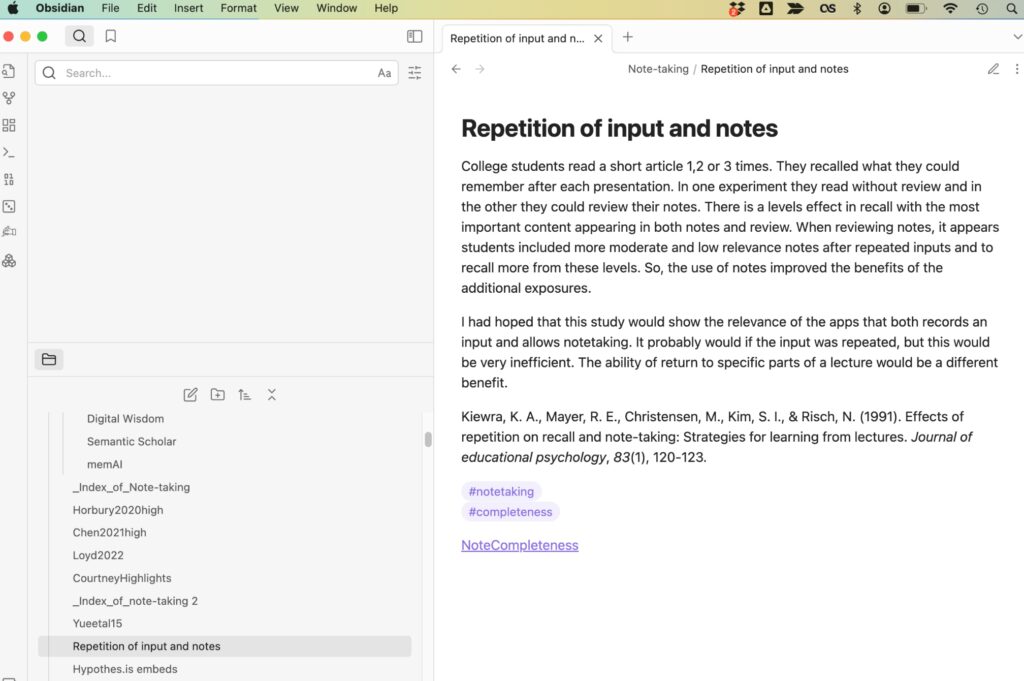
I have prepared a video to offer some idea of how Smart Chat prompts can be applied to the content stored in Obsidian. If you are unfamiliar with Obsidian, the video also offers a glimpse of Obsidian itself. One point I think is important Obsidian and differentiates it from Mem.AI is the way it stores content. Obsidian stores content as individual text files which include content as text and what is called markdown. Markdown is a simple set of tags that allow a user to establish links, tags, and text embellishments such as bolding, size, etc. The benefit is the independence of the files from any specific tool. So, if Obsidian was to go away, you would still have a collection of documents with your information you could salvage. In contrast, Mem.AI stores content in what I think of a database in the cloud. There are ways to export your content, but I find value in knowing I have my content on my computer in a format I can access if necessary.

The Smart Chat plugin requires that you have an Open.Ai account and add some money to cover the cost of your AI activity. I don’t consider the investment that large and have been contributing $5 a month which has covered the cost of my activity.

Mem.AI

This image shows the home screen for Mem.AI. At the top of the screen, you can see the AI prompt window. I pay $10 a month for MEM.AI, but the AI feature is included. The following prompt (same as I used for the Smart Chat plugin in Obsidian) generated the following response. The content of my two note systems is similar, but not completely identical. You see some differences in the content that was generated.

Prompt

List my notes that involve a comparison of taking notes by hand and by using a keyboard. Write a 400 word summary of these notes.

Response

Based on your knowledge base, there are two notes that involve a comparison of taking notes by hand and using a keyboard:

  1. Horbury2021: This study compared the performance of 10 and 11-year-olds taking notes by hand or using a computer. The study found that conceptual understanding was superior when taking notes by hand. The authors speculated that keyboarding may have produced greater cognitive load, especially for children who may have less experience in keyboarding.
  2. Writing a paper step by step: This note mentions a study by Mueller and Oppenheimer (2014) that found no difference in terms of the number of facts students were able to remember whether they took notes by hand or by typing them into their laptops. However, in terms of understanding the content of the lecture, the students who took their notes by hand performed much better.

Here’s a 400-word summary of these notes:

The method of note-taking, whether by hand or keyboard, can significantly impact a student’s understanding and recall of the material. A study by Horbury (2021) compared the performance of 10 and 11-year-olds taking notes by hand or using a computer. The study found that students had a superior conceptual understanding when taking notes by hand. The authors speculated that keyboarding may have produced greater cognitive load, especially for children who may have less experience in keyboarding. This suggests that the physical act of writing might help students process and understand the information better.

On the other hand, a study by Mueller and Oppenheimer (2014) found no difference in terms of the number of facts students were able to remember whether they took notes by hand or by typing them into their laptops. However, in terms of understanding the content of the lecture, the students who took their notes by hand performed much better. This suggests that while the amount of content stored may not significantly differ between handwriting and keyboarding, the process of handwriting might lead to a deeper understanding of the content.

These findings have several implications for educational practices. Given that handwriting seems to lead to a deeper understanding of the content, educators might want to encourage students to take notes by hand, especially during complex lectures or discussions. However, it’s also important to remember that what works best might vary from student to student. Personalization of learning strategies, taking into account individual strengths and preferences, could also be a valuable approach.

In conclusion, while technology has its place in the classroom, these findings suggest it should not completely replace traditional methods. A balance between digital and analog methods could be the key to effective learning. Furthermore, students could benefit from explicit instruction on effective note-taking strategies, such as focusing on understanding over verbatim transcription. The cognitive load of keyboarding for younger students or those less familiar with typing should also be considered when deciding on note-taking methods.

Loading

The Impact of Social Media on Youth Mental Health

A couple of recent resources concerned with the relationship between social media use and mental health. As an educational psychologist with an interest in technology. I find myself in the middle when addressing this topic. I see value in the use of online sources and I also have studied cyberbullying through social media and have some insights into at least that peril. A significant challenge in the actual study of this general question is the difficulty of applying experimental research methods. When you collect data without control (correlational research), you must deal with problems interpreting the direction of causation (does too much social media cause mental health issues or do those with mental health issues turn to social media) and the illusion of a relationship because both variables are related to a third variable. There is also the possibility that the relationship works differently for different individuals. Some may benefit and some may be harmed. What do you do then? 

People often tire of researchers offering the results of their studies and then arguing more research is needed. However, this is probably the best advice as looking for simple answers often does not seem to fit the data. Why does this caution matter? Consider that politicians are being pressed to address social media issues. Those who work in specific fields frequently ridicule the knowledge of politicians. Aside from situations that this is legitimate, there are many situations in which there seems great pressure from the public for action. However, sometimes simple responses are not ideal.

In the digital age, social media has become a significant part of our lives, especially for the younger generation. However, its influence on youth mental health is a topic of growing concern and research. A summary of the two sources I mentioned follows. As always, I provide links and encourage your own reading of these documents if the material covers a topic you find of great importance.

According to the Surgeon General’s Report on Social Media up to 95% of youth aged 13-17 report using a social media platform. The influence of social media on youth mental health is shaped by complex factors, including the amount of time spent on platforms, the type of content consumed, and the degree to which it disrupts essential activities like sleep and physical activity.

While social media can provide benefits by fostering positive community and connection, especially for marginalized youth, it also poses significant risks. A longitudinal cohort study found that adolescents who spent more than 3 hours per day on social media faced double the risk of experiencing poor mental health outcomes, including symptoms of depression and anxiety.

The Atlantic Article on Teens and Social Media further explores this complex relationship. It suggests that social media’s effects depend a lot on the person using it, playing different roles for different demographics and at different stages of life. The article also highlights the need to identify which aspects of social media are riskiest and which adolescents are most susceptible to its harm.

The article also discusses the importance of externalizing our thoughts and feelings, suggesting that those who view social media more positively and feel in control of their use report better outcomes. This highlights the potential for social media to be a tool for expression and connection when used mindfully and responsibly.

However, the relationship between social media and youth mental health remains complex and potentially bidirectional. It’s crucial to continue researching and understanding this relationship to develop effective strategies for mitigating potential harms and promoting positive online behavior.

The Surgeon General’s Report includes specific recommendations for policy makers, companies, parents, and young people.

Loading

Is the online revenue model shifting?

I was listening to a recent podcast episode (This week in tech) that featured an interview with Reddit app Apollo developer Christian Selig (this is the first portion of the podcast should you want to listen) and he described his decision to abandon his popular app for using Reddit because of soon to be imposed cost increases to developers whose software makes use of the Reddit API. The rebellion of multiple Reddit subreddits has been in the news and this interview helped me understand what is going on. The interview also made me think about the issue of revenue generation and those who are users and also content generators in the social media environment. Selig offers a realistic and appreciative interpretation of the rate increase imposed by Reddit, but in describing his decision to shut down his own participation he offers insights into a system that is failing. The “free to use” mentality appears to be breaking potentially with a decline in ad revenue. It is a complicated situation – companies provide the tools which costs for personnel, hardware, and bandwidth. Some have responsibilities to stockholders to generate profits and offer a return to investors. Most depend on content creators who receive little or nothing for their contributions. 

The value I found in the podcast interview was the specific descriptions of some of the financial variables associated with a service such as Reddit and importantly in this case the smaller supporting companies that depend on the infrastructure, members, and content creators provided by Reddit. 

Content creators can make money on platforms such as Reddit, YouTube, and Medium. However, services such as these tend to have minimums that must be met before a content creator makes anything. For example, to receive a cut of ad revenue from YouTube a partner must accumulate 1000 subscribers and 4000 public watch hours in the last 12 months. So, if you can meet such levels YouTube will split the revenue generated with you. 

Personal note – I was once eligible when YouTube had a lower hour total and no user requirement. I don’t generate many videos anymore and am nowhere close to what would be required. 

I began cross-posting some of my blog posts to Medium which has a 100 user follower requirement. Again, have not qualified for the follower minimum. My posts receive attention at about the same level as the original blog posts, but these views do not translate into followers. I admit I use Medium in kind of the same way. I read a few things that are relevant to me and come to my attention, but I don’t follow many individuals. I subscribed to the service for a bit, but eventually decided to invest my subscription money in other services. 

To be fair, if you are interested in your content being viewed and read, you can make free use of these platforms. You just have no hope of generating income if that is your main motivation.

The system I continue to support is that provided by Brave. Brave is a chromium browser (very similar to Chrome) that will show consenting users ads without relying on personal information and that allows those browsing to share some of the revenue generated through these ads with content creators who register with Brave. I have been a Brave user for 6 years now and as a content creator and micropayment supporter of other content creators, I pretty much break even on my costs and income. I originally invested $50 in the cryptocurrency used to anonymously connect producers and consumers and the value of this initial contribution was inflated by the whims of the crypto market. I am slowly depleting this investment as the inflated value of crypto has come down and my micropayments for viewing narrowly exceed what I take in as a content creator. This system seems fair to me. A piece of the pie for the service provider (Brave), content consumers, and content creators. 

I am reluctant to abandon the blogs which I post through a paid provider (BlueHost). I have maintained a blog for more than 20 years and the accumulation of thousands of posts has value to me if for no other reason than it is such an integrated history of my thinking on so many issues. There are ads on my blog posts (you are reading such a post at this point) and I pay approximately $150-200 a year for the services I use. My income is probably $15-25. It is a hobby, but I do value the content I have created. Aside from the value of reading to write in order to generate posts, participation in the online world as a creator has always allowed me to gain insights into the workings of this environment.

My prediction is that the present model is going to change and I think the Reddit situation is a harbinger. As services move from ad-supported models to subscriptions, I anticipate content creators will respond by seeking situations in which their content has value as well. 

Loading