Making studying more productive is my research thing. I assume motivation and then consider how best to go about learning in the aftermath of reading or listening. I have a bias toward the use of technology, which seems to run counter to those who have tuned in to the recent “take notes on paper and not using a computer crowd.” I could and have written extensively about my resistance to this message. Briefly, my logic goes like this. Whether you buy the handwritten-notes-are-better perspective or not, the difference in how important note-taking is accomplished is small compared to the impact of what most people would call studying. Digital notes are better suited to stronger study strategies. This advantage matters especially for those of us beyond our classroom experiences who are self-directed, lifelong learners, using notes to advance our careers or personal knowledge interests.
By “studying,” I mean a Revisit – Revise – Review framework that may help you reflect on your own study habits and identify activities that might be promoted for students. The framework is intended to explain what could happen post-exposure (reading or listening) and before the application of what has been learned (testing, project application).
One quick related comment before I continue. All the recommendations I make aside, perhaps a bigger issue is whether learners are aware of and taught study strategies. This topic deserves an extended analysis. Folks like me, steeped in cognitive psychology and what learning involves, can typically propose principles and practices that make sense and have probably been tested in carefully controlled research studies. The transition to what I guess we’d call the diffusion of such ideas somehow seems to break down. We teach many “how to” skills in formal education, but who is responsible for teaching, modeling, and evaluating “how to learn skills”? Is it, we assume such skills are common sense? Is it, we assume it is someone else who should be responsible? We seem alarmed by how much content is easily available to us, but mostly we throw up our hands rather than ask even the most basic questions about what we offer as strategies learners can use to process this information.
Revisit
What we hear or read lingers in our minds for a bit. This isn’t what we cognitive psychologists call short-term memory, although I guess your STM would be included, but I’m thinking more of the Ebbinghaus forgetting curve. What we retain without purposeful activity drops quickly, and the earlier we can pay attention to what exists the better off we are long term. Using information as soon as possible changes the long-term consequences of the forgetting curve. So a time frame like the rest of the day following a lecture would allow for what I call the revisit stage. Perhaps unusual to some, researchers have shown the benefits of inserting pauses within lectures to encourage revisiting information just presented (Luo and colleagues, 2016). The supposed advantage of handwritten notes assumes immediate personalization through summarization, which also fits this category because it assumes summarizing key points immediately after reception. There is no logical reason taking notes on a keyboard does not involve summarization because the greater speed of capturing ideas should allow more time for thinking, but I guess this is not how most learners use the time – they tend to just record more.
More to my focus on revisiting, aking a look at your notes after class, or even after the day’s classes, still gives you access to information not included in the existing notes. This is a chance to modify and extend the notes you took by adding what you remember but what doesn’t currently appear on the page or screen. Skimming your notes does not require much time; the practice involves retrieval practice if what is there relates to your memory of class, and may allow you to add a few details and recognize confusions. I can’t argue that digital offers a great opportunity while skimming, but again, the advantage I see requires that you start with digital.
Revise
Key productive activities in the period of time between the exposure to information and the application of that information are typically categorized as either retrieval practice or generative. Retrieval practice tactics such as flashcards or practice tests primarily increase the likelihood that information already in memory remains available, or increases the probability that it becomes available. These activities are important, but not the focus here. Generative activities grow the present level of understanding and application value both of what is stored externally (the notes) and in memory. Such activities can include an indirect form of retrieval practice because working with what is externally stored as notes is related to existing information stored in memory, which obviously involves retrieval. For example, generating examples that fit general principles or concepts presented in class uses existing knowledge to extend what might already be stored in notes. Such generative activities may occur purely as a mental activity or be externalized by adding such ideas to the notes that already exist.
The basic insight with generative activities is to treat in-class notes as raw material rather than a finished product. Beyond revisiting what you recorded, active note modification, gap filling, and structural reorganization are ways to work with or think about your notes. One revision strategy is tagging, linking, and separating summaries into independent notes, popularized by those interested in digital personal knowledge management systems, and is more easily accomplished within a digital environment (e.g., Obsidian). Paper-based strategies such as the Cornell note-taking method are another. With Cornell notes (imagine a page divided vertically into a wide right-hand column and a narrow left-hand column with a horizontal space at the bottom), the physical structure of the page provides a template for revision. Comments related to the notes, questions, additions, etc. are to be entered in the left-hand column during study sessions. Use the area at the bottom of the page for a summary.
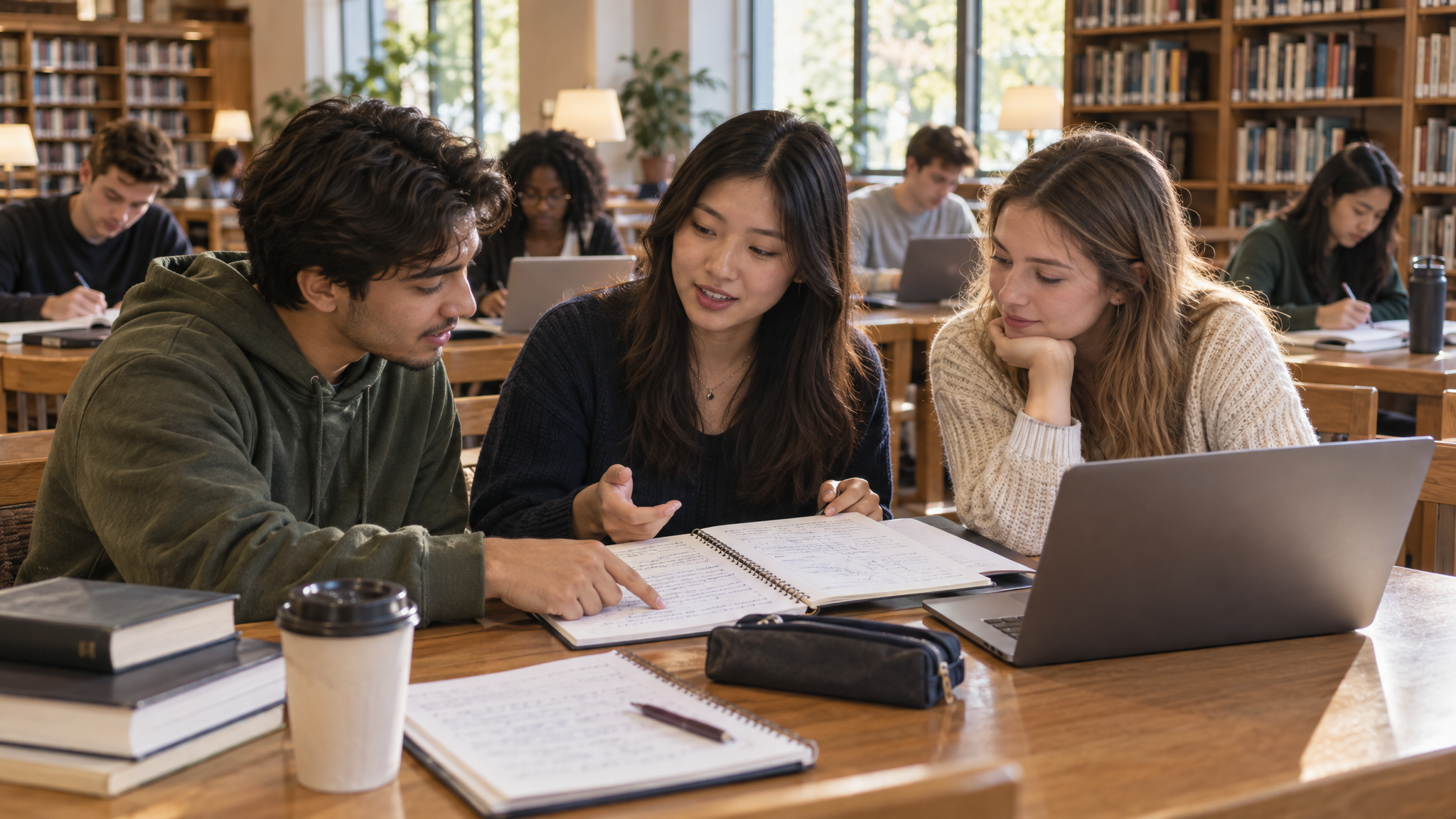
Study groups have always been a strong, concrete suggestion for learners who want to improve their performance. Cross-checking notes with colleagues is successful because what ends up in your notes is a strong predictor of what you can recall. If you only cross-check for errors and completeness, that is significant, but interacting with peers also encourages you to explore how others understand challenging concepts and can involve retrieval practice if you are expected to answer questions posed by others in the group. Fanguy and colleagues (2021) found that a variable they labeled turn-taking significantly predicted performance. Members of those groups involved in more interactions were the most successful.
While I always asked students who commented that they had no idea how they might improve their understanding whether they ever interacted with another student from the class to discuss their lecture and reading content, I tend to think of study groups as more common among higher-level and more demanding content (much of my thinking about note-taking from lectures was centered on the many times I taught Introduction to Psychology to very large groups of students).
Proposal for a study group meeting. Perhaps formulaic, but the description of activities seems useful.
1. Silent read-through (5 min). Each person reads all sets without talking. No copying yet.
2. Gap hunt, one topic at a time (20 min). Go section by section and ask specific questions. “We all have the definition; did anyone get the example she gave?” “I have ‘three factors’ but only two names — what was the third?” This is the difference between simple sharing (adds volume) and collaborative retrieval (adds learning)
3. Reconstruct aloud (10 min). One person explains a segment from memory while others check against their notes and correct. This is where turn-taking earns its correlation with achievement Fanguyetal2023notes.
4. Resolve disputes from the source. If two notes conflict, go back to the recording, slides or textbook rather than majority vote. Cross-checking is the accuracy benefit.
5. Individual close (10 min). Everyone writes their own one-paragraph summary or five-question self-quiz from the merged notes, closed-book. This protects the encoding you would otherwise lose, and gives you a retrieval-practice event rather than a rereading event.
One caveat. The research on collaborative note-taking reminds me of many similar issues with AI. If they have access to the notes taken by peers some may come to rely on such notes and at an extreme even skip classes. When explored in the field, as compared to more controlled laboratory studies in which students likely take a more idealistic approach, experiencing the benefits, but the results from access to the notes of peers or experts in actual classes are more mixed.
Review
If you followed the revision advice, you have already learned not to rely on cramming. In the last day or two before an important exam, keep using retrieval practice activities, not just to identify gaps in understanding, but also because focusing on producing information from memory reduces test-taking anxiety. Old tests are useful because they provide opportunities for retrieval practice and offer insights into what your instructor is likely to ask. Long-term retrieval practice helps even when you don’t produce the correct answer because the process activates related information. However, at this stage, it is important to identify correct answers, as you don’t want to leave incorrect answers as the last thing you remember.
You likely have some insights into areas that you find particularly difficult and allocate the time you study accordingly. Use these metacognitive insights to apply time productively.
Summary
The time between when you take notes and the day or two before the next exams offers the opportunity to develop a better understanding and increase long term retention. By intentionally moving through the stages of revisiting your recollection of a lecture, revising raw notes to expand and integrate what you recorded, and reviewing the products of previous work shortly before an exam, learners transform raw records into enduring, lifelong knowledge. Maybe, all things considered, the biggest insight here is that there are three stages and moving directly from taking notes to review is the limited approach too many take.
Sources:
Butterfield, B., Metcalfe, J. The correction of errors committed with high confidence. Metacognition and Learning 1, 69–84 (2006). https://doi.org/10.1007/s11409-006-6894-z
Cohen, D., Kim, E., Tan, J., & Winkelmes, M. A. (2013). A note-restructuring intervention increases students’ exam scores. College Teaching, 61(3), 95-99.
Courtney, M., Costley, J., Baldwin, M., Lee, K., & Fanguy, M. (2022). Individual versus collaborative note-taking: Results of a quasi-experimental study on student note completeness, test performance, and academic writing. The Internet and Higher Education, 55, 100873.
Fanguy, M., Baldwin, M., Shmeleva, E., Lee, K., & Costley, J. (2021). How collaboration influences the effect of note-taking on writing performance and recall of contents. Interactive Learning Environments, 1-15.
Luo, L., Kiewra, K. A., & Samuelson, L. (2016). Effects of lecture pauses on student note-taking and learning. Journal of Educational Psychology, 108(3), 342-353. doi: 10.1037/edu0000139
