Debating an AI Opponent

I have written on several occasions about the educational potential of debate. Researchers who focus on this topic often use the alternative term “argumentation“. Debate requires a deep understanding of the contested topic and offers a concrete way to exercise critical thinking. It also involves a motivational element because it involves competition. I read some educational research on debate and made a personal connection, noting how quality argumentation differed from the arguments I read on social media. Most of my previous posts about argumentation are available on my blog

A couple of years ago, I encountered a proposal that AI chatbots could serve as debate partners and saw a connection to Deanna Kuhn’s research, which investigated text messages as a way to develop argumentation skills because the process created a written record that could be analyzed and discussed. I saw a similar opportunity in the written record produced in an AI chat and the AI system could provide an opponent. 

I had done little more with this idea until recently, but I began thinking about a more formal debate format and decided to see how AI would implement the format I had in mind. 

Here is the prompt I have been exploring.

I want you to debate me on the topic of whether a computer and keyboard or handwriting on paper is the best note-taking approach. First, write a 200-word position statement supporting handwriting, and I will do the same for using a keyboard. After evaluating my position, write a challenge to my position. I will reply and challenge your position.

I chose this topic because I have read much of the related research and popular press and I think I understand the issues and competing positions. I also argue the less popular digital approach. This combination seemed a good combination to evaluate the experience. 

The change I made from my previous approach to an AI debate was to add the expectation that each participant create an introductory position the two parties a way to identify what appeared to be issues that were in disagreement. One more thing, while I first explored this experience using an AI subscription I use (Claude), I then tried the Mac mini on which I self-host an AI system (running Ollama) and repeated the process. The self-hosted experience was great and had the strange benefit of being to take an hour or so off for lunch and come back to the computer with the debate still active. I was particularly impressed by the content the AI was able to through at me. This Mac was not connected to the Internet and the only explanation I can offer is that I use the same setup to run a Karpathy Wiki and I have a great deal of relevant content within that system.

I have a substantial amount of content stored from this session and I often include such material as an Appenedix, but this was simply too much material. As an alternative, I decided I would upload the transcript of the entire debate to NotebookLM (Gemini Notebook) and include a link to this notebook for anyone interested in reading the transcript. 

I had one final idea. What if I use the AI embedded with the notebook to ask for an evaluation of the arguments and a winner?

Even if you don’t examine the transcript of the debate, NotebookLM’s evaluation gives you a sense of the level of the content and the interaction produced. I was a little disappointed because I thought my position was beyond logical refutation, but Notebook seemed unwilling to declare me the clear winner. The experience was not unlike actual debates. Can you get your opponent to engage with you on what you want the judge to accept as the key or deciding issues? 

Prompt: I want you to evaluate this debate considering whether taking notes by hand or using a computer is best in preparing a learner for tests based on lecture content. Are the best arguments made by the pro-keyboard or pro-handwriting supporter?

Evaluating this debate through the lens of preparing for tests based on lecture content reveals a fundamental tension between efficient information storage and active cognitive processing.

Both sides offer strong, distinct arguments depending on the type of test being taken and the student’s studying habits.

The Pro-Handwriting Case: Best for Conceptual Tests and Internal Recall

The pro-handwriting supporter makes the most compelling arguments regarding internalization, conceptual understanding, and performance under actual exam conditions.

  • The “Recall” vs. “Retrieval” Advantage: In an exam setting, students do not have access to their devices or a search engine. The handwriting supporter argues that digital note-taking promotes “cognitive offloading” and “retrieval” (knowing where to find a fact in a database) rather than “recall” (pulling a concept from internal memory). Handwriting forces the brain to do the heavy lifting immediately, creating the robust neural pathways needed to recall information under pressure without a digital “crutch”.
  • Performance on Conceptual Questions: Backed by the Mueller and Oppenheimer (2014) study, the handwriting advocate highlights that because typing is fast, it leads to mindless “transcription”. Because physical writing is slower, hand-writers must summarize and prioritize key concepts in real-time. This “selective encoding” means they perform significantly better on conceptual and synthesis test questions.
  • The “Sieve” vs. “Bucket” Study Cycle: Handwriting acts as a “sieve” that filters information during the lecture. When test preparation begins weeks or months later, the hand-writer reviews a distilled, pre-processed “mental map”. In contrast, a typed “bucket” of notes requires the student to spend limited study time filtering a mountain of raw, flat data before they can even begin deep synthesis.

The Pro-Keyboard Case: Best for Detailed Tests and Long-Term Study Flexibility

The pro-keyboard supporter makes highly sophisticated arguments regarding information completeness, managing cognitive load, and the reality of long-term study cycles.

  • Performance on Detail-Oriented Questions: The keyboard allows students to type fast enough to capture almost everything accurately. For exams that test factual details and specific data points, the pro-keyboard side is heavily favored, as research indicates laptop users perform better on detail-oriented questions due to their comprehensive records.
  • Managing Lecture Cognitive Overload: The keyboard supporter rightly points out that a fast-paced lecture is not the ideal setting for deep conceptual thinking. Attempting to synthesize while keeping up with a speaker can cause cognitive overload. Keyboarding minimizes the friction of capture. This “offloads” the processing during class so the student can focus on capturing data, leaving the deep reflection to a low-pressure study environment.
  • Iterative Study and Optimization: Digital notes are highly malleable. Features like searchability, audio-linking, and inserting placeholders (like “XXX”) for missed content allow students to efficiently patch gaps, reorganize ideas, and elaborate on notes over a semester-long period. This active post-processing provides a substantial generative advantage over rigid, handwritten pages that are cumbersome to restructure.

Conclusion: Who Makes the Best Arguments?

The pro-handwriting supporter makes the superior psychological and cognitive arguments for final test performance. Their points are deeply anchored in established learning science—such as “desirable difficulty” and the “generation effect”—proving that the physical friction of writing is a feature that directly constructs a student’s internal cognitive map. Under test conditions, a “remembered concept” will always outperform a “searchable note”.

However, the pro-keyboard supporter makes the more realistic argument regarding modern study workflows. If a student is highly disciplined and actively uses the study phase to review, edit, and link their digital notes, the digital “workspace” provides a highly scalable and superior infrastructure for long-term learning.

Ultimately, if the goal of note-taking is to build a high-functioning cognitive map to ace conceptual exams, the pro-handwriting arguments are the strongest. If the goal is to build a durable, searchable archive for detailed reference, the pro-keyboard arguments win out.

Would you like me to create an interactive study guide or a set of flashcards based on these opposing cognitive theories to help you further analyze these learning principles?

References:

Kuhn, D., Goh, W., Iordanou, K., & Shaenfield, D. (2008). Arguing on the Computer: A Microgenetic Study of Developing Argument Skills in a Computer-Supported Environment. Child Development, 79(5), 1310-1328

Mayweg-Paus, E., Macagno, F., & Kuhn, D. (2016). Developing Argumentation Strategies in Electronic Dialogs: Is Modeling Effective. Discourse Processes, 53(4), 280–297. https://doi.org/10.1080/0163853X.2015.1040323


Loading

AI (Grammarly) and Writing: Good or Evil?

I am interested in the potential of AI in developing writing skills. I am presently focused on Grammarly, having used the tool for years, and am now considering how it might play a productive role in secondary and higher education efforts to develop writing skills. Exploring what those writing about Grammarly on Medium have to say about Grammarly, I have come away with the impression the majority argue the tool is overpriced, less effective than tools with a similar purpose, and generally a bad idea when applied in an educational setting. I don’t agree. 

Writing in the classroom

I like to draw a distinction between learning to write and writing to learn. This distinction is artificial, as classroom instructional strategies such as “Writing Across the Curriculum” argue that both goals can be addressed when writing assignments in other disciplines are evaluated both for the quality of the writing and for what the writing suggests about students’ understanding of a given topic. My argument here focuses on the potential value of AI in learning to write. 

When and why is AI a problem when learning to write

In situations where the development of writing skills is the emphasis, an AI tool is argued to be problematic because students cheat by using AI to avoid doing work that requires them to practice the skills they are expected to master. In addition, by turning in work for evaluation that students did not actually perform, they do not receive feedback on the skills they are supposed to be learning and are credited with achievements they have not actually earned. 

AI and writing: A different take on the actual problem?

Many educators, aware of the possibility of cheating, have resorted to approaches such as short, handwritten in-class assignments that eliminate the possibility of using AI. There are limitations to this approach, especially for the unique skills required to create longer arguments or other lengthier projects. 

As adults with reasons to write and without worrying about the need to prove everything that appears in a written product is based on our own knowledge and writing skills, we may take advantage of AI in many different ways. One real question is how, and perhaps if, we are preparing students to transition from a focus on learning new skills or the graded demonstration of one’s knowledge to a combination of AI and personal knowledge and writing skills. In addition, some are suggesting, and again rightfully so, that AI can benefit students’ efforts to learn to write and write to learn. Here, I want to emphasize the potential assistance in learning to write more effectively. 

I tend to react to what I think are naive expectations of teachers and the reality of working in classrooms is important here. For example, I support the exploration of AI as a tutor, not because I think AI is equivalent to a human tutor, but because human tutoring is costly and many students who need help do not receive sufficient human attention as a consequence. I have a similar opinion about learning to write. It would be great if each student could write a lot and receive rapid feedback, as well as an individual conference related to their effort. Neither immediate, consistent feedback nor frequent individual attention is practical. Just having an AI writing tool, such as Grammarly, that can provide immediate feedback on what has been written seems like a practical improvement.

So Much Depends on Personal Motivation

Grammarly and asking pretty much any AI tool to evaluate specific attributes of your writing quality will provide you with feedback to consider. The issue is really whether you take the time to ask for this feedback and to consider the feedback that is produced. Here is what I mean. I use Grammarly while I write, and it constantly provides feedback. In reflecting on my own behavior, I almost always quickly accept the suggestions for what I have written (these appear as underlines in various colors) by clicking to have Grammarly fix the problem. I don’t stop to figure out what was wrong with what I wrote. Was that an actual error of grammar or spelling, and if so, why? The fixes always seem better, but they also remove what may just be my voice or personal preference in how I say something. I avoid the opportunity to learn and also allow Grammarly to “standardize” my writing. At this moment, admitting this has made me self-conscious. 

This reminds me of the experience I had providing comments on many of my grad students’ theses and dissertations. In later years, I liked to use the comments feature in Google Docs to leave comments and identify actual errors. I started to realize that some students were simply allowing me to rewrite their papers, when what I wanted was for them to consider something different. Often, I had to remind them of the difference between my thoughts about their work and the actual errors I pointed out. 

If you use a tool such as Grammarly, you probably recognize my observation in your own behavior. It is so easy to accept proposed changes based on a kind of “that sounds pretty good thinking” and trust in the assumption that the “system knows the rules better than I.” Taking this approach is quick, painless, and “good enough.” The problem is that this approach fails to take advantage of at least some of these situations to learn. Why were these changes recommended? Is my way of expressing myself flawed or just unique? Grammarly will help you consider which is most likely. 

What was wrong with what I wrote?

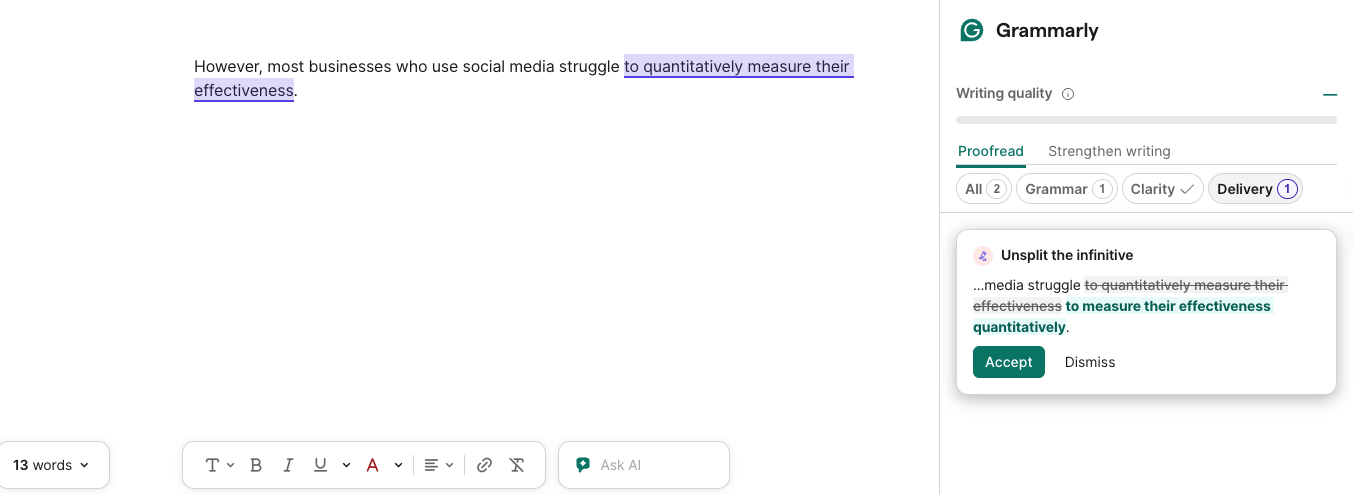
Grammarly has always allowed you to pause when suggesting a change. There was no time limit on the opportunity to consider what you wrote in comparison to what was recommended. As the tool was improved and with the more recent integration of AI, efforts were made to explain why a change was recommended. At first, the tool offered a general reference to rules. Here is what a split infinitive is, and here are some examples of sentences containing a split infinitive and improved versions of the same sentences. Here is an example of passive voice, and here are some examples. The most recent advance offers similar information, but specifically related to your own words rather than just generic examples. 

One note – I have encountered descriptions of this newest capability from others, but I haven’t been able to replicate the same output on my own computer with the latest version of Grammarly. I have had this difficulty even though I input exactly the same text used in the other demonstrations I have encountered. My setup will identify the error and provide generic examples, but it won’t explain based on the text I have entered. I can generate explanations specific to my written text, but I have to use the AI window to enter a prompt asking for this information (see examples below). 

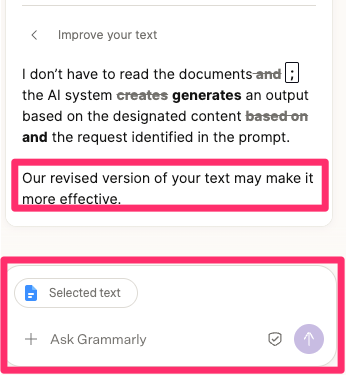
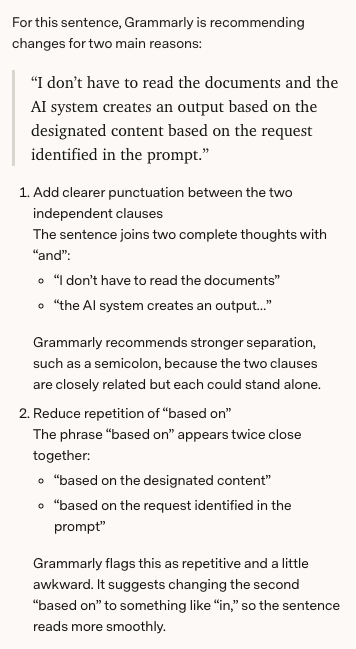
Here are a couple of examples. In the first, you see a sentence with three components underlined in blue (I highlighted it in blue so you can find it). In the associated column on the right you see the proposed alternative with the changed words or punctuation bolded. The red box identifies the button to get additional information. The second image shows the result of making use of this button. The explanation for the proposed changes – Our revised version of your text may make it more effective. – is Grammarly’s explanation. As I said, this offers little of value to me. However, if I use the AI prompt box (Grammarly calls this Superhuman Go), which appears at the base of the right-hand column, I can ask for an explanation, and I receive the lengthy explanation shown in the third image. 

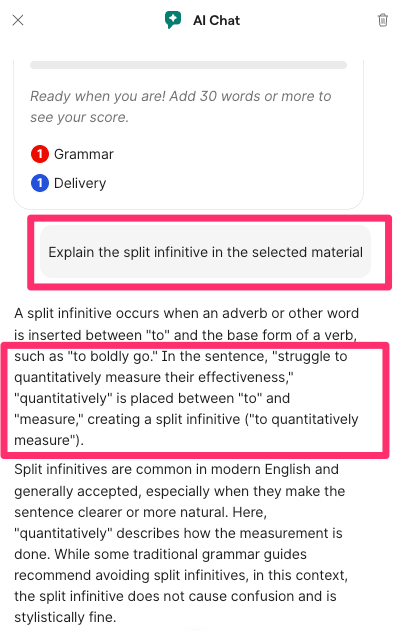
Here is a second example that explains a split infinitive. Again, if I ask for an explanation related to the limitation in my writing, I get both a general and a targeted explanation of the split infinitive (second image).

Improvements at multiple levels

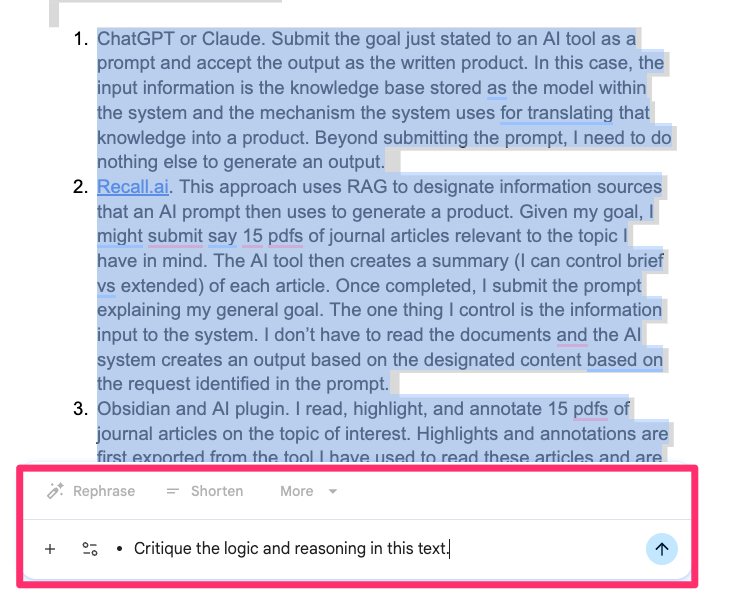
Improvement in writing happens at multiple levels. There are spelling errors and grammatical failures. These are the easiest for a digital tool to identify, and spelling correction has been around for decades. These might be described as superficial errors. There are deeper levels of good writing that any of us who critique others’ work find much harder to evaluate and that are the most difficult proficiencies to teach and learn. Grammarly’s AI capabilities provide a way to address these proficiencies. The easiest way I can describe this capability is to list some of the prompts Grammarly suggests. 

  • “Critique the logic and reasoning in this text.” 
  • “Are there any gaps in my argument here?” 
  • “Does this conclusion follow from my premises?” 
  • “Point out any weak points in my reasoning.” 

I will append Grammarly’s extensive analysis of a recent post based on one of these prompts (see Appendix). I have extensive experience as an academic writer with two published textbooks. These works involved feedback from a dedicated editor and input from multiple paid professors regarding both the content and communication style. The detail in Grammarly’s feedback is easily as detailed. 

Summary

The point I am trying to make here is not that AI cannot be used to cheat. My point is that Grammarly and other AI tools can also provide feedback more quickly and consistently than is practical for educators. This seems to be another example of the constant dilemma with AI, it can be used for good or for evil. In this case, when a writer is working on their own, they decide which it will be. 

Addendum

Grammarly’s analysis of AI Processing Options

Prompt: Point out any weak points in my reasoning

A few places in the reasoning could be stronger or more precise:

  1. The continuum needs clearer criteria
    You describe a continuum from “total AI” to “total human,” but the dimensions of that continuum are a little mixed. Sometimes the distinction is about who selects the source material, sometimes who reads it, sometimes who organizes it, and sometimes who writes the final text. You might strengthen the piece by naming the dimensions explicitly, such as:
  • control over source selection
  • depth of human engagement with sources
  • human contribution to interpretation
  • AI role in organization
  • AI role in final wording
  1. “Information input” may be too narrow
    In the Recall.ai example, you say the main thing you control is the information input. But choosing 15 PDFs is not just supplying information; it also frames the argument by deciding what evidence counts. That choice may involve substantial judgment, even if you do not read the documents closely.
  2. The quality question needs more defined standards
    You ask which approach produces the highest-quality product, but “quality” could mean many things: factual accuracy, originality, usefulness, writing style, source integration, depth of understanding, efficiency, or ethical acceptability. The argument would be stronger if you noted that different approaches might score differently depending on the quality standard.
  3. The “total AI” end may not be truly total AI
    Even in the ChatGPT/Claude example, the human still defines the topic, purpose, and prompt. So it may be more accurate to call this “minimal human input” rather than “total AI.”
  4. The “total human” end still includes tool-mediated thinking
    The Obsidian-only example is described as having no AI use, which makes sense if the point is AI involvement. But it still involves a digital tool that shapes organization, retrieval, linking, and thinking. If your continuum is specifically about AI involvement, that is fine—but you may want to clarify that it is not a continuum from tool-free writing to machine-written writing.
  5. The RAG example may understate verification
    You note that you do not have to read the documents, but that raises an important issue: without reading them, you may not be able to evaluate whether the AI’s summaries are accurate or whether the final product fairly represents the sources. This is an important weakness in that approach and could be made more central.
  6. The Karpathy Wiki stage could use more explanation
    This is the most complex example, but the reasoning around why it is distinct could be clearer. Is the key difference that AI creates a reusable knowledge structure? That it separates source processing from final generation? That it mimics a human note system? Stating the main conceptual difference directly would help.
  7. “Parallel to how human writers function” is promising but underdeveloped
    You suggest that identifying themes and concepts before drafting may parallel human writing. That is an interesting claim, but it needs a bit more support. Human writers do not just extract concepts; they evaluate, synthesize, prioritize, and sometimes change direction. You could strengthen this by explaining exactly which parts of the AI process resemble human writing and which do not.
  8. The ethical/authorship issue is implied but not addressed
    Your categories raise questions about authorship, responsibility, and acceptable AI assistance, but those issues are not directly discussed. If this is meant to help readers evaluate AI writing practices, you may want to include a brief note about where responsibility for claims and interpretations resides.
  9. The examples could be labeled more consistently
    Some category labels name tools, while others name processes. For example, “ChatGPT or Claude” names tools, while “Obsidian to Karpathy Wiki to Product” names a workflow. You might make the structure more analytical by using labels like:
  • Prompt-only generation
  • Source-constrained generation
  • Human-annotated source generation
  • AI-organized knowledge-base generation
  • Human-authored synthesis

Overall, the central idea is strong: you are not treating “AI writing” as one thing, but as a range of workflows with different levels of human involvement. The main improvement would be to make the continuum’s criteria explicit so readers can see exactly what changes from one category to the next.

Loading

An AI LLM Can Identify Important Missing Content In Student Notes

There seems to be a resurgence of research interest in note-taking and note-use. One source of new work was the controversy over whether students should take handwritten notes or use their laptops or tablets. A second focus has been generated by what I would describe as “out of classroom” notetaking described by those promoting personal knowledge management (PKM) and interactions with a second brain. 

I have had a long-term interest in notetaking and studying and recent activity has caused me to review old sources in light of newer activity. Possible connections between notes taken and stored digitally and the capabilities of AI tools seem worth exploring.

I still understand note-taking and note use from a decade old model that argues learning with and from notes can be outlined in terms of an immediate generative benefit of taking notes and by then using the external storage function of notes for review and study. A generative benefit implies that taking notes provides an advantage over simply listening and reading. The external task prompts the note-taker to identify important ideas because it is not practical to record everything, and then cognitively acts on the selected information to personalize the original content through summarization and connections to existing knowledge. Of course, there are many strategies for doing this, as well as individual differences and less active approaches, such as simply writing down what the instructor displays on his/her PowerPoint slides.

One topic relevant to how I imagine AI being used in interaction with student notes is work that examines how effectively learners have recorded important ideas. How many ideas find their way into the notes and are these ideas important ideas? Here you find some interesting controversies. Early work on note-taking in actual classroom settings found a substantial correlation between the volume of content students recorded and their exam performance (Nye and colleagues, 1984). I want to emphasize the word “naturalistic” here because, as the authors of this study claim, so much of the research has been conducted in short-term laboratory studies involving short segments of content and immediate examinations – not the situation students face in practice. I have made the same complaint in a recent post

A recent controversy related to what might be described as the “more is better” position is the handwriting vs. keyboarding controversy. The issue here is that keyboarding allows for more input, but handwriting appears to lead to more generative activity because the slower process encourages greater selectivity and summarization. My observation is that selection and reworking of notes does not have to happen in real time and having more content to work with during review and study makes such reworking more productive. 

This brings me to a second observation. While it seems possible that learners would not record information they think they already know, for one reason or another, students fail to record a sizeable proportion of important information, and what is not recorded can be related to specific later failures of recall and application on learning measures. It is difficult to study what you don’t know and what was not recorded (e.g., Kiewra, 1985; Lawson & Mayer, 2024).

Expert Notes and the AI Alternative

One solution to the many important ideas that students miss, especially less capable students, is to provide what are often called “expert notes” – essentially notes provided by the instructor or taken by an advanced student (Kiewra, 1985). This is a topic I explored in my own research with my graduate students (e.g., Grabe and colleagues, 2005). To be clear, the idea is not to substitute expert notes for student notes because of the generative value of taking notes, but to provide a second source learners can use to “fill in the blanks” for what they missed or perhaps did not understand well enough to even attempt recording. 

There are practical issues with providing quality notes to students. One issue that interested me in the citation I provided was the relationship between providing quality notes and class attendance. You do want students to attend class, but the reality is that there is also the question of what can be done for those students who miss class for legitimate reasons. Second, the generative effect of taking notes describes note-taking itself as a learning experience, so you really don’t want to discourage student note-taking. 

I have been exploring a use of AI that seems interesting and efficient in a couple of ways. It is relatively easy to prompt AI to identify the “important ideas in a lecture”, to compare this material with the notes taken by a learner, and to generate an output of the important ideas not contained in the student notes. This approach is efficient for students because it does not require reviewing the entirety of what might be considered “expert notes.” It also builds on rather than eliminates the student’s generative effort to create their own notes.

To explore how this might work, I used my current AI service to run the following prompt. The inputs included, first, the transcript of a source podcast on why climate change can be responsible for both drought and flooding, and, second, the notes I took while listening to the podcast. The original source contained approximately 2500 words and as a podcast required approximately 15 minutes. I attempted to play the role of students and created a set of notes while listening. I admit that I was surprised to learn a few things about how climate change works even though the material was prepared at the high school level. I purposely ignored comments that appeared near the end of the podcast that focused on fire danger and health concerns as a way to approximate what notes might look like if a student became distracted or cut out of class early. 

Prompt: I am providing two text segments. I want you to identify the important content from the first segment. I then want you to compare this important content with the content in the second segment and identify the important ideas in the first segment that are not included in the second.

I have included, as an Appendix, both the important ideas identified by the AI tool and the list of “important ideas” in the presentation that the AI tool said were not included in my notes. 

The approach identified and provided missing comments on both wildfires and health issues, which was my proof of concept when it came to responding to the problem of students missing important ideas, but it also included additional information that the comparison of the original content and my notes did not. So, when I compared the summary with my notes, the comparison in response to the prompt identified content I purposefully missed and other items I heard but did not record. This second body of information was much larger than I would have anticipated and fits existing research concluding even better students (apologies if this sounds conceited) fail to record more than one might expect. It is hard to know if this is an actual problem or simply a difference in standards. I have no idea whether the prompt could be altered to change how the AI tool interpreted “important content.” 

One interesting item – there is at least one item in the comparison between the AI summary of important ideas and my notes identified as missing that actually does not appear in the AI summary but was included in the full transcript (The claim that the most destructive floods now occur about three times as often as before). 

Final Comments

It is likely not a surprise that AI creates a summary of content, as this is a commonly offered service now often available as an alternative to asking readers or listeners to review all of the original raw content. I am not certain if I explored different wordings of my prompts if a request for the “important ideas” would be much different from a summary.

I have considered whether a summary or review of the most important information would offer essentially the same practical value as the second step I have AI to provide. The amount of content would differ. The summary I provide as an appendix is about a third of what would be generated from a traditional fifty-minute college lecture. I do like the idea of identifying what a student missed, which may have unique value in prompting students to consider their note-taking process. Helping students identify important information they missed also keeps the focus on student responsibility for the generative learning opportunity in making their own notes.

Sources:

Grabe, M., Christopherson, K., & Douglas, J. (2005). Providing Introductory Psychology Students Access to Online Lecture Notes: The Relationship of Note Use to Performance and Class Attendance. Journal of Educational Technology Systems, 33(3), 295-308.

Kiewra, K.A. (1985). Providing the instructor’s notes: an effective addition to student notetaking. Educational Psychologist, 20(1), 33-39. https://doi.org/10.1207/s15326985ep2001_5

Nye, P.A., Crooks, T.J., Powley, M., & Tripp, G. (1984). Student note-taking related to university examination performance. Higher Education, 13(1), 85-97. https://doi.org/10.1007/BF00136532

Appendix:

Important content in Segment 1

  • Climate change is intensifying both droughts and heavy rainfall/flooding.
  • A warmer atmosphere holds more water vapor, while hotter land surfaces evaporate moisture faster:
    • This dries land and worsens drought.
    • It also creates the potential for more intense downpours once rain occurs.
  • The most serious change may be in extreme storms, rather than in average rainfall or average storms.
  • Existing infrastructure is poorly suited to extreme weather, especially because roads, roofs, parking lots, and other impervious surfaces increase runoff and flooding.
  • Flood risk is not limited to coasts and rivers; intense rainfall can cause serious stormwater flooding inland.
  • Communities can reduce flood impacts through:
    • Updated emergency plans and warning systems
    • Recovery resources
    • Green space, trees, grass, and rain gardens
    • Reducing impervious surfaces, including through greater public transportation
  • Climate impacts vary by region:
    • New England’s warming coastal ocean can fuel stronger winter storms.
    • Subtropical regions, including the U.S. Southwest, are generally expected to become drier or more arid.
    • Some areas may not follow this pattern; for example, the Sahara may become wetter.
    • Monsoon regions may receive rain in fewer, more intense events, harming people and agriculture.
  • Water-cycle changes also worsen other hazards:
    • Drought can increase wildfire risk.
    • Alternating wet and dry periods can grow vegetation and then dry it into wildfire fuel.
    • Humidity makes heat waves more dangerous because it prevents sweat from cooling the body effectively.
  • Adaptation is necessary, but reducing fossil-fuel use and climate pollution is also essential to limit future worsening.
  • Community discussion and engagement are presented as meaningful individual responses to climate change.

Important ideas from Segment 1 not included in Segment 2 (my own notes)

  1. Examples and evidence of current extremes
    • California reservoir lows, Fort Lauderdale flooding, and Brooklyn’s extreme rainfall.
    • The claim that the most destructive floods now occur about three times as often as before.
  2. The distinction between average conditions and extremes
    • The largest storms are becoming stronger even if the average storm is not necessarily changing as much.
    • The primary concern is extreme downpours, not merely average rainfall.
  3. Detailed flooding and infrastructure discussion
    • Impervious surfaces such as roofs, roads, sidewalks, and parking lots worsen runoff.
    • Inland communities face stormwater-flooding risks even when they are far from rivers or coasts.
    • Specific adaptation measures: rain gardens, trees, green space, early-warning systems, emergency planning, recovery resources, and public transportation.
  4. New England’s regional climate risks
    • Rapid warming of nearby ocean waters.
    • Greater land–ocean temperature contrast in winter that can help fuel nor’easters, blizzards, and hurricane-force winds.
  5. Regional variation and uncertainty
    • Climate impacts do not follow identical rules everywhere because continents and local wind systems complicate global patterns.
    • The Sahara may become wetter despite the broader tendency for many subtropical dry regions to dry further.
    • Monsoon rainfall may become more variable and concentrated into fewer, more intense events.
  6. Wildfire impacts
    • Drier conditions make vegetation easier to ignite and allow fires to spread.
    • Wet-to-dry cycles can build vegetation and then convert it into highly flammable fuel.
  7. Humidity and heat-wave danger
    • Humid air makes sweating less effective, making humid heat more dangerous than dry heat.
  8. Mitigation and social response
    • The need to transition away from fossil fuels and reduce climate pollution.
    • The message that some worsening is already expected, but further escalation can still be limited.
    • Encouragement for people to discuss climate change within their communities to build understanding and counter despair.

Loading