When I first began writing professionally about K-12 use of technology in the mid-1990s, a popular approach was to organize content around the tutor, tool, tutee model. This model proposed that technology in the hands of students could deliver instruction (tutor), facilitate the activities of being a student (tool), and program/code (tutee). While AI now blurs the lines between these roles, this simple organizational scheme still seems useful.
This post was prompted by what I sense to be dissatisfaction with the instructional component of this model and a recent paper entitled the “5% problem. This paper challenged the positive benefits of commercial instructional offerings (e.g., Kahn Academy, CK-12) as misrepresenting what the data on achievement they have collected demonstrate. Ignore my descriptor of such programs as commercial when I know you can use at least many of the features of such offerings at no cost. How these efforts are funded is a different issue. The relevance of “5%” lies in the hidden expectation that only those who use the learning system as intended are included in the analyzed data. Some studies reporting high effectiveness are based on 5% of those provided access and this important factor is not highlighted in the reporting of results.
Such assertions make me uncomfortable. Despite what to me seems a backlash against screen time, cautions related to AI allowing learners to offload the experiences intended by learning tasks, and concerns classroom circumstances associated with technology have caused educators to limit meaningful social contact with students and students with each other, now I am feeling I must question the studies I have explored on the benefits of AI tutoring and the personalization of the rate of progress through instructional materials allowed by computer supported instruction (e.g., Kulik & Fletcher).
Teacher Commitment
As I have considered this recent challenge, it has occurred to me that I have encountered a variant of it throughout my career. In 2019, I wrote a blog post titled “There is a reason teachers don’t use the software provided by their districts.” At the time, this issue caught my attention because my wife and I were serving on an advisory group for our local school district and the tech director reported on a monitoring software used to track the use of software the district had purchased to make decisions about which license access packages could be dropped so funds could be reallocated to other requests. I noticed some researchers were using what seemed like a similar system to examine the use of instructional technology and to consider why it was underutilized. These scholars reached a conclusion nearly identical to that of the more recent, in-depth examination of online instructional tools. “One of the other primary findings of this report is that usage of apps is generally lower than might be expected. Most apps are used only for a limited time, and most purchased by districts go unused. This has an impact on efficacy – an app cannot be effective if it is not used” (p.25).
At that time, it seemed the issue was explaining teacher commitment. Thomas Arnett has weighed in on the issue of school-funded software being seriously underutilized, speculating, based on his Jobs to be Done Theory, that educators simply don’t perceive that the software they have access to helps them satisfy the jobs they perceive as expected of them, relative to more traditional approaches. These jobs are described as 1) Help me lead the way in improving my school, 2) Help me find practical ways to engage and challenge more students, and 3) Help me replace a broken instructional model so I can help each student. From my perspective, many technology-based instruction systems seem purposefully designed to address individual learning speeds and existing knowledge, but perhaps this is how these resources by educators. In a more detailed version of this only online description, these authors propose that educators might respond if a greater effort were made to engage educators with data and anecdotal accounts of the success of peer educators.
What about the learners?
As I explored this history and what seems a frustrating pattern for those of us who have been influenced by the seeming promise of personalized progress systems and intelligent tutoring systems in a carefully controlled context, when turned loose in the complexity of schools and classrooms. The challenge of matching key elements of the controlled setting in which concepts are developed in applied settings is termed fidelity and is an issue in many fields (e.g., Trustschel and colleagues). I have struggled with this challenge in my own research, which has often focused on creating technology-facilitated study environments for college students enrolled in large introductory classes.
Cognitive research has accumulated a massive amount of evidence demonstrating the effectiveness of retrieval practice and the challenge that less capable learners are often much less aware of their specific knowledge gaps and a false sense of understanding (i.e., metacomprehension). In other words, less capable learners often don’t know what they don’t know and thus are very inefficient at remediating their problem areas. One way to provide retrieval practice and address poor metacomprehension is to provide practice tests. More sophisticated applications that make use of technology can also track weak areas so that these areas can be emphasized, link the student to remedial content when individual elements of information are not known or misunderstood, and even request students to predict the accuracy of their performance in an effort to increase awareness of strengths and weaknesses.
If you are interested in the details of this study, I have provided a citation below. The relevance of this study for the present post concerns the willingness of learners, college students in this case, to take advantage of a resource designed to improve their performance. The following graph is an easy way for me to make my point. Learners were divided into three groups based on course performance. For each of the three exams, the percentage of learners in each performance group who satisfy the stated goal of the study task, use but do not meet this standard, or do not use the study task is identified. There is a clear pattern: those performing the worst do not meet the study goal. Most persuasively in keeping with the other data reported in this post is the data on those who made no effort to use the system. It is possible trying but failing to reach the stated standard is related to understanding or aptitude, but failing to try, which should still be beneficial, is not.
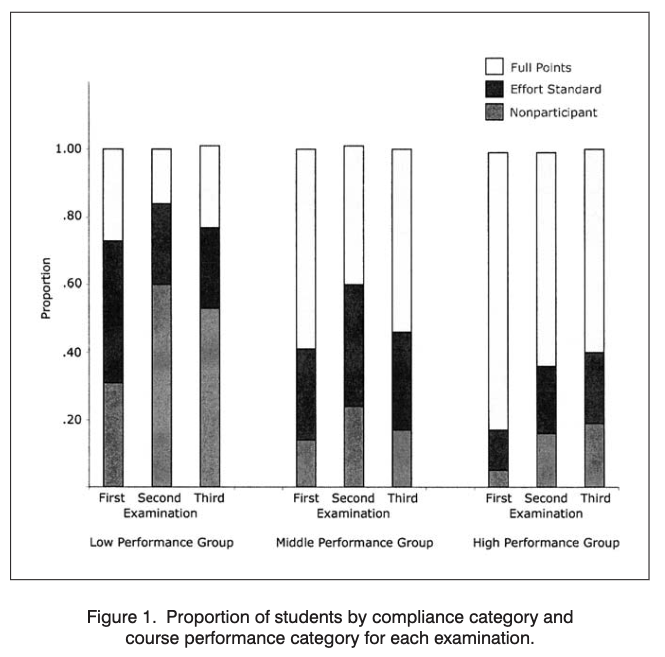
As was the case in the 5% paper, those less in need of assistance participated more in a likely beneficial activity. In fairness, the “perceived suitability” of a learning opportunity proposed while vague offers a second possible explanation.
Summary
In this post, I consider the persistent “underutilization gap” in educational technology, where instructional tools—from commercial platforms to AI tutors—frequently fail to achieve their promised impact because they are either ignored by teachers or avoided by the students who need them most. It is true that the “5% problem highlights how efficacy data is often skewed by only including the small fraction of users who follow the system as intended, while struggling learners consistently participate the least in these personalized systems. Ultimately, I suggest that EdTech’s potential for personalized progress remains stalled by a lack of “fidelity” in real-world settings and a failure to align software with the practical “jobs” educators and students actually prioritize.
Citations:
Grabe, M., & Flannery, K. (2010). A Preliminary Exploration of Online Study Question Performance and Response Certitude as Predictors of Future Examination Performance. Journal of Educational Technology Systems, 38(4), 457-472.
Kulik, J. A., & Fletcher, J. D. (2016). Effectiveness of intelligent tutoring systems: a meta-analytic review. Review of educational research, 86(1), 42-78.
Trutschel, D., Blatter, C., Simon, M. et al. (2023). The unrecognized role of fidelity in effectiveness-implementation hybrid trials: simulation study and guidance for implementation researchers. BMC Medical Research Methodology, 23, 116. https://doi.org/10.1186/s12874-023-01943-3

You must be logged in to post a comment.