Public education receives a lot of negative attention, and in a way, much of this criticism is not fair. Too often, schools are expected to correct for the failures of parenting and society. There is a certain reasonable expectation for shared responsibility that is often ignored.
While I focus much of my attention on the possible role technology can play, I can’t help recognizing that the proposed alternative, human resources, are not provided at a sufficient level to meet expectations to help each student meet a meaningful level of achievement. While student motivation and parental expectations of students seem to be flagging, you don’t fix that with fewer human resources.
I look to research to support my contention and I would point to research in two areas suggesting that an even greater investment in human resources would make a difference. These two areas are class size and tutoring.
Class Size – The research on class size makes sense to me, but many suggest it argues against my position. What anyone with a passing interest in class size seems to know is that class size does matter, but very modestly. Yes, there’s solid evidence that within the typical range most schools operate in, adding or removing a few students makes little measurable difference. Economists regress the number of students on average achievement and find a very small advantage per student (Opatrny and colleagues). Here is the missing specificity – the relationship is nonlinear. Below 15, the impact of adding a student is much larger. Classes with fewer than 15 students are rare.
I teach at the college level, but in my experience the difference between a lecture class of 200 and a class of 60 doesn’t matter much. You can’t really have much of a discussion in either. Now, a seminar with 10 students is quite different, but I was not allowed to count any seminar I taught of this size against my expected teaching load. We worked closely with individual students on research collaborations and directed readings, but these were opportunities students requested. Even with required office hours, even in semesters when I might work with 400+ students in a couple of large lectures, very, very few ever took advantage of the opportunities for individual conversations, and almost none to discuss course content.
My point – I think working with individual students matters, and yet the general environment of education cannot economically make sufficient opportunities for frequent interactions practical.
Tutoring – Tutoring could be considered the extreme of small class sizes and is a topic I have written about many times. Benjamin Bloom argued that tutoring was the standard against which other educational strategies should be judged because of its effectiveness. He called this the two-sigma challenge, suggesting that tutoring would improve a given student’s performance by two standard deviations. While actual studies of tutoring find that the advantage is far lower, tutoring still provides a substantial benefit to students who receive it (Kulik and Fletcher). However, tutoring is limited to a few students. The definition of what receiving tutoring means varies from study to study, but the highest value I could find was 15%.
So, whether it is class size or tutoring, the economics make it unfeasible for students to receive the level of attention we know would significantly impact their academic performance.
What about tech?
I keep suggesting that technology can provide the type of individual attention that the economics of hiring humans severely limits. Whether it is AI-based tutoring or a related category of AI-driven experiences without a common label, I will describe as AI-guided learning, ways to personalize student learning are becoming more and more common. I will focus on AI-guided learning here because I believe few educators have explored these opportunities for students.
The major AI companies all seem to be making an effort to create variants of their technology to provide learning opportunities. The best way to understand the experience of using such a tool is to try it. I will list the options below and simply recommend that you open the tool and suggest something you would like to learn. Obviously, a search using AI or not, can provide you with plenty of useful resources to explore. Guided learning is more than that and involves multiple interactive and adjustable components that attempt to motivate you, activate the relevant knowledge you already have, present knowledge and skills in efficient chunks, engage you in practice with feedback, and move you ahead when your mastery of the present level of understanding or skill suggests you are ready for the next stage.
I spent some of my academic career teaching courses in an instructional design program. These people are preparing to develop learning experiences often for professional training rather than for classrooms. Part of this preparation is based on models of learning and instruction that seem very similar to the components I now see being implemented in the AI-guided learning approaches (e.g., Gagne’s Nine Events of Instruction). I had not considered how similar the approaches are until I began to look carefully at how guided instruction could be driven by a sophisticated AI prompt (I will show you later).
Take a look at the following tools:
Anthropic Claude Learning Mode
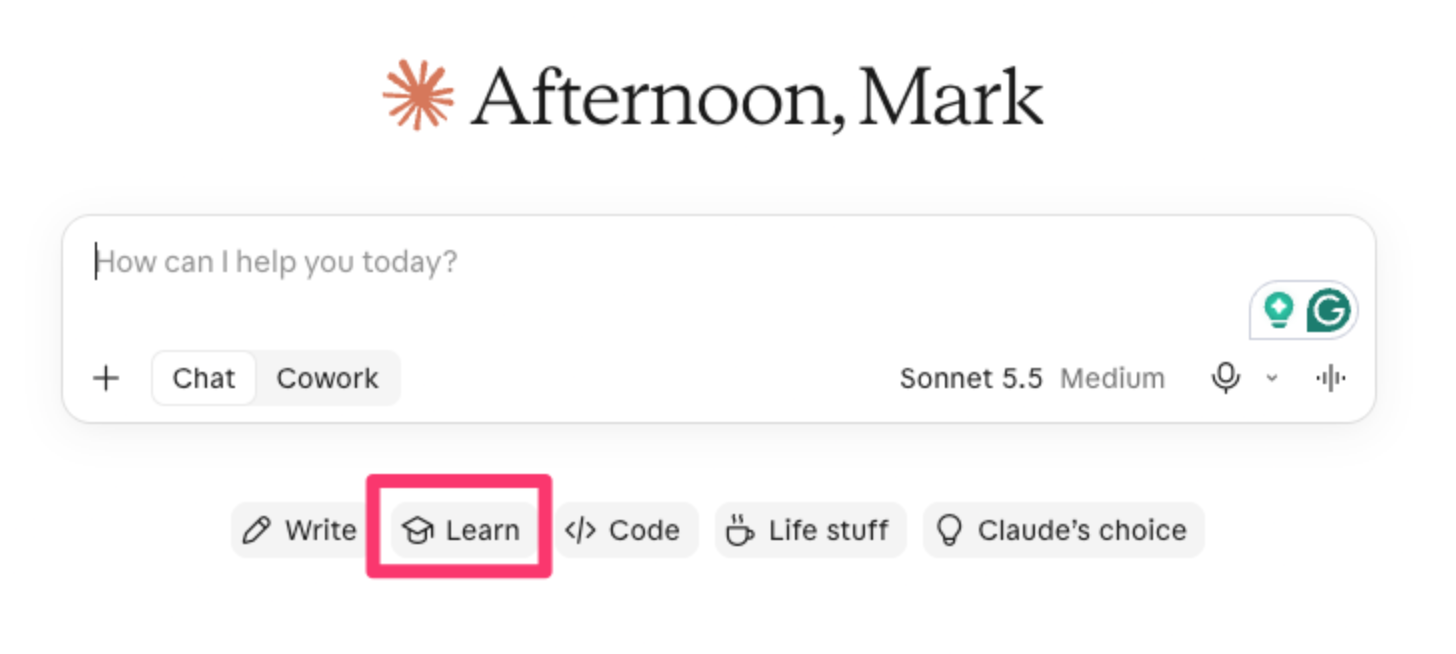
Guided learning is similar to the adaptations provided by the other companies, but I wanted to include a few screenshots to offer insight into how the learner exerts control over the learning experience and the AI does more than just present information. To get to the guided learning approach, a user must use the + icon to open a drop-down menu and select Guided Learning. Depending on the device used and perhaps other differences in how the service is accessed, the screen display may look a little different.
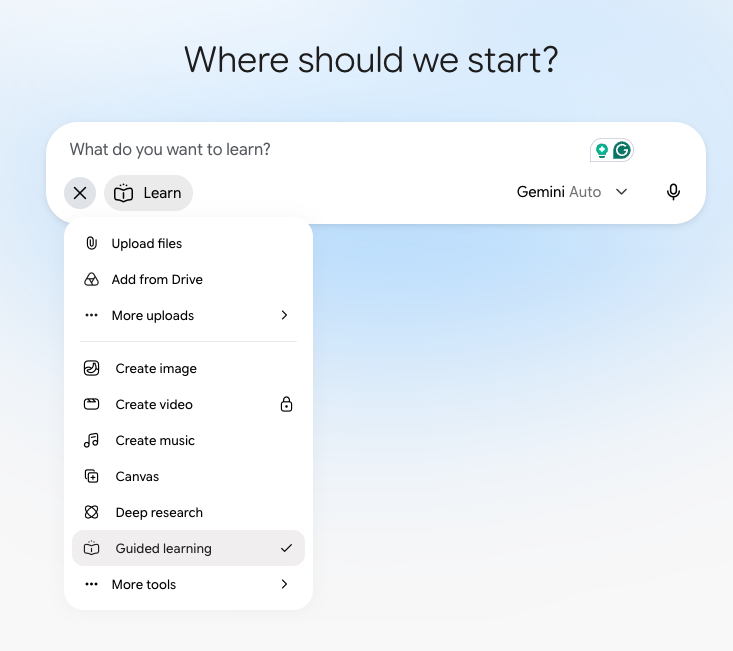
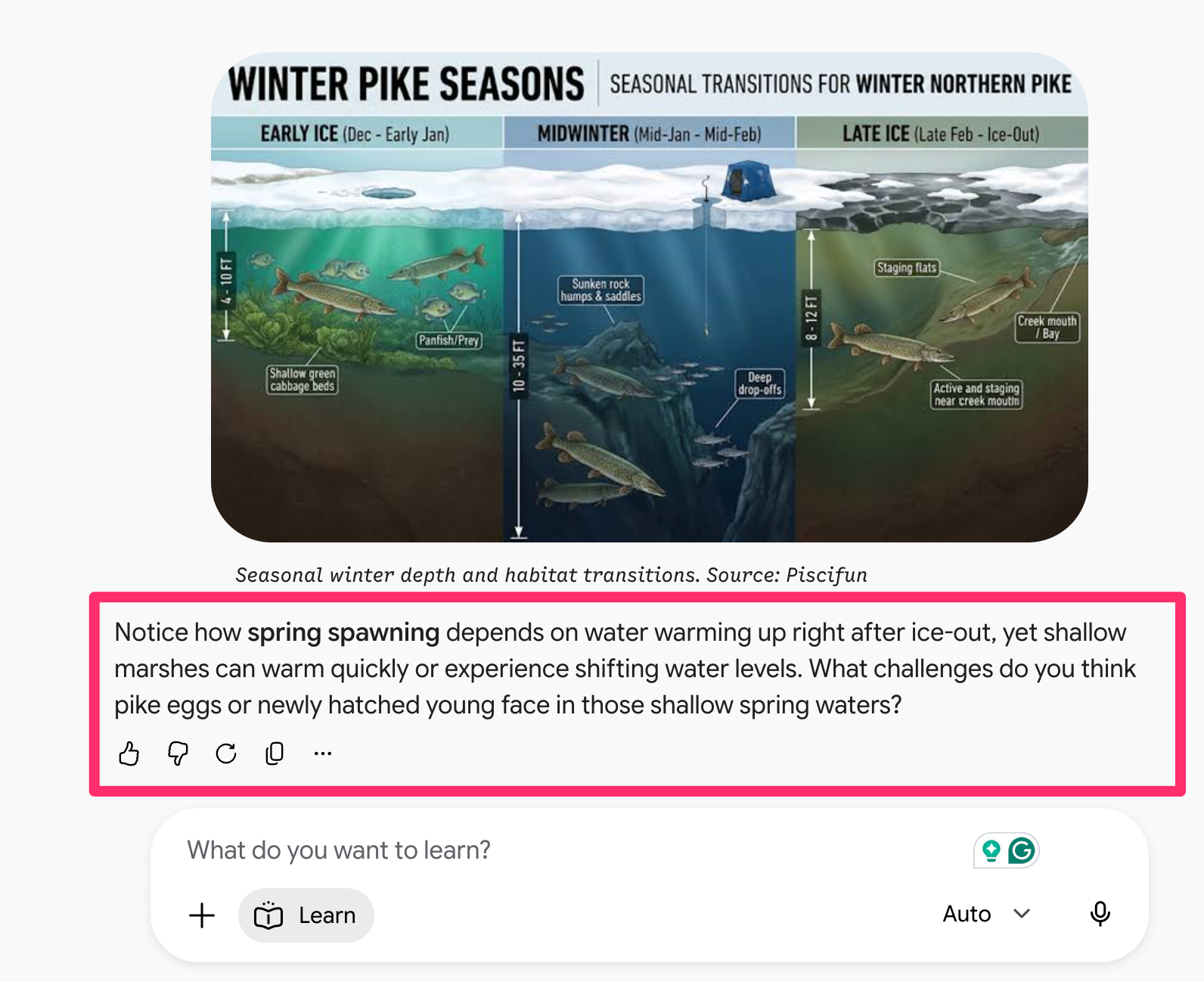
I have been exploring the experience when learning a variety of issues and trying some that would not be the focus of traditional classroom instruction. I have a middle school grandson who discovered fishing and searches online constantly for YouTube videos and other sources of information. His interest gave me the idea to see how Guided Learning could teach me about the characteristics of Northern Pike and how fishing strategies would make use of these factors.
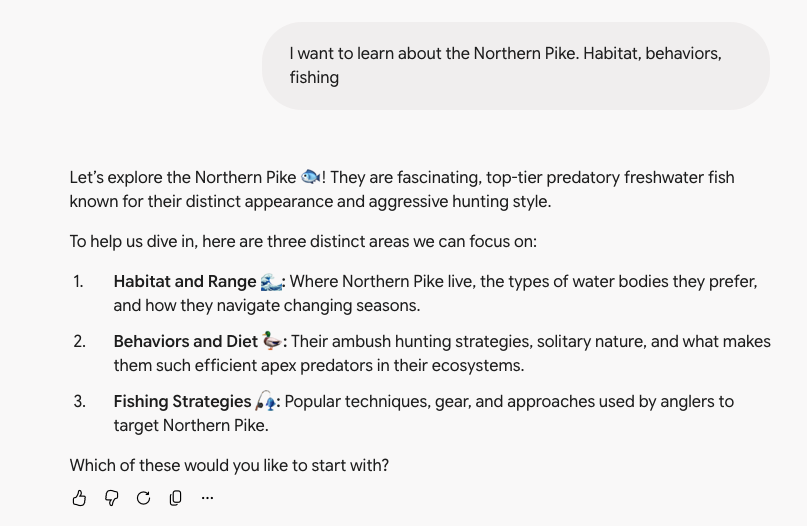
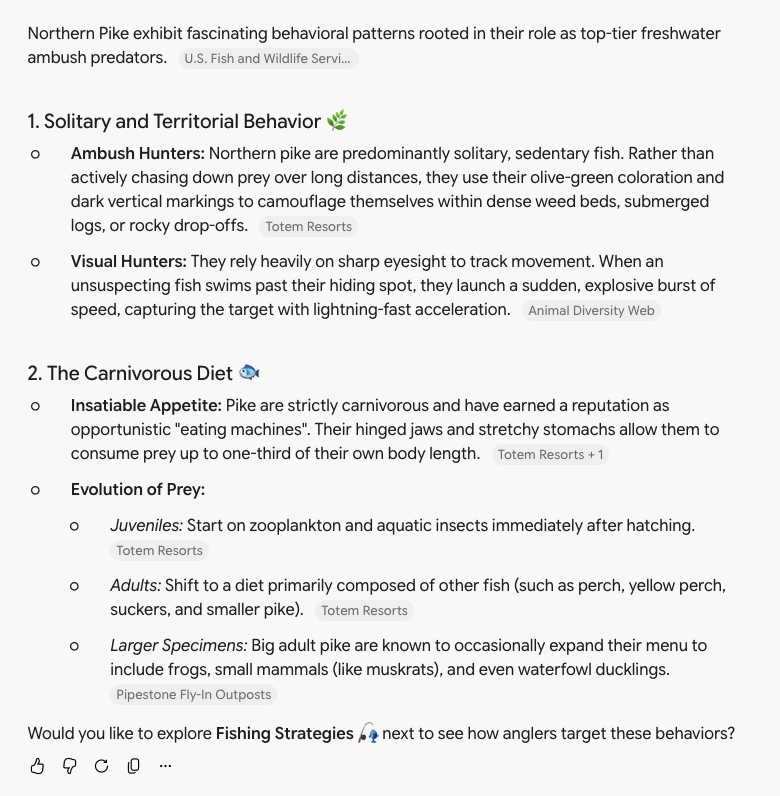
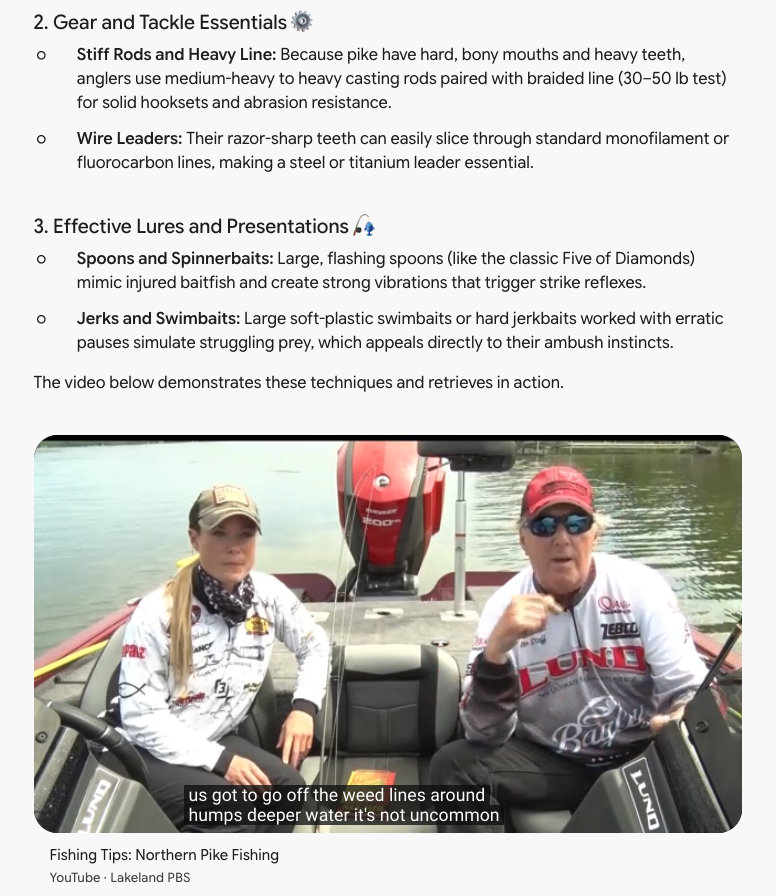
Instruction involves more than presenting information and AI instruction attempts to integrate other tactics. After presenting several information sources, the learner is asked questions and provided feedback.
Taking a look under the hood
I have been exploring other AI-based learning experiences and came across one that may help others understand at least one way the system interacts with a learner. This link provides access to a GitHub source for Chiron. The developer, Paul Del Signore, describes his creation as an adaptive tutor. I have been exploring this creation using Ollama on my Mac Mini. If you are curious, you can use it as a prompt with any AI service you can access. Propose something you want to learn (my Pike request works great) and the AI you are accessing will engage you (text only) in multiple, integrated learning experiences.
What I think others would find most helpful to understand the logic behind a guided instruction approach is to read the prompt. The natural language is easy to follow. You can follow both the logic behind the learning experience and the interactive components the developer has specified. By both trying the learning experience and reading the prompt, you get helpful insights into how similar AI learning environments work. For instructional designers, I would also recommend reviewing the prompt and seeing how many of Gagne’s 9 elements of instruction you can spot.
Here is just a short snippet so you can see what I mean by my claim that reading the prompt is instructive.
“1. **Instruct.** Explain the idea directly. Use a worked example and one analogy, and draw the analogy from the learner’s anchors where one fits — a cook gets a kitchen analogy, a cyclist gets a gearing analogy.
Only when an anchor fits honestly, though: a strained analogy teaches the wrong structure, so if none of their anchors maps cleanly, use a neutral one and say so. Keep it short — this is a starting point for practice, not a lecture. Novices need direct explanation before they can be questioned productively; Socratic questioning of someone with no base model just produces guessing. Where the learner holds a known misconception, name what is *not* true explicitly rather than hoping the correct version displaces it on its own.”
Caveat
I find it difficult to create a personal explanation for why AI tutoring or instruction are not more positively received. Educators are likely familiar with the Kahn Academy and the attempt to augment the instruction offered through this service with AI (Khanmigo). My take on the research conduted on Khanmigo might be that students don’t stick with Khanmigo, perhaps because they find it boring. Why? Maybe the human element adds the perspective that a person is watching and cares. The presence of others, which social psychologists call social facilitation, improves a variety of cognitive and physical skills. Having some watch and interact with you, even beyond feedback and praise which programmed instruction can provide, simply motivates effort and engagement.
I came to this perspective by thinking about the differences between AI and classroom-based approaches, social environments, and self-directed learning. So, as an adult independent learner able to select and control the topics I learn about, I find reading and AI experiences satisfactory. Much of my experience with instructional design involved students preparing to be instructional design professionals, expecting to work with adults required to meet job-related training requirements. Characteristics such as flexibility in completing learning tasks, understanding of the personal relevance of the skills or knowledge to be learned, and short-term commitments may reduce the motivational advantages of a supervising human instructor. A book club I have joined provide motivation with at least one additional feature. I read books I would not and sort of don’t find interesting because I meet with colleagues to discuss what we have read. Maybe students respond for some of these same reasons.
Summary
Traditional educational methods like small class sizes and personalized tutoring provide clear academic benefits, but their high cost makes them economically unfeasible for most students. To bridge this human resource gap, AI-guided learning tools are emerging to deliver interactive, personalized instructional experiences that adapt to individual learners. Yet, providing optional access to such tools in classroom settings does not seem to generate a high level of interest.
Sources
Kulik, J. A., & Fletcher, J. D. (2016). Effectiveness of intelligent tutoring systems: a meta-analytic review. Review of Educational Research, 86(1), 42-78.
Opatrny, M., Havranek, T., Irsova, Z., & Scasny, M. (2025). Publication bias and model uncertainty in measuring the effect of class size on achievement. Journal of Labor Economics, doi.org/10.1086/737989

You must be logged in to post a comment.