Bloglines Problem

Technology can be buggy so it sometimes tough to know when a problem is really a problem.

I have been having problems with my Bloglines account for some time. Several of the feeds were not working and I was getting the red exclamation point indicator.
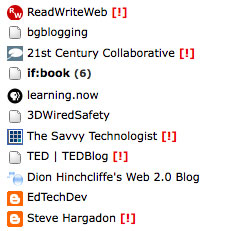
Bloglines explaines the problem as follows:

Bloglines has encountered an error trying to fetch the latest version of this feed. Bloglines handles errors automatically, no action is required by you. The error was:

The feed does not appear to exist. This can be caused by the feed URL being incorrect, or it can be caused by a configuration issue with the server hosting the feed. If this error continues, you should check the feed URL and, if it is wrong, subscribe to the correct URL.

While it sounds like a temporary situation, temporary has now stretched to several weeks.

Now it appears this may be something more serious – others have the same problem and are speculating regarding the state of the company.

I take more than the casual interest in such matters. When you invest time in explaining how these tools work for others, it is an issue when the tool you decide to focus on goes out of style or simply shuts down.

I hope this is not a sign of economic problems.

Loading

Presidential Debate 3 – Education

The final question in last night’s presidential debate concerned education. The question mentioned the amount spent per student and the “disappointing” return and asked the candidates what should be done. YouTube has the debates broken out by question and the following segment provides the answers to the education question.

[youtube:http://www.youtube.com/watch?v=_8SWPExIxTE]

Perhaps the more unique segments included Senator Obama’s recognition that parents must take some responsibility for the performance of their children and Senator McCain suggested increased attention to Troops to Teachers. As someone involved in the preparation of teachers I cannot support programs that ignore certification requirements and examinations for some under some conditions. If we are concerned about the qualifications and qualities of our teachers, how does it make sense that we begin to look on teaching careers as a type of jobs program. I see these as separate challenges. If you did not hear the debate, I have linked this segment for your scrutiny.

I still talk about the Coleman study from the ’60s in my ed psych class. My take is that Coleman said two things – a) factors beyond the school account for the largest % of variability in student performance and b) teacher/school quality matters when you can control for the other factors. Various predictions might follow from this. Good teachers always matter (point b), but on average the performance of motivated and supported students with a mediocre teacher may be better than the performance of unmotivated and unsupported students with a good teacher. This is one of the challenges of assuming that school to school competition will fix things. Make your own decisions – the segment is 4 minutes long.

It is too bad that the economy tanked when it did. I wonder if education and energy would have received more attention if the pressure to address immediate economic problems did not take attention away from what are likely long term economic issues.

Four minutes out of 90.

Loading

Multitasking- only in your dreams

This is the time of the semester when students in my educational psychology class are studying basic human cognition. When I teach this and other topics I, personally and for my class, attempt to relate the topic to issues I read about or see around me. So, as I consider the issue of the limited capacity of working memory and memory overload, I ask what students think about the multitasking capabilities that are commonly associated with K-16 students. Did anything they read in the book explain how talking on the phone, listening to music, and keeping a couple of chats active while reading a textbook could possibly be acceptable? I keep waiting for the experts who write the textbooks I use in educational psychology to update their books to explain the new capabilities of 21st century learners. So far, no luck. Perhaps the authors pay more attention to the research literature than the blogs claiming we must adapt to the new skills of those in our classrooms.

I was listening to an NPR story on multitasking while driving to work this morning. The piece involved an interview with a scientist with a research program related to the popularity of engaging in online communication while doing other things (e.g., driving). I was careful not to talk back. It turns out that sound bite stating that talking on the cell phone is equivalent to driving drunk is not just a way of explaining the impact of distraction. The statement is based on an experiment conducted in a driving simulator comparing intoxicated participants and participants using a cell phone.

I think I have made this point before – “just because lots of folks do something does not mean what they are doing is productive and it certainly does not mean that we are being helpful by being enablers”. Adolescents are likely no better at performing while distracted than you were at the same age.

Loading

Energy and tech

As we attempt to become more conscious of our energy consumption, we do need to consider the energy demands of our technology. I started thinking about this (again) when I encountered a blog post indicating that Google was using its power as consumer to require chip manufacturers to increase the temperature at which computer chips fail. The server farms Google operates require a hefty investment in energy for cooling and greater tolerance for heat would reduce cooling costs. What I know about the energy demands of server farms I have learned from Tom Friedman (Hot, flat and crowded) and technology does use a lot of energy.

You get a sense of the same issue when you enter a school computer lab. My department’s computer lab is located next to my office and we sometimes run the fan on the air conditioner even in the winter. The windows are sealed so using the air conditioner to pump in some sub zero air is the only way to cool the room.

I operate a high end Macintosh in my office. It turns out the Mac has 4 fans evidently necessary to keep the system functioning. I seldom put much strain on this equipment. The most demanding thing I do (programming) is probably the least demanding of my computer. The power of my old 2e would easily keep up if I know how to work using the command line and could connect to my servers.

I wonder if “thin client” technology would save energy – no hard drive, mostly just the energy to power the monitor on the client side. What about the demands on the server side. Perhaps server farms should be located in North Dakota. At least the cost of cooling in winter should be lower.

Loading

We could have been contenders

I just finished viewing a short video of Maine’s past Governor Angus King talking about the rationale in support of Maine’s 1:1 initiative. Whatever you think of spending for this particular tech initiative, the Governor’s grasp of educational issues and his arguments for technology were impressive.

Watching this video reactivated this uneasy feeling I have had for some time regarding technology innovation in my own region. At one point, I was convinced that North Dakota was a national leader at the K-12 level. We benefited from and hopefully encouraged developments in our neighbor to the east – Minnesota. The days of MECC represented a heady time and I remember making trips to regional conferences and returning with disks of new educational software. Working in higher education, I was convinced that K-12 folks were far ahead of us.

I do not feel this way anymore and I am not sure whom or what to blame. I think NCLB may have taken K-12 folks out of the game. While those of us in higher education are facing ever more frequent calls for demonstrations of accountability, at least we have yet to identify some standardized tests by which this accountability will be measured.

I also think the good times in ND may be a problem. Yes, I am willing to claim these are relatively very good times. We have a regional advantage that includes agriculture at record prices, oil, and Canadian shoppers. In a state with a small population, the amount of money involved from what many would consider unlikely sources can have a significant impact. Unfortunately, these benefits can be distracting. I was convinced when I regarded North Dakota as innovative that this leadership was a function of our rural setting. Distance education and software were an attempt to compensate for a lack of diversity and the limited offerings that are economically feasible in small schools. Perhaps, the innovation evident in Maine stems from similar challenges. Perhaps now there is less local pressure because the political and public pressure to look forward is less intense.

Big mistake!

Loading

Thin client, cloud computing, what’s the difference

The relatively recent focus on “cloud computing” has a vaguely familiar feel to those of us who have been involved with technology for a while. Some of my early ed tech research was conducted with a PDP 11/34 mini computer “serving” a dozen “dumb terminals”. The terminals were basically a keyboard and monitor and everyone connected to the same “remote” computer. Remote in this case meant “in another room”.

A recent NY Times article indicates that “thin client” computing may be on the rebound. The “hook” is often financial assuming that many users can share programs (software) and hardware (server) with the result that the work stations can be less powerful and thus less expensive.

Cloud computing is very similar. For example, many users with low end hardware can connect via the Internet and use Google docs rather than invest in many copies of Microsoft Word.

What is the difference? One difference might be the openness/extensiveness of the network. A thin client architecture serving a company is different than an Internet-based service available to everyone. Perhaps a second difference is how completely “clients” must subject themselves to “the system”. One model of the thin client approach assumes users are connecting with the bare minimum of hardware and software and cannot perform actions that allow independence – e.g., storing local copies of work completed. In contrast, Google Apps allows local storage of resources and through the use of Google Gears independence from the Internet.

While some are concerned that cloud computing is a trap, I am concerned only to the extent the options are few and inexpensive opportunities come at the expense of becoming dependent on one or two providers.

Blogged with the Flock Browser

Tags:

Loading

Text To Speech

Cindy has a project underway that involves developing educational resources that ESL students can use from iPods. She has been exploring Text to Speech conversion programs that create audio files.

Here is one example. CK’s Text to Speech takes advantage of the built-in conversion capabilities of the Macintosh. The applescripts convert from selected text in Safari, from a text file, and from the clipboard.

The content read to you here can be viewed on our participatory web site. It is a web page with bullet points, headings and images that may not make the most comprehensible audio presentation, but is fairly typical of an extended web page.

The Macintosh reads text as part of the basic operating system. I have not explored the text to speech capabilities in some time and found the quality to be quite impressive. The connected file allows you to judge for yourself. What is different about this application is the generation of an audio file that can be used in other ways (e.g., used as part of a web page, offloaded to an MP3 player). There are other programs that perform this same function and perhaps do so in a slightly easier way (not requiring multiple scripts/programs). The advantage of the resource we link to is that it is available at no cost.

Loading