Trying to do the right thing

Sometimes it is really tough to follow the rules. I have spent a significant part of the morning trying to register some software I purchased from Adobe. They dropped support for GoLive and so now I have  to use Dreamweaver. I don’t like Dreamweaver and that probably makes this process even more irritating.

Anyway, to obtain the educational discount, I must prove that I am a faculty member. There is a list of things you can provide – a faculty ID with picture, a pay stub, a letter from your boss, etc. I used my digital camera to take a picture of my id and sent that.
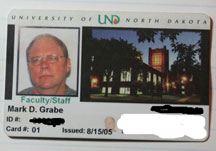
It turns out my ID was issued in 2005 and it does not prove I am presently employed as a faculty member. I agree the date clearly does not say 2008, but my institution does not go through the process of issuing IDs each semester. Unless we go to a different numbering system, this is my card for life. They can reprogram the swipe strip, but why take another picture. I should have smiled. Efficiency is not unique to universities. My state does not require I get a driver’s license each year. Sorry, I am getting worked up again.

I thought perhaps the fact that I was corresponding via a university email service might prove I was a faculty member or a student. A university email account is not on the list.

I think a letter from my boss is out. These are tough financial times for educational institutions and he is probably meeting with the legislature or rich alumni. I don’t want to bother him with a request for a letter proving I am a faculty member.

I guess I will have to wait until I get paid so I can fax a copy of the pay stub.

I suppose I will have to use GoLive until then. Did I say that GoLive was a superior product and I have no idea why Macromedia would continue Dreamweaver and drop GoLive?

Loading

How did that hologram thing work?

If you watched CNN for your election coverage, you likely saw the spots in which the CNN anchor talked with a correspondent (or will.i.am) appearing as a hologram. I am not certain what unique advantage it offered, but it was really cool and I think the first time something of this nature has been part of a major production.

[youtube:http://www.youtube.com/watch?v=js6b31_p5cc]

Here are a couple of accounts of how it was done:
Gizmodo

CNN Video –

Not likely this will make an immediate impact on distance education. It took 35 HD cameras and 20 computers to produce the effect.

Loading

Now the hard part

The election is now behind us. Whatever your pre-election orientation, it is time to take a hard look at President-elect Obama’s plan. The Obama/Biden web site does a great job of identifying key issues by area.

The top three education challenges include:

  • Reform No Child Left Behind
  • Invest in early childhood education
  • Improve the affordability of a college education
  • There is a great deal of information on this site. The word “technology” does not appear on this page. Neither does the word “research”. I liked what Sen. Obama said about parental responsibility. As long as the challenge to institutions and teachers extends to parents and students, count me as a supporter.

    As I suggested yesterday, the vast digital collection of promises and priorities will hopefully represent a type of contract.

    Loading

    Accountability

    I wonder if the ease with which digital video can be saved will influence how we think about political candidates? In the present election candidates are pushed to offer specific details on their plans for the economy, health care, or defense and sometimes they come up with plans. The plans are often vague at first, sometimes the proposals become more specific under prodding, and somethings the plans are altered when the public does not react favorably. However, the commitments are often not really commitments. This is partly the advantage of vagueness and partly explained away by changing circumstances. Still, what if elected officials had to respond to their own promises a year or two down the road. Perhaps, a record of promises made during this season will serve such a purpose. 

    Here a couple of clips available on YouTube – search for what interests you from 2004.

    [youtube:http://youtube.com/watch?v=_LDsp67eKaI]

    This clip from Republican convention 2004. Included are comments on NCLB, tax relief, the economy, etc.

    Loading

    ISU Researcher Claims Video Games Experience Allows Causal Link to Violence

    I read several stories on violence and video games today (CNN, Washington Post). Comments to these stories note that the link between violence and video game activity is not causal, but these folks probably did not read study cited because the logic of this study cannot be dismissed with the traditional position that pre-existing characterstics were not considered. Media interest in video game violence has re-emerged in response to a study published by Craig Anderson and associates. Anderson is from the Psychology Department at Iowa State. I was trained in this department many years ago so I pay some attention when my alma mater pops up in the news.

    ISU Center For The Study of Violence announcement offers some insight into the argument for causality. Researchers assess pre-exposure level of violence and use as a covariate still demonstrating that exposure to violent video games among 9-12 year-olds still differentiate later evidence of violent tendencies.

    I was able to locate the study online (from Pediatrics) through our library. The key finding and the statistical method is explained in the following quote from the study.

    .. the finding that across 2 very different cultures HVGV predicts physical aggression 3 to 6 months later, even after controlling for previous aggressiveness and gender.

    It is important to note the method used in this study does not manipulate access to aggressive content as would be the case in a true experiment. The method attempts to discount for nonrandom assignment by accounting for a measure of the pre-existing level of aggressiveness. Pre-existing agression predicts interest in violent video, but accounting for this correlation still leaves significant group differences.

    As far as the quality of the research method goes, it is difficult to offer a better example than Bandura’s bobo doll studies from the 1960’s.

    [youtube:http://www.youtube.com/watch?v=uMwOexrV6fM&feature=related]

    Yes the narration is not in English. Watch the behavior of the children after they view the models.

    Loading

    Grown Up Digital and Maybe Lazy

    We went to Fargo today. I mostly spent the time in in Barnes and Noble and then the food court of the mall reading. Today, it was Tapscott’s new book – “Grown Up Digital”.

    After getting back home, I decided to read and grade a few student papers. The first paper I read has me pretty agitated. I think it was first reading Tapscott (and some of the endorsements – e.g., Lessig). In the early stages of the book, Tapscott notes the writing of several authors who are concerned with some of the values and skills of the “net generation”. He pretty much dismisses the concerns of these writers (e.g., Bauerlein) with the exception of the concern that students reveal too much private information and this may come back to haunt them.

    Anyway, I am one paragraph into the first paper and I immediately am concerned that the student did not write what I am reading. I Google a unique phrase from the first paragraph and locate the original source as the first hit. Unbelievable, I think. I turn the page of the paper and at the bottom of a two page section is the reference. OK, so this technically was not plagiarism. What do you call it when a page and a half is copied and pasted into a four page paper? Perhaps Lessig would describe this as “Remix”.

    I asked students in my educational psychology class to identify an identifiable study strategy that they have never used, apply it in a course of their choosing for two weeks, and then write a 4-5 paper describing their experiences and evaluating the strategy. I tried to be fairly specific in outlining what I wanted in the paper. The first item on the list – explain the strategy you selected. I am assuming this is what prompted the cut and paste. Do you think a sophomore in college really assumes the instructor wants the actual words from the original source? If this would have been a hard copy paper instead of a digital file perhaps the first couple of pages would have been photo copied.

    I really meant – explain the strategy. TRANSLATED – I want to be able to evaluate if you understand the strategy in the same way I understand the strategy. Should I really have to take the time to explain that I will not know if you understand the strategy if you give me the same thing to read that you read. Way back when I learned Bloom’s taxonomy (the original one), I was told that the way to evaluate “comprehension” was to seek an appropriate translation in the student’s own words.

    I do understand some of the areas in which “remix” makes some sense. However, in promoting the constructive “use” of parts of the works of other people there is an important assumption that the nuances of using such works will be appreciated. As I have said before, what I fear is that such nuances are never taught or of even greater concern that a vague awareness of such nuances becomes an excuse for taking short cuts.

    I sent the paper back and requested a redo. Perhaps I should have requested a remix.

    Loading