What I Want From a Conference Presentation

Dave Warlich’s post on learning at conferences gives me an opportunity to say some things I have been thinking about for some time. First, let me say that the conference experience is not a unitary thing. There are various types of sessions and various categories of presenters. There are also informal opportunities that are planned for and that attendees generate themselves. Second, folks go to conferences for multiple reasons. My attitudes are my own and reflect my experiences and personality. Conferences also differ greatly. I attend some conferences at which most attendees are active researchers and are there to share (AERA). They present, but they also listen. I attend other conferences which involve very distinct categories of participants – some presenters arrive, give their pitch and then leave; others mostly listen and move from session to session picking up what they can (NECC). 

I hate it when a presenter in a moderately sized group or larger takes time away from a presentation to engage the audience in a Q&A or worse yet asks them to talk among themselves. I attend sessions based on the topic and the reputation of the presenter. My time at most conferences is limited and I would rather not spend it in what nearly always amounts to unproductive chit chat. Random combinations of people in a large group sharing ideas for a few minutes at a time seems very unproductive. I know that short writing assignments and short discussions are promoted in large lecture classes, but this is a very different situation in which the participants spend a great deal of time together and acquire some skill in responding to what become predictable requests from the instructor. A presenter is not an instructor. If the presenter is not going to present, I would like to know so ahead of time so that I can avoid such sessions. 

A format that I do like is the round table. This is one of the options AERA uses as an alternative to short (15-20 minute) research papers and longer presentations. You can move from table to table if you like, but typically you pick the paper that most interests you and spend a longer period of time with that group. The person presenting his/her work usually has a paper to distribute and spends some time describing their work, but the interaction is free flowing and unpredictable. Most conferences have sessions focused around a large collection of posters that provide similar opportunities. 

So, most conferences have opportunities for topical discussions. I would rather when someone signs on to take the role of presenter they not turn their session into something else.

Loading

Do It Yourself “Cliff Notes”

I seem to remember that Microsoft Word has a built-in autosummarization tool. I am the curious type so I have used it to see what the tool thought was the core of what I had written. I was never certain what I was to do with the results. After spending hours writing something, I was not likely to send a 10 sentence summary to anyone.

GreatSummary offers a similar service online. You submit a URL or upload a document and the service will return a summary consisting of the number of sentences you specify.

According to the site, the system works by:

# Using a mathematical technique called singular value decomposition, the system identifies the words that capture the key threads of the text. The process is repeated until the number of sentences requested by the user is reached.
# GreatSummary then ranks the sentences according to these words.

The content I decided to summarize can be found on our web site – Participatory Web. It is a description of Web 2.0 (participatory web) applications and the common characteristics that identify Web 2.0 applications. I would think the core of this piece would be the characteristics of Web 2.0 applications. Our list was not selected, but the first sentence selected (see below) is a reasonable choice.

* Our intent is to offer these examples as a frame of reference before attempting to identify ”characteristics” of these or other examples that both explain what experts argue make such a collection of services different from what was available previously and perhaps set the stage for speculation regarding the adaptation of such services for educational purpose (18)
* We provide these examples because we assume you are aware of at least a few, not because we are proposing that the examples are suited to educational applications as the examples are commonly encountered or that a given example is the most educationally relevant within a category (e.g., all blog services, all wikis). (18)
* Within this environment, learners have ready access to the collected skills and knowledge of the community (collective intelligence) and these resources can be tapped efficiently (access data at a granular level). (43)
* Henry Jenkins (2006) (note this is a pdf) challenges educators to involve students with participatory experiences to address some different issues. (46)
* Taking some time to consider these characteristics is productive because it is the characteristics rather than the examples that make the case for a qualitative difference in the way many use the Internet (28)

It reminds me of the speed reader’s summary of War and Peace.

It’s about Russia.

Loading

The Wisdom Of Intro Students

The question of exactly what conditions must be met before online participatory experiences result in increased rather than decreased insight continues to fascinate me. I am using the opportunity presented by teaching introductory topics in social psychology to explore topics in group information gathering and processing. Groupthink and selective bias were known issues long before bloggers attempted to educate themselves by reading the comments of others with similar views. Part of what I am doing is translating some of the research from the textbook into examples students may appreciate. I am not certain that I will discuss blogs and the bias in blog rolls, but I think the question of whether you prefer FoxNews or CNN and what is your political orientation is likely to make some sense. I am also thinking that using the “poll the audience” example from “Who wants to be a millionaire” will be more likely to connect than talking about wikis. Students are very familiar with wikipedia, but for them it exists as an online information rather than a participatory opportunity.

I collected data in my last class that I am preparing to present and discuss during our next meeting. James Surowieki begins the “Wisdom of Crowds” (at least the audio version) by telling a story about Sir Francis Galton. According to Surowieki’s account, Galton was somewhat of an elitist and believed that expertise should be trusted over the wishes of the group in making important decisions. However, an event at a country fair resulted in a somewhat different perspective. Galton observed an event in which a large of group offered predictions on the dressed weight of a live ox. Within the group were some (e.g., farmers) who might have unique knowledge in such matters and many others who would seem to know very little. After the event, Galton secured the data and conducted his own analysis. Galton, a pioneer in statistical techniques, discovered that the average guess of the group was remarkably close to the actual weight. The aggregate of the crowd’s knowledge, the input of experts combined with the input of the agriculturally uneducated, was superior to nearly every individual prediction (and the predictions of most of the experts).

So, I decided to see what I could do to replicate this demonstration. I was not exactly certain where I might locate an ox and to tell the truth I am not exactly sure what an ox is (we had cows back on the farm in Iowa). I decided to substitute a large box of Hot Tamales. I have no explanation for this choice and understand that the connection between the ox and a favorite candy possibly defies any known form of logic. Anyway, I offered a box of Hot Tamales to the student or students who came closest to the box I held up. Because others may not have my personal experiences, I also opened a second box to show the size of a hot tamale and passed the open box around for individuals to sample. Students submitted their estimates on signed slips of paper.

It turned out the box held 131 pieces of candy. The average estimate was 143 which was somewhere in the 60th percentile of all estimates (significantly above average). It looked like my little experiment had kind of worked, but I was hoping for something more spectacular. When examining the individual estimates I discovered one entry that predicted the box would contain 1000 pieces of candy. How could anyone seriously believe this could be true? Perhaps I had tapped into a type of learning disability – some failed form of basic numeracy. More likely, this situation may have involved a student who did not appreciate the seriousness of the task I had presented. Such things do happen in Intro Psych. Anyway, I discarded this one entry – statisticians might label it an outlier – and the results were magical. The group average was 131.7.  The closest prediction was 135 (3 individuals).
 

I have some difficulty grasping exactly how this works. As I understand the explanation, any “estimate” consists of knowledge and error. As long as the error does not reflect bias it will be random and pretty much cancel itself out (as much error above the true value as below). I remember the concept of “true score” from my early statistical training, but I am not certain if this is the same thing. As you are reading the answers and encounter values from the 60s to 250s, it is difficult to imagine that the mean will be nearly right on.

So what might the Intro students know that would be valuable? I suppose most have useful notions of volume and numeracy. It turned out some had knowledge I did not anticipate. In passing the box around several noticed the nutritional information. This box contains 7 servings. Each serving consists of 20 pieces. Lucky for me, since I am purchasing a box for those making the best estimates, the manufacturer must only have to offer approximate information. Galton might have sided with the smug experts. Ha, no candy for you!

Blogged with the Flock Browser

Loading

Little Green Apple

The news this evening carried a story concerning Apple Computer’s attempt to become “greener”. Sure enough when I visited the Apple site and searched for green I found a note from Steve outlining the efforts being made to remove harmful toxic chemicals from computers and to increase recycling. 

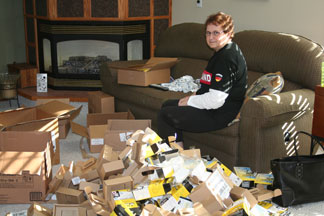
However, the story also reminded me of some pictures I took a couple weeks ago.

Cindy received a grant to use iPods to help ESL students and their families. I took these pictures as she was in the process of unboxing her new equipment. There must be a less wasteful way to ship this product.

Loading

Book Sort

I have been working on my final Intro Psych lecture for the semester. The general topic is social psych. While reviewing the themes covered in the book, I was struck by how many topics could be applied to my personal interest in productive and unproductive uses of the “participatory web”. After all, social psychologists should have something useful to say about the social web. Actually, an understanding of what  social psychologists have to say about groupthink, persuasion, and group thinking could easily be substituted for most of what is said in the last dozen books I have read. So, review an old Intro Psych book and save your money. Actually, I am just kidding, those folks need to make a living too. Perhaps a more careful analysis of what one might learn about the issues associated with the participatory web from the social psychology chapter in a freshman intro psychology book should be focus of a future blog post.

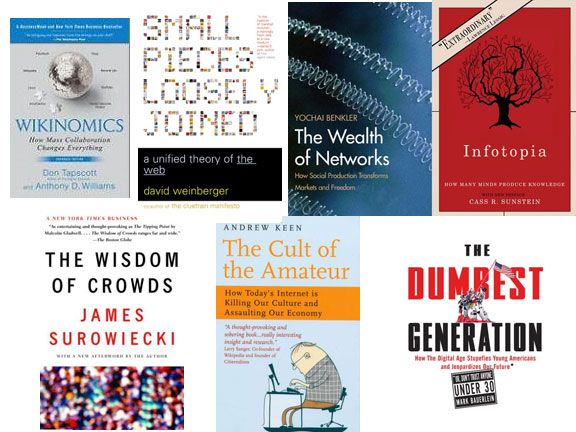
Anyway, I prepared a collage consisting of the covers of several books I have read recently in order to talk to may class about some issues in group processing and filtering of information. Perhaps books they have heard of (maybe) might show the relevance of these issues. The Wisdom of Crowds is most relevant for my situation, but there are interesting associations among all of the books I have included.

For some reason, I look at this collage and see the potential for a card sort task. The way a “sorter” creates groupings is supposed to reveal their organizational schemes. So, here is my collage, give it a try. What, for you, goes with what?

Loading

Mac Users – Relax

If you are a Mac user, you may have been alarmed in recent days by information that appeared to recommend you immediately install virus software. In fact, the messages seemed to imply that you should install multiple virus protection products (I guess the idea was to make it more complicated to create malicious code).

I do worry about virus protection on the Windows machine I run. I rarely use this machine, but each time I do I go through the lengthy process required for the machine to check in, download, and install patches related to new viruses that have been discovered. In fairness, the length of this delay is probably somewhat related to the delay between the times I use this machine.

I would not know what virus protection products are available for the Mac. There are the old standards, but my authority on such matters (Leo) seems to recommend that these standbys have grown bloated and are less useful. The Apple Tech report offered some options.

New information indicates Apple has taken down the tech note that prompted this scurry of online rumors. An attack against Mac users may not be imminent (I assumed someone knew something too.).

This entire episode was strange and possibly offers more information on how information spreads on the Internet than on the vulnerability of a particular operating system to exploitation.

Loading

WIFI access as a universal right

Is internet access a right? I guess it depends on who you ask? Providers who have invested millions, perhaps billions, in hooking many of us up argue their investment assumed they could charge a fee for access. They have a valid point, but the reality is that this logic leaves many without. Clearly, some do not have the means to take advantage of internet resources and some end up being treated differently based on where they happen to live. History demonstrates we have encountered these issues before. Electricity and phone service are examples. A pure market approach ignores those who cannot be conveniently connected or expects some unfortunates to pay additional fees.

There is some hope this issue will be addressed by the new administration (after the economy is back on course I assume). The outgoing FCC chair made a pitch for universal access and the FCC promises to address this issue in the near future.

High speed Internet access could be argued to be an economic/educational necessity much in the way transportation (Interstate highways), power, electricity, and phone communication came to be regarded as necessary services.

Loading