Are There Too Many Portals?

I have been working to create an educators portal for about a year now (Learning Aloud). It is a combination of my blog posts, a social bookmarking site focused on topics in educational technology, and most recently something I think of as an online book entitled Meaningful Learning and the Participatory Web. I originally developed the online book as a personal wiki (anyone could read, but only I could write), but then converted the content into more traditional web pages. There are also options for participation – it would make little sense to write about the participatory web without welcoming and offering opportunities to participate. The social bookmarking site allows registered users to contribute and rate. Access to some parts of the stie are controlled through Drupal and those who register are provided a page they are encouraged to use to link to their own projects and examples.

My site was certainly not the original. Those who work in this area enjoy working with the tools and sense the value of using these tools to tap the knowledge and experiences of others. However, a reasonable question might be – if too many portals are created has the potential body of participants been diluted to the point that the potential benefits of collaboration cannot be realized. I have begun to think about this topic because of two new portals I have encountered in recent weeks.

Social Networking 4 Teachers

ISTE Connects

One site is sponsored by a major organization for educators with technology interests (ISTE). Those organizing the other are a little difficult to identify (I know how some of the individual components originated, but not the site). While it has been argued that survival as a content/service provider is really a battle for attention, I encourage your examination of all of these sites. BTW – I am making no effort here to be exhaustive.

So, the site I am attempting to organize may have little hope of competing with the resources of an organization or perhaps an organized group with well-known members. So, what I would like to argue, perhaps in an effort at self delusion, is that the model I propose is more useful. Others could offer this model (a cohesive position/vision statement in combination with examples and comments), but I am guessing this will not be the case with the examples I offer here. I translate “cohesive vision” into something as comprehensive as a book. I say that I doubt the willingness of the sites I have mentioned to offer such a resource because of the “money” issue – the examples I am using as contrasts generate income from books or presenters’ fees. It is therefore difficult to acquire an integrated model and examples from these sources.

I think others offer a similar perspective. In Tapscott’s recent book (Grown Up Digital), he offers a perspective he bases on Geoffrey Moore’s famous “Crossing the Chasm” (this analysis based on an even earlier model of innovation that I remember using farmer adoption of hybrid seed corn as the core case study if my Iowa roots serve me well). To be honest, I am using Tapscott’s analysis here – I have not read the original content for some time. I am guessing you have encountered the argument – ideas take off when the early majority (rather than early adopters or visionaries) buy in. Moore argues that to reach the more pragmatic “early majority” one must offer a “whole product”. Visionaries and early adopters are excited enough by pieces that they will generate their own implementations and discuss these implementations with anyone willing to listen. I read an interesting ReadWriteWeb post that went further and proposed a somewhat different scenario when applying the Moore model to tech innovation. This post argued that innovators and early adopters can be driven by the excitement of the innovation (my interpretation), but they may not necessarily serve the most useful role in promoting change because they often move on to new innovations before the present ones are actually fully implemented or given a trial. I see a real germ of truth in this claim.

Blogged with the Flock Browser

Loading

Google Earth

Yesterday I read a post on LifeHacker describing the newest release of Google Earth. A video offered within this site describes new features available in version 5.0. You can locate the download at the Google Earth site. A new feature I found intriguing allows the investigation of changes over time.

Rather than duplicate the examples discussed, I wanted to test the tool using a situation I have experienced. I happen to be watching a local outdoor show a few days ago. The guest was a resort owner from Devils Lake, North Dakota, who was talking about the interesting history of the lake. He described the tremendous changes in the level of the lake that have occurred over time and told his own personal story as a short term example. He described working at the Creel Bay boat launch as a youth. At the time it was one of the few locations on the lake where you could rent a boat or purchase bait. He described that the facility was now gone as the location was submerged in the rising waters. This caught by attention. When I first came to North Dakota 30+ years ago a few colleagues from the department and I would go fishing from the Creel Bay marina in the summer. My brother later moved to Devils Lake and lived near this location. He left the area and I stopped taking trips there, but I knew the story of the rising waters.

I decided to examine this phenomena using Google Earth. My strategy was simply to locate Devils Lake in Google Earth and capture a picture of the area. Without changing the area shown, I using the “clock” tool to change the date and attempted to capture the same area of the map. recentdl

Recent image (2005)

olderdl

Older image (1997)

I found my assumptions regarding how easy this would be were somewhat naive. It turns out you cannot find images for any given date. The most recent I could locate for Devils Lake were from 2005. The images were generated by different organizations. I also assume that the time of year the images were taken would influence what was observed. In other words, precise control was not possible. However, if you look carefully, you can detect change. I have identified a common area in a small section of map that shows how a greater area of land is submerged in the more recent image. Science is like this – it is difficult to control all variables and demonstrations are often more difficult to produce than one expects. This is a very interesting tool and certainly available for personal experimentation.

More information describing Devils Lake is available online.

Loading

Server Issues

I have operated at least one server pretty much since this was possible. My motivation for this commitment has varied. Early on, having my own server allowed me to do quite a few things others could not do. This is still the case in isolated areas. My research involves database driven interactivity and storage requirements I cannot duplicate with services provided by the university. Even some of the instructional strategies I employ are very cumbersome when using something like the Blackboard CMS. For example, creating and modifying linked web pages is not practical in Blackboard. The system does not allow modifications to one part of an interconnected system of pages. Some familiar with a CMS may question my claim. Try changing one page of a 40-50 page web site saved on a CMS. Blackboard, at least, wants to treat the entire site as a unit.

The last few days I have been experiencing some of the limitations of having a great deal of personal control. The server offering instructional materials for one of my courses and the development site for online content associated with our book has crashed over night. Temporarily losing the development site is not catastrophic, but students do get frustrated when course content is not available even if they happen to discover this is the situation at 2 in the morning.

At one time, I had hoped that most educators would each operate a simple server and it seemed that things were going in that direction. The Mac had a simple way to share web pages. You did not have to FTP content to a remote server, you just moved files into a folder on your desktop machine. Some things have changed. The assignment of static IPs is now less popular. Security concerns also seem more prevalent. You can still use any Mac as a server, but I know no one who actually does this.

I now have another option. I can rent server space at a reasonable price. The resources I offer at Learning Aloud are provided on rented space. I can do PHP and MySQL scripting, but I do not have to setup or maintain the server. This combination offers advantages.

There is an expression that often applies – I know just enough to be dangerous. I have learned some things operating a server. I know a little linux and to consider some of the exploits that hackers might apply (sql injection). However, when you don’t maintain a server on a daily basis you end up applying your time very inefficiently. I never completely understand what I am doing and I must expend a great deal of time and energy in trial and error. As the equipment I use (typically cast off Macs) changes and runs on different operating systems, what worked last time does not work this time. Critical files are located in different places and executing a statement on the command line from my old notes may not work this time. So, I can spend 8-10 hours over a weekend to get something working a couple of times a year or I can pay $10 a month to not have to worry about it. It would be nice not to have to pay anything, but those hours of labor have to be worth something even to me. This is now the decision. How important is it to have physical contact and control over the entire process?

— I located this post through bloglines that outlines issues in using the Mac as a server

Blogged with the Flock Browser

Loading

The Images of Our Lives

Our kids bought me a scanner for my 60th birthday. This was some months ago and it took some time to get it ordered and delivered and for me to find some time to get it put together. It is a Canon CanoScan 8800F and it has an adapter for scanning slides. It does occur to me that talking about slides and slide projectors may not be particularly informative for many who read my posts, but this disconnect is kind of the point. I have these old pictures in a format I can no longer display and I wanted to do something to save them.

I started to look at some pictures (slides) we saved from my parents’ house shortly before it was torn down. Some of the slides are likely older than I am and even pictures in which I appear are really at the earliest reaches of my powers of recollection. It is impossible to know if I really remember or if I remember the descriptions provided by others.

markdanlowell

Here is a picture I am guessing was taken approximately 55 years ago. I am on the right with the binoculars and my brother Dan is on the left. We are not twins, but my mother must have thought it interesting to dress us alike. Perhaps it was a way to keep us from fighting about who had the coolest stuff. The kid in the middle is Lowell Monke our neighbor from down the gravel road. At least I think this is the case. I must admit I even have difficulty differentiating the pictures of me from my brother after this length of time. Actually, maybe it is my brother Bill, but that would make this story less interesting. I wrote about Lowell in a blog post some years ago because we both went on to academic careers that had something to do with classroom technology. I wrote a book about the integration of technology and he wrote a book cautioning educators against instructional dependence on technology with younger children. I have not had the opportunity to talk with him in years and I have no idea how different our perspectives really are. What are the odds?

I am intrigued by the current interest in stories, storytelling, and the importance of collecting the stories of our lives. Images may be a neglected part of these stories. Maybe now is the time to consider how we will save the images we tucked away in our closets and basements.

Loading

Books Online (at least some)

I have written multiple posts concerning copyright and the publishing industry. I certainly don’t have the answers, but as both a producer and consumer I at least understand the frustrations experienced by the multiple parties involved.

The NYTimes Review of Books offers an interesting editorial on such topics prompted by Google’s efforts to digitize and offer as much published content as possible. I learned some new things – e.g., libraries must pay $25,910 to offer access to the Journal of Comparative Neurology. I was curious and tried to access this journal. UND does have it and I could access online. I took a look at the first title – Deletion of the citron kinase gene selectively affects the number and distribution of interneurons in barrelfield cortex (p spc1) –and decided that I would stick to reading the Journal of Educational Psychology. I wonder what the library budget for the College of Education is.

BTW – the editorial does not come down on the side of open source:

Libraries exist to promote a public good: “the encouragement of learning,” learning “Free To All.” Businesses exist in order to make money for their shareholders—and a good thing, too, for the public good depends on a profitable economy.

I offer this resource as another comment on this complex issue. The article describes the present agreement between copy-right holders and Google (students don’t count on legal online access to your textbooks) and also expresses some concern that the present agreement is limited to Google.

Loading

Twitter Stage Theory

I have been working on some material on group microblogging to add to my participatory web for learning site. I have been developing some content describing educational uses of Twitter and have been thinking about how people seem to react to Twitter. I am easily distracted and instead of finishing the material on Twitter, I decided to develop a developmental stage theory of Twitter users.

I discuss developmental stage theories in my work as a psychologist and while a little bit of a stretch perhaps some of the assumptions of stage theories apply to Twitter users. A major assumption proposes that not all individuals go through all stages and not at the same speed, but all individuals go through stages in the same order.

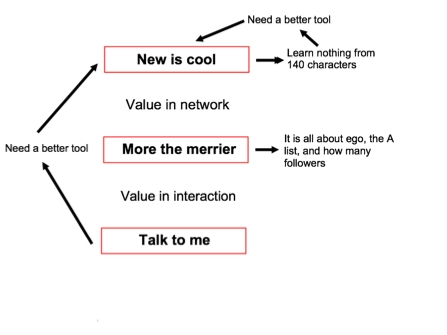
I do not know if the following diagram is self-explanatory or not, but it proposes three stages, it outlines the the realizations that allow some users to progress to the next stage, and the perspectives that encourages others to quit the Twitter community all together.

microblogstagesSo, I welcome you to test this model against your own experiences. If you have tried Twitter, which stage did you achieve?

BTW – the need a better tool links should probably be differentiated – I need a better tool vs. We need a better tool

P.S. – I noticed something interesting after I added this post to my blog. When you examine any single post on this blog, a plugin I have added to WordPress identifies what “it” thinks are similar posts I have generated on the same topic. In the case of this post, it generates earlier posts on Twitter. You can kind of see my own attitude change as I collect experiences with Twitter. Cool.

Loading

Leapfish – Another attempt to improve search

A post by David Warlich encouraged my exploration of Leapfish – another attempt to improve the search experience. As I understand the intent of Leapfish from the “About us” page and the Warlich post, it appears that Leapfish is an attempt to do a better job of integrating the multiple dimensions (webs, blogs, video, images, news) from which we potentially might acquire information.

I like to evaluate such services using my “question of the day”. Today’s question happens to be “If the inauguration set such an optimistic tone, why did the stock market take such a drastic downturn?” I really want to know.

I tried – inauguration AND stock market – I could find no guidelines regarding boolean search techniques, but this phrase seemed to work.

leapfish

The Google search seemed to reveal that others had similar questions (the second hit linked to CNBC).

The top link from the News panel offered a comment from MarketWatch . There was some reassuring data from this source –

Consider that, of the 27 inaugurations that have occurred since the Dow was created in 1896, this index has declined on 19 of those days, or 70% of the time.

This was at least reassuring.

BTW – the MarketWatch link did appear a little further down on the list of sources provided by Google so perhaps this cannot be regarded as an additional find.

One of the top listed blogs (an offering from Tim Paradis of the Associated Press so also kind of a news source) seemed to at least offer an explanation noting recent news regarding further struggles in the banking industry.

One of the most interesting resources was a YouTube video which if I understand the language seems to predict a bounce. WRONG, but interesting. It is reassuring to note that my naive assumptions were expressed in more complex language by folks who get paid for this sort of analysis and we were both wrong.

So LeapFish did expand my personal experience. I tend not to look for explanations on YouTube and probably trust Google too much.

The message – perhaps we all fall into a rut. A tool like Leapfish makes options more visible and perhaps encourages a little more explanation.

Loading