D. Warlich offered a post in which he commented on Personas – a MIT Media Lab application that categorizes Internet “references” to an individual. I guess he liked the representation of himself (looks like a genetic representation to me) and is using it as a header for his blog. Clever.
I decided to create a persona and contrast it with the persona of the individual I think I now best (cg).
Now, I am attempting to understand what the categories mean and what about our online presence would reveal differences. My wife is certainly more social and she has cause to be more involved with medical issues, i.e., she is a two time cancer survivor. I think the “books” priority for me makes sense (although Cindy’s Kindle did arrive today). Giving me any credit for “fashion” seems foolish (I guess one cannot assume mentions are necessarily positive).
BTW – your genetics seem to change a bit with each run – not sure what that means. I must be mutating.
I noted a couple of weeks ago that my professional responsibilities had changed as a function of my new role as department chair. The one component of this position that may be relevant to this blog is my administrative role associated with two department online programs (a graduate program in forensic psychology and the undergraduate major). The forensic program has been operating for a couple of years, but we are just rolling out the online undergraduate program. As I indicated in my previous post, my administrative role offers a different perspective than my previous roles as online instructor or graduate faculty member preparing other academics to teach online or design for online instruction.
Here is a concrete example – the financial challenge of an online program.
As a department, we have committed to a faculty in which all members are involved in teaching, research and service. We believe these roles are interdependent in that each is necessary and each role supports the others. When we moved last year to the initiation of the online major, we started by having existing faculty teach a few courses as overloads (with pay). However, this year with have added three faculty members. These individuals are not in tenure-track lines, but are given some expectation of stability. These individuals are expected to teach 5 “group” courses during the year (a 3-2 or 2-3) and all have research expectations. Nearly all of us are involved in teaching online courses, so the new hires both teach online and cover FTF courses when tenure-track faculty members teach online.
Here is a mathematical description of the money challenge. One can calculate the amount of return from tuition (approx. $225 per credit) that must be generated to cover instruction. We must generate approx. $13,300 per 3 credit course. The department receives approximately 55% of tuition dollars after money is taken out for Continuing Education and the college so we make about $370 per enrolled student. We do make some additional money in fees from 300-400 level courses. Here is the problem. We do very well in lower division courses and a few other courses taken by many majors. The problem is that we cap courses at 40 students and we must enroll approx. 36 students to cover instructional costs. So there is little room on the up side to generate a little extra money for administrative costs and GTA support (40 students online is a challenge and far more time consuming than 40 students FTF). When we get to courses likely to be taken by majors only we do receive an additional fee ($50 per credit), but we have far fewer students. The limited upside in fully enrolled courses does not compensate for the struggles to generate enrollments from online majors. We are pretty much breaking even.
I think we are doing what we should be doing to offer a quality program. We want those who take online courses to experience the same faculty members campus-based students experience. I offer this information as a concrete way of explaining what it takes. If our experiences are typical, universities need to be doing this because it is the right thing to do and not because they anticipate large financial gains.
I have been reading and commenting a lot lately about the free alternatives to commercial information products (e.g., newspapers, textbooks). My latest read is Curt Bonk’s “The world is open” (ironically a book I bought).
We have been attempting to get our publisher to consider a different model for some years without much luck. However, it does look like there is now some movement among commercial providers. I am guessing the hardware (e.g., Kindle) is available that will offer the providers some assurance their basic products will not be passed around.
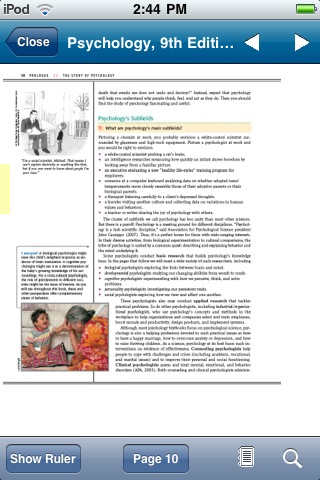
I read today (ReadWriteWeb) that CourseSmart now offers content for the iPhone. I am familiar with CourseSmart as a provider associated with textbooks I have used and I own an iPod Touch (close enough) so I downloaded the app (the RWWeb article contains a link) and tried some of their demonstration materials.
A display from a psych textbook involving an entire page.
A display from a biology textbook zoomed to one column. This offers a better idea of how one might actually use the iPod to read.
The screen captures from the iPod are larger than actual size.
I find this interesting and a useful mobile tool, but I am not certainly I would be willing to read a thousand pages a semester (multiple books) in this format.
We are taking an end of summer break and spending some time camping in Northern Minnesota. The attached image was taken on the way in a sun flower field near Crookston, MN. This post originated in Flickr and takes advantage of a flickr feature allowing posts to various blogs (including Twitter). The entire process has been accomplished using my mifi from a camper in the woods. A weak cell signal, but still functional.
How copyright and fair use apply in an online world have long been issues that have confounded me? I think I have found an explanation that seems logical to me, but then find some “expert” advocating a practice that I would regard as an infringement. I think I understand “fair use” as it applies in my face to face classroom or to materials I might provide students. I understood that fair use did not apply to materials I might offer others online. This made some sense to me based on my experience being associated with a commercial product – I knew that if I wanted to use an image in our book the responsible individuals had to provide permission. Online was “publishing” whether the product was paid for or not.
The 2002 TEACH act seemed consistent with this perspective. It authorized online behaviors similar to classroom behaviors as long as those with access were enrolled students and efforts were made to exclude others (e.g, a sign-in CMS). This seemed logical. In addition, the act itself seemed unnecessary if my interpretation of online fair use was wrong.
EDUCAUSE has recently released a “research report” on copyright and fair use in a web 2.0 world. I thought this would make it clear that my interpretation was overly strict which is what the report says educators tend to do. I even thought I found the page on which my answer existed (page 9).
Copryighted content can be displayed openly on the web so long as it meets appropriate exceptions under fair use, compliance with the TEACH act, OR is licensed. (OR caps for emphasis – meaning different issues are in play)
I interpreted this to mean my existing interpretation was overly cautious – I might use an occasional image or short segment of music as such would meet fair use guidelines in my classroom and it would seem I could do the same on a web page.
I read on (unfortunately).
In discussing making lectures available to any interested party as is being done by many institutions via iTunes U, the authors state:
“..students are increasingly demanding recorded lectures, which commonly include copyrighted materials, such as photos or diagrams from books…”
(top of page 10 now):
To comply with copyright law, permissions must be obtained for the copyrighted materials, the materials must be removed, or the materials must be recreated …
Am I wrong about fair use, I would regard using a scan of a single image from the textbook in a powerpoint slide as fair use. If this is true, the experts authoring this EDUCAUSE article appear to have contradicted themselves (perhaps reversed themselves) within the span of three paragraphs.
What are the options here? This still makes little sense to me.
The Pew Internet and American Life project has released another report concerning how and how much we use the Internet. The focus of this most recent post was the rapidly increasing use of wireless Internet use. The study reports that 1/3 of Americans have now accessed the Internet using a cell phone or smart phone. I tend to interpret the data sources I follow based on my interest in educational applications and I know there is growing interest in smart phones in classrooms. My immediate reaction is based not on the number of families or teens with cell phones, but the number with a data plan. The proportion of those who have a cell phone who have browsed the Internet, watched a video, or sent email is 25% or less. I wonder if this is approximately the proportion with a data plan.
I think access issues are important. I find netbooks appealing because the lower cost may make it practical for schools to provide each student with a “learning device”. The limitation is home access. Equity cannot be achieved without home access.
I am a fan of the iPhone but I cannot own one because I live in North Dakota. Another equity issue, but I guess I have other resources. The rumors of an Apple tablet are also intriguing. Again, a mobile device that will rely on cell access rather than or perhaps in addition to wifi.
The problem is the cost of data plans. As I have explained in my other blog, I now have a solution to iPhone problem in North Dakota. I have discovered mifi.
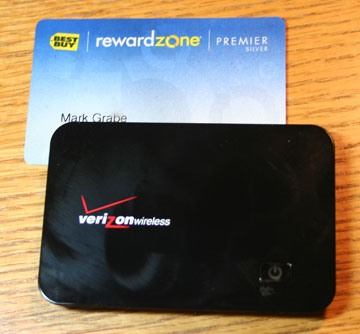
Here is my mifi. As you can see, it is about the size of a credit card and maybe 1/3 inch thick. A mifi is a combination EVDO and wireless access point. In other words, it uses a cell service (Verizon in this case) and then extends this as wifi to up to 5 devices in a 30 meter circle (if I remember correctly). Here is what is cool. I can put this device in my pocket and use my iPhone touch as a very mobile computer. I become my own walking access point. If I was younger I could be my own running access point.
Here is the down side. We pay $60 a month for 5 gigabyte access. I was concerned about the quantity of content we would normally download/upload. We were out of town over the weekend with Cindy’s brother and wife and we all connected – sometimes two computers and my Touch at one time. No video or music that I remember, but lots of Internet use, Twitter, email, etc. Several hours a day I would guess.
We used only a fraction of a gigabyte so 5 gigabytes would probably meet the needs of an average family if there was not a need to download movies.
Still, $60 is more than basic cable (with no quantity restrictions in most locations) and as an annual expense far exceeds minimum hardware costs.
We worry about inexpensive devices. We worry about the cost of content. Seems to me that the immediate challenge is the cost to connect. At present, the real opportunities that exist are available only to some.
I had a plan for how the rest of my career would play out. Senior-level (i.e., old) academics can kind of do this kind of thing. The plan went something like this. Professional: At work – a) teaching – educational psychology and ed tech, intro psychology, and b) research – technology support of study behavior for students in large introductory courses. Outside of work – work on revision of book with Cindy, develop participatory web portal for anyone who might be interested. This blog is a small part of my portal concept. I do not have a plan for all of those aspects of my life outside of what I consider my professional life.
The plan changed two weeks ago. I have spent 13 years as a department administrator (i.e., chairperson). Six years ago, I decided it was time to refocus so at the end of a three-year term I decided it was time to quit. Now, I am back in that role. Three years – a big chunk of the time I am likely to remain employed have now been committed.
I am familiar enough with the role that I realize things are now quite different. I am still uncertain what will go to make room for these new commitments. Blogs posts may be less frequent. Topics may change.
The administrative responsibilities have changed quite a bit from six years ago and much of this change involves technology. Psychology has added a large distance MA program in forensic psychology (60+ students) and a complete online undergraduate major (e.g., students can add a major in psych to an existing undergraduate program). There is an interesting reality in administering such programs that one not does appreciate or need to worry about as a researcher or ed tech academic. These programs need to make enough money to at least break even. People have their jobs on the line. Ideals regarding how such courses should be taught, how many students can be enrolled, and what will be demanded of students take on a different perspective. I am not the “talent” in this case. I am the one who must keep an eye on some of the variables involved to hopefully assure that the books balance and everyone has a satisfying experience.
This should be interesting.
Manage Consent
To provide the best experiences, we use technologies like cookies to store and/or access device information. Consenting to these technologies will allow us to process data such as browsing behavior or unique IDs on this site. Not consenting or withdrawing consent, may adversely affect certain features and functions.
Functional
Always active
The technical storage or access is strictly necessary for the legitimate purpose of enabling the use of a specific service explicitly requested by the subscriber or user, or for the sole purpose of carrying out the transmission of a communication over an electronic communications network.
Preferences
The technical storage or access is necessary for the legitimate purpose of storing preferences that are not requested by the subscriber or user.
Statistics
The technical storage or access that is used exclusively for statistical purposes.The technical storage or access that is used exclusively for anonymous statistical purposes. Without a subpoena, voluntary compliance on the part of your Internet Service Provider, or additional records from a third party, information stored or retrieved for this purpose alone cannot usually be used to identify you.
Marketing
The technical storage or access is required to create user profiles to send advertising, or to track the user on a website or across several websites for similar marketing purposes.





You must be logged in to post a comment.