I have owned a Blackberry for a couple of weeks now and it has changed the way I think about cell phones. I had a TREO before so I am not new to “smart phones”, but the ease of use of the newer equipment has caused me to both use the phone more and to explore more applications.
I am presently interested in the opportunity to send images to Flickr by email. The combination of commonly available camera phones and Flickr capabilities would seem to have some interesting applications.
What appeals to be is the opportunity to establish a Flickr email address for uploads that can be shared with multiple individuals combined with the opportunity to set permissions on uploads so that I or another account owner can review uploads before the images are shared with the world. This seems a practical way to implement classroom projects – a combination of convenient access AND control.
EdWeek reports that candidates have commented on education in recent ads and speeches.
“Senator McCain … is interested in empowering families and speaking directly to the educational needs of Americans, as opposed to the system,” said Eugene W. Hickok, a former deputy secretary of education under President Bush who is advising the McCain campaign. “Whereas Obama, beyond his mantra of more money, more money, is really just supporting these traditional approaches to the system.”
My read of this article is that policy comments follow fairly typical party lines. Still, the article offers a nice summary and includes the recent television ads in case you have decided to watch movies until mid November.
While based on “web kit“, underlying code more central to Apple web ventures, Google decided to first release their new browser, Chrome, for the Windows platform. Mac users may be envious of the Google strategy.
Here is a temporary fix. LifeHacker describes how others have already created a port of Chrome for Linux and Mac users.
I gave CrossOver Chromium a try and it is functional, i.e., something to experiment with until Google releases the official version.
I listen to audiobooks or podcasts while I work out. Lately, I have been listening to Friedman’s Hot, Flat and Crowded. I can only “listen” while involved in another task that allows me to think so getting through 20+ hours of content will take many trips to the gym.
I really like the way Friedman writes. The content flows easily and his approach combines interesting stories often based in personal experiences and well reasoned arguments supported with specific and annotated facts and statistics. It is the type of approach I can process and find convincing.
I have been thinking about the difference between this approach to persuasion and the present experience of trying to understand the rhetoric of the election – vague comments, spin, sarcasm, and irrelevant concerns. Consider the attention in the past few days to lipstick and pork (but not the undeserved windfall directed toward supporters).
Today, in Intro Psych, I was trying to make the point that trying to understand the work of researchrs can be valuable to those who have no interest in becoming psychologists or taking more psychology courses. What researchers have to do is “operationalize” the concepts they study in ways that allow measurement or manipulation. They cannot hide behind vague terms like motivation or intelligence most of us use in daily conversation, but must determine how they will measure these variables. Everyone could benefit from such a challenge. It is a great exercise in taking the vagueness out of topics. Tax and spend, liberal, etc. would be too imprecise to be useful. What do phrases such as these really mean. Should we really expect that it would be allowable to spend on something like a war and not take responsibility for raising the money to support such an effort. The reality of the present deficit would seem to argue some in power accept spend, but don’t tax. Perhaps sometimes to be responsible you have to tax. Critical thinking requires getting to a clearly defined position that can then be evaluated against well defined standards. Keeping the country in the black represents a possible standard.
I know that Friedman has his critics who contest his logics or his facts. However, in being precise at least you are willing to give your potential critics something specific to address and what is expected is the same level of specificity in counter claims.
Ignorant as we want to be (paraphrase of a Friedman comment). Friedman describes our tendency to find a way to accept a short term, self-serving solution while ignoring long-term and significant problems. Don’t look too closely at the facts or think an immediate solution through to the point of eventual consequences. Perhaps we prefer our politics the same way.
BTW – material related to Hot, flat and crowded is available online. This is serious stuff. Being ignorant, even if you would rather be, is not acceptable.
Researchers investigate topics most of us don’t consider as questions. A recent article in the Sydney Morning Herald summarized human factors studies related to email use. I really don’t follow this paper but read a description of the article on Slashdot.
Email proves very distracting for some users who feel the need to constantly check email. According to the article, it takes approximately a minute to recover your “train of thought” AFTER checking your email. So, it is not just the time to process the email, but the added inefficiency once you return to your primary task.
Hmm, this explains a lot …
Now, what was I working on before I decided to check my bloglines and write this post? There are addictions worse than email.
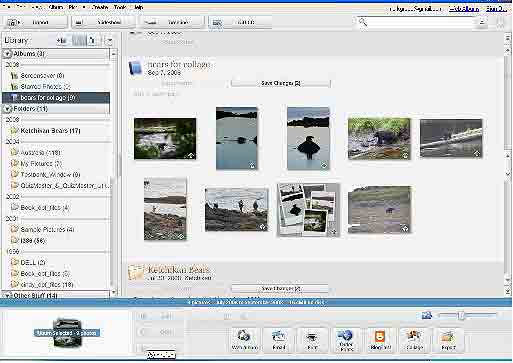
The potential of photography as a generative learning activity has always appealed to me. I am mostly a Macintosh user, but I realize that not everyone shares my choice in equipment so I try to keep up with options for the Windows OS. You can use the online photo sharing site whatever your choice in operating system. What I have searched for is a low cost alternative for collecting, organizing, and annotating images similar to iPhoto. Picasa is such an application. Actually, iPhoto is low cost, Picasa is free
I found the newest Picasa sluggish, but I am guessing my old hardware was at fault. The YouTube video linked above showed a much more responsive experience. The layout is very similar to iPhoto and I was able to duplicate what I saw in the video without difficulty.
There are some things in Picasa that are not available in iPhoto. The opportunity to organize a collection of images as a collage offers a nice way to present images associated with a theme. Organizing the images within the collage is what caused me the most difficulty with response speed, but the product is of high quality. The collage appearing below is approximately 50% of the size of the original.
Picasa the app and Picasa the photo sharing site do work together and it is easy to upload an album. I have attempted to match a set of photographs and one Flip video to allow comparison. I realized after completing the process that it is impossible to unconfound the application from the social site, but a more straight forward comparison will have to wait.


You must be logged in to post a comment.