
I guess there are boundaries!

My university has held an annual technology conference, Beyond Boundaries, for several years. Some of my past blog posts were generated from the perspective of a participant in this event. Working in a fast moving field such as educational technology from North Dakota is challenging. Internet access and all aside, it is hard to be a leader from the periphery. Hosting a conference of this type was a way to bring some folks here instead of us always going there. I liked the vision and the commitment this demonstrated.

Approximately a week ago as a registered attendee at this year’s conference, I received an email indicating that this year’s conference was canceled. The details were sketchy, but some mention was made of limited travel budgets. I was disappointed and upset by the short notice which I think really makes the university look bad (i.e., we might lose a little money on this so we are backing out), but it was kind of one of those things I just let go.

I have since changed my mind. If you believe in something, it is your duty to say something. Such is the responsibility of the participatory web

So ….

I apologize on behalf of my university, whether I have the authority or not, for this cancellation and for the late date on which it was issued. Sometimes you should do things because it is the kind of thing universities take responsibility for doing. Everything should not be about money and everything does not have to be run on a “charge back” model. Universities have tremendous resources (people, space, Internet access) that are available and paid for. While it would be nice to generate some income with these resources, the resources exist and the money is often spent whether the resources are applied to a purpose or not. If we can find millions of dollars to support moving our sports program to division I despite the reality that nearly every team will lose money, we should find a little money to support a conference we have made a commitment to host.

Loading

You can fool me once, BUT

Perhaps you, as I, have been carefully watching Washington as our elected officials attempt to bail us out of what seems to be a dire economic crisis. Perhaps you can’t figure out why those folks can’t pull the trigger and institute the bail out. I have a theory.

I call this the “You can fool me once” explanation. I propose that we have experienced this combination of national fear, vagueness, and urgency before. Now, as a consequence of quick and unquestioning acquiescence on this earlier ocassion, we find ourselves with thousands of dead citizens and hundreds of billions of dollars of added debt. WMD, Al-Qaeda staging area? It now appears not to be so. Those who signed on in accepting the initial flawed analysis found themselves forever limited in their ability to criticize because of their initial support. FOOLED THEM ONCE!

Now, the concern is that this may be an opportunity to demonstrate that “You can fool me twice”.

I don’t know what should be done at this point. However, in this politicized climate, I understand that despite the urgency urged by some there is a willingness to be careful and go slow. 700 billion dollars? What if we eventually learn we have not used this opportunity to fix the underlying problem and instead have added to the existing financial woes and saddled ourselves and our kids with well over a trillion dollars in debt?

I blame the administration that took advantage of circumstances to “fool us once”. Whatever the causes of the present financial crisis, this is the climate of distrust you have generated.

Blogged with the Flock Browser

Loading

Slackers – Rise Up

Michael Moore’s new movie – Slacker Uprising – is now available.

If you are unfamiliar with Moore’s present project, he is offering the movie at no cost (download) to increase the likelihood young people will vote. It may offend your sensibilities, but it is probably not aimed at you. Whatever you think of his approach or his politics, it is hard to dispute the importance of his mission.

Loading

Blogging in 2008

Technorati takes it upon itself to publish a state of the blogosphere report. I pay attention because I like the numbers. This edition looks more detailed than most and is emerging by topic over the course of this week.

Basic Stats

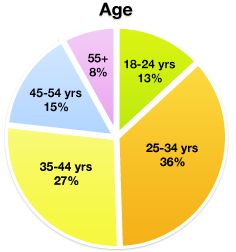
One of the first things I noticed was their break down of bloggers by age. Given the hype regarding the interests of young folks in “new media”, I was very surprised by the low percentage of 18-24 year old bloggers. I am thinking that Technorati does not consider posting to Facebook or MySpace as blogging. The study did not consider individuals who would be in a K-12 settings.

The report also indicates there are more male than female bloggers. For some reason, I thought I had read otherwise. Bloggers tend to be well educated – 74% are college grads and 42% have some graduate school experience.

Only 8% of blogs have been active for 6 years. Hooray for the persistent ones.

Loading

Hacking Email Accounts

Curious about how a hacker was able to access Gov. Palin’s email? The account hacked was a personal Yahoo account. This article from MacWorld explains how it was done.

Yahoo offers a method for users to recover a forgotten password. You may recognize the procedure from your own experience. When creating an account, users are allowed to select from a limited set of questions a question that must be answered before a forgotten password is revealed (in this case before access to change a password is allowed). If you know the answer to the question, you can gain access. If you select a question that is “researchable”, you are vulnerable. In considering some of the questions, it seemed that questions I felt most comfortable predicting I could answer consistently (e.g., mascot of my high school) would be the type of information someone else might be able to locate. I was a Kingsley-Pierson “Panther”.

I investigated my own Yahoo account (I don’t use Yahoo for email, but a Yahoo account is needed for Flickr). I agree with the security assessment – if you know the Yahoo ID and if you selected a question to protect your password requiring information that might be readily available, it would not be that difficult to hack. For example, it might be possible to determine the city in which I was born and it would be more likely if I was a political figure.

As you might guess, I did not use my high school mascot or city of birth as my security question.

You would know that your security had been breached (you might not be able to get back into your account because the password had been changed, you received an email sent to a second account indicating your password had been changed), but by that time any information you were hiding would be available to others.

Loading