The advantages of digital reading

In the past year or so, I am guessing educators have become aware of a controversy related to whether learners are best able to learn from content presented on paper or a screen.  I am certain some researchers will continue to compare the comprehension of content appearing in a book versus on a screen, but whether or not such research reaches a conclusion one way or the other (see reference from recent meta-analysis), we have already switched to heavily relying on information we can access from our devices. It makes more sense to accept that learning with a phone, tablet, or computer will be involved in a significant proportion of our learning experience and consider how best to use the unique capabilities of these devices. What does digital reading look like and what presently neglected skills are being ignored that educators can help learners acquire? 

I do many different kinds of reading and I think this is true of many learners. I read for pleasure and I read to learn. Those who study reading probably can come up with many more meaningful categories, but these two are sufficient for my argument. I like to describe these reading activities as associated with shallow and deep goals. Some who study different reading activities seem to describe deep reading a little differently than I do. My use of the term implies the intent to learn, retain, and apply information gleaned from reading. I also see an opportunity for digital reading when retention and application follow initial exposure to text by longer periods of time than would be involved in the delay until the next examination. A unique advantage of digital reading is the opportunity to externalize immediate insights and personal interpretations in ways that take advantage of storage, organization, and search capabilities of technology. Some describe this as using technology as a second brain. Accept that human memory is far from perfect. If we think about reading a little differently and consider that reading could also involve efforts at external storage, the time invested in reading to learn may have a bigger return on investment in the future.

What follows are four books (linked to the Kindle version from Amazon) that take on the notion of digital reading. Yes, I have included one of my books among them although this book is focused more on how educators can take advantage of technology to facilitate how students learn when they read. All of these sources explain what I mean by the externalization opportunities technology make available. If you want a single recommendation, it would be “How to Take Smart Notes: One Simple Technique to Boost Writing, Learning and Thinking”. I find the title a bit misleading as the text is concerned with far more than taking notes. The author considers learning from reading and learning more generally. I make this recommendation because offers both solid theory and concrete suggestions for practice. 

Grabe – Designing Instruction Using Layering Services: Educators and students guiding learning

Cohn – Skim, Dive, Surface: Teaching Digital Reading

Kalir & Garcia – Annotation

Ahrens – How to Take Smart Notes: One Simple Technique to Boost Writing, Learning and Thinking – for Students, Academics and Nonfiction Book Writers

My Diigo account should provide me notes on all of these books.

Reference:

Furenes, M. I., Kucirkova, N., & Bus, A. G. (2021). A comparison of children’s reading on paper versus screen: A meta-analysis. Review of Educational Research, 0034654321998074.

Loading

Online Privacy Demonstration

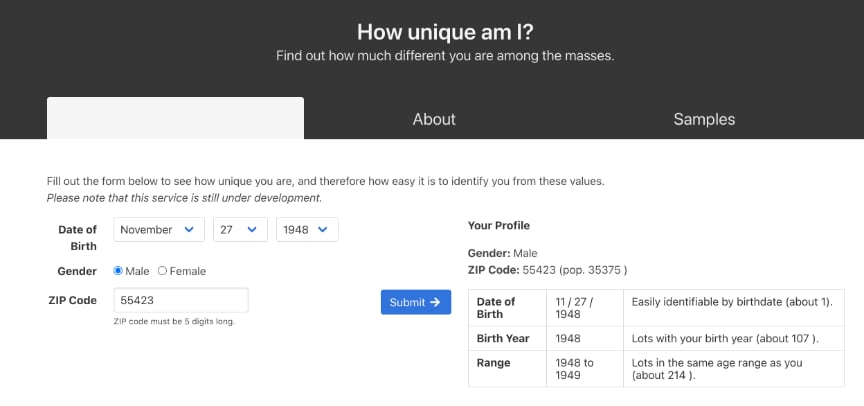
I have been reading a book on privacy (System Error) with a story and recommendation of a demonstration site I thought others might find interesting. The issue considered is how information we think to be shareable can still be used to identify us.

Latanya Sweeney, then an MIT graduate student, and anyone else who wanted, had access to the record of Massachusetts hospital visits by all state employees. These data contained no information assumed to identify individuals – name, address, social security, etc. The governor of Massachusetts contended that the privacy of those associated with these records was secure. Sweeney did not agree. She purchased a list of all registered voters in Cambridge that contained the names of voters as well as their birth date and gender. There were six people in Cambridge with the same birthday as the governor, three of these were male, and one lived in the same zip code as Weld. Sweeney cross referenced the medical records by birthday, zip code, and gender, located the governor’s records and sent him a copy.

Sweeney contends that 87% of Americans can be identified based on zip code, birth date and gender. These are variables we commonly provide without concern.

Sweeney now works at Harvard’s Data Privacy Lab. The lab offers an interesting demonstration. You enter your birthdate, zip code, and gender. I tried the demonstration and found that I could be identified as unique. This may seem amazing, but work through the math. There are likely at least three gender categories and 365 days in the year. I am 73 years old. Even though there are 35,375 individuals in my zip code, the combination of my age, gender, and birthdate identifies one person.

These data do not offer up my name. I suppose this could be determined from voting records as Sweeney demonstrated. For other purposes, this is demonstration of just how easily we can be targeted with ads or information.

Reich, R., Sahami, M. & Weinstein, J. (2021). System error: Where big tech went wrong and how we can reboot. HarperCollins.

Loading

Check yourself

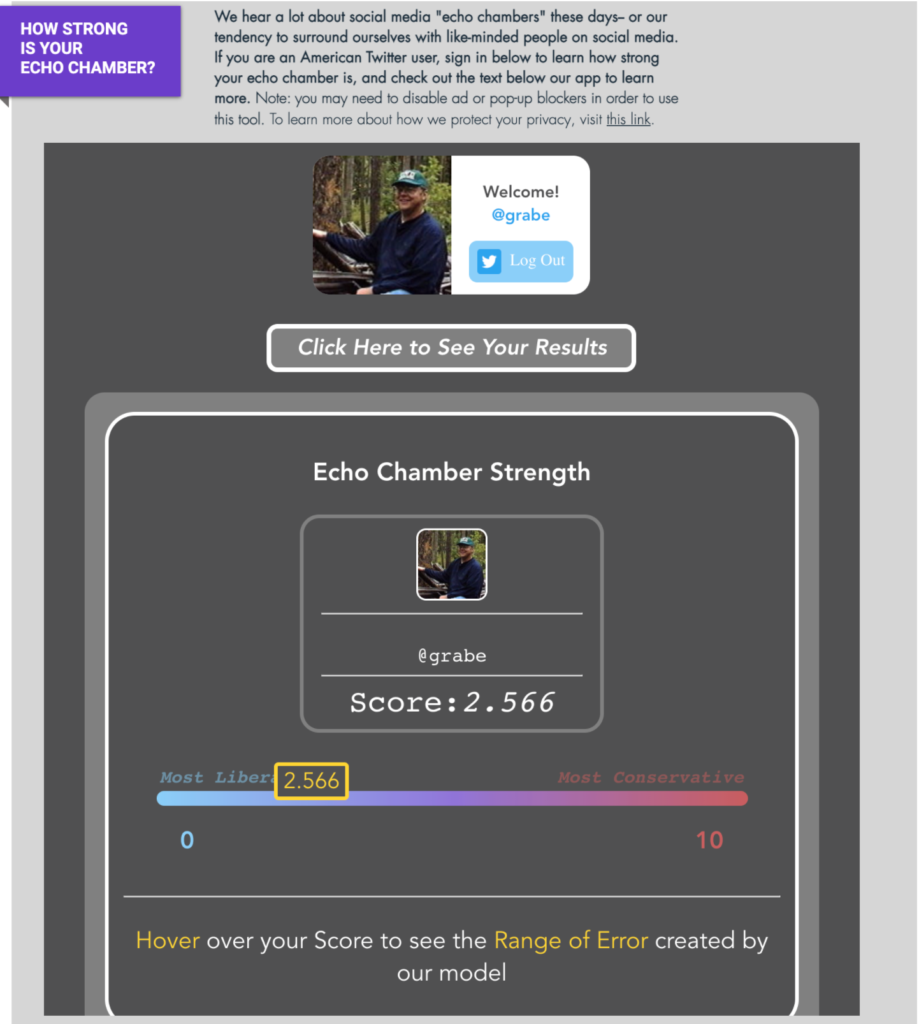
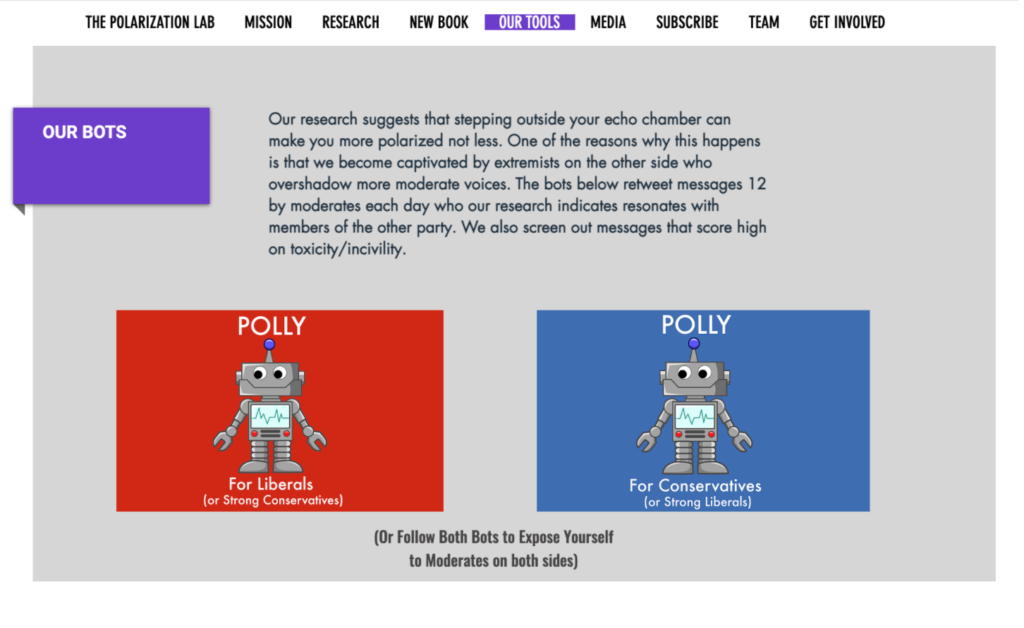
The Polarization Lab (Duke University) has conducted some interesting research on political polarization. They have developed tools you can use to estimate the orientation of your Twitter feed and bots you can use to expose yourself to positions taken with the opposite orientation. The premise of their work is that exposure to different perspectives can reduce bias.

Check my echo is a tool that compares the orientation of the politically oriented Twitter accounts you follow to prominent politicians, journalists, and advocates to generate a score on the polarization of those you follow.

The Lab offers bots to expand your perspective. The bots pass on tweets liked by prominent liberals and conservatives. The idea being liberals should friend the bot forwarding tweets liked by conservatives to gain insight into the positions taken by those unlikely to show up in their feeds.

Loading

Checkology

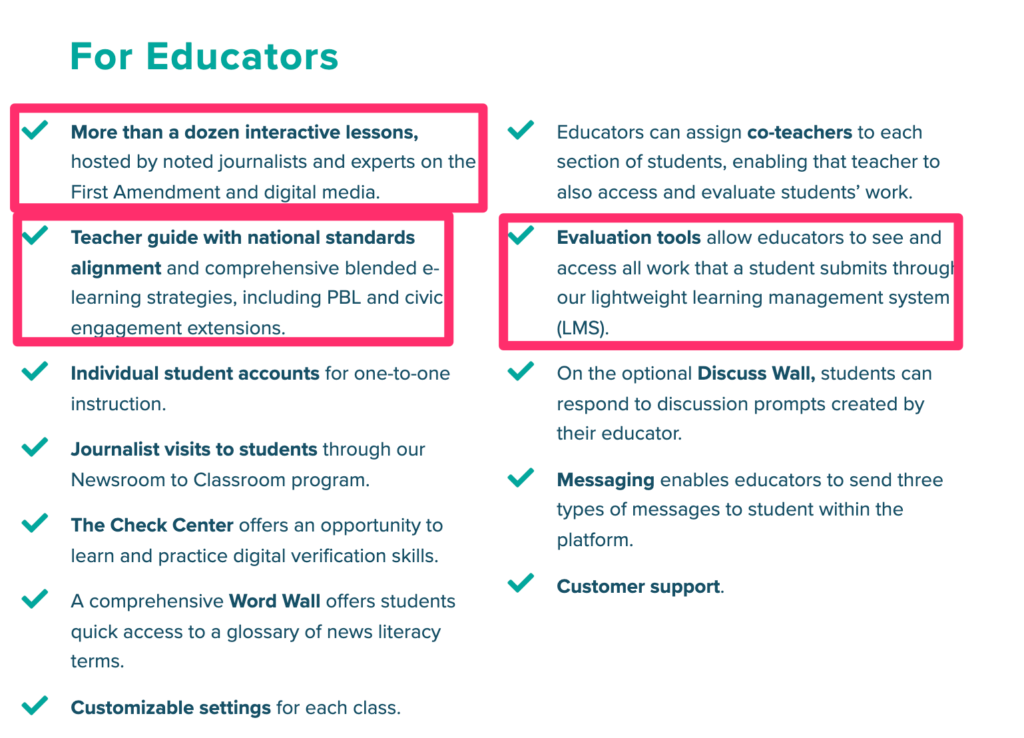
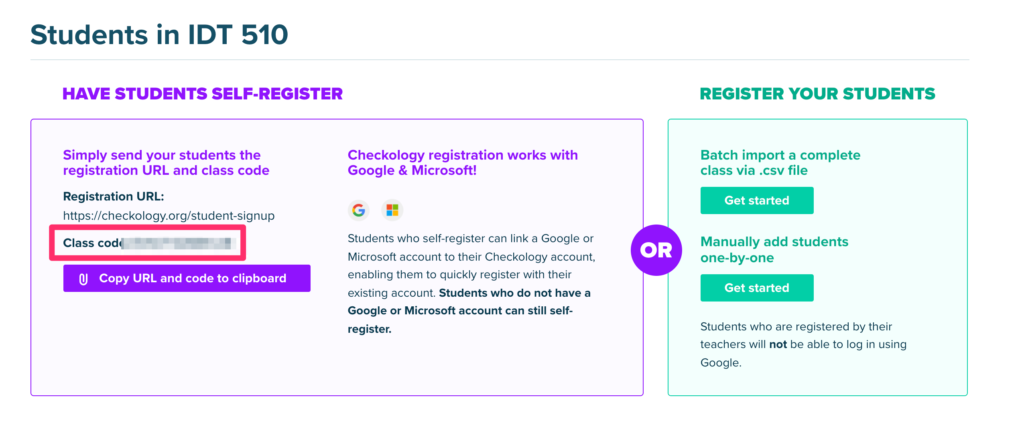
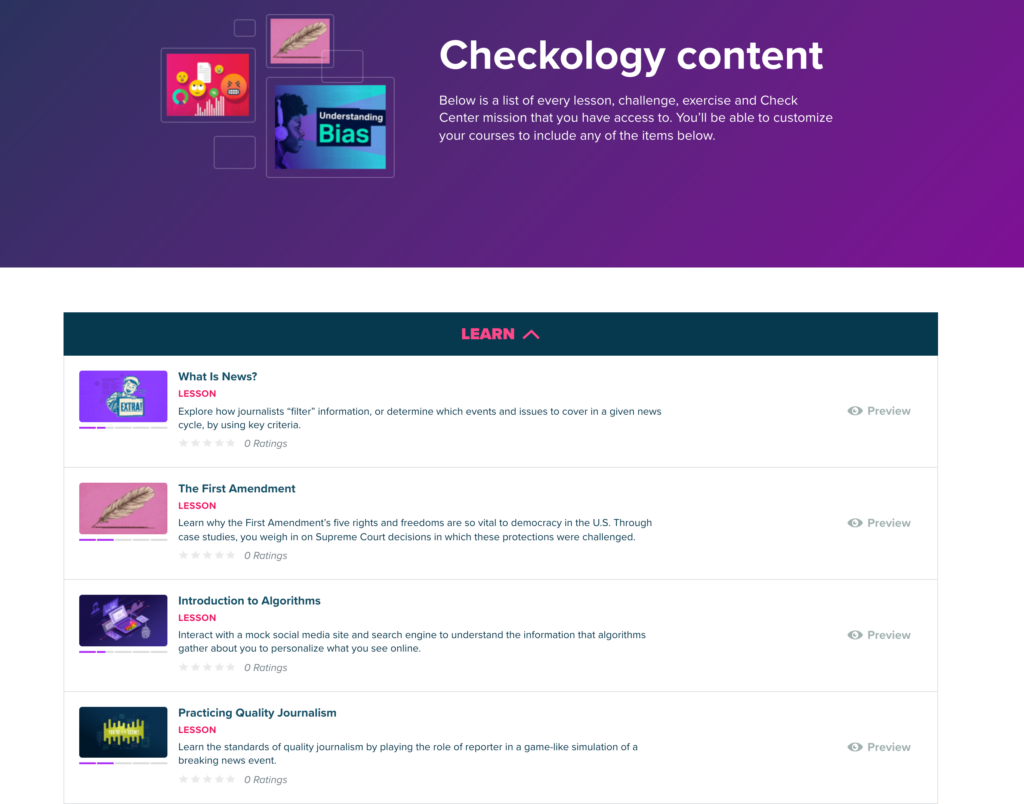
Checkology is a great resource for educators or any individual interested in developing the skills of news literacy. It is a free and complete instructional resource – lms for creating classes and making assignments, instructional content, skill evaluation tasks, and open-ended resources for further exploration.

Educators can designate a class, select content, and invite students into the learning environment.

Loading

Battling Online Toxicity

We have learned that social media can be very inappropriate. While the promise of interaction for greater understanding is certainly there, the negativity of such interaction seems to have destroyed this opportunity leading to the expectations of many that political pressure must be put on social media services.

There may be an alternative. The idea of middleware proposes that a technology fix can be positioned between the user and the service. This concept is explained in this article from the Wall Street Journal. While the article describes the potential and approach in some depth, it lacks specific examples.

Work is underway on at least one approach. Jigsaw, a group associated with Google, has been working on the development of Perspective which proposes the use of AI to develop an API to screen comments before they are sent or before they are read. The link provides an explanation and an opportunity to test a comment you might send. Research has demonstrated that users will often make modifications in reaction to what are called nudges. The proposal is that such technology could be incorporated by social services, but also function as middleware.

While this technology exists and is being refined, you can already use a version of what is now available. Tune is a chrome extension you can add to screen comments you would be exposed to through several social media platforms.

Toxicity middleware may be coming to school technology equipment in the near future.

Loading

Paradox of abundance

Essayist David Perrell has written a post arguing that the abundance of information offers a great opportunity for a few, but a significant problem for many. He calls this position the paradox of abundance and uses the metaphor of abundant food as a parallel providing possible insights.

As I understand the logic of this parallel (starting from the challenges of abundant food), human evolution has lagged significantly beyond the technology of modern agriculture and prepared foods. Biologically, we are not “programmed” to deal with an abundance of food especially the great variety of food not necessarily ideal for consumption. The more primitive drive encouraging consume when you can have not yet adapted to abundance. He also references a finance argument called Greshman’s Law familiar to many which suggests that bad money drives out good. I interpret this to mean, in this case, that cheap poor quality food that tastes good will be particularly attractive. For those who are discriminant consumers and Perrell suggests who prepare their own food from scratch, the abundance of quantity and quality is of great benefit. For the greater number who pay less attention to food quality and rely on purchased and at least partly prepared food, the abundance of low-quality food has led to many problems.

The essayist sees a similar situation with information. We clearly have an abundance of information varying greatly in quality including content purposefully generated to mislead and confuse. Free access allows discriminating consumers to benefit greatly, but those with less skill or those making less effort will likely encounter poor quality content. The poor quality drives out good is used to explain the penchant to consume simplistic explanations for complex things and to be drawn to emotion-inducing content. The author proposes the benefits of focusing efforts to assist through curation. He also argues the benefits of writing much in the same way to sees benefits in cooking from scratch.

I encourage reading of this essay as an interesting way to think about an obvious issue. In general, reasoning from metaphor is not a strong approach, but I can see the logic in the comparison. Describing a problem in an interesting and innovative way does not necessarily mean the core causes have now been identified and can be addressed. What about the recommendations – make use of the recommendations of trusted curators and write yourself are consistent with my own biases, but I would be challenged to offer data in support. At a more general level, writing forces extended processing and requires metacognition evaluation through translation that provides some advantages.

I don’t think it likely we will escape from the abundance of food or content. This is a consequence of the capitalism we endorse and once opportunities exist it becomes difficult to go back.

Loading

A video playlist to understand the challenges of social media

I have been interested in the problems of social media for some time. I feel somewhat responsible because I was very excited by what was once called Web 2.0 or the participatory web. There seemed like so many opportunities for engagement and learning at that time for so many areas – politics, education, human interaction on a global scale. With cell phones being so ubiquitous, it seemed a reasonable way for nearly everyone to learn and communicate. I did my best to spread the glad tidings and offer suggestions for the use of technology in classroom settings. If you are reading this, you can assume I tried to influence you. Things have certainly not worked out in the positive way I anticipated. Social media and the Internet have obviously impacted us in many ways and have generated great amounts of revenue for some. However, there are serious problems that need to be recognized and addressed. 

My wife and I meet online with a group from our college days every two weeks. As part of these meetings after socialization and catching up, we have a topic for discussion led by one of the participants. It was our turn and I wanted to talk about surveillance capitalism. Several of the participants work in economics and finance with one being a college prof. By definition, we are all social media users as we are meeting with each other via Zoom. Issues with social media seemed to me to be an issue most should find interesting – the Pew Research Center in 2018 found that 68% of U.S. adults use Facebook, 35% use Instagram, and 24% report using Twitter. Even old folks like us are involved. I searched about for a short video I could offer to the group and I intended to generate a shortlist of questions that might guide a discussion. I found it difficult to find a single source that would include the multiple issues I see combining to produce the challenges I see so I picked one of the components I thought might offer a good activation. I was talked out of the idea as something that many folks may not think about and a kind of heavy talk ill-suited to casual conversation. 

However, once started I kept thinking about a way to offer others some insight into what might seem a troubling but opaque topic. I had decided I could not identify a single source that would accomplish what I wanted to accomplish so I tried to identify key elements of the online environment that are involved in determining what I think is our present situation. I decided to focus on video resources.

What follows is a list of videos that explain individual components that combine to produce the challenges and complexity of our present online social world. In an effort to identify what I see as the individual components, I have designated a term or phrase and you will find that term or phrase highlighted in the following list. In many cases, I came to these topics and individuals based on individual books that I read. My bias for exploring what I consider personally important topics is to read rather than watch, but I understand others don’t consume information in this way. Most of the names identified below are also authors and be could search for more detailed presentations. 

Components of the social media mess explained for those who don’t like to read

  • Filter bubble – what we want to see and not what we need to see – Pariser – TED talk 
  • Surveillance capitalism – Zuboff – Triangulation 
  • Section 230Wall Street Journal
  • Radicalization – austav Mukherjee – TED talk 
  • Confirmation and other biases – Shepard – TED talk
  • Spread of misinformation – Aral – TED talk  

Loading