Smart notes and useful highlighting in K12

I have been trying to decide how to bring together a couple of strands I have been exploring for several months. I tend to write for educators in the world of K12, but explore ideas and research from elsewhere. I have spent a lot of time lately examining the focus on professional or life-long learning involving personal knowledge management (PKM) / second brain uses of technology tools. You can review the posts by selecting the category for digital notes you should find in the margin of this post. Somewhat independently of this strand, I have been reviewing the content on the advantages and disadvantages of reading from paper compared with reading from a screen. Many of these posts appear within the category I have labeled digital literacy. Finally, there is the issue I have long been interested in which I might describe as who teaches what? Who teaches learners to study? Who teaches learners to highlight and annotate? Does anyone? At some point, I should make an effort to offer the K12 audience actionable recommendations. So, here is one idea.

This recommendation combines strategies recommended by Porter-O’Donnell (see reference at end) and the use of Scrible a digital note-taking and highlighting environment I described in a recent post. There are probably many options to Scrible, but it is free, useful in a group setting, and available for educators and learners. 

Let me begin with Porter-O’Donnell. She teaches what I think most would be described as literature. For those reading her article, her focus is important to keep in mind as I believe her strategies generalize, but the specifics of the strategies would vary with other content areas. For example, what one might be guided to highlight and annotate when reading a classic poem or story would be different from what one would annotate or highlight when reading a chapter in a biology or history textbook. The author beings by reflecting on her own experiences. She notes that in high school she was not allowed to highlight or annotate and then was lost when entering college without such restrictions. She claims she initially highlighted far too much and without much in the way of goals. She said it took her several years to develop strategic approaches. I can identify and would add from the personal perspective of teaching a couple of very book-based, large lecture, introductory courses (Introduction to Psychology and Developmental Psychology) that effective reading skills are most deficient at a time when there is limited support for application. Students begin college taking many courses in a large lecture setting and have limited interaction with the instructor.

Porter-O’Donnell accepted the responsibility for changing this typical set of learning experiences and developed strategies to embed as part of her traditional instructional goals. She began by asking students to work with her in identifying types of information they might expect to glean from a reading assignment projected using pages on an overhead (note the date of the author’s activities as I describe them). What would be highlighted and what notes might be written in the margins. For example, one might highlight characters, setting (where and when), vocabulary, and important information. One might write in the margins – predictions, questions, summarizations, connections, and literary techniques. She then proposed making copies of pages from a story and having students apply these categories (she used symbols to differentiate) making use of highlighters, margin annotations, and sticky notes. She also created a system for after-reading follow-ups. Reread annotations and review highlights. Were predictions verified? Was the title a good summary? What would be a good summary? These are just a few of her suggestions and what I am asking would be the equivalent categories during reading and post-reading in content areas you teach. Students were asked to compare notes (my effort at a pun) as a way to gain insight into how their interpretation and emphases contrasted with those of other students. 

I cannot help but think of reciprocal teaching when I review the Porter-O’Donnell approach – teacher modeling and think-aloud, group-guided effort and sharing, etc. 

Now, consider how a digital annotation and highlight environment would be applied in a similar way. Scrible does make a great example with its features for sharing. Demo, specify specific goals to identify and annotate, share and discuss, etc.

The basic transfer of strategies seems easy to grasp and once applied other strategies could also be explored. For example, how about progressive summarization. What about smart notes and the question what about this chapter do you think you might want to have at your disposal a year or decade from now. 

Porter-O’Donnell, C. (2004). Beyond the yellow highlighter: Teaching annotation skills to improve reading comprehension. English Journal, 82-89.

Loading

Try Brave this summer

I think of summer as an opportunity for teachers to try some things that may be useful during the time when they work with students. Here is an easy recommendation. Try the Brave Browser.

Brave can be installed on any device and is based on chromium so anyone who has used Chrome will know pretty much everything there they need to know to use it. I have yet to find an extension I use on Chrome that will not work with Brave.

I recommend Brave for two reasons. First, it blocks ads, cookies, and scripts. I have few concerns about ads, but the collection of information about me and my online behavior through cookies is a concern. Brave can block all of the intrusion and turn capabilities back on for specific sites if necessary. I have found a few sites that require cookies for full functioning.

As I said, I am not concerned with ads per se and I understand that ads are a legitimate source of revenue that supports content creators and infrastructure providers. Brave is part of an ecosystem that provides a solution. If you are willing to view ads provided by Brave, you will be compensated with BAT for viewing these ads. BAT (basic attention token) is a type of cryptocurrency. Rather than keep this incentive, I suggest you use it to provide micropayments to the sites that register with Brave. This is a way to compensate content creators and online infrastructure services that rely on ad revenue.

The system is still evolving and has some obvious limitations. First, many service and content providers have not registered with Brave. In some cases (e.g., Google) there is a conflict of interest. Second, the ads shown seem dominated to cryptocurrency-related companies. I suppose this is because Brave is associated with a cryptocurrency and users may be more open to this means of exchanging revenue. I believe there is a chicken and egg situation with advertisers. The audience brings interest in advertising and too many shy away because they don’t understand crypto. You don’t have to understand or invest yourself to use Brave. I think of the system as a type of micro-payment system. If there was a similar service that allowed me to dole out a few pennies here and there based on my online behavior, I would it a try as well.

The following video provides a glimpse of Brave.

Loading

Progressive summarization

I promised I would explain Forte’s notion of progressive summarization which I mentioned in a recent post. The idea concerns how to transform typical annotations and highlights taken while reading into what Ahren’s would call Smart notes – stand-alone notes that capture the essence of what was read.

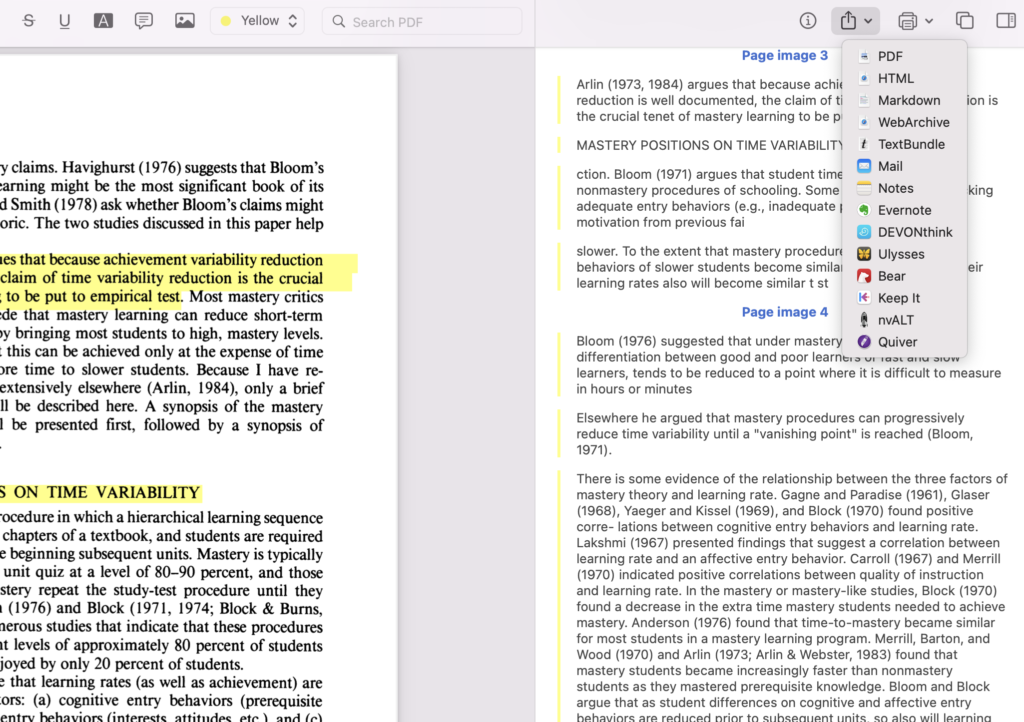
The process works like this. Read and annotate as usual using an app that allows the isolation of the highlights and annotations. My example is based on using Highlights while reading journal article pdfs on my iPad. In the following image you can see a little bit of the article pdf to the left of the image and the extracted highlights and annotations to the right. This extracted content can then be shared with another app. Ideally, the extracted content would allow linkages back to the original content and this works when moving content to Apple Notes. This works only when the content resides on the same device is not very practical long term. I simply cut and paste the content into a Google doc for the additional processing I describe next. The page references provide a way to connect to the original content.

Forte suggests the following sequence with the extracted content. First,, bold the most important ideas. Then, in a second pass, highlight the essential ideas from this bolded content (the reason I like Google files in drive is the opportunity to both bold, highlight, and add text). Finally, write a summary of the highlighted material. He suggests bullet points. I prefer the Ahren stand-alone notes as a way to record the key ideas I may want to use later.

If you are interested in an example of the finished product, I have embedded a pdf of progressive summarization I created in this format.

The goals of this approach are to find the most essential information to retain a context that maintains the context from which the key items extracted. Ideally these documents would be retained in a meaningful way. Making certain the full citation is included and searchable would be one way to do this. To tell the truth, I store the stand-alone notes and go back to the annotation original if necessary.

Loading

Scrible

I have a personal interest in promoting to teachers the educational potential of what I have decided to describe as layering services. Perhaps layering is not the best choice of descriptors, but I think it makes sense once I explain what I mean. By layering, I mean the opportunity certain online services provide students to highlight, annotate, and add questions to online content (web pages and videos) in a way that does not violate the copyright of the content creators. For educators, layering involves these same components plus some others (e.g., discussion prompts) allowing teachers to share documents with these embellishments with students. These capabilities are of value when assigning online content or when teachers create their own content to implement instructional strategies such as flipping the classroom. Typically, different services must be used to layer websites and videos.

Scrible is a tool for layering web pages. I have described this service some time ago, but the service offers some new features and it is worth a review. If you want to explore Scrible use this link which takes you to the version for educators and students. Scrible is free with extra storage and a few extra features for a price.

You will note the similarity between my recent posts on tools for taking Smart Notes. Certainly, Scrible shares many of these same capabilities (highlighting and annotation, collection of layered resources into a library, sharing layered resources with others) and perhaps Scrible might be described as a Smart Note or Second Brain tool designed for students. I see some differences in this perspective and more traditional thinking about how learners can most effectively study digital texts, but many tools can be used for either purpose. The difference is mostly the time frame in question (e.g., the next test vs. the next decade), but I see the more common educational emphasis on note-taking and note studying – what types of external activities can help a learner develop understanding and improve retention and application. I think a description of how Scrible works will allow educators to see benefits of the tool in meeting either goal.

Scrible Tutorial

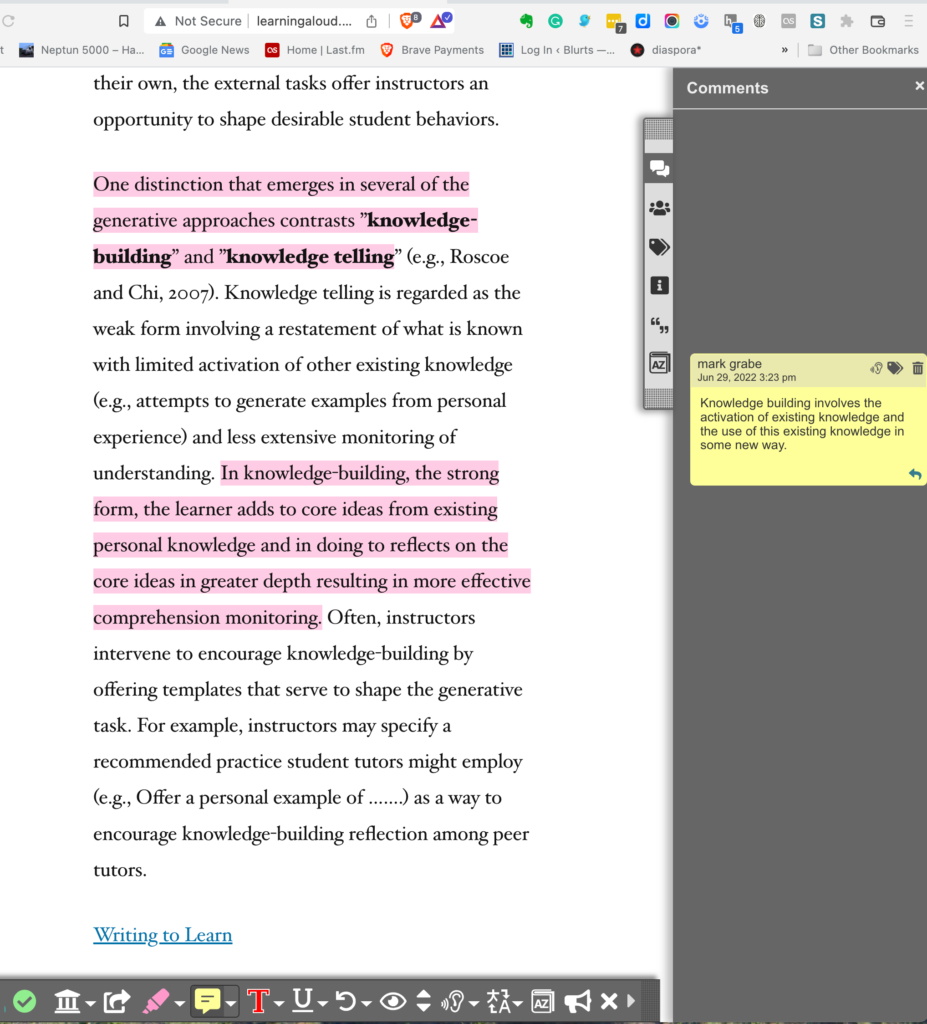
Scrible is an extension for Chrome. You use the browser to get to a page you want to study and then activate Scribe from the toolbar of the browser. The toolbar icon activates the tool tools that now appear at the bottom of the browser window and also a toolbar along the right-hand side of the browser. Here you can see I have already used the highlight tool and the note tool to create a note that appears in the Comments column.

The tools on the right allow the right-hand sidebar to be used in different ways.

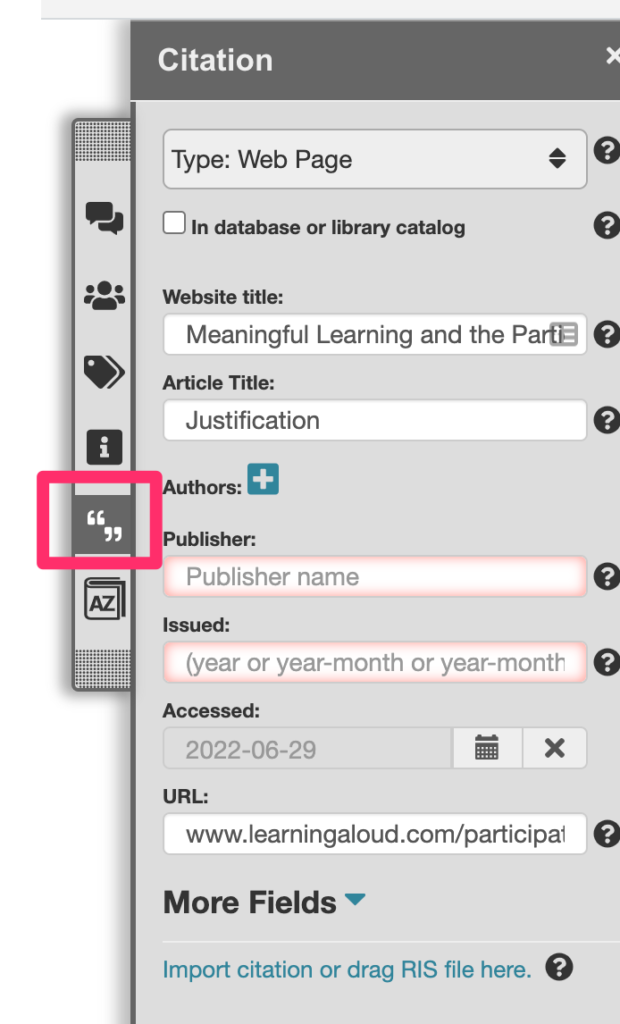
Storage of information about the source.

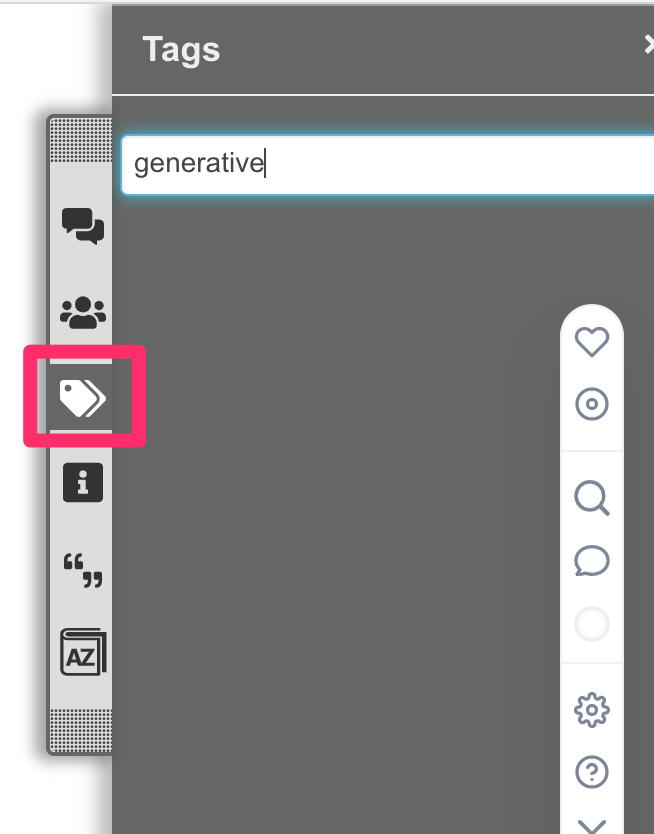
The addition of tags to the stored representation of the page.

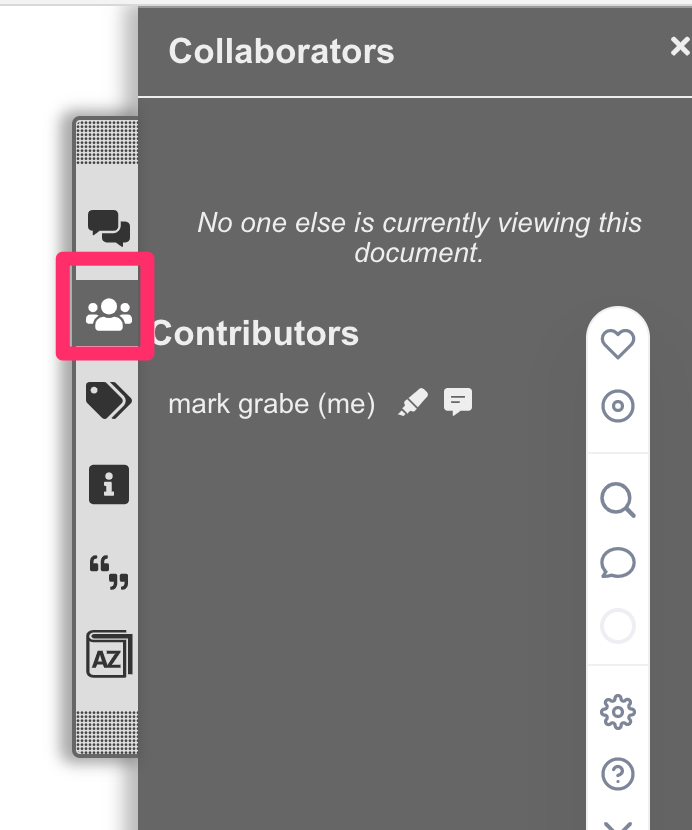
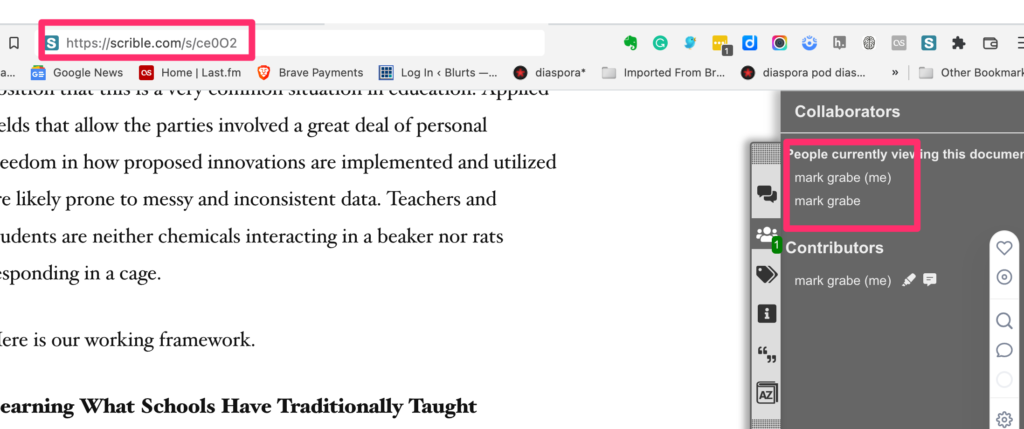
The contributors who have worked on the annotation of the page.

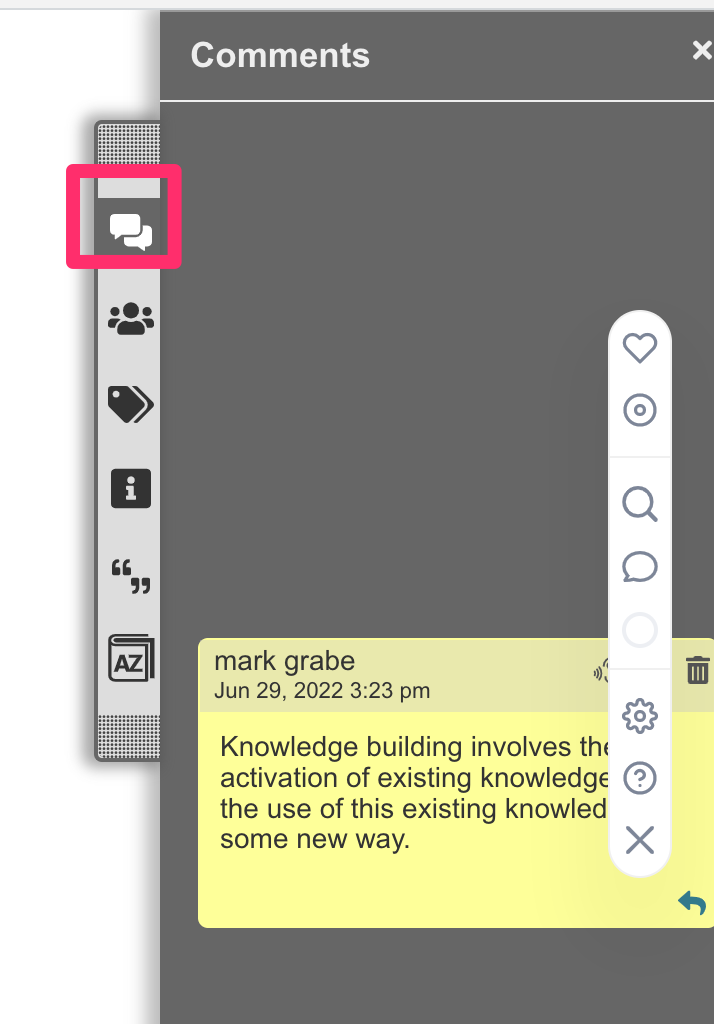
The stored comments (annotations).

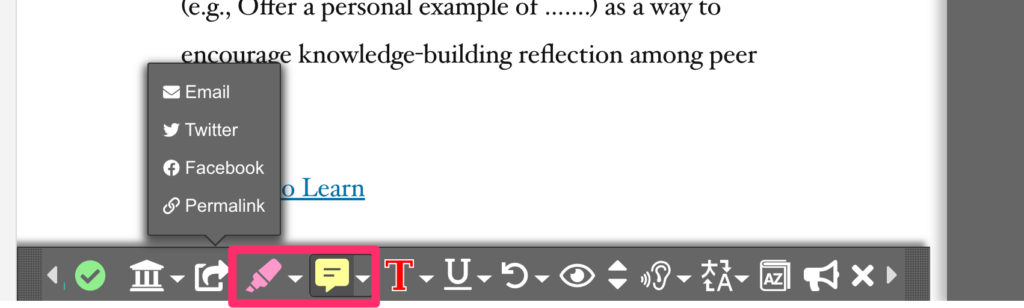
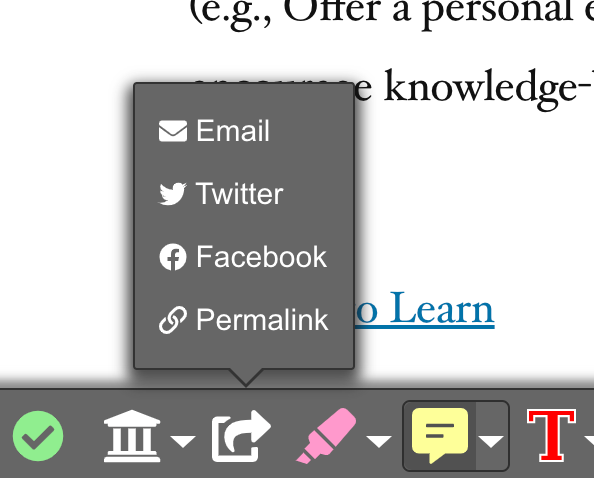
A link can be generated to share an annotation page with another user (Permalink). This link can be used to invite others users to contribute to the annotation or just to view what has been added.

See the link to the layered annotations on the original page and the addition of a second user when this link is used by another Scrible user.

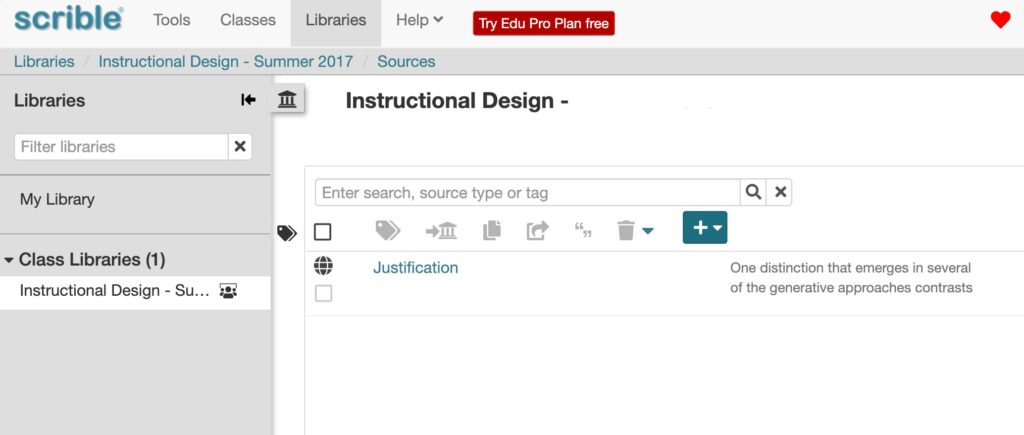
The icon next to the share icon in the bottom toolbar (the building) is used to store annotated content and access the body of stored content.

Loading

Taking Notes to Learn

I have read the following books which all focus on the processes of using notes to collect, organize, and apply information. From this collection, I would recommend Cohn for educators and Ahrens for the tech aware wanting to use technology to improve their learning and reading to application.

Cohn, J. (2021). Skim, dive, surface: Teaching digital reading. West Virginia University Press.

Forte, T. (2022). Building a second brain: A proven method to organize your digital life and unlock your creative potential. Atria Books.

Kadavy, D. ( 2020). Digital zettelkasten: Principles, methods, and examples. Amazon ebook.

Ahrens, S. (2017). How to take smart notes: one simple technique to boost writing, learning and thinking-for students, academics and nonfiction book writers. Amazon books.

Over maybe 35 years, I have used technology and whatever digital tools were available at the time to keep track of the content I was exposed to and thought I might find valuable at some future time. So, I have tried many different times tools and tactics. This more recent set of resources has identified two new tactics I thought were helpful. I described multiple tools in a series of posts I did a few months ago. In the left column of this blog, you should see a drop down menu identified as Categories. One of these categories is labeled Digital Notes and this link will identify the past posts.

New to me strategies:

Write earlier (Ahrens) – rather than read and highlight journal articles and books and then searching these same sources at a point in time that could be ten years later, I discovered the value of taking stand alone notes shortly after or while reading. The idea is to generate a note that can stand alone to explain something to me or others. Saving and linking these notes to the original source and to other notes allows a much more efficient approach for using the residue of previous reading at a later point in time.

Progressive summarization (Forte) – Forte describes a process by which the highlights and annotations created in an initial reading are digitally exported. This collection is reread and important ideas are initially bolded to identify and differentiate them. This bolded content is then reviewed and the most essential ideas are highlighted. Finally, a summary is generated from these highlights for this document. He proposes a summary consisting of bullet points. My preference would be for the smart note format I have attributed to Ahrens.

The advantage of this system is that context is maintained. If certain types of technology tools are used, you can trace a summary note back to the highlighted material, the bolded material, and then the content from the original source. Keeping these transitions connected seems a good idea.

I have not found a collection of tools that allow me to do this for the different original formats I explore (digital books, PDFs, web pages, videos), but I have patched together some combination of tools that work. I admit that I have not explored some tools that involve a subscription fee and might reduce the number of steps I presently employ. I will follow this post with at least one related post taking you through my processes.

One more thing. Notes for long term personal learning and notes for academic learning are likely different. The same digital tools apply, but there is a significant difference understanding your are taking notes in preparation for an exam and recognizing what you and your professor thinks are important may be different and notes you take to support your own self-directed learning. Yes, I understand that what I may find valuable a year from now is not necessarily what interests me today. We have all had that experience of knowing you have read something relevant to a present need and not being able to recall the details or the source. Notes, highlights, and another components that can be added to digital content by educators and learners have long been an interest of mine and I would direct you to a Kindle book I have written on the topic for greater detail.

Loading

Mastery methods in applied settings – reality

Great ideas don’t always meet their argued potential when implemented. Reality has a way of adding complexity that reduces potential. Here are some examples of this effect I am aware of that apply to mastery learning.

Variability in time to learn

Individual learners vary in their speed of learning. Any teacher knows this. The issue in any classroom, whether implementing a mastery strategy or not, is how this variability is handled.

Some have studied variability and what happens when student variability meets a mastery approach. Arlin (1984, 1984b) conducted several experiments and referenced other work to indicate that a group-based mastery approach does not eliminate differences in time to learn. Time to learn appears to remain constant unit after unit. 

Arlin (1984, 1984b) challenges what he claims is Bloom’s group-based mastery promise that over time the Bloom approach will eliminate individual differences in the rate of learning. Arlin offers multiple studies that indicate with group-based mastery variability between individuals remains relatively constant. I must admit I was surprised that Bloom argued individual differences would be eliminated, but references to Bloom’s writings appear to indicate I was wrong. Bloom appears to shy away from the existing knowledge and aptitude distinction I make. Arlin does find that given extra time most students will learn what is taught. 

Arlin references other scholars with notions of a “wait around” or “Robin Hood” effect for more capable students. This concern argues it is possible more capable students can be held back by certain implementations of a group-based approach. However, I would suggest a) group-based approaches could provide supplemental learning activities not focused on the learning goals of a given unit and I would think most educators would understand this, and b) the Arlin position fails to acknowledge that traditional instruction must teach to a point at which the rate of learning is not optimized for more capable learners. 

Conclusion: Most students can learn what is taught if given sufficient time and appropriate instruction and b) student differences in what is sufficient time will not be eliminated. How much time is required – I remember (no reference I can point to) that a 2:1 ratio will be sufficient for 80% of students to reach goals. Recognize that this means twice as much time to learn the same thing.

Procrastination

Studies of college students engaged in Keller-type individualized mastery learning demonstrate a high drop-out rate. What appears to happen when students are given a great amount of independence is that other requirements are prioritized (usually implied to be other courses, but I am guessing other personal priorities should be included here), and study within the mastery course and evaluation test completion lag. Students get significantly behind an acceptable pace and when they try to re-engage find that catching up is not as easy as they had hoped. They drop the course unable to see themselves finishing.

A remedy sometimes described as “the doomsday” contingency (early Keller advocates tended to be behaviorists) set a standard for completing the first several units (e.g., finish two units in the first two weeks) or students faced being dropped. This approach improved completion rates giving students a taste of the effort required. Purists might argue this type of approach was inappropriate.

Hoping for minimal effort

I conducted several studies of what I came to call effort errors (Grabe, 1982, 1994). Several of these studies involved a one-retake option for all course exams. This is not a pure mastery system, but it turned out to be a way to demonstrate the extent to which students bought into a mastery approach.

For example, if a control group and a retake available group are provided, a mastery advocate would predict that groups would be similar on the original exam and the retake group would improve the performance on the second opportunity if students chose to take it. Not so. The one-take group (traditional instruction) performed significantly better on the same initial exam. Clearly, the students who knew they had a second opportunity were not giving their best effort.

I took to identifying different types of what I would call “effort errors” – skipping the initial exam; taking a second exam, but scoring below the score on the first exam (I used a several point differences before this type of decline counted as an error); and skipping the second exam opportunity with a score of C or lower on the initial exam. More effort errors predicted lower course grades and were more common among students most in need of additional opportunities. Lower final cumulative exam scores related to more effort errors likely indicated a general lack of motivation.

Conclusion – motivation to spend additional effort cannot be assumed. 

References

Arlin, M. (1984). Time variability in mastery learning. American Educational Research Journal, 21(1), 103-120.

Arlin, M. (1984b). Time, equality, and mastery learning. Review of Educational Research, 54(1), 65-86.

Grabe, M. (1982). Effort strategies in a mastery instructional system: The quantification of effort and the impact of effort on achievement. Contemporary Educational Psychology, 7(4), 327-333.

Grabe, M. (1994). Motivational deficiencies when multiple examinations are allowed. Contemporary Educational Psychology, 19(1), 45-52.

Loading

Mastery approaches

I became familiar with the idea of learning personalization for mastery in the 1970s. Even though there are recent applications of mastery concepts making use of technology, I continue to point to the early mastery work because of the research base associated with that time period. The examples of more recent mastery approaches I will link to these early efforts do not come with a rich collection of peer reviewed studies I look for when advocating for what amounts to a serious departure from day to day classroom practice.

To me there were two very different approaches labelled as mastery methods – Fred Keller’s Personalized System of Instruction (PSI) and Bloom’s Learning for mastery.

The Keller Plan

Keller (1968) advocated a truly individualized approach to instruction based primarily on written material (not be confused with the programmed instruction of that time which was often paper-based as well). Keller did make use of teacher presentations, but these were not used for the core approach. Keller liked written materials because individual students could work on written content on their own and could read at whatever rate was productive for them. Instructional text was associated with study guides for guidance. When students felt prepared, they would ask a tutor for an examination over that material. The tutor presented the assessments, evaluated the assessments, and helped learners with challenges they seemed to have encountered. Movement to the next unit depended on a satisfactory score on the unit exams and failure to meet this standard directed the learner to restudy the same material.

Bloom’s Learning for Mastery

Bloom’s (1968) approach to mastery learning was group based. A group of learners would focused on content (e.g., chapter) to be learned for approximately a week and would then be administered a formative evaluation. Those who passed this evaluation would continue to supplemental learning activities and those who did not pass would receive remediation appropriate to their needs. At the end of this second period of time (at about the two-week mark), students would receive the summative examination to determine their grade.

There are many variations and details of these approaches not explained here. My intent was to establish the more individualized and the more group-based approaches. I see the Kahn Academy as similar to the Keller Plan and Modern Classroom Project as similar to Bloom’s approach. My guess is more educators are aware of the Kahn Academy and understand that students can work on this technology-delivered content demonstrating mastery of specific skills at different rates. Many use this content for supplemental learning, but it can also be used as the basis for comprehensive approach. The Modern Classroom does not individualize progress to the same degree and is not necessarily as dependent on technology administered mastery checks. I encourage exploration of the links provided here for those unfamiliar and interested in the present, more technologically based mastery approaches receiving a lot of attention at present.

The idea of mastery and what teaching for mastery means in practice varies to some degree to how essential it is to master specific skills or concepts. I would think that all knowledge/skill deficits are not equally damaging. It might be useful to differentiate general and prerequisite deficits. A prerequisite deficit would describe a skill or concept necessary in the short term to understand/master a more advanced skill/unit of understanding that builds on the deficit skill. A general deficit would identify a skill or a unit of understanding that is missing, but not necessary for the mastery of other units soon to be taught. Original approaches to mastery (Bloom, Keller) focused on an acceptable level of general skill. Kahn approach is more focused on the identification and remediation of specific deficits. I would think technology would offer a much more practical approach to the linking skills and for tracking individual student mastery of prerequisite.

Note that both Keller and Bloom are not absolutists. Technology allows a much more specific approach with Kahn’s complex identification of prerequisites and specific mastery checks in the Modern Classroom approach. Being specific about the identification of unmastered skills does not stop progress as learners can continue to work on other skills with technology allowing the more careful identification of problem areas in contrast to the mastery approaches of the 1960s.

References

Benjamin, S., Dhew, E., & Bloom, B. (1968). Learning for mastery. Eval. Comment1, 1-12.

Keller, F. S. (1968). “Good-bye teacher”. Journal of Applied Behavior Analysis, 1, 79–89

Loading