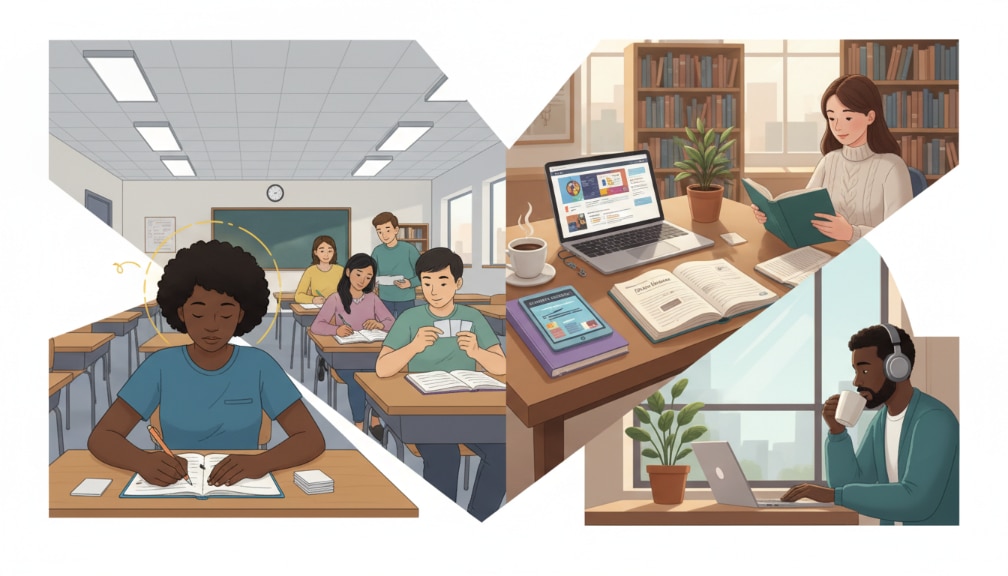
My interest in lifelong learners as a category of learners or as an expected focus of research activity has been frustrating. I have spent considerable time proposing that the research on note-taking and other study strategies can be translated, especially when applied to learners functioning independently outside of classrooms or in response to classroom-based assignments. When reading efforts to encourage strategies associated with concepts such as “personal knowledge management” (PKM) or “second brain”, I was surprised to be unable to find research associated with these proposals and often not even references to the literature I studied and tried to contribute to throughout my academic career. While at some level “learning is learning”, efforts to propose strategies for practice must consider differences in learning contexts and evaluate specific translations of controlled research as operationalized for these contexts.
Much of this post is based on the book “Make it Stick” (Brown, Roediger & McDaniel). I’ll explain why this book, rather than other sources, is used later. The following list of learning activities, which have been found to improve learning outcomes, is paraphrased from this source.
Purposeful learning should require:
- Finding and retrieving information from memory (retrieval practice)
- Spacing learning activities (spaced practice)
- Mixing the focus of learning activities (interleaving)
- Building personal knowledge – use existing knowledge structures to integrate new information, use new information to modify or extend existing structures
- Testing understanding – recognizes failures of understanding
If you are unfamiliar with this terminology or the cognitive processes that are argued to be influenced by them, I offer the following set of links to extended posts I have written.
Spaced practice and desirable difficulty
Generative tasks and building understanding
Interleaving and desirable difficulty
When I think about useful learning activities, I do so from a different perspective. I focus on generative tasks. I define a generative task as an external task that increases the probability of productive internal (cognitive) activities. The recommendations proposed by Brown and colleagues would fit this more general category.
Brown and colleagues (Make it stick) define generation as an attempt to answer a question or solve a problem before being shown the answer or solution, and note that it makes the mind more receptive to new learning. This is a very different and I think less common use of how cognitive types use the phrase. See Fiorella and Mayers (see sources at the end) for a list of generative activities that have some overlap with those Brown and colleagues provide. The way I describe a generative activity makes sense to me. It is like asking a teacher what she has assigned a classroom activity. The teacher might use phrases such as “it gets my students to think” or “it requires my students to use”, but these are just different ways of saying internal (cognitive) behaviors are required.
Differences in the classroom and lifelong learning contexts
When the authors of Making it Stick argue that similar learning strategies can be applied by both students and lifelong learners, they note that the contexts in which these strategies are used differ and that the strategies are adjusted accordingly. What are some of these differences?
Structure
Classroom learning is typically more structured, with teachers deliberately designing activities that encourage generative activities. Teachers mostly select the goals and related tasks – lectures, syllabi, and tests. The time course of learning is driven by external decisions informed by the needs of the group and not individual learners.
Lifelong learning is personally structured and depends on the challenges of daily life or personal interests. Task selection and the continuation of the effort of learning is based on individual insights, accomplishments or motivation.
Most consistent source of motivation
With classroom learning, the educators shaping the tasks build in base-level, external sources of motivation (grades, evaluations).
Lifelong learners rely on personal challenges and goals to motivate their effort.
Task Initiation
In classrooms, the teacher often presents or assigns material first, then asks students to act on this material in some way.
In lifelong learning, it often begins with “learning from experience” – you face a problem, try to solve it, and only then seek answers. Learning as part of daily life is often referred to as experiential learning. Learning activities may also be driven by personal goals and interests.
Feedback
In classrooms, feedback is typically immediate and provided by the teacher (graded quizzes, comments).
In lifelong learning, the consequences of responding to life challenges are a source of feedback. Personal goals are typically evaluated based on reflection or in some cases the reaction of others if the goal is to produce a public product. Tasks that result in feedback can also be self-initiated.
Time Frame
The time frame for classroom learning is short and predictable. Exams and assignments have clear performance rate and these evaluations tend to be a couple of weeks or at most a couple of months.
When lifelong learners commit to a learning goal they may or may know when any knowledge or skill will be applied. In many situations, there is no guarantee a learning accomplishment will ever be applied.
The Insight from Make It Stick
The benefits to me of reading Make It Stick were in making the connection between the efforts to identify and evaluate learning strategies and both classroom and lifelong learners. As my own interests from shifted from classroom to self-directed learning I tried to find other educational writers who addressed this relevance and made some effort to explore how the same core of strategies might apply in each learning environment. My efforts to use search tools focused on scholarly research yielded close to nothing that I would label research focused on adults learning on their own. To bridge this gap I followed the speculation about the best approaches to personal knowledge management and second brain creation and use and translated research focused on classroom learning to interpret the underlying bases for the ideas being developed to guide personal knowledge management and learning.
Brown and colleagues were of interest because they argued that the same principles are key to all learning with emphasis and tactic of implementation varying with structural differences. The assumption of a commonality seems reasonable and not surprising, but the identification of lifelong learners and the recognition of structural differences in their learning tasks was unique.
This brings me to an effort to identify structural differences and how these differences alter strategy implementation.
Interaction with structural differences
In school, students rarely practice these strategies spontaneously; those who do “will need more than encouragement if they are to practice them effectively”. Teachers must build retrieval, spacing, etc. into the course design (cumulative quizzing, peer instruction, daily summarizations, etc.). Secondary students can be taught to take some responsibility for these skills using tactics such as flashcards, peer quizzing, and note-reworking techniques, such as those encouraged by the Cornell note-taking system.
Lifelong learners typically don’t have external structure, but they do have autonomy and clearer intrinsic goals. Application becomes designing their own schedules and systems, e.g., setting spaced reviews, using self-testing, and writing brief reflective summaries. Digitally based note systems often have tools encouraging random reviews and embedded AI allows the generation and evaluation of content-related questions.
Students’ metacognition and self-regulation are still developing, so these learners are more likely to misjudge what works and gravitate to easier illusions of learning like rereading. Imposed strategies and purposeful skill instruction are important. Adults often have stronger self-regulation, but must deliberately create constraints and routines or the strategies don’t happen.
Existing knowledge and life experiences
Students tend to have less developed background knowledge, so adding complex strategies can create working memory overload when they’re already struggling. So in K–12/undergrad, teachers often need to scaffold: start with simpler retrieval (short low-stakes quizzes, guided questioning) and gradually move toward more independent study behavior.
Lifelong learners usually work from richer life experiences and probably more formal education, so elaboration, self-questioning, and application can be more generative right away, and spacing can be stretched further because there is more prior knowledge to attach to. Goals are also based on a longer time frame for potential application.
Why: The same strategy (e.g., self-testing) places different cognitive demands depending on knowledge and fluency; novice students need more support and tighter feedback loops.
Motivation and time span
For students, motivation is often extrinsic (grades, exams). This external focus is based on a predetermined curriculum and external expectations for what must be learned. This can make the challenges of learning feel like unfair obstacles, so teachers must explain why they’re spacing, mixing, and testing—making assessment “a positive learning experience” rather than just judgment. I have a long-term interest in what is often called “mastery learning” which is a competency-based system that allows multiple opportunities to demonstrate competence. This approach would fit well with promoting the benefit of feedback, but unfortunately is not a common approach.
Lifelong learners are generally motivated by relevance (job, hobby, citizenship). This aligns well with an emphasis on generative activities such as write-to-learn activities and linking and adding to original notes.
Why: With adults, you can lean hard on immediate application and self-explanation because the “why this matters” is obvious; with students, you often must cultivate that connection. The lifelong learner accepts that what they learn may not have immediate value and that skills and knowledge often find an application, impact motivation, and create a focus on improving the retrievability of notes and on linking, reviewing, and reworking notes over time as interests change and goals become evident.
Summary
This post builds on a short section of “Make it stick” that recognized that lifelong learners and students in formal educational settings likely apply similar learning strategies adapted to unique characteristics of their settings. To me, just the mention of lifelong learners and students in the same publication seemed unique. Certainly, the brief effort to analyze a few interactions of learning strategies with these different settings is very uncommon. I admit that research of the same quality would be very difficult to evaluate the effectiveness of proposed strategies for lifelong learners, but at least the effort to speculate about how techniques of proven value in classrooms apply elsewhere seems useful.
Sources
Brown, P. C., Roediger III, H. L., & McDaniel, M. A. (2014). Make it stick: The science of successful learning. Harvard University Press.
Fiorella, L., & Mayer, R. E. (2016). Eight ways to promote generative learning. Educational Psychology Review, 28(4), 717-741.

You must be logged in to post a comment.