Project Noah is a favorite tech recommendation for a couple of reasons. First, it is participatory. It allows anyone to contribute and builds the resources it curates from these contributions. Second, it serves as an example that disputes the popular fallacy that technology limits your activity to staring at a screen indoors. To become actively involved in Project Noah, you must do the opposite and explore the outdoor world around you.
Project Noah may seem intimidating and only for experts, but the community associated with Project Noah can be very helpful (see the example of my own experience that follows) and some components of the service are designed specifically for teachers and students.
I have made a few contributions to Project Noah over the last couple of years based on photographs I have taken near our cabin in the north woods of Wisconsin. We have many opportunities to view and photograph wildlife and I have submitted a few photos based on these experiences.
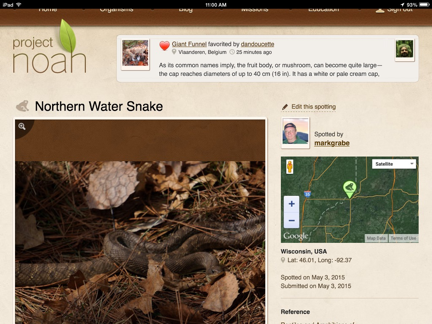
Recently, I encountered a couple of snakes on our property. I had no idea what these snakes were and wondered if they might be dangerous. The snakes were found very near play equipment we have for our grandchildren. I was able to get a pretty good picture of one of these snakes and I sent it to the Wisconsin DNR for identification. I was concerned that the snake might be a Timber Rattlesnake, but thought it was more likely a bull snake (based on my online research). The DNR person said it was most likely a Northern Water snake. This made some sense because we live on a lake.
I submitted the picture to Project Noah identifying the snake as a Northern Water snake and I was soon contacted to indicate that the snake was likely a Hognose Snake. I decided to remove my own identification and leave the picture as unnamed. This is part of the fun.
This is a book recommendation. I read a variety of content because I believe my personal creativity works best when I feed it ideas. This might be described as reasoning by analogy, but I believe the focused approach of so many academics suffers from an influx of new, but existing perspectives.
I encourage those interested in generating instructional content to consider some of the ideas advanced by Jeff Jarvis on the news and the business of selling the news. Specifically, I recommend Geeks Bearing Gifts. If you are unwilling to spring for the $10 demanded by Amazon, Jarvis is also providing the same content as Buzzmachine posts. As I write this, he has made it to the latter chapters so you could read most of the book for free.
I want to highlight two ideas from the book which I think offer some interesting ideas for the educational publishing industry. There is much more to be had, but these are two ideas that immediately caught my attention.
Idea 1 – the article is not the only way to imagine the unit of distribution
I have long believed that a textbook has some specific limitations because it is offered as a single unit. Recognizing components would allow a number of limitations to be addressed (my analysis). Jarvis makes a similar case with the newspaper article. Most of us have a vague understanding of the format journalists often use to generate news articles. There is the initial summary, segments supporting and expanding this summary (quotes, background, deeper explanation), sources, etc. We probably learned somewhere that an article is originally written to gradually taper off should the editor have to shorten an article by cutting at the end. We may also be familiar with the issue of “burying the lead” in which an author misses what should have been the most important point and did not highlight it in the initial paragraph.
Jarvis does a nice job of pointing to experimental approaches related to the ideas he identifies. For example, he points to Circa News as a service built to use the elements of typical news articles more creatively. You can try Circa (optimized for reading content on your phone) and might want to review another of my posts on this service.
What insights might educational content providers gain? I think the idea of identifying the components in what we offer and possibly providing better ways to provide and develop these various components may be helpful.
Idea 2 – show me the money. How can professionals support their work?
Within the present reality of unlimited and often free online content, how can professional content providers and content organizations support their work? Clearly, the cost of textbooks has generated a lot of attention and scorn. Jarvis deals with the reality of business models throughout.
Here is one example of an idea I like. I would suggest I have had a related idea about educational content, but that is not the point here. Jarvis proposes that authors and readers represent a relationship that is not necessarily one directional. Relationships are a big thing in his book. He suggests one idea related to a more participatory approach I found intriguing. What if “readers” could buy down the cost of content in various ways (this is my interpretation and even if this is not what Jarvis intended I still like my spin)? This would obviously be more practical with a subscription model than a single purchase (a book). For example, a reader my buy down the cost by being willing to view ads (some free vs. paid services already use this approach). What if readers provide information (complete surveys) or even content (personal stories, examples) to reduce personal costs for the primary service? For example, I have proposed that practicing teachers might provide classroom examples as a way to supplement textbooks.
I know that making these ideas work would be a challenge. Implementation would not be that technically problematic, but it seems that it would be easy to game such systems without contributing much of value. Some type of evaluation would be necessary, expensive, and messy.
The Jarvis book has one major contribution I think is overlooked. When traditional models are obviously in decline, we should not assume that all is lost. New models that value quality will eventually be developed. The models in the book may not be the eventual successes, but it is reassuring to review ideas that exist and are interesting.
There may be comparable developments in the development of educational content. I just do not see traditional publishers investing much in R&D efforts. Perhaps someone will write something that will reassure me in the same way the Jarvis analysis brought me new insights into a different area of content generation.
No one is reading you was the title of a recent article describing scholarly publications. My brief summary would suggest the article claimed “most publications receive little attention even though some might offer useful information”.
The article reminds me of a story told by my wife’s sister who claims to have checked my dissertation out from the university library. At the time books had a little card in front that was marked with the “due date” and she said she was concerned there were no return dates on my masterpiece. I guess it makes a good story at family gatherings. I admit that I have never checked out a thesis or dissertation either. I did read many before students finished their work I thought that was enough.
A couple of quotes from the linked article will give you the flavor:
Even debates among scholars do not seem to function properly. Up to 1.5 million peer-reviewed articles are published annually. However, many are ignored even within scientific communities – 82 per cent of articles published in humanities are not even cited once. No one ever refers to 32 per cent of the peer-reviewed articles in the social and 27 per cent in the natural sciences.
If a paper is cited, this does not imply it has actually been read. According to one estimate, only 20 per cent of papers cited have actually been read. We estimate that an average paper in a peer-reviewed journal is read completely by no more than 10 people. Hence, impacts of most peer-reviewed publications even within the scientific community are minuscule.
Note that the examples in this article do not include educational research. I also could not determine the source for the data provided which prevented me from understanding the scope and method of the research. Citation frequency is easy enough to to check. With access to Google Scholar you can now check citation frequency and most of us are vain enough to know which of articles have drawn the most attention. I do agree that many cited articles are not read. I think people sometimes cite what other researchers cite without actually reading the publication beyond the abstract.
If few scholars read each others work (I think this statement is a serious exaggeration but I have only my own experience to go on), the chance that such work influences practice seems unlikely. I am more concerned about this issue especially as it applies to education. Clearly, from time to time, “trends” move through the educational community. These ideas must come from somewhere and I would hope the basis for innovations had some basis in careful scholarship. My concern is that this is not the case.
I am reading a book by educational historian Jack Schneider -From the Ivory Tower to the Classroom – that addresses the transfer issue in education. Based on his analysis of several specific ideas, Schneider argues that there are key characteristics of ideas that make the transition from research to practice
Perceived significance – research offers a big picture approach rather than a piece of the puzzle.
Philosophical compatibility – fits with the professional identity and values of teachers
Occupational realism – fit within the professional constraints within which teachers operate – e.g., time
Transportability – easy to communicate
Understand that the author is not attempting to identify the characteristics of research that is most meaningful research or ideas with the greatest potential. The author is attempting to identify ideas that seem to have been accepted/considered rather than ignored. His arguments through a kind of case study approach – here are some ideas that have been accepted and here are some ideas that have been ignored. I assume the approach assumes all are credible ideas and the arguments are based in an analysis of the factors that determine acceptance.
In a later post, I will provide a follow-up on two of his cases. I have particular interest in two of the cases – projects (accepted) and generative processing (ignored). Much of my writing on technology stems from a generative processing perspective. I see “writing to learn” as an extension of the generative position and I have morphed “writing to learn” into “authoring to learn” as a way to justify many of the tactics I propose.
I think this is a very important issue. I do not expect practicing educators to read basic research, but I do wish they accepted the value of research and read a little more of the secondary literature based on this research. Now retired, I consider myself no longer an active researcher, but I hope to spend some time reading the publications and writing to offer my perspective.
The Atlantic recently carried an article entitled “Down with Textbooks” . Every time I enounter such an article I feel the need to respond. It is likely such pieces generate this reaction because a) I author a textbook and b) I used a textbook in most of the courses when I was teaching full time.
To be fair, the Atlantic article is about the teaching of history. I admit I did not enjoy history as a student and did find it boring. I have not tried to teach history and certainly would be poorly prepared to do so. I do know something about the teaching of history because of some grant work I did and I recognize that there are different schools of thought regarding the purpose of learning history. Clearly, students in early history courses do not experience history as historians experience history. History can be a great exercise in critical thinking requiring an explanation for historical events pieced together from the interpretation of multiple primary sources. This seems to be the position taken by the author of the Atlantic article. The history most of us experienced was an effort to familiarize ourselves with historical events. This is what some want. Some see a basic understanding of history as the basis for citizenship assuming a common understanding of our heritage. Some politicians push for this approach and others see this approach as a form of indoctrination. History may not be the best subject area to use as the basis for evaluating the contribution of a textbook.
I am not certain I accept the argument that textbooks are boring as a rationale for much of anything. What you or I find to be boring is likely a function of many factors. For example, I find what some consider inherently interesting experiences such as discussion/conversation to be extremely boring if either a) I want to experience what an expert has to say about the topic or b) I or the individuals I am to engage in a discussion with have only casual knowledge of a topic. I do not see interest as a global characteristic of method. When I can supply my own interest, I often prefer an efficient approach in the early stages of learning. When I must learn something, interested or not, I also prefer efficiency. For example, I have moved to a new state and now must retake the exam to acquire a new driver’s license. I want a resource that will prepare me for this requirement in the most efficient way possible. I do not require diversity of experience. I do not require entertainment. I want an efficient exposure to the information I am expected to understand.
I assume textbook authors have different perspectives on their work. My own perspective in writing a textbook used to prepare teachers to help students learn with technology has been to identify the range of themes important to consider and to explore these themes with a sensitivity to the complexity of these issues. By range of themes, I mean topics from coding to copyright. By complexity, I mean that there are often disagreements and multiple perspectives on many of these issues – e.g., constructivism vs direct instruction. To the extent that I understand complexities to be unresolved, I feel it is my responsibility as an author to use the research available to explain strengths and weaknesses.
The Atlantic article made a case for the value of multiple resources in learning. I would certainly agree. What I think I do as an author is to provide a general starting point true to issues and alternatives and assume the course instructor will use his/her expertise to explore some topics in depth. I believe learning is a function of breadth (context) and depth. I hope to free the instructor to provide the depth appropriate to the instructors own expertise and the individual needs of the students in a given course.
The notion of “flipping the classroom” has proven popular in recent years. This phrase likely means different things to different people. To me, it means use face to face time to do best what can be done in face to face time. A good textbook frees up face to face time for discussion, individual needs and interests, and the unique expertise of the instructor. I also think a second core, but typically unexamined idea in the flipping approach assumes the establishment of a basic framework or background on which depth of understanding is then built. Again, this is what I think a good textbook should try to provide.
One final point – I do not consider many popular books on educational topics are textbooks. This is not to dispute the value of such books. Most popular books take a focused approach and do not make the effort to examine the strengths and weaknesses of alternatives. Again, without a solid background what is proposed in such books can be very challenging to evaluate critically. I do not expect these books to carefully examine what others would argue are the limitations of what has been proposed, but I would expect such a critical analysis from a textbook.
The individualization of learning experiences is one of those educational goals that sounds so logical, but ends up being difficult to implement in a practical way. Finding or generating learning materials suited to individual needs can be quite time consuming. What could be ideal in many situations is combining individualization with group discussion. Discussion and sharing can be an important social and learning activity, but learners must share at least some background in order to have something to offer.
Newsela is an online service suited to these circumstances. The benefits of the service have been described in several different ways depending on the reviewer. Newsela offers news articles within several topical areas ranging from science to world events. Each article offered on multiple reading levels – the claim is from 3rd grade through high school. To be clear – this means students reading at different levels can be reading about the same specific topic. Each article connects to a writing prompt and comprehension questions.
It seems that Newsela could be used to completely individualize the learning experience. One strategy would be to differentiate the experience for each level based on interest and reading level. I like the alternative of having students read a similar article suited to their level of functioning and then having the opportunity to discuss the article in a group context.
Newsela comes in a free and a pro version. Newsela requests that educators or administrators contact the company for a bid. EdSurge suggests the cost for the pro version is approximately $2000 per classroom. The pro version offers features such as an annotation tool for teachers allowing teachers to highlight content within articles to guide students and advanced data tracking features. It seems that the free version might be a great way to supplement/diversify literacy instruction and the pro version would appropriate if one wanted to make these resources a core part of instruction.
As the year winds down and educators are seeking a few new things to spice things up, it might be an ideal time to explore Newsela.
The concept of relevance as applied in education seems such an important and multi-faceted issue. I hope to generate a couple of posts around the general theme of “who gets to decide what is relevant”.
Who has a role in determining relevance? This is part of the more general question of who has a role in education? This second question is a serious matter and I think is ignored in considering many educational issues. For example, some now seem to believe that grades are unnecessary and may serve to discourage some learners. While there may be truth in the concern for motivation, a grade (or other evaluation record) offers information to others as well as the learner. For example, the grade may be important in competitive hiring or educational admission decisions. Public investment in the educational process might assume the generation of such information.
A similar argument might be made regarding the topics fo be learned – what is considered relevant. Simple examples make this clear. As a driver, I should be able to assume that other drivers recognize a stop sign and know the appropriate reaction to encountering a stop sign. To some extent we are interdependent so collectively we should be able to depend that others have certain knowledge, skills, and perhaps values.
I do think that there is a great deal of inertia behind what is considered relevant and it would be better to carefully consider what should be emphasized, but we are all stake holders in this process. It turns out there seems no end to the suggestions and this is also part of the problem. Learning takes time and we limit the time educators interact with learners. In general, it seems unfair to add items without deleting items. Unless the time available is going to be expanded, it is not really is a topic relevant, but rather how relevant is a topic within the realm of other possibilities. How relevant is art class in comparison to American history or intermediate algebra.
I do not see this as a situation with an easy answer, but it does seem to me that educators and formal education is being placed in a very difficult situation. Is education about vocational preparation? Is education about preparation to live in a society? Is education about preparing to live a fulfilling life?
The is the Amazon Echo. It might look like the insulated coffee mug you drink from on the commute to the office, but it is actually a voice controlled Internet device. In other words, it conducts basic Internet searches and performs certain actions based on your voice commands. You activate the device with the word “Alexa” and then inquire about the weather, ask for a mathematical calculation, request a joke, ask a factual question, or my favorite ask for music. Like other voice controlled services (SIRI, Google voice search), the Echo is far from perfect, but impressive if you are willing to consider just what it is capable of doing. This is one of those situations in which an immediate experience might be less than perfect, but within the context of the voice recognition capabilities of the past what happens is impressive. Certain patterns seem more predictable, but the Echo is also surprisingly flexible.
I have been exploring the capabilities of the Echo for a few days now. I am not certain just how much I will use the device in the long run. I usually sit within arm’s distance of my iPad and using verbal commands still seems strange a bit strange. One function I know it will continue to serve for me is accessing music. We have an Amazon Prime account and this account in combination with the music I have stored on Amazon is really fun to explore using voice commands. “Alexa – Play cool jazz!” “Alexa – Play Muddy Waters!” “Alexa – play Happy by Pherrell!”
I wonder about how this device might be used in a classroom. I am anxious to see how our grandchildren will interact with the device. I reject the notion that we no longer need to things because we an Google anything. However, when we want information that is not available why not have an effective way to get this information. I assume search will only continue to improve. Students in a classroom might be given license to approach Echo and ask their questions. Someone give this a try.




You must be logged in to post a comment.