Better edchat tools and tactics

Since I have been critical of the value of “edchats”, I thought it appropriate I do more than criticize and offer potential ways the group experiences could be more beneficial.

I have fallen into analyzing educational technology experiences in terms of tools and tactics and this approach may be useful here. The idea is to consider the potential of the tool (the specific service or application) and tactics (the strategies of use). My assumption is that the general goal is professional development – the acquisition by professionals of new knowledge and skills. The existing tool is Twitter and the tactic is participant responses to a series of approximately 10 questions within an hour block of time.

Assumed advantages of tool (twitter) – free, easy to learn, large installed base of users

Assumed advantages of tactic (I am having a little more difficulty here) – educators are familiar with a question and answer format

One interesting issue associated with social media is that once a platform (tool) has attracted a user base, new and better tools fail to gain participants because individuals are reluctant to migrate for fear their social connections will be lost. I think this is the case with Twitter in the education community. I think Twitter has inherent issues because of the brief comments it allows. This limitation, in my opinion, leads to rather shallow interactions. It may be a great way to learn about new things via links, but it is not a tool suited to meaningful, synchronous discussion.

The edchat format (the tactic) has taken hold and it seems popular to have such chats. There is a certain momentum here. There is also the issue of doing it like everyone else. Conformity seems to limit a consideration of both tool and tactic.

I tend to look at this setting as if it were a class I was facilitating. As educators, does the typical edchat generate the type of interaction you would want to see in your class. What would you change?

How to improve edchats:

Prepare beyond review of a lengthy series of questions. Either come up with 2-3 questions of greater depth or offer a common preparation task (read this post, read this book, etc.). Perhaps the moderator for the week should either find a resource or write a position statement. I also find the questions and topics to be too general. As an academic I understand that since we are frequently described as being abstract and not getting the level of actual application this would seem a strange concern, but review chats and see what you think. The questions seem to generate few specific suggestions or examples. When a specific detail is provided (often via reference to a recently popular book or author) just exactly what this reference is to imply for the classroom.

I see very little interaction. Sometimes a response from another participant is praised, but there are few reactions, counter examples, requests for clarification, etc. If this was a FTF classroom, the typical edchat would be similar to choral responding rather than a discussion. I would propose these limitations are the result of both the tool (lack of room for depth) and the tactic (tool many questions and responding without preparation).

Some comments on tools. I admit at this point that it is difficult to isolate tool and tactics. I think moving beyond Twitter would be helpful. Blogging before discussing might be helpful. Taking a position on an issue before interacting can be productive. Give some thought to your position before you are tainted by what others have to say. Offer an example. Process your own experiences and externalize a position for others to consider. A moderator and other participants might then use these comments to request clarification or note differences of opinion.

Beyond the inclusion of pre-session comments, I think it is time to consider other tools. I have always had access to discussion tools and I see greater opportunity for depth in synchronous commenting and responding in using these tools. I understand that folks enjoy the social experience of Twitter chats, but I think it important to think carefully whether group socializing is the primary goal.

I am not familiar with all of the tools available to educators. Does the state offer a general set of tools (a discussion option, a blogging option)? I think groups should more actively consider other tools. For example, Slack  offers some interesting opportunities. My concern with so many such tools is that the jump between the free and the lower paid version seems so great.

Summary:

1) Reduce the number of questions and give more thought to the type of questions used

2) Have a pre-session expectation for preparation of some type. I think expecting a product is always helpful related to this preparation is always helpful. Somehow, the popularization of “flipping” various education experiences should apply here.

3) The moderator needs to encourage more give and take rather than limiting “discussion” to call and response. As I have already suggested, existing positions statements that can be contrasted would be a great place to start. I understand the concern with how stating a different position will be received, but the generic positive reactions add little.

4) Consider other technology tools. What about Google hangouts? etc.

5) Generate a discussion summary (perhaps the moderator or a designated discussant). Did the summarizer learn anything?

Loading

Chromebook – Explain Everything

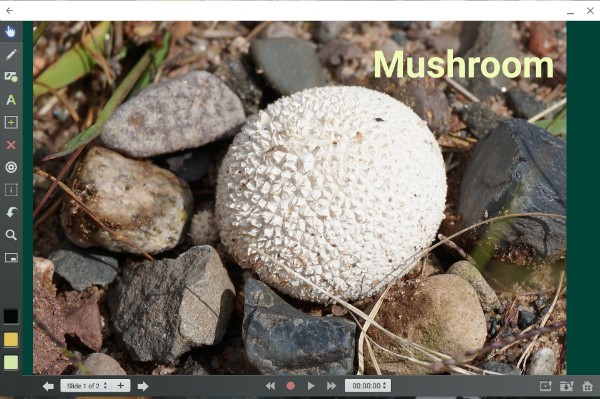
Explain Everything has long been a “go to” app on my iPad. I created narrated presentations for many situations using this app. Recently, it was announced that Explain Everything was coming to the Chromebook.

My initial reaction to using Explain Everything was neutral. The app seemed sluggish and I had some difficulty figuring out just how to import content to my slides. I understood that I would be bringing in images from Google Drive, but I could not get the connection to work. For some reason, restarting my Chromebook helped. I have a Chromebook Pixel so I was disappointed with the responsiveness of the program. This is an expensive machine and more powerful than inexpensive equipment students will be using.

I wondered about the importance of the Internet connection. I was exploring the app from the cabin and our connection is very slow. Today I had a chance to get to the coffee shop and try the Chromebook with a better connection. I am much more impressed today. Evidently, Explain Everything is more demanding than other online services I use and the speed of the connection seemed to make a difference. Hence, educators who want a class of students to work on Explain Everthing simultaneously may want to be aware of the importance of ample bandwidth.

chromeevery

P.S. – this is probably the first app I have actually bothered to take advantage of the Chromebook Pixel’s touch screen.

Loading

Individualization

I tend to be a topical reader. I get hooked on a topic and follow that thread until I can take it no more and then I switch to something else. My present “professional” thread concerns technology and individualization. I am also reading spy novels, but that topic is not relevant here.

I am about to finish a couple books explaining the role technology can play in disrupting education (Blended and Disrupting Class). These two books are related as Blended draws heavily on Disrupting Class. If you are interested in reading one, I would recommend Disrupting Class. I find this book has greater conceptual depth.

I will likely comment on these books a few more times in the next couple of weeks because the combination provides me plenty of ideas to address. First, a reaction to what is claimed regarding individualization.

Using my own way of conceptualizing issues, I would describe the authors as identify two reasons for individualization – mastery and learning styles. Mastery argues that learners progress at different speeds as a consequence of differences in aptitude and background knowledge. Pushing learners before they are ready creates inefficiency and frustration. The learning styles position argues learners learn in different ways.

Here is where I differ with the authors on a professional level (I worked as an educational psychologist before I retired). I strongly support the mastery perspective. I started reading this literature in the 1970s (B Bloom – group-based mastery and F Keller – Personalized System of Instruction) and published several research studies based on mastery methods. Technology may now offer more practical ways to implement some of these ideas.

When it comes to learning styles, I must say that while the idea strikes a chord with so many, research fails to support learning styles as real. Styles should not be confused with preferences. A style would be demonstrated by showing that individuals with different styles are advantaged when learning in different ways. So, group A learns significantly better with method A than B and group B learns significantly better with method B than method A. Research does not demonstrate this happens. Typically, one method is better or at least equivalent for both groups and this method should thus be the desired method of instruction. There is nothing to gain from the added complexity and cost of matching method to group.

To be clear, the lack of a trait (style) by treatment (method) interaction does not argue that only one method should ever be used. Different methods may develop different capabilities (creativity, achievement) and all learners may benefit from a mix of learning experiences.

Mixing aptitude, knowledge and learning style differences together creates a methodological challenge that is overly complex and costly to address. Individual pacing as a way to address aptitude and background knowledge differences seems a more practical methodology. Kahn Academy resources would be an example of curriculum materials consistent with the concept of individual pacing. Such resources and similar commercial offerings are available now.


Loading

Preparation

Mid August is time to get serious about preparation for the Fall semester. I realize that some educators are already back and hard at work, but this is for the rest of you.

I have spent the past month or so updating “Meaningful Learning and the Participatory Web“. This is one of Cindy and my online textbooks for preservice and in-service educators. We have two textbooks one derived from our original textbook (now a Kindle book “hybrid”) and our experimental online book. We first used our online book to explore how our traditional book might be modified so that educators and students were not forced to rely on a hardcopy book within a field emphasizing other methods for learning. We did move beyond our traditional commercial textbook, but we have retained both products to continue our exploration of content options.

Our online book has gone through a number of iterations over the past ten years. It was first written as a wiki. We then recreated it as a set of web pages. Now, we have redone the book as pages within WordPress. Most use WordPress as a blogging platform, but the software is quite flexible and offers advantages as a content management system. The content of the book has been continually updated and the WordPress environment should make future updates easy.

Meaningful Learning and the Participatory Web is out effort to demonstrate the generative learning potential of technology. Using the long accepted value of “writing across the curriculum” or “writing to learn”, we redefined such as activities as “authoring to learn” and “teaching to learn” in keeping with the participatory theme and the enhanced capabilities of digital technology. The book uses the interrelated concepts of tool and tactics to propose classroom activities. For each category of application, we connect tutorials explaining technology use (tool) with classroom applications (tactics).

All of our online resources are available at no cost.

Loading

Scam

scammail

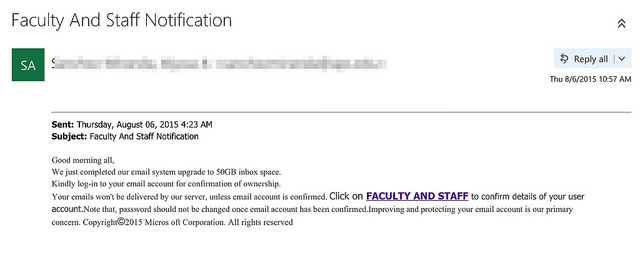
I fell for a scam this morning. In my defense it was 6 AM, I had not had my coffee yet, and I was in bed working from my iPad. The iPad version of Outlook does not reveal all of the sender’s info unless clicked.

I should have known better and I even thought it strange as I entered the requested information. Why would a university tech person send out a request for important information in the middle of the night? The email was not a work of literary genius. The form looked a little primitive like something I would do to collect information and store it in a database. I filled it out anyway. Afterwards, I clicked on the sender to reveal the address and then decided it was likely a scam. I called tech support (the local folks were not at work yet, but the state system had someone on duty) and verified I was correct.

I changed my password and hope that this will be the end of the problem.

The kid working the overnight shift told me I should not respond to requests for my password. If only human nature included the requirement of careful analysis and lack of trust.

Loading

Page Builder

I work on two major writing projects. The first is our hybrid textbook combining a Kindle Primer with online resources. The second project is also a textbook of sorts, but has always been online and has always been available to anyone at no cost.

I first wrote Meaningful Learning and the Participatory Web as a wiki. I then converted this resource to individual web pages so I could offer better multimedia. Now, I am converting the Participatory Web site from individual web pages to pages delivered by the WordPress “blogging” engine. The conversions each have taken a considerable amount of time, but the work provides enough experience I feel I can  speak with some insight about each form of authoring.

The multiple web page version of the Participatory Web content was created with Dreamweaver. Working with CSS, templates, and a high end development environment is certainly the way to create sophisticated and attractive sites. I moved on because the sophistication of the tools was no longer necessary to generate the content I wanted to offer and because I prefer not to “lease” software (which is the present Adobe model).

WordPress is probably more known as a blogging platform, but it also allows the creation of “pages“. With the addition of specialized plugins (I am using Page Builder from SiteOrigin), it is possible to create a wide variety of page formats. The combination of the blogging platform with the page plugin has more than provided the flexibility I need to offer my “book”.

There are some interesting differences between building a site with a traditional web authoring tool and with a “blogging” tool. The traditional way to create a complex web site involves creating multiple pages stored as individual files. The page files may load a common CSS format file. In contrast, a blogging platform uses a database with content stored as “records” rather than multiple, independent files. With the traditional approach, the web authoring tool creates pages locally and then uploads the content to a server. With the blogging tool, the content is created within the online environment provided by a server using a conventional web browser. Working online requires different backup strategies. The traditional web page approach already leaves you with a copy on your personal development machine. The use of an online development platform does not and it is important to find a way to backup the database and media files you have uploaded. Of course, an advantage of the online approach is that your work does not require that you work from the same machine or purchase software for the multiple machines you might use/

If you are interested in this project, I encourage you to take a look. The WordPress version of our Meaningful Learning and the Participatory Web book is partly finished and available for viewing. I would wait until the entire project has been completed, but I estimate that the conversion project will take another 20-30 hours because of the amount of content involved. I want to offer instructors and K-12 staff support personnel an opportunity to view what is done as soon as possible.

Meaningful Learning and the Participatory Web

Loading