Kialo – structured argumentation

Kialo’s mission statement is to “empower reason” in the midst of a social media environment that seems to have lost the capacity to enable meaningful discussion. I see a great opportunity for educators here while Kialo has a broader focus. In a way, Kialo is similar to Hypothes.is, a service which wanted participants to “annotate the web”, both expressing a desire to develop services providing a way for all to participate in addressing important issues.

I am interested in the potential of Kialo because I have written about argumentation (similar to debate) as an important learning activity. My perspective has been strongly influenced by the work of Deana Kuhn who writes about the limitations of the perspective students often take in considering controversial topics and the value of teaching argumentation as a way to address these limitations and to develop critical thinking skills.

Kialo allows a host to state a thesis (e.g., Educators should abandon traditional textbooks and use projects and online resources), seed a discussion with several pro and con statements, and then invite others to react.

The “discussion” can be made public or shared with designated others (considered private). Invited participants can rate their level of agreement with the original premise (A), rate their agreement with specific pro or con statements (B), or add their own pro or con statements (C). They can also add their pro or con statements in reaction to existing pro or con statements. Comments and links can be attached to pro or con statements as a way of adding supporting evidence.
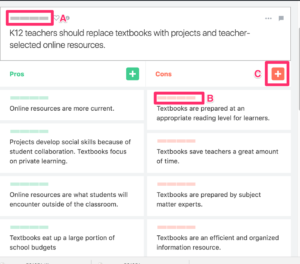
My thinking was that this service offers a way to implement some of the techniques suggested by Kuhn. Dr. Kuhn liked to use a simple messaging technique allowing participants to post brief arguments and evidence to each other. The value in this approach in contrast to a traditional verbal debate was the concrete record of comments allowing for followup and analysis. Kialo would allow this and has far more detailed opportunities for analysis should users want more.

Should you want to explore, I have posted the “abandon textbook” Kialo project and you are invited to participate.


Loading

The end of “Don’t be evil”

Google has decided to “downgrade” “Don’t be evil” in its employee code of conduct. I always liked the Google story and the original directive to its employees. It seemed a positive message and a laudable goal. From my perspective, Google is still less evil than the others in the big four (Amazon, Apple, Facebook, Google).

Citizens of the U.S. seem to be struggling with the ethics of unbridled capitalism. We live in a society that has come to question the equity of our system. It turns out that everyone does not actually have the same opportunities and our politicians are embracing the failed model of trickle-down economics moving tax dollars from the needy to large corporations. The Internet itself is no longer open with the removal of the provision preventing the companies that control our access from the opportunity to control that access often leaving citizens no opportunity to seek an alternate provider. Now, we must deal with the end of don’t be evil.

We are partly at fault. We have embraced the false promise of free. We should have known better. Most of us would seem capable of processing the impossibility of providing services and hiring employees of great talent without an obvious source of income. Yes, we saw a few small ads, but few of us ever clicked on those ads. We should have known better.

Perhaps reality has now set in. Given that “free” is an illusion, what should we expect now? Probably, the best we can hope for is transparency. Trading the record of our online behavior to Google for ads that are consistent with our interests AND free services seems a reasonable deal. Companies that collect this information and sell it to other companies is not (Facebook).

Government oversight is presently confused with socialism. People seem confused by the promotion of economic principles that are argued to be open, but are really not when examined more closely. We need regulation that actually allows for equitable competition. I am still a Google fan, but the downgrading of “Don’t be evil” is a sign of the times.

Loading

Google Photos – Lens

I have been waiting for some time to explore Google lens. This Google Photos capability was first available for Android devices but was supposed to be rolling out for iOS. Cindy has the capability on her iphone, but I, as yet, do not.

Anyway, I found that I can use Google Lens on my Chromebook and the larger screen offered advantages in recording a demonstration of what Lens can do.

My demonstration may paint a picture that is too positive. The service is impressive. One of the capabilities I keep searching for is related to my background in teaching biology. I am a sucker for apps that purport to identify plants and animals. Google Lens might be expected to have similar capabilities.

What I have found about this application of AI is that plant identification is very challenging. This makes sense as the images provided may or may not reveal critical features the AI needs to make an accurate identification. What I remember from classes requiring that I identify unknown species with a “key” is that even with guidance this process is challenging. I like to test the AI capability of these products by visiting a zoo or botanical garden that offers examples I do not know, but also provides labels for the exhibits. Does the identification of the technology offer a match?

What Lens does in such circumstances is make its best guess, but it also shows you images of other matches it considered. This seems a reasonable combination of AI and human intelligence. As a learning experience, the consideration of the options may offer a superior opportunity. You have to be involved. The technology scaffolds the experience by limiting the options and you end up making a decision.


Loading

Consumption/production and transfer

We are on a transatlantic cruise and the passage gives me plenty of time to read. I have had the opportunity to spend a little more time than usual with my Kindle. The book I am presently working on is Mitch Resnick’s Lifelong Kindergarten.

I would describe the book as Resnick’s attempt to make the case for maker culture which I tend to translate as “production” culture. When translated to the school environment, I would describe the theme as “too much consumption, not enough production”.

I started thinking about my own efforts in “consuming” his book. I probably go through an average of 2-3 books a month and I think I have purchased one “paper” book in the last several years. That was necessary because the book was not available in a digital format. I am committed to the digital format as an important part of what I consider my workflow. I do read some for pleasure, but I also still spend a lot of time reading to give me something to write and speak about. So, my consumption and production are tightly connected. An example might be this post. I would not be writing about Resnick’s ideas unless I had first read his book.

Even my process of consumption is far from pure. I like the digital format because I can highlight and annotate, search for my additions later, and copy my embedded content to my external products (writing). I understand that some argue reading on a device is inferior to reading a paper version, but I think this assessment must be considered carefully as to the purpose to be served. Reading as an active experience is certainly cognitive construction, but the thinking can also be simultaneously externalized as annotations and highlighting. Often, reading is not independent of external productions.

It seems reasonable to me to consider the consumption/production processes as linked. This was certainly the logic behind the language experience approach (reading/writing, speaking/listening) that has been used as a way to understand the development of reading proficiency. What I think is important to consider is which areas is this consumption/production process can be emphasized. When does consumption/production develop something beyond the content of interest (critical thinking, problem-solving, etc.) and how far does the development of these higher level skills transfer (near transfer, far transfer)?

The issue of transfer is important and the research on the extent of transfer should play a role in the educational focus on production. What I mean by this is that the educational setting does not have the time to provide production experiences in every possible consumption/production area. When should production be emphasized as an elective and when as a requirement? Consider the possibilities that are seldom examined. Most individuals enjoy the consumption of music, theater, photography, and food.

There are two questions here. First, which production areas should be emphasized if the time necessary to develop related thinking skills can be accomplished by any production experience. Most research suggests that the time necessary to assure transfer is significant. This is one of the concerns with the use of coding to develop higher order thinking. Most research shows that limited exposure is not enough. Second, there is the issue of which areas should be required of all if near transfer is all that is produced. Again, choices have to be made.

My thought is that we have been doing it right all along. I would propose that we emphasize the reading/writing connection which probably means students don’t do enough writing. The processes of reading and writing have such wide utility that has not diminished over the decades and probably needs enhancement. I would focus on the arts, coding, and making as electives. These questions are a matter of balance and it should not be assumed that earlier questions of emphasis resulted in the wrong decisions.

Loading

The Padlet Story

I hope that recent revelations regarding social media, particularly Facebook, has caused reflection focused on what we can expect when using a free service. I thought that the reaction to Cheryl Sandberg’s reply to what Facebook would do to provide an ad free space – charge a subscription – was telling. So many seemed shocked probably because they have not  given a thought to how Facebook maintains its infrastructure and pays its many employees.

This is not a post about Facebook, Twitter, Google or other services that have relied on ads and the sale of personal data. This is a post about the reaction to the announcement from Padlet that it must cut back its free offering and charges schools or teachers. To be clear, Padlet will maintain a free “level” – three pads with ads. However, the level at which many teachers used the service will now require payment.

The reaction on the part of many was not that understanding and in response (I assume) to this reaction the Padlet Founder offered a detailed explanation of their plans and their decision. His comments are worth considering.

My one negative reaction to the Padlet announcement which seems common to most paid edtech services is the lack of intermediate offerings between free and the lowest subscription. A counter example would be InsertLearning which offers a monthly fee. My guess is that the bookkeeping required might be thought not to be worth the effort to offer some type of tiered model. As the Founder suggests, the cost for the subscription model is reasonable for those classrooms that make extensive use of Padlet. They have good data on patterns of use and have used these data in setting the price for their paid tier.

I do wonder about the ads in the Padlet free plan. Didn’t Channel One receive a lot of criticism for their ads on their educational television channel.  Who will be the targets for these ads – the adults or the students?

Loading

Diversify your social media presence

Present awareness of the collection of user private data by social media giants has increased public awareness of security concerns and led some to look for alternatives. While I do make some use of Twitter and Facebook, I have been exploring alternative services for several years. I have a mixed reaction to the present concerns. On one hand, I am bothered by my data being used in ways I did not anticipate. On the other hand, I understand that the companies providing these services have expenses and are expected to be profitable. I agreed to the use of my data, but to a lesser degree than I understood.

Simply put, I use the social media giants because this is where people spend their time. This is a present reality. My concession to what I consider the limitations of these services is that I limit my use to specific purposes. I use Facebook mostly to argue my political views. I use Twitter to discover educational resources being promoted by others and I automatically post notices when I add something to one of my blogs.

One of the dark realities of social media is that it seems to encourage a winner take all process. People are attracted by people rather than be superior experiences. Taking this into account, my recommendation is that people cross-post. Encourage innovation by supporting new services while you continue posting to popular existing services. It is your content so put it as many places as you want.

My present recommendations would be Mastodon as an alternative to  Twitter and Diaspora for Facebook. One innovation of these alternatives is that they use an approach called federation. Rather than relying on one source, both services combine access provided by multiple instances. You join an instance, but can also explore content added to all instances in the federation. I am a member of diasp.org and mastodon.social.

Growing alternate social media requires more than adding content. The process of making connections takes some time. I make the effort to star and share content each time I connect. Using hashtags is important with diaspora as the use of hashtags offers a way to identify other users who post on a common interest. Use hashtags and learn how to follow a hashtag (e.g., education).

So, if you are interested in innovative uses of social media I encourage your exploration of alternative social media services. My motivation for my activation is part technological interests, but also the belief that fostering alternatives is a way to encourage companies to be more responsive to consumers.

Loading

HyperCard rising from the ashes?

Maybe, just maybe, the best learning to code environment still has life. HyperCard, the Apple project that launched hypermedia, is the focus of an open source project called ViperCard.

Vipercard is web-based and you can do many of the same things you could do in HyperCard. The scripting language originally called Hypertalk seems to work as I remember it.

The developer is looking for support to fund his planned additions to the project. The developer has written an explanation of his efforts.

Loading