A warning appeared in my mail box this morning. Writing a scam must be kind of an art – you obviously cannot offer that much information and yet you must convince the recipient you are attempting to address a very specific problem. I am tempted to write back and ask which of my accounts has generated this concern, but it is probably better to just ignore the request.
From emailaccount@antivirus.com
Important notice, harmful virus was detected in your account which can be harmful to our subscriber unit, you are to enter your password here{_______}to set in an anti virus in your user account to clear up this virus so we do need your co-operation in this, because providing us with this personal information we enable us insert in your account information into our anti virus machine for clean up. We are sorry for the inconveniences this might have cost you.
After 48 hours of providing this information you are advise to change up your password.
Failure to do this, we are sorry to let you know that, your account will be deleted immediately to prevent it from arming our subscriber unit.
Fellow fish and “subscriber units”, beware the lures of the phisherperson.
Here is a comment on the present down turn in the economy and the web 2.0 resources we have been promoting for education.
Today, I read comments from several venture capitalists (e.g., Ron Conway) as they offered advise to those they support. The comments expressed concern that while the present financial situation did not originate with online apps and services (like the Internet bubble of a few years ago) tight money would eventually impact tech companies hoping to make their mark with Internet services. The advice was to economize.
Of course, those companies that can find a way to make it through the lean times will likely find they have less competition on the other side. It reminds me of the rise of the Bubba Gump shrimp company – this likely makes no sense unless you are fans of Forest Gump.
My concern is that I invest too much time and perhaps resources I have created in an online (probably free) service that has no way to generate funds. The idea that good services will be bought up by Google, Microsoft, etc. or catch the eye of those with venture capital may not hold in the short term. For example, Yahoo, owner of Flickr, fell below $14 today. Time to back up just in case.
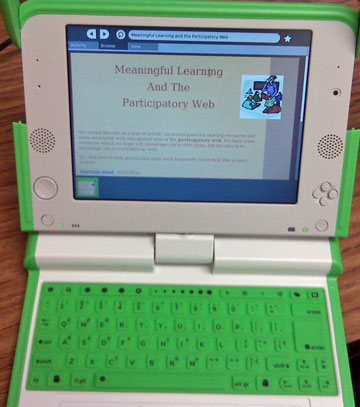
The mission of One Laptop Per Child was to bring very inexpensive laptops to needy children. Perhaps you did the same thing we did and purchased one for ourselves as part of the get one / give one project.
I can’t say that I have used ours much. The keyboard is pretty small for my hands. Originally, I spent some time online, but we switched our router from WEP to WAP and I have been unable to figure out how to configure the new password (it seems you have to convert the password to hex, but the conversion with a Airport Extreme works differently, etc.). I can still get the XO to work at my office.
To me, the project has struggled with direction. The original commitment was to put these computers in third world countries and then it turned out deals were made to offer the machines in some U.S. schools. The machine was to be developed based on open source software and now Microsoft has become involved in the project to include Windows.
This linked interview (Robert Scoble and the COO from OLPC) offers an update.
We took yesterday off and drove in the countryside looking for fall foliage. The fall colors in North Dakota are probably not as spectacular as you might see in other parts of the country, but you can find pockets of great scenery if you know where to look. We seem to have fewer trees that produce that intense red color.
These images were taken a few miles from the Canadian border near Pembina.
The remoteness is one of the interesting features of North Dakota. You do not have to travel very far to be able to explore areas with few people (the hilly terrain shown below is not typical). However, even the most remote areas were busy this weekends. Trucks and tractors were everywhere as the harvest was in full swing. We pulled off to the side here to take this picture and a few moments later a semi came barreling down the gravel road toward us.
We have now made it through the first presidential candidates’ debate and the only vice presidential candidates’ debate. I watched and listened. I have decided I hear what I want to hear and really don’t learn much. I thought I would learn more than I pick up from the carefully orchestrated 30 second ads. It turns out the debates are about as orchestrated. The candidates seem to resort to their well rehearsed talking points if the question or the last respondent’s answer offers a point of departure. I thought the moderator in the first debate pushed back against this strategy, but I did not have the same reaction last night.
Perhaps our engagement in the process is as important as the outcome. I am not sure I believe this, but I do believe that this is the point in time at which it is important to think carefully about the choice before us. We can no longer coast along relying on what used to be our technological and resource advantages.
In 2004, a nonprofit organization sought to increase the interest of young people in the election process by sponsoring a mock election for students AND their parents. The timing of the election in late October offers some insight into what a national sample of citizens is thinking. The National Mock Election is scheduled for Oct. 30 and educators are offered several levels at which they can involve their students (and parents). Check the web site for elections instructions and curriculum suggestions for those wanting to do more.
This additional recommendation from Cindy – a post on election education from the Infinite Thinking Machine.
In his recent book (Infotopia), Sunstein suggests that we may think we are digging deeply into a topic by participating in an online participatory community, but we must take care that we are not actually echoing and perhaps moving to even more extreme positions by following the premises around which the group is organized (my interpretation).
I have my own remedy. I attempt to purposefully explore contrasting extremes. I have done this in the past sequentially by reading one book and then reading a second book criticized in the book I just finished.
I am now going to try this process in parallel. Two book arrived in a box from Barnes and Noble today.
My next project is to read Palfrey and Gasser’s “Born digital” and Bauerlein’s “The dumbest generation” in parallel. I should have tried this last summer when I had fewer other commitments. Perhaps if I announce my intentions I will make more progress. I am guessing several posts will follow.
I have explored and written about several image storage and sharing sites. LifeSnapz is a new addition to this list. Each time I take the time to experiment with a new service I try out the features and consider what unique role each might serve. If I understand the unique characteristics of LifeSnapz, I would suggest the unique focus is on group collections over time.
By a group image collection, I mean that multiple participants generate a collection. The host invites the participants and as far as I have been able to tell there is no way to offer others “veiwing” priviledges without a specific invite.
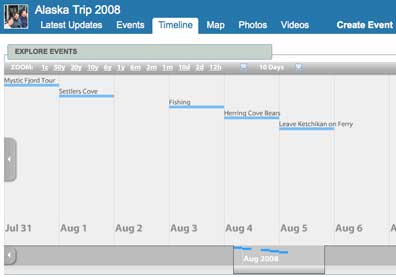
The second interesting idea is the focus on “events” that are time-linked. If you imagine a situation in which grandparents might begin to collect images from “family events” (Summer at the lake, 2006; Christmas at home, 2008; etc) over time, you would have some idea where this might be going.
I typically explore by creating a demo. In this case, my demo was based on a collection of images I had from our summer vacation. The events in this collection consist of identifiable activities from each day of the vacation. You see the LifeSnapz timeline below. The timeline is set to the most micro level view because I am exploring events across a week and not years.
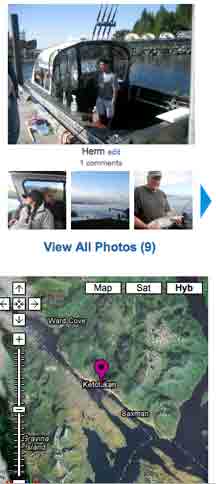
A description of each event and related photos can be created and the event can be geotagged.
Of course, viewers are also able to explore the individual images and associated descriptions organized within an event.
Yes, it was a nice fish!
Consider how a classroom teacher might use this tool. First, the controlled registration system might be useful in dealing with the security issues teachers must address. The event option might also be a way to organize collections of photographs added throughout a year.
I must say that I know little about this company or exactly where it is heading. With all new companies, I always wonder about the funding model. No ads were evident during my exploration. So, the company will likely eventually attempt to charge for access or at least offer a premium version of the system (something like Flickr) or perhaps resort to the inclusion of ads. I tend not to invest a huge amount of time in a service until I have a better feel for the “final product” and until the service has been around for a little while.
At this point, I am willing to say LifeSnapz is worth exploring.
Manage Consent
To provide the best experiences, we use technologies like cookies to store and/or access device information. Consenting to these technologies will allow us to process data such as browsing behavior or unique IDs on this site. Not consenting or withdrawing consent, may adversely affect certain features and functions.
Functional
Always active
The technical storage or access is strictly necessary for the legitimate purpose of enabling the use of a specific service explicitly requested by the subscriber or user, or for the sole purpose of carrying out the transmission of a communication over an electronic communications network.
Preferences
The technical storage or access is necessary for the legitimate purpose of storing preferences that are not requested by the subscriber or user.
Statistics
The technical storage or access that is used exclusively for statistical purposes.The technical storage or access that is used exclusively for anonymous statistical purposes. Without a subpoena, voluntary compliance on the part of your Internet Service Provider, or additional records from a third party, information stored or retrieved for this purpose alone cannot usually be used to identify you.
Marketing
The technical storage or access is required to create user profiles to send advertising, or to track the user on a website or across several websites for similar marketing purposes.








You must be logged in to post a comment.