The Wall Street Journal presents some data on recent iPhone sales that is quite intriguing.
Ownership of the iPhone rose 48% from June 1 to the end of August among households earning between $25,000 and $50,000 a year, compared to 21% overall …
Some speculated that Apple would be differentially harmed by an economic downturn because of the focus on more expensive products. Perhaps more expensive is better if one product can substitute for many.
I must add my usual complaint. North Dakota is part of the U.S. – it would be nice if we could buy iPhones too.
“Colleges and universities are entering into very difficult financial times — and access and quality are likely to remain at great risk”
I had a sense this was coming. Tuition has been going up consistently and we hear more and more criticism from the public. In the past, I was not that sympathetic to complaints about tuition increases. It really depends on how you crunch the numbers. Tuition dollars represent only a fraction of what it costs to fund public higher education. As states offer less money, students and parents must pick up the slack. The total cost per student changes far less drastically than one might assume from watching the increase in tuition. Lower taxes and the burden for higher education falls more heavily on the families of college students. As pressure from those most directly impacted mounts and the system within any given state becomes noticeably inferior to other states, one hopes that those who make such political decisions intervene. What happens, however, when everyone goes into a recession?
Explaining why a pay as you go system is unfair and why higher education offers broader advantages to a state and the nation than is directly manifest through those who benefit as students is difficult. Part of the explanation concerns equity and the unfairness to bright individuals who happen to grow up in families with limited means. We all don’t start life with the same chance to be happy and productive. Part of the explanation concerns the general value of the relatively inexpensive research and scholarship that drives economic development, medical advances, and cultural opportunities. Business and industry do R&D within a very narrow range and even this commitment is one of the first thing cut when budgets are threatened.
Public institutions in North Dakota are competing for a shrinking pool of in-state students. Distance education offers some opportunities, but most institutions have looked to this alternative at about the same time. Let’s hope that student loan money is part of the “bail out”.
Daughter Kim spent the summer + working in Ketchikan and continues to follow developments in Alaska even though she is now back in MSP in graduate school. She just sent me a link to a Newsweek article authored by the mayor describing the “bridge to nowhere”. I kind of met the mayor. Actually, he was heading into his favorite bar while I was walking past. We passed within a few feet. Close enough to meeting a politician for me. According to my daughter, the mayor is very approachable and it would have been fine to start a conversation.
I understand the position of the mayor. When your there is described as nowhere by so many, it must be irritating. Perhaps living in North Dakota has encouraged this level of empathy.
I even understand where the bridge was supposed to be. We arrived on the island across the water from Ketchikan on the last flight of the evening. We boarded the boat (translation – a ferry) with the other passengers, pilots, crew, and airport workers and headed across. If the bridge to nowhere went to somewhere, I could have taken a taxi.
The New York Times reports that the Christian Science Monitor has decided to terminate the hard copy edition and try to make it online (with the addition of a weekend magazine).
“We plan to take advantage of the Internet in order to deliver the Monitor’s journalism more quickly, to improve the Monitor’s timeliness and relevance, and to increase revenue and reduce costs. We can do this by changing the way the Monitor reaches its readers.”
The article also indicates that sales have trended downward for 40 years. A video from major players at the Monitor offers a very informative account of trends faced by print publishers and their thinking in trying to make the move before other papers with a national distribution.
Sometimes, the idea of change seems remote and speculative. Sometimes, the idea hits you up alongside your head.
This post is time sensitive. CodeWeaver is offering some free software TODAY ONLY. See this post from Slashdot for an explanation. Pretty funny and I assume a legit explanation. Use your own judgment.
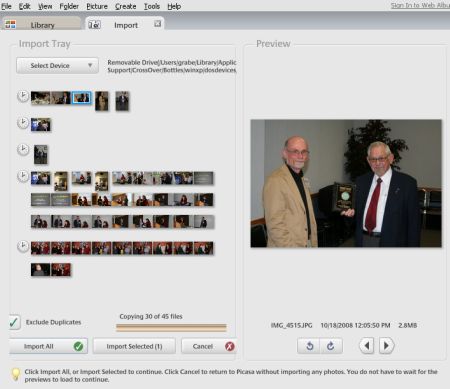
I downloaded CrossOver Mac Pro (a program allowing Windows programs to run on the Mac without the installation of Windows) and I was successful in running Picasa (a free program for the Windows OS resembling iPhoto).
Today the jury returned a guilty verdict in the corruption trial of long-standing Republican Senator Ted Stevens. While Stevens vows to fight the conviction, one would think the reaction of Republican Gov. Palin would make it difficult to successfully seek a future government position.
Statement of Senator Ted Stevens I am obviously disappointed in the verdict but not surprised given the repeated instances of prosecutorial misconduct in this case.
Sen. Stevens holds key committee appointments that influence technology applications. Yes, this is the Senator associated with statements regarding clogged pipes when addressing the topic of net neutrality. I am more focused here on “filtering”. Senator Stevens has been associated with DOPA (Deleting Online Predators Act) and introduced a new version of DOPA entitled “Protecting Children in the 21st Century Act” in 2007 and continued this focus through the beginning of this month.
“Specifically, the bill requires schools that receive E-Rate funds to offer age appropriate education regarding online behavior, including social networking, chat rooms, and cyberbullying awareness and response. The schools would have to include this education as part of their Internet safety policy.
In the past, I have argued that making e-rate funding contingent on filtering was misguided because the dangers to K-12 students are far more likely to be encountered from a home (student’s home or the home of a friend) computer than from a school-based computer and blocking commercial social sites eliminated potentially useful educational tools without addressing the potential dangers of using such tools outside of school. It appears the new direction for DOPA endorses a similar switch in priority.
First, these measures help shift the focus of federal efforts in this area toward education and away from regulation. No matter how much regulation lawmakers propose or enact, access to objectionable materials and concerns about online safety will remain problems that must be confronted.
Without getting into the politics and legal issues of the present, it seems reasonable to suggest that future developments in this area will go through the office of another legislator.
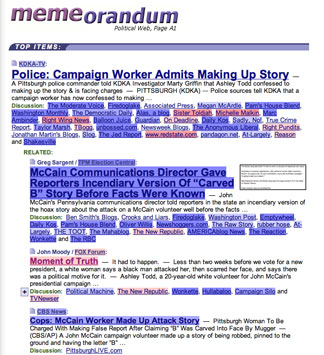
I ran across a post on LifeHacker describing an interesting election season technology project. The basic idea was to identify links leading to conservative or liberal sites. Conveniently, the add-on color codes the links (blue, pink, red).
The colors don’t necessarily represent each blogger’s personal views or biases. It’s a reflection of their linking activity. The algorithm looks at the stories that bloggers linked to before, relative to all other bloggers, and groups them accordingly. People that link to things that only conservatives find interesting will be classified as bright red, even if they are personally moderate or liberal, and vice-versa.
The project is described at Waxy and is based on a three-month collection of link history borrowed from Memorandum (a political web information portal). The technique is interesting to read about and I think I might even understand how it works if I spent a little more time. Think of it this way – the approach defines an orientation by the associations (i.e., links) they keep. You can play with an exploration tool they make available. As I understand it (and from my limited experience using it), the tool calls upon the database they have created and will color code the link if that link is in the database. Don’t expect to explore your local newspaper to determine which direction it leans. The Memorandum site works the best because this was the basis for the project.
I happen only to have Safari on the machine I was working on when exploring this site. The add-on available from Waxy does not work with Safari, but a link to Daytime Running Lights provided a bookmarklet that does. This post also suggested that the exploration of Google News.
The following screen capture will give you an idea what applying this tool (to Memorandum – the ideal target) generates.
It occurred to me that this tool could be the basis for some interesting classroom activities. The Bionic Teacher must also read LifeHacker because I was not the first with this insight.
What an opportunity to consider some topics in digital literacy (e.g., media bias). Just for kicks I did a search for Fox News in Google and then applied the tool. Nearly all of the links turned red. “Fair and Balanced” and red. I searched for CNN and found that nearly all links turned blue. NPR – mostly blue.
Cool!
Manage Consent
To provide the best experiences, we use technologies like cookies to store and/or access device information. Consenting to these technologies will allow us to process data such as browsing behavior or unique IDs on this site. Not consenting or withdrawing consent, may adversely affect certain features and functions.
Functional
Always active
The technical storage or access is strictly necessary for the legitimate purpose of enabling the use of a specific service explicitly requested by the subscriber or user, or for the sole purpose of carrying out the transmission of a communication over an electronic communications network.
Preferences
The technical storage or access is necessary for the legitimate purpose of storing preferences that are not requested by the subscriber or user.
Statistics
The technical storage or access that is used exclusively for statistical purposes.The technical storage or access that is used exclusively for anonymous statistical purposes. Without a subpoena, voluntary compliance on the part of your Internet Service Provider, or additional records from a third party, information stored or retrieved for this purpose alone cannot usually be used to identify you.
Marketing
The technical storage or access is required to create user profiles to send advertising, or to track the user on a website or across several websites for similar marketing purposes.


You must be logged in to post a comment.