Student 2.0 Interest

Various bloggers and educational writers frequently float the idea that our students regard us as out of touch because we do not take advantage of participatory web tools in our classrooms and do not use such tools ourselves. While personally quite interested in participatory web applications in education, I have expressed skepticism regarding just how involved students actually are with such tools (perhaps ignoring Facebook which may or may not meet my personal definition of “participation”). Ironically, Will Richardson seems to have come to a similar conclusion. I say ironically in that pro-blogging and personal learning network (PLN) advocate Richardson has a way of suggesting that conventional education is unacceptable. His recent post represents a more balanced perspective.

I say these things as an introduction to what was for me a very unique experience. After my educational psychology class (undergraduate) on Friday a student approached me to say that he had been reading my blog and found what I had to say quite interesting. He went on to say that I was the only faculty member he knew who used tools like blogs and wikis and he was glad to meet someone who was doing this kind of thing.

I am not certain how I react to criticism, but I know that I am even more awkward in reaction to praise. I did thank him and suggested that there were probably other faculty members who were involved in this type of thing. I suggested that I teach these tools in one of my graduate education courses and I felt it important to be a practitioner of the activities you advocate.

I thought more about this interaction afterwards. I know other faculty members involve their students in blogs and wikis. I know that other faculty members have Facebook pages. I am not certain I know other faculty members at my university who are active bloggers or who create wiki content outside of their own courses. This could mean several  things. It could mean we operate in our own little worlds and are unaware of each other. It could mean there are simply few of us who do such things.

Despite my cautious remarks regarding the level at which 12-25 year olds have embraced participation, I do think such activities should be more common among academics. Richardson is right – not everyone is a reader/writer. However, academics are. Grants and publications are expected responsibilities. We get paid for discovery AND communication. We are familiar with the proposal that it does not count until it is published – our responsibility is to communicate.

Perhaps the sad reality is that we get no credit for communication outside of the classroom that does not result in a product that ends up in some research library. I am careful to so say “some” because most libraries are unable to secure many of the journals that now exist. I support scholarly publication as a priority, but there is a point at which there is a diminishing return on this activity. Three pubs a year, 4 pubs, is there a meaningful difference. Perhaps some of the commitment here should be devoted to a public discussion of what we do. Perhaps if more “scholars” made the effort, the tax money expended on public institutions would be regarded as more acceptable by the general public. What about communication for public consumption as a responsibility of the scholar?

The student who responded to my earlier posts did get me thinking about why I do this. I originally proposed that I wrote for my own amusement and my own education (hence the title of this blog). It is more isn’t it? I do want others to understand what I do on a level that is personal and understandable. It turns out it does not take much feedback to keep me going. So, if the student I described reads this post – thanks for your comments!


Blogged with the Flock Browser

Loading

Google Trims a Few Services

Google has announced that it is closing down or stopping development of several services. This announcement indicate the intent was to concentrate on fewer services. I am assuming this narrower focus is related to the down turn in the economy.

The one tool on the list that I have used was Google Notebook. I became interested in Google Notebook after listening to a conference presentation a year or so ago. The presentation concerned the potential educational benefits of Google applications. Basically, Google Notebooks offers a cloud application that can be used by individuals or collaborators to store content. The Google Blog encouraged Notebook users to explore the functionality of related applications. I am a heavy user of Google Docs and I must admit I was never certain how Google docs was different from Google Notebook. A “word processing” file in docs seems very similar and perhaps there was not enough unique customer interest in Notebook to continue.

Loading

The Multiple Dimensions of Time

I have been making decisions about the articles I require for my graduate class. I added a short Research Summary from AERA that considers the topic of Time to Learn (pdf). There are many facets to this topic. How long is the school day? How much time is spend on academic subjects and which subjects receive what proportion of the school day? How engaged are individual learners during the time allocated to a given subject?

I have long been interested in some of the theoretical issues associated with time. By long, I mean some of these topics were being raised when I was in graduate school. The notion that individual differences in time to learn may represent an alternate way to think about aptitude differences has long fascinated me. The assumed meaning of aptitude is that differences in aptitude are reflected in differences in how much is learned (given a fixed amount of time). Thinking of aptitude as differences in time to learn was originally not very practical – what is realistic about  understanding that less capable students may require 3x more time? Where would that time come from? Of course, ignoring this reality is also unrealistic. What is practical about offering many students less time than is necessary to learn what they need to learn? Such students simply fall behind, become frustrated, and give up. Mastery learning (a model of individualizing instruction I find most of my younger peers have never heard of) argued that moving ahead when understanding was present offered the most efficient approach to learning. Is differentiated instruction a new version of this claim (time and method)?

Whatever the skills to be acquired (traditional or 21st century), there are still important issues to be resolved regarding time in group settings. Perhaps it is time to expect students to acquire certain skills outside of the “school day”. I suppose this already happens for those with motivation and opportunity.

Loading

ITunes – DRM Free Now and Then

I have used iTunes and the iTunes store since the beginning and have a substantial investment in music. I like the proposed change in the price structure – I buy mostly “older” music (blues, jazz, classic rock) so the lower price for this music is a good deal for me. The DRM free change is more difficult to evaluate. I do find it annoying to have music split between my office and home machines and no legal way to play one collection on the other machine. It seems to me new DRM-free music I download could be “duplicated” across my two machines. I assume this would be legal.

Unless I am missing something, the offer to remove DRM from existing music does not make sense. It seems likely a penalty for my existing purchases (cost to “upgrade” vs. cost to purchase now).

itunesupgrade

The cost to do this across two machines (the cost for my home machine which has the smaller collection is shown here) is more than I am willing to commit.

I also wonder about the interest in the higher end charge for new releases. I know I can download DRM free songs from LaLa for .89 today – why would I pay more than this from Apple?

So – I like the move to DRM-free, but I don’t understand the policy regarding my existing collection.

Loading

Picasa for the Mac

Macintosh users become comfortable with the tools that come with or can be inexpensively added to their Macs (e.g., iTunes, iPhoto). Why bother with similar apps? I don’t really have a great answer for this question. For me, possible answers include curiosity and perhaps experience with an application that works cross platform. The integration with cloud services may represent another advantage – mobileme is still too much of a mystery for me and I am willing to continue the search for something more.

I have commented on Picasa (Google) in previous posts. The caveat in my previous post was the lack of a Mac version. This has now changed – beta for the Macintosh. You need an intel-based Mac and 10.4+.

When you begin, Picasa offers the opportunity to search your computer for images. I turned the program loose without carefully considering the potential consequences. I have a huge collection of images in iPhoto. The message that offered me a choice of where to locate images specifically mentioned iPhoto. Picasa leaves images where they are (potentially scattered all over your hard drive) so my typically full speed ahead approach did not get me in trouble. Picasa is also sensitive to the presence of iPhoto and treats images stored in iPhoto as protected (read only) and makes a copy if you want to use the Picasa editing tools. This is a very nice approach for Mac users with a commitment to iPhoto.

picasamac

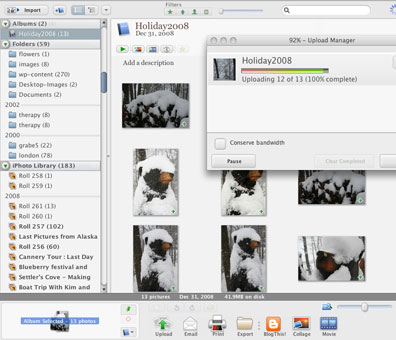
The advantage of Picasa on the Mac is probably the easy integration with Picasa online. Sample of uploaded images. Until the Yahoo financial situation is resolved, I am a little concerned about a total commitment to Flickr. Picasa (from Google) is a good hedge.

Loading

First Day of 2009

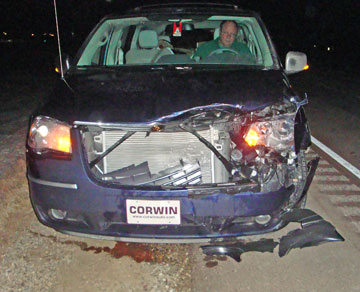
We drove from western Wisconsin to western Iowa yesterday to visit mom. About 6 in the evening we came over a slight rise in the highway and were confronted with a herd of deer. No escape route and not enough time to stop. I know we struck at least two deer and messed up our car.

wreckedcar

We met a couple of nice officers after calling 911. Contrary to what I had assumed, the dispatcher did not know which county we were in let alone which mile marker we had just passed. Like I would have some idea. Explaining that I was on highway 60 close to an ethanol plant brought us help in about 20 minutes. One nice lady did stop to ask if we needed help. No claims adjuster will take a look at the car until Monday (accident was Thursday). My brother is lending us a car so we can get back to North Dakota and we will work out the details via phone.

Yes, those are dealer plates on the car. First accident of my life and it happens in a new car. Probably a good thing. The car handled very well – not certain what would have happened years ago if we would have experienced the same thing in our original VW van.

There must be some lessons here. I am trying to figure that out. You can’t control all of the variables. Sometimes a herd of deer decides to sacrifice a few members.

We are both fine and enjoying our holiday.

Loading

The Year Ends

We have spent the past few days with family at a cabin in Wisconsin. Everyone but us has now gone home and we will leave in the morning. It has been a very relaxing time with family.

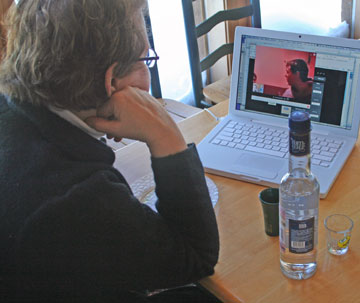
The most unique event of the day was a virtual chat with Sasha and Marcia from Nizhny (Russia). These are friends Cindy made during her travels and she stays in touch. The coming of the New Year seems a bigger event in Russia. They give presents and welcome Father Frost much as we do on Christmas eve.

We exchanged several vodka toasts each followed by a pickle. There appears to be an order to the toasts. I remember the second round is to remember your parents. They were eating caviar on toast. Hard for us to match that, but the cost in Nizhny is a fraction of the cost in the U.S.

marciasasha

We won’t be able to toast the New Year with all of our friends, but consider this a virtual toast – To you and  yours, may the New Year treat you with kindness and engage you with new adventures.

Loading