All of Me

I is a gorgeous holiday weekend and I am trying to work. Perhaps there will be time for fun later. I happen to be working on a chapter focused on the topic of cyberbullying.

Anyway, one of the issues I came across in my reading concerned the origins of the term – who used it first as a technical term.

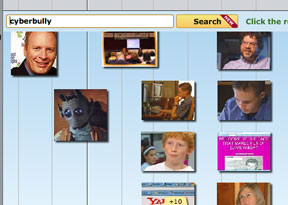
When I work I tend to be easily distracted and my wife does not help because she is constantly showing me interesting online tools. She ran across a service called “All of Me” that allows the creation of a timeline of available online resources. I am guessing most folks first do a vanity search (or perhaps that is just me). The first record I could find for me was from 1979 – it was the citation for a publication I had that year.

Anyway, I decided to do a search on “cyberbullying” and found the first reference to the term according to this tool appeared in Nov. of 2004. It was not a reference to the two individuals I was searching for (Belsey or Willard), but a complaint about an individual labelled as a cyberbully.

This is an interesting tool to use for explorations. It would not qualify as a professional reference tool, but an interesting way to look for date-related content.
firstcyberbully

Loading

The “theoretical” power of the crowd

This was to be the day I made progress on some important writing projects. I arrived at the office early and was ready to go. Then, I checked my email. There was a note that the wiki I maintain for student projects in my graduate course had been modified by someone I did not recognize so I thought I better take a look. Now, three hours later, I am back in my office. Instead of working on my writing projects, I felt the need to blog.

If you are an instructor, you have likely encountered a student comment that goes something like this – “that sounds good in theory, but …. “.

I have developed a response to these statements explaining that there is nothing as powerful as a good theory and students should recognize that what they are saying is that they prefer their “personal” theories over the theories proposed by others.

I am questioning the “theoretical” power of the crowd this morning. I did  spend considerable time adjusting some security measures on one of my servers, but such adjustments are necessary only to cover for the inadequacies of “the crowd”. Some “Russians” are messing with my servers again. I hate to speak in stereotypes because my wife has very productive connections with some Russians. I also know that IPs can be spoofed. Anyway, the IPs of those causing the problems translated to RU. The crowd should have made this unnecessary.

The theoretical power of wikis is that these social resources combine the talents and dedication of multiple individuals. When the opportunity for abuse within an open system are raised, the theoretical response is that the dedicated folks can easy take care of the problem because a wiki allows previous versions to be activated or modifications to be reversed. The idea is that those who care can easily reverse damage caused by those who are malicious. Wikipedia is supposedly a reasonably good reference because those who care watch and fix things.

The theory assumes a) someone cares and b) someone watches. Perhaps tasks completed as assignments meet these conditions only until the grade is awarded or the semester ends. Or, because I believe my graduate students have a little more commitment, until authors forget about what they have written.

Perhaps active wikis meet the most optimistic version of the theory, but sites that are only sporadically worked on need a more “practical” version.

Loading

Potential Incentive Fund Considered for 21st Century Skills

S. Bill 1483 proposes a fund that will encourage states to adopt the 21st Century Skills framework.

As part of the rationale Congress has concluded that:

  • In order for our Nation’s students to be prepared to succeed in our communities and workplaces, students need 21st century content, beyond the traditional core subjects, that includes global awareness, financial, economic, business and entrepreneurial literacy, civic literacy, and health and wellness awareness.
  • Students need to go beyond just learning today’s academic context to develop critical thinking and problem solving skills, communication skills, creativity and innovation skills, collaboration skills, contextual learning skills, and information and media literacy skills.
  • Information and communications technology literacy is the ability to use technology to develop 21st century content knowledge and skills, in the content of learning core subjects, and students must be able to use technology to learn content and skills so that the students know how to learn, think critically, solve problems, use information, communicate, innovate, and collaborate.

I was reading the provisions guiding the award of grants should the bill be passed.

Award Rule- The Secretary shall award grants under this Act on a first-come, first-served basis, so that the grants are awarded–

(1) to eligible States in the order the Secretary receives approvable applications; and

(2) in an amount determined on the basis of the amount of the non-Federal share identified, and supported by the information contained, in an approvable application.

My participation in grant writing typically occurs when someone needs help. I usually do not follow the process from authorization through to the process of application. However, this language about first come, first served seems strange. Whatever happened to a deadline and review process with intent of identifying the most deserving proposals?

Pay attention – some folks probably knew this was coming and have their proposals ready to mail.

The proposals require a 50% match so perhaps those looking for a handout will look elsewhere. These seems one of those initiatives intended to steer state money in a particular direction by offering the opportunity to double your money.

Note the connection to the Partnership for 21st Century Skills.

A white paper from this organization is available. I have a test I apply when examining white papers – I check the references. You can do the same – do you see any research reviews from the Review of Educational Research or individual research studies from the American Educatioanl Research Journal or the Journal of Educational Psychology. I am in support of most of the core ideas of this initiative, but we need a more serious approach to the examination of issues. If the incentive fund can come up with couple of hundred million for implementation and there seems to be a great urgency for how these funds will be dispensed, perhaps a little more funding for research would seem warranted.

Loading

Wolfram|Alpha Launch

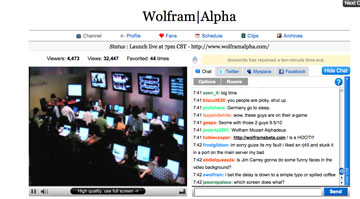
I followed the video feed of the Wolfram|Alpha launch tonight. Offering this as a live feed was innovative and not without several hitches.

wolframlaunch

After a couple of hours, the site went live. I was able to conduct a couple of searches. I was unable to find out anything about me. I was able to obtain a lot of information about Grand Forks.

wolframgf

At present I cannot connect so I decided to just call it a night.

Wolfram|Alpha should be available to everyone soon.

The site is functioning this morning. I am still attempting to understand the intended focus of this service. The FAQ tries:

Is Wolfram|Alpha a search engine?

No. It’s a computational knowledge engine: it generates output by doing computations from its own internal knowledge base, instead of searching the web and returning links.

Loading

Are people getting grumpy?

The school year is drawing to a close. As the end approaches, people tend to get a little grumpy. That was my reaction to a recent post by Wes Fryer. Frustration seems to be setting in. This post complains about the proposed cuts to EETT. The post goes on from there to claim that President Obama  supports a continuation of NCLB. As is typically the case, I expect that the situation is more complex than EETT and NCLB. For example, I anticipate that stimulus money will potentially influence school opportunities to modify infrastructure and invest in technology if decisions at the local level move in that direction. I am guessing many districts in many states are simply attempting to hold on to as many teachers as possible.

Changing minds is important – confrontation is unlikely to convince the majority. The position that drastic reform is necessary only plays well with those who are convinced. The idea is to escape from the echo chamber and influence moderates. I fear some who fancy themselves as visionaries and leaders may find themselves with few voluntary followers.

In my opinion, change will come when advocates:

  • Do something cool that offers the opportunity to inspire learners and convince parents and colleagues on the local level. We need more visible examples. I think we may be getting to the point we have too many visionaries for hire and too few teachers known at the local level with impressive student work to share.
  • Support research. How else will we really know what makes a difference? I am not convinced that we have important answers in hand. Complaining that standardized tests miss important skills is fine. If you are an advocate support research using some other dependent variables.
  • Answer the question of why new teachers are no more innovative in their use of technology. Why is it that supposed digital natives teach like those of us of more advanced age? What about present opportunities fails to translate into classroom practice?

BTW – I have read the Texas “immersion” research as well (the 2009 summary (a pdf) is available) and the results are mixed and in some cases negative. To claim this research warrants a general commitment to a 1:1 model is simply wrong. In fact, the report indicates that following the period of support some schools decided to back away from a traditional one-to-one model. The report (according to my interpretation) also seemed to imply that teacher and administrator beliefs about how students learn influenced how technology is used. This sounds a lot like Windschitl & Sahl (2002) and other older research.

Loading

Coolpix P6000

I bought Cindy a Coolpix P6000 for Mother’s Day. Some husbands get pressured into giving diamonds by those horrid television ads, but I give a present that shows I really care. Just wait – this is so cool – you will see.

So, because it will eventually be her camera, I decided the first pictures should be of her. I caught her in her favorite location watching television while reading blogs.

cindyoncouch

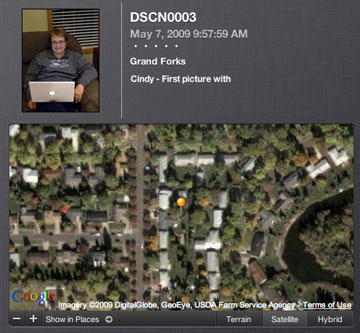
Now, I load the pictures into my Mac within the most recent version of iPhoto. Looks like Cindy so far. BUT, I click on the small “i” (information) that appears on the thumbnail, the picture flips over AND

gpscamera1

I know that Cindy and the couch are located in my house (easier to see when full size).

I think Cindy will have a great time with this camera and she will be very surprised on Mother’s Day. Don’t worry, she seldom reads this blog and she is used to me running around doing strange tech things. She won’t suspect a thing.

Oh – the camera is GPS enabled if I was not making myself clear. Now all my mountain pictures will not only be beautiful, I will actually know which mountain (approximately) I am looking at. I mean which mountain she is looking at.

What a great tool – map images very precisely to a map.

I see the time is wrong – I got too excited and started learning before I read the instructions.

Loading