College Alternatives – I can beat $99

I read a recent blog post (The Coming Colleagiate Crash) that reviewed a Washington Monthly article entitled “College for $99 a month“. The post and the article address the cost of coursework and potential alternatives. The article begins with a description of a student taking a course from StraighterLine for $99.

I took a look at the course offerings from Straighterline – mostly the easy money courses (Intro courses for which there are large audiences). As a career academic and long-time administrator (and self proclaimed amateur economist), allow me to react. The inexpensive Intro course alternative is hardly new to those of us who work at universities. The $99 price point is new. I can probably give you an even less expensive alternative if you are really interested (you must read to the end). Those of us who work at state institutions are often bound by articulation agreements. This basically means students can transfer in work from other institutions and we must accept the transfer. So, a course taken at a junior college with which we share an articulation agreement must be accepted (I suppose the agreement works in the opposite direction as well, but I am guessing the number moving course work from a junior college to a university is far greater than the number moving course work from a university to a junior college). By state mandate, two-year colleges can offer courses at a lower rate than we can. Sounds strange, but as chair of a department I cannot offer a bargain on Intro Psychology seats. It would be cool to auction off open seats after a certain date, but we do not really work in this fashion.

Dual-enrollment high school courses operate in a similar fashion. Some high schools offer a specific course for both high school and college credit (not the same as AP courses). They may do so with the collaboration of a college or university, but because of articulation agreement the credits can be applied state wide.

My point, for a variety of reasons (cost, smaller class size, proximity, convenience) students take course work at one place and apply those credits to a degree elsewhere. I am not challenging the quality of these experiences. Reality is such that the quality of such experiences when transferring credits in Psychology would be very difficult to evaluate. I do know that my colleagues in math and engineering go ballistic on this subject. It is easy to set them off by asking about students who transfer in calculus credits.

The point I want to make, however, is an economic one. It is also a simple point. We take short cuts in charging students for the credits they take. In a way we are lazy. With a few exceptions for fees (lab fees in a few courses), we charge for courses as if the actual costs were identical. You probably over pay for Intro Psych – there are 200 students in there and the personnel costs are not substantial (one instructor and a couple of graduate students). You get a tremendous bargain for other courses (20 students with your own instructor, access to costly software in a computer lab, etc.). When you complete your education at a single institution things even out. If too many students bring in credits from elsewhere the assumptions of the system would begin to cause problems. I think larger institutions will ignore this issue for a while, but at some point will be required to make adjustments. One solution would be to charge based on the actual costs of the course. Another might be to accept credits as is done at present, but offer tuition advantages to those taking a high proportion of their credits from the institution they graduate from. Think of it as the difference between being a season ticket holder and buying tickets for individual games.

I know there are many other issues. What happens within courses is only one component of the teaching/learning experience of a university and the teaching/learning component is one of several components of what a university does. I am ignoring such complexities here ( see one previous post on a similar topic).

I promised an ultra cheap alternative (beat the $99 price) – “take” a course via iTunes U and then CLEP. The cost of a CLEP exam is $72.

Powered by ScribeFire.


Loading

Feed From My Reader

I have added a RSS feed to the sidebar of this blog (near the bottom to be less distracting). This feed offers the titles of the 15 most recent blog posts I have saved at my feed reader site. I am presently reading blogs using a self-hosted aggregator called Fever . Fever offers some interesting features I am evaluating. The feed identifies the posts of others I have saved for later review. I guess this feed would be similar to recent additions to the public view of a social bookmarking site.

Loading

Google Canned Responses

Do you have to send the same email to many individuals on different dates? If this is a common experience, it is worth learning how to use Google Canned Responses.

Here is my situation so you get the idea. Cindy and I offer a free online resource (book) focused on participatory web applications in K12 settings. The book is part of a suite of resources some of which allow users to contribute material. For security reasons, we want to make certain that those who have access to this content and who can add comments or links are educators. Our biggest problem has been scammers who add links to unrelated commercial sites. We are using a protection scheme that requires users to authenticate (within Drupal) using an email address associated with an educational institution.

I find myself sending a large number of emails to applicants who do not provide an appropriate address. This may happen 5-10 times a day. I end up typing a similar message into each of these emails. I heard an explanation of a Gmail feature during a podcast that allows the insertion of a stored comment in an email, but could never find the feature. Today, I happened across a comment from Google on “lab” features and found that “canned response”  was a lab product. I have now had an opportunity to explore and here are some instructions if this feature sounds useful. I do not claim mastery but I have been able to get the feature to work. For all of the great tools Google provides they do not seem to invest a lot of effort in tutorials. I guess this comes with “free”.

Canned Responses

cannedresponselab

The feature I thought was available and could not find within Gmail is called Canned Responses. The feature must be enabled before it is available. Hence, the explanation for why I could not locate it. To activate canned responses, a Gmail user must go to settings and open the “Lab” features (be forewarned lab features potentially may be changed, may not work, or may be discontinued). I guess this is the way Google coders experiment with features and you are invited to participate. Any given AVAILABLE lab feature must be enabled before it is available.

It then took me a while to see what changed when the feature was enabled (again, do not expect a tutorial explaining how to use the different lab features – you have to search and explore).

cannedresponse

Finally, I found something with pictures and it became obvious that Canned responses had something to do with the “Canned responses” link that had appeared under the Subject dialog box available when composing an email. Here I am still a little uncertain. What I finally got to work may employ some behaviors that psychologists refer to as superstitious behaviors – some things are necessary, some are not, but the actor does not know which is which. The Canned responses link opens up a box revealing “Insert, Save, and Delete). Under Save, there is an option for “new canned response”. So, I wrote the response I wanted to use repeatedly, used the save now button (this is normally used to save a draft), selected the “new canned response” option and generated a label for my response. I then started over as if I was going to write a new email, went to “canned responses” and selected the entry now available under insert. It seemed to work.

I admire the exploratory nature of the Google approach. Some serious folks probably would be frustrated by the exploratory nature of things and the lack of clear documentation. Too time consuming. I think exploring with Google is worth the effort.

Loading

Self definition in an age of options

I have been reading an Educational Researcher article titled “Web 2.0 and classroom research: What path should we take now” (vol. 38, 246-259). The article is too wide ranging for me to summarize here.

The section that is the focus for this comment is titled “Cultivating academic lives online and social scholarship”. This section is more focused on educators and how web 2.0 options have the potential to change the way we do our work. The section begins with a description of a faculty member requesting that a student review the faculty member’s Delicious site in preparation for the student’s scheduled meeting with the faculty member. I guess the idea was that the student might learn a lot about the faculty member’s priorities and background by reviewing what the faculty member had been reviewing. I must admit, I can’t see myself making such a request. The authors used this introductory anecdote to transition into the notion of social scholarship. The concept suggests that scholars might broaden their scholarship which traditionally has focused on the generation of “scholarly publications” to include additional information about what they are doing and why they are doing it. Social bookmarking was the web 2.0 tool used as an example of the beginning of such a process. So scholars might “open up” their work, at least to other scholars outside their inner circle, by allowing others a peek into what sources they are reading. The example given was CiteULike. In investigating this service, I was surprised to learn that I already had an account. There was little there, but I did have an account.

I have noted on several occasions that the bloggers I read are not researchers and the researchers I follow do not seem to blog. I wonder if the same is true of social bookmarking. Perhaps Delicious and Diigo appeal to one category of user and CiteULike to another. I review a great amount of online material but I have yet to become disciplined enough to create a system for organizing my notes or citations that is worth much to me or anyone else. Perhaps my blogs serves this function. I tend to take notes within my blogs and I then search the blogs when attempting to remember something in the future.

Actually, my personal “system” is not very social. I download pdfs of the articles I read into a PDF organization system called YEP. Even when I own the journal it ends up being more convenient to download the pdf of articles through the library system at UND. I then use a tool called Skim that allows me to highlight and take notes “on top” of the pages of the pdf. Between YEP which allows me to create collections of pdfs around topics I am working on and also tag individual PDFs and Skim which allows me to take notes, I have created a workable system. The danger with my approach is that these tools may go away leaving me with a giant folders of PDFs. Every time I see something like CiteULike I can see how it might be quite useful but with the investment I have in my present “system” it is difficult to move to something different. I guess this is why “standards” would be helpful and why CiteULike can import and export using standards I  barely recognize (e.g., BibTeX). I am guessing professionals, i.e., librarians, understand these things.

My latest exploration in following online content involves a “rss reader” called Fever. Fever appealed to me because it attempts to aggregate posts in a way that identifies “hot topics” (Fever – get it). The idea is that I would be certain to note trending topics. I also liked the opportunity to run the software on my own server. I am hoping enough folks showed an interest in the first effort that the programmer will continue to improve the product. Anyway, this brings me back to the idea of social scholarship. Fever offers a feed of the content “saved” by individual using the software. So, if anyone cares, here is my Fever feed – http://studytools.psych.und.nodak.edu/fever/?rss=saved

I wonder if we define ourselves by the tools we use. The social web has yet to solve the challenge of cross-tool exploration.

Loading

Mental Telepathy

I have been home by myself for about two weeks while Cindy has been doing her thing in Russia. I like watching professional sports and there have been some very interesting games during this time. The Twins are involved in a bid for the Central division championship that looks like it may fall just a bit short (they did win today). The Vikings are off to a great start. The end of the game on Sunday was just short of miraculous and if the pass thrown by Favre (in case you missed it) would have ended a playoff game would have rivaled the Montana to Rice throw that is is still shown to this day.

So, within a day of this event, Cindy tells this story of being in factory in Russia that creates maturska dolls (those wooden dolls that are nested within each other). She sees one in the display of past works that catches her attention and she asks if she can purchase it. The doll was specially ordered in 2002 and she is told it is not for sale. When she is leaving, someone brings her the doll and she buys it for $18.

brettdoll

Wrong colors, but for the time being the right quarterback. It does bother me that it resembles what I remember as a tackling dummy.

Loading

Sidewiki from Google – Cool, but beyond my control

Google introduced a feature within the Google Toolbar that allows users to comment on web sites. Other Google users can then review these comments. In the image below, I have identified the toolbar (in the case added to Firefox) and a comment I added to my own web page. The service is called Sidewiki.

sidewiki

Here is the description from the official Google blog and the NYTimes.

Here is perhaps the most useful post I found on sidewiki (Danny Sullivan).

This idea is not exactly new and reminds me of some of the features of Diigo. Most others have compared sidewiki to other services so perhaps they are seeing something different in this product.

It is important to note that this service has already drawn criticism. Jeff Jarvis, normally a Google advocate (What would Google do?), predicts this will generate criticism of Google. I think the issue is that I as creator of content cannot control whether this service is linked to me content or not. I might welcome the interaction and see this is easier than some other add-on (e.g, tinychat), but I might also prefer that others not add to what I offer and perhaps encourage links elsewhere. The point is I am not in control. Google offers other services based on the inclusion of a small bit of code within the HTML of a page, this approach might have solved the lack of control issue. (Follow-up post from Jarvis)

I did a Twitter search on sidewiki and it has been a very hot topic today.

BTW – the Google toolbar has other interesting capabilities. For example it, allows the translation of a page into other languages. Cindy is in Russia at the moment. So, babe – see if someone can read this.

inrussian

Loading

Import EXIF Location Data (cooler than it sounds)

I have solved a problem and want to share. It is likely a problem for very few others. YET.

Here is the problem. We have a digital camera with an interesting feature. It has a built-in GPS and stores the exact location from which each picture was taken. These data are stored as part of EXIF (exchangeable image file format) in the same file as the image. If you are a Flickr user you may know that some images are accompanied by information such as the camera used to take the picture, aperture, shutter speed, etc. This is EXIF data. The longitude and latitude (I can never remember which is which) can also be stored as EXIF data.

The location data are very exact and allow images to be connected to a map (e.g., the map available within Flickr). I have been unable to get this to happen automatically (based on the EXIF data) and have had to display the data in iPhoto and then manually associate these coordinates with images once in Flickr. Some Google searches finally led to me the problem and solution.

Evidently, geo-locating images is possibly a security/privacy issue and the default setting in Flickr must be to not import location data. To allow these data to be uploaded with the image, you must locate “privacy and permissions” under the “your account” settings. There is a setting for “Import EXIF location data”.

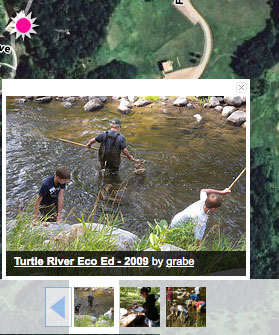
googlegpsmap

The results are impressive. Here the position of the image (the pink dot) is positioned on the “hybrid” view of the map within Flickr.

It does make sense that you would not want the location of every image you upload to Flickr to be available to the public. Here is the technique I discovered for entering the same precise information for individual images.

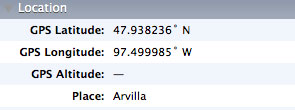
I keep my images in iPhoto. You can connect images to a map location within iPhoto, but it is a little difficult to find the actual coordinates. Under the “photos” menubar heading, there is a feature “Show extended photo info”. This opens an information window that contains location information.

locationinfo

You then use the “add to your map” from the appropriate image in Flickr and enter 47.938236,-97.499985. The image will be added to your flickr map.

Loading