Hobby Coder

I enjoy writing code. I have developed the tools I use in my research and I have created some other products I think are useful. The problem I have is keeping up.

Back in 2006, I took an open source, social bookmarking product and added my own modifications. I wanted to create a service that prioritized search suggestions. So, I extended the social bookmarking product by adding a system that counted the number of times suggested links were followed and also allowed users to rate the value of sites they visited. These data were saved and search results were ranked by a combination of these data. My little project continues to be used by those who find it and I was even asked for my code.

Time passes and technology projects age. The original Scuttle was upgraded to Scuttle Plus. I have no idea if any of my code ended up in this project. One of the problems with making your own modifications, especially to projects that involve a database, is that you cannot easily take advantage of upgrades to the “official” project. When improvements have been made by others, merging your modifications with an improved product means you have to carefully go through the new product and understand how the code has changed, determine if the modifications you made can be inserted in the same way, and consider whether changes in database structure require some other modifications. To tell the truth, I forget where in the code my changes even are. So, I am stuck with my 2006 era code.

One thing I came to realize is that my ranking scheme is confounded with time. Some records have been in this database for four years and have accumulated more hits (on average) simply because they have been available longer. This confounding increases in severity because older records are then displayed first and the suggested links followed more frequently. This results in suggestions that may not be suited to current interests. The ratings feature worked great and could potentially counter balance the time confounding problem, but I had to protect the opportunities to rate sites behind a password system. Scuttle was fairly open as I guess a social bookmarking site should be and I began to encounter trouble makers who added inappropriate content. Can’t have that if you hope to offer a service to educators. By limiting inputs behind a password system, you seem to discourage raters. Works great, but too much trouble to use.

Counting the number of times a link to a recommended site is followed does not create security problems and I am attempting to generate a system that would weight popularity by time. I suppose I could create a variable that continually divides the number of hits by the number of years a link has been available. There must be a way to make use of the information in the tens of thousands of times links have been explored from this site.

Maybe I will just wait until summer and then take a look at modifying the official upgrade.

Loading

Why is it always STEM?

It appears that the math, science, and technology folks may be able to cash in on the vague connection between the competitiveness of the U.S. economy and education (see Washington Post article). I would ask the same question of this initiative that I would ask of the focus of NCLB – why the narrow focus? Why not just take as a starting point that K-12 is probably grossly underfunded or is functioning poorly no matter what the content area? What not give increased attention to reading, writing, general health, languages, etc.

As a college prof, I do not actually have a dog in this fight (or whatever the expression is), but I am interested the preparation of K-12 educators and I also have some thoughts on claims made regarding an emphasis on math, science, and technology. In part, I am reacting to claims made by supporters (e.g., Eduflack) that to me seem over the top.

Just a couple of comments rather than a full analysis:
1) I would suggest that while the concern that all students develop problem-solving skills is certainly valid, the notion that a given content area offers the best area for developing such skills is unsubstantiated and likely rejected. My understanding of the position of cognitive psychology is that problem-solving is fairly domain specific. For example, if high school physics or calculus does develop problem-solving skills, these skills do not necessarily matter in other areas of human endeavor.
2) I am of the opinion that the skills that actually place a country in a more economically competitive position come out of the college setting rather than the high school setting. This is a derivative of my more general concern that economic development is only one of many goals of K-12 education. For those going on to college, the question of what best prepares students for college may be quite different than how can we improve STEM.
3) I have little perspective on international economics, but if I were to increase the emphasis in any given area at the K-12 level with regard to this focus it would likely be language skills – both reading and writing in English because of the feed-forward advantage moving into higher education and a PROFICIENCY in some other language. We tend to envy the emphasis on math and science we see in other countries. My wife who has a great deal of international experience makes another point. I think she would suggest that what we miss in this focus is that these same kids in these same countries are Skyping with kids in our classroom. In her most recent experience, the Russian kids are speaking English. Do you think any of the U.S. kids are speaking Russian?

Loading

A commitment to 365 days and at least 365 pictures

Year end always brings goals and resolutions for the year to come. The goal of taking and sharing a picture a day received some attention within this general discussion and Cindy thought it sounded interesting. We have made the commitment to give it a try.

As I thought about the concept, it occurred to me that I had encountered it before. Under my coffee table (now the table in my office that holds my Tivo, AppleTV and HD TV) is a book by Jim Brandenburg – Looking for the Summer. I think of Brandenburg as the nature photographer from this area famous for his wolf images, but this book is a one picture per day thing. I thought the book was based on an even more challenge premise – take only one photograph per day – but in rereading the Intro I learned that this was an earlier Brandenburg book – Chased by the light. I remember that self challenge and have always been impressed. Impressed, but not sure that I exactly understand the point. Perhaps it involves a personal commitment to perfection. My personal standards are not so high. I find life with all options available, even some second takes, about as challenging as I can handle.

Then, I remember seeing a news story about a photographer, a college prof if I recall correctly, who walks to the same location each day and takes the same picture. I also tend to remember this as a Minnesota photographer. I tried to find this collection online and failed. Perhaps someone will recognize the individual or can identify a related web site.

The 365 photos project (there seem to be several) is presented in several ways. Version 1 – improve yourself as a photographer. Version 2 – reflect on or photoblog your life. There are perhaps other foci as well.

Here are several web sites on the concept:
Photojojo 365 Project
365 Project
Flickr Project 365
Lifehacker Description (this is the source I reviewed)

There must be some interesting educational versions (e.g., Middle School Matrix, CogDogBlog). Perhaps a photograph from each school day. Seems like this is a little different than a photoblog. Instead of “here is something interesting I encountered”, think “this is what was interesting today”. Perhaps this is about realizing that there are interesting things around us at all times. Isn’t that what good photographers are able to show us? Things that we see, but don’t really SEE.

Our own plans are still a little sketchy and I not sure yet how we will format our final version. We are presently just uploading images to my Flickr account and attaching the 365 tag. Our personal rules are simple – the picture must be taken on that day. I think “taken” is close enough for me. If necessary, I think I will let upload and annotate slide a little. So far, three days and three images. I wonder how long we will go before we forget? Will I get out of bed when I remember and trudge outside in the snow to find something I can photograph with my Blackberry? Actually, this may increase the likelihood that I will carry my phone with me a little more. We will see.

Loading

What next?

I have been enjoying “end of” lists. We get a double dose this year – end of the year, end of the decade. Albums of the decade. Best apps of 2009. Best apps of 2009 for educators. I have purchased some music, but no apps.

It is also time for the brave among us to make predictions. I read Warlick’s post today. He found it easier to raise questions than make predictions, but did come up with a few prediction. He predicts the rise of augmented reality and the end of high stakes testing

Warlick does raise the Apple tablet as a possible wild card for the coming year. I have hopes for some device that will allow information consumption to be combined with the potential for information manipulation and production. Existing handhelds are either too small (ipod) to allow for efficient content production or are primarily intended for consumption only (e.g., Kindle). I think commercial educational resources suited to future interactive tablets will take on a format that includes a provided information framework, information options to allow for instructor/student preferences, and opportunities for students to contribute and interact in reaction to the contributions of colleagues.

Powered by ScribeFire.

Loading

Knowing when to give it up

I hate thinking about “what I used to be able to do”.

I used to be able to dunk. Now, I have trouble getting out of a chair.

I used to be able to run for miles (more like a fast trot). Now, I pace myself walking up multiple flights of stairs.

So, the physical capabilities are slipping a bit.

Age is supposed to bring wisdom (can’t remember which, but fluid or crystallized intelligence takes quite a while to drop off).

I used to be able to run my own servers (Apache, PHP, MYSQL, etc.) and thought it was great fun. I think I learned a lot doing so. Even if my time was not spent as efficiently as that of my colleagues who either let the pros do it or who did not bother to explore ahead of the pack, I still think it is worth understanding much of how technology does what it does. I sense this capacity beginning to slip as well. So many new concepts and so little time to explore. I hate having to accept it all as magic.

Today’s challenge is the following:

Fatal error: out of dynamic memory in yy_create_buffer() in /Library/WebServer/Documents/wiki/index.php on line 30

I am trying to set up Mediawiki to accommodate an activity I have in mind for my graduate educational psychology class and I get this error intermittently. I hate intermittent errors. They make no sense. Things should work or not work. I doubt the students I expect to use this wiki will accept “works most of the time”.

I have started to transition from operating my own servers to purchasing space on a server. Far less expensive if my time is worth anything. Select an application and it is installed automatically. No fooling around for a weekend to see if you can get it run. Where is the fun?

Still, if others depend on you, maybe  you must take the easy way out.

I’ll give it a few more days.

Loading

A Wonderful Life

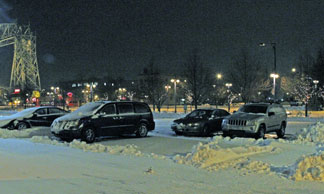
Cindy and I are spending the first part of our holiday in Duluth. We had originally intended to go to Iowa and then on to a cabin by a like in Wisconsin to spend the holiday with the majority of our family. The storm changed that. We headed to Duluth to get closer to Wisconsin and now it looks like we will be staying here a little longer than anticipated. We are nearly here by ourselves.

A opened my present from Cindy a little early (a 7D) and we have been taking some pictures. A new camera and a good Internet connection. What a wonderful life.

So, I have had some time to explore and I found a new server application from Google (flogr) that offers a new way to display Flickr pictures. Google writing applications to support Yahoo!’s flickr. I uploaded the files to my server and was able to get the application running (take a look). A hint – Previous and Recent tabs appear near the top of photos when moused over.

The 7D takes some great pictures even in the storm.

Happy holidays.

Loading

Final week and a comment on evaluation

So, it is final week and final week brings with it the intense focus on reading and grading that goes along with being a prof. I need a break.

I have been reading several books critical of the U.S. educational system, teachers, and how we were failing the business community, failing to prepare the younger generation to compete with the Chinese, Norwegians, or whomever and I was starting to get depressed. I would like to think of myself as a serious scholar and committed to preparing the next generation for their opportunity to make a living, have children, and think meaningful thoughts, but perhaps I have been deluding myself. By the way, I have started to dilute the depressing stuff with the book by Daniel Willingham and I am now less concerned about my world view.

Did you ever notice how Andy Rooney begins many of his 60 minute segments by asking did you ever notice?

Did you ever notice how multiple choice tests are often the culprit in the sad state of education? I don’t mean MC tests as in high stakes testing and NCLB, but multiple choice tests in how we focus far to much on memorization (actually read Willingham and note that the importance of knowing stuff is not necessarily an endorsement of rote memorization). Just so this post does not get out of control and I can get back to grading I will make two points.

1) MC test items are not equivalent to a focus on facts and knowing stuff (as if this were proven to be a bad thing).

One of my favorite things is to get into a discussion regarding cognitive skill hierarchies with someone (OK so this may not be one of your favorite things). I love when someone attempts to educate me regarding such hierarchies ’cause a) I can usually effectively demonstrate that alternative evaluate devices such as essay exams are typically focused on factual recall and b) because yes I have heard of Bloom’s taxonomy.

Regarding Bloom’s hierarchy – I happen to have one of his (with colleagues Hastings and Madeus) books on my shelf and because I am old I have actually read what he wrote in the original. In fact, if you are concerned with cognitive skill hierarchies, you might explore this book and consider the examples provided. It appears Bloom felt multiple choice items were an acceptable way to exemplify the assessment of cognitive skills above the levels of knowledge and comprehension. Many MC items are offered to help the reader understand the differences among levels of the taxonomy.  Hmm… who knew.

Point noted – what is possible is not necessarily what educators do. I agree. However, see my earlier comment regarding what types of skills that are tapped by the majority of essay items. Asking the student to list and explain the same three poinats you made in class is not higher level thinking just because the information has to be written in a blue book. I apologize for resorting to stereotypes – I know of no one who uses blue books.

2) Student reaction to different types of assessment and how instructors may adjust

I have been an administrator for more than a dozen years. I have been trying to think of any case in which a student came to me complaining about items on an instructor’s MC test. Honestly, I can think of no example. What I tend to field are complaints about the way papers, essay exams and presentations have been evaluated? Despite rubrics, it seems there are concerns about fairness and consistency. Just what is it that I should do in such situations? Should I attempt to score the various products to see if there is some pattern of bias? I love the complaints about the evaluation of presentations. What I have are the marked rubric and the student’s claim? An impossible situation to evaluate.

My point? I am not sure. I am just noting that students are more likely to complain when instructors make the effort to do what some argue is the only acceptable thing.

BTW – I have a similar position on developing “higher level” MC items (which I do when I work with hundreds of students at a time). Pretty much by definition, you have to use items that involve information you did not provide when you attempt to evaluate something other than retention. I am puzzled by the complaint that sometimes results from this – “you did not tell us that ….”. I try to respond consistently – “you are correct, I did not tell you that …”. I DO NOT explain that “If I told you that, this would be a recall question and I am supposed to be assessing your ability to apply, think critically, etc.”. I actually do explain that this is my intent at the beginning of the course, but when students are complaining about how my approach is unfair after the fact I tend to just listen.

I am of the opinion that students would not feel cheated if you were to ask them some obscure fact. Why – you could show them where the obscure fact was in the book and what could they say? That would be fair. Not particularly meaningful, but fair. There is some unfairness in asking questions that involve assumed background knowledge, awareness of the world, or awareness of what commonly happens in a work environment students are preparing for. This is not typically information provided in a courese.  I think of this as a sampling problem. I assume the general awareness that is necessary to respond to such “scenario” or application items evens out across items. I cannot deny that for any given item some students will be at a disadvantage. There are all kinds of sampling problems in education. What topics/skills did those three essay items that made up the final sample or miss? What skills did that oral presentation hit/miss?

So, assessment and the relationship of assessment to learning are complex issues and nothing at the surface level, in my opinion, guarantees success or failure. Much depends on the specifics of whatever assessment approach is taken.

Back to grading (essay exams)

Loading