I sometimes use a wiki in my graduate class. I call what I ask the students to do “public scholarship” – instead of developing content that only I will read, I require them to create products that will be available to other educators.
This semester I encountered a problem I think I understand but that has not been a problem before. Past projects have required students to develop their own portions of the wiki. This time, I divided students into 2-3 person groups and asked them to work together. What are the odds that in the time frame of a week two individuals will decide to connect at the same time, wait until they have entered a considerable amount of content, and then save? Evidently, the outcome is more probable than I would have thought. If the students would have saved it would not have prevented the problem, but it would have lessened the damage.
I run MediaWiki which I regard as a fairly sophisticated product, but I cannot think of a way of preventing this problem. A system would either have to automatically lock out a second user when someone had a page open or perhaps would have to rapidly update a common file after each keystroke.
If there is a solution to this problem, I would appreciate a note.
We are pretty much stranded today because of heavy snow. The Super Bowl will occupy my time later this afternoon, but I took the time this morning to read the most recent Kaiser Foundation Generation M study. The national survey study has been conducted every 5 years to track media use among 8-18 year olds.
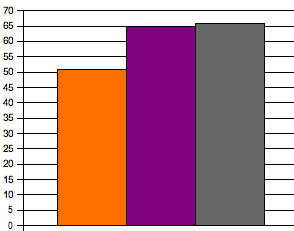
There are interesting data about just how much media young people consume, but I was most interested in the relationships between media consumption, academic performance, and psychopathology. The categories are crude (heavy, moderate, light media consumers; % earning mostly As and Bs), but those who consume more media tended to have lower grades and to exhibit more psychopathology. Certainly, one must be careful in jumping to conclusions about causal relationships (I tell my students this all of the time), but the relationships would be difficult to describe as desirable no matter what the direction or what additional variables were included as part of the explanation.
The authors generated these relationships for different media and the one media type showing a positive relationship was print. Young people who engage in more recreational reading seem to do better academically. The opposite appeared to be the case for television viewing, games, etc.
One of the other “hidden” issues in this study is the decline of recreational exposure to print media. In the ten years since the first study was conducted print media consumption has dropped from 43 to 38 minutes per day. Online print consumption does not make up for the decline in newspaper, magazine and book reading.
These trends and the relationship to academic performance parallel many of the issues raised in Bauerlein’s Dumbest Generation.
I see such findings as a challenge. For those who argue the benefits of games (e.g., Gee, Prensky), what is the counter argument? Hours on new media are increasing and the totals accumulated relate negatively to academic performance.
My academic upbringing left a residual of guilt. I think that was the idea. I don’t feel quite right when I advocate for something without being able to offer references and the references are much more heavily weighted if they contain a methods and results section. Else, how does one avoid the tendency of falling into the fanboy trap of advocating for the latest fad and falling for the attention that comes with promoting the new and exciting?
So, I struggle with what I should say about classroom use of participatory web tools. I look and I look and I find little that involves applied research. By the way, I don’t buy the excuse that technology moves so fast that research cannot keep up. This represents a position taken by those trying to quiet their own guilt. Try explaining such an argument to those grad school mentors who trained you. Try testing this position against the best practices of other fields. Think the medics you visit when feeling ill would suggest that you try a new, but untested therapy explaining that there simply hasn’t been time to evaluate whether the treatment actually works?
So, without convincing research offering evaluations of specific uses of participatory web activities, just what can I offer. My most recent focus has been on the literature evaluating the benefits of peer tutoring FOR THE TUTOR. Consider that classroom applications of certain tech tools might be represented as teaching others.
I think that “mature research” offers some interesting characteristics. Often, initial studies that hope to identify simple generalizations give way to studies that offer more sophisticated analysis. I link to think about the big idea studies and the follow-up nit pickers. Sometimes the sophistication seems annoying if you are seeking clear guidelines or simple recommendations, but sometimes the details are important. In this case, consider that teaching may be helpful in benefiting the teacher for several different reasons – e.g., knowing that you must explain something to others might influence your preparation, teaching others may provide feedback that leads to deeper understanding. My initial investigation of studies in this area leads me to the conclusion that “preparation to teach” offers fairly reliable benefits. I think this is helpful. As “assignment givers”, we might then consider what tasks involve the preparation to teach. There are questions to consider. For example, is a task that involves summarization the same as a task that involves explanation? What if explanation sets a standard for understanding that only some within a typical group can meet? Perhaps such questions give us a place to begin.
Coleman, E.B., Brown, A.L. & Rivkin, I.D. (1997). The effect of instructional explanations on learning from scientific texts. Journal of the Learning Sciences, 6, 347-365.
Topics I write about often seem to coalesce from active themes. I can kind of identify the sources for this post – iPad announcement, reaction to health care reform, and reading the first chapter of “Rethinking education in the age of technology”. The topic that emerged is – Time for subsidized wifi.
Components:
1) From Collins and Halverson – the claim that the education that occurs outside of school is changing and the related concern that those most likely to benefit are those who can afford the toys and the access
2) From the iPad – this appears to be a great tool (although pricey) for exploring and participating online
3) from health care reform – are citizens of the U.S. capable of getting beyond what they can do for themselves to consider what might be best to do for the country
I do think that learning outside of school offers significant possibilities, but the notion that “hand held” devices as they presently exist will change much ignores the cost of access. I always wonder when I listen to presentations about hand held devices why no mention is made regarding the monthly cost for a data plan. Sure, a proportion of kids of all backgrounds may carry a cell phone, but SMS is not going to get it done. Schools might provide the devices (see below – Cindy working in our kitchen), but who will provide the access.
I like the idea of public wifi as a government subsidized option (hence the reference to health care and what we are willing to do for each other).
One of the down sides of social media is that we have control over the connections we make. We tend to select sources that fit our own biases and while we assume the inputs we process are making us more knowledgeable, we may simply be becoming more entrenched in flawed positions.
I have summarized the comments of others on this topic in previous posts (e.g., Keen) and proposed that we all force ourselves to read different positions before we consider ourselves informed (e.g., Bauerlein). I still like the mental image of simultaneously watching Fox and CNN news.
I cannot remember exactly how I came by this resource, but I recently visited Political Compass and completed the instrument supposedly designed to reveal my political “leanings”. The concluding representation was pretty much how I would describe myself without going through the process. A bit of a liberal supporting individual choice. Still, not that far off center. Hence, this blog originates from such a perspective.
Maybe all bloggers should provide such information on “personal perspectives”.
I do think it a concern if online services could connect such data (and responses to individual items) with any individual. I am willing to share, but the instruments asks some specific questions in order to arrive at this more global representation. As a university affiliated researcher, I know the safe guards institutions require before they will let a research collect data. The Political Compass claims that no personal data are retained (no login is required, but an IP could potentially be stored), but does warn that a Facebook app collecting similar data does not offer the same assurance.
This technique involves the inclusion of special markup that is called by the plugin (see above with last part of the document ID obscured for security). The technique works, but after experimenting, I now consider it more appropriate to WordPress pages more so than blog posts. The one situation I can think of that might relate to blog posts would involve making groups responsible for posts to a protected blog. The blog administrator could share a Google doc with specific individuals and establish a link from different docs to a post in WordPress using the unique document IDs. This still would seem a more likely page than post technique.
I was taking pictures as my grand kids opened their Christmas presents. Our two and one-half year old granddaughter received a Dora camera. My son gave a quick tutorial on taking pics and off she went. Maybe she just liked the flash. She aimed her camera at me and I reciprocated. My son must have off-loaded her pictures, because the following image arrived today.
The following was my perspective.
There is always a debate regarding when children should be exposed to technology and how much time they should spend. Wouldn’t it be cool to just let young kids take pictures of their world. I wonder what they find interesting? They may wonder the same thing about us.
Manage Consent
To provide the best experiences, we use technologies like cookies to store and/or access device information. Consenting to these technologies will allow us to process data such as browsing behavior or unique IDs on this site. Not consenting or withdrawing consent, may adversely affect certain features and functions.
Functional
Always active
The technical storage or access is strictly necessary for the legitimate purpose of enabling the use of a specific service explicitly requested by the subscriber or user, or for the sole purpose of carrying out the transmission of a communication over an electronic communications network.
Preferences
The technical storage or access is necessary for the legitimate purpose of storing preferences that are not requested by the subscriber or user.
Statistics
The technical storage or access that is used exclusively for statistical purposes.The technical storage or access that is used exclusively for anonymous statistical purposes. Without a subpoena, voluntary compliance on the part of your Internet Service Provider, or additional records from a third party, information stored or retrieved for this purpose alone cannot usually be used to identify you.
Marketing
The technical storage or access is required to create user profiles to send advertising, or to track the user on a website or across several websites for similar marketing purposes.








You must be logged in to post a comment.