Am I getting credit for this?

Cindy recently relayed to me a post from the IT forum regarding blogging (and I assume other forms of online expression) and whether such activity should count for anything among those of us who are college academics. This got me thinking. I have blogged since 2003 and authored content for pubic consumption before that. Sometimes I did the latter because of funding I had secured (I was lucky enough to be in on a Technology Challenge grant many years ago), but mostly I wrote and still write as a hobby. Perhaps I should now argue for compensation. I also serve as a department-level administrator and I deal with contracts and expectations on a daily basis. I have listened to many arguments related to what faculty members would like to receive credit for doing. My point? I can imagine myself dealing with this topic from several perspectives.

First, here are some of the links referenced on the listserv and on linked blogs:
Hastac
Virtual School Meanderings

My reaction as blogger:
If I were to attempt to make a case for my online content as part of me job, I think I would argue that it would be part of my service or perhaps part of my teaching (as professional development). I think some of the things I have read (listed above and comments to those posts) reach the same conclusion, but then note that this does not really count for much. I work (except for my administrative responsibilities) in what is pretty much a 60, 30, 10 model (teaching, research, service). Most of the evaluation for teaching relates to what I do with students and very little to my own efforts at professional development. I don’t know that I even bother to list professional development activities (what I read, time spent at conferences, etc.) when I list my annual activities. The 10% for service also gets broken down and variability from one faculty member to another is some fraction of 10% amounts to very little difference in the annual merit evaluation and certainly little toward major decisions (tenure, promotion).

I do not regard my activity as research and I have reviewed very little online that I feel should qualify. I am an educational researcher by profession and my research activity is assumed to be based on data that I collect. I publish formal papers based on these data and my analysis. Writing in reaction to what I read elsewhere is just my opinion and not research. My opinion may be worth something because of my personal experiences, but offering such opinions would be public scholarship as teaching or service and not research.

My reaction as administrator:
When we hire individuals we make a good faith effort to explain the type of program we are and the type of activities we expect of those we hire. Certainly, this is what we expect of individuals in evaluating them for tenure. If individuals decide they would like to spend time in creative ways after tenure, we encourage such behavior (I think the faculty handbook says 20% of effort) but what one does with this 20% does not guarantee anything when it comes to merit. I guess my point is that it is possible that offering “information” to the public in the form of blogs or other unmoderated content could be of value if an institution say offering such information to be part of the institutional mission. I think you ask this question before accepting a contract and not argue about expectations later.

If a blogger (or writer) can make some money I think we accept this as part of the 20% allowed for such activities.

Powered by ScribeFire.

Loading

Flashcards

I have an assignment in my Educational Psychology class that asks each student to try and then evaluate a study strategy. I offer a list with some options and allow students to add their own. Past experience has demonstrated that the students gravitate toward a limited number of options. I now require students to register their selection with me and I cut off an option after it has been selected by 10 students. I want to create a situation in which we have some different options to discuss.

The most popular choice this semester was note cards (flash cards). So much for trying something new. It has always struck me as a little sad that advanced students seem focused on memorization. Perhaps they see the challenges of exams differently than I do. I think I am asking them to demonstrate or apply, but they see the most immediate challenge as recognizing key terms in the questions. Perhaps they feel that once they can translate any unique terminology, the rest tends to be easy. So, I have mixed feelings about this post. Here, I offer a suggestion for a “better” flashcard system. Clearly knowing some things is necessary, but we hope students make the investment to do more.

Handheld devices (phones, iPod, iPad) offer a convenient technology by which improvements to note card flashcards might be accomplished. I see I generated a post in 2008 describing flashcard apps for the iPod Touch. Cindy has been exploring newer flashcard systems for the iPad so I purchased a few myself and spent some time during the football game exploring. My favorite ended up being Flashcard Deluxe. I purchased the version I used to generate the screen captures, but there is a lite version you might explore.

Technology offers the opportunity to improve the traditional flash card experience in several ways. The advantages I describe are available in my recommended app, but may not be in alternatives.
1) A device-based system can collect data on performance. With Flashcard Deluxe, the student determines whether a response is correct or not (actually a three level system is available – strong answer, moderate answer, poor answer) and this delineation can be used to change the probabilities of seeing an item again.
You swipe a different direction to indicate which best represents your answer. Items can also be categorized. The self-scoring system also allows the question types to be varied – you could use multiple choice, but why not use open ended questions. Just creating the questions and responses is likely a valuable learning experience.
2) A device-based system allows multimedia. My daughters were heavy flashcard users because of the types of content they studied to become a physical therapist and an occupational therapist. Cindy did get the youngest to use a technology-based system. I don’t know if they would have sketched representations of the things they studied or not. How do you study musculature and the skeletal system with terms and definitions?
3) A digital system allows the accumulation and sharing of content. Flashcard Deluxe allows sets of flashcards to be downloaded from Quizlet and from a collection accumulated by OrangeorApple (the company responsible for Flashcard Deluxe). A student or group of students could create and share study aids.

A couple of screen captures:

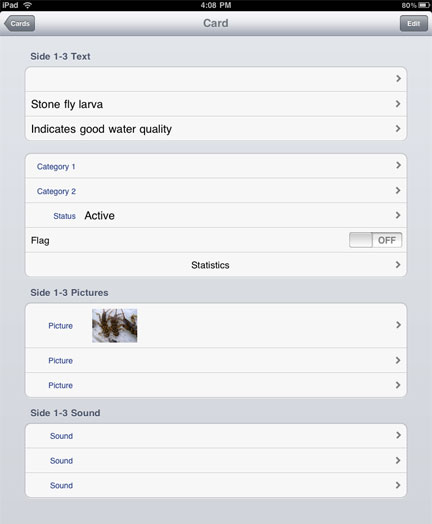
This is the card that allows the creation of a given flashcard. There are three sides – a question, the answer, and other info. You do not have to use all three. In the following image, you can probably figure out that the question is really an image (the picture), the second side is the name of the organism, and the third side provides some additional information. I was a bit lazy in generating this example. You can include a lot of content on each side.

So, this would be the “question” side of the card.

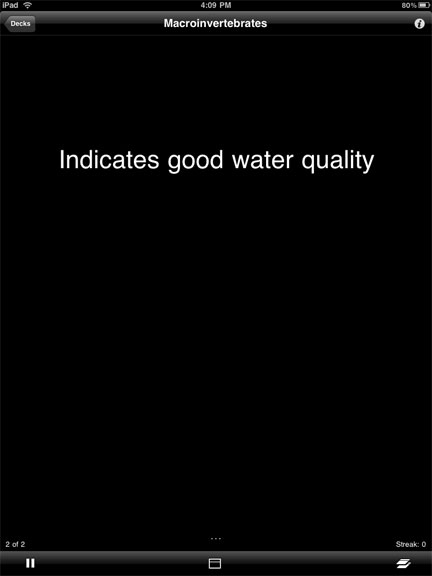
This would be the third side (in this case, the deck was intended to be a collection of macroinvertebrates that indicate good or poor water quality).


Powered by ScribeFire.

Loading

Why proven ideas are not used

I don’t focus on the research literature on this site, but I want to make an exception. I encourage those of you interested in educational research make the effort to read the article by Rohrer & Pahler in the June/July issue of Educational Researcher (2010, 39(5), 406-412).

The article argues that researchers have made a number of concrete suggestions that would improve student learning and that these suggestions are often ignored. The three examples offered include – learning through testing (increasing retrieving), spacing of practice, and interleaving. These examples were selected because the basis for the suggestion are quite solid AND because the suggestions are about studying differently rather than studying more.

Perhaps the most interesting part of the review was a speculative addition at the end of the presentation which asked the question “Why are inferior strategies so popular?” It is this focus I think should receive wider consideration because it may extend to many current topics in education. The authors pose the question in an interesting fashion. Since some of these suggestions could have developed as common practice simply as a function of student trial and error, why do students typically spend their time in inferior strategies? Remember these proposals are about a different way of doing things and not about the expectation that students spend more time. The authors suggest that these strategies tend to produce a higher error rate during study which may be more discouraging for students. It appears students prefer passive strategies because there is less challenge to their illusion of understanding. I wonder. Perhaps students do understand that a technique is less effective, but still persist because it is what they know and it is easier.

Powered by ScribeFire.

Loading

Multi-Taskers? Not really.

I had my educational psychology class complete a short in-class writing assignment related to the topic of working memory and multi-tasking. I originally had no specific motive beyond getting them to apply some of these ideas to their own experiences and so I asked them to write about listening to music while they studied. There were some specific prompts, but this was the general topic. I have read so many who claim younger folks are multi-taskers and prefer this or that environment for learning that I guess I was somewhat surprised with how the students responded.

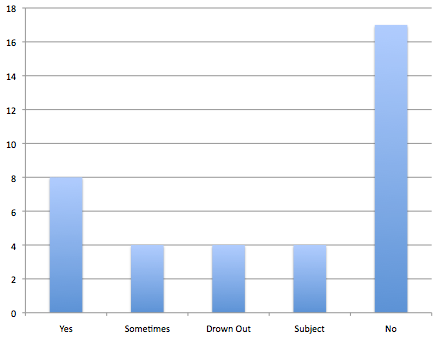
After reading the responses, I created a simple way to organize what I thought each student had said and I came up with this distribution. If one combines the students who say they listen to no music with those who say they use music to mask out other sounds, it would be pretty difficult to argue these students must multi-task.

I did encounter some interesting comments regarding musical tastes (what works while studying) and when music is helpful and when not. Avoid popular music with lyrics (one student claimed to listen to game tracks). Music while writing and working problem sets (math, chemistry) seems workable, but do not try to listen to music while reading.

Of course, there were some who say they listen to music constantly, but the point is these individuals were not typical. Sometimes I wonder about the methodology used by those who attempt to make the case that learners are changing and educators need to take notice and make adjustments. What I did was quite informal as far as research goes and not really designed to test formal hypotheses, but the typical student in this group is not a multi-tasker.

Loading

Shutterfly Classroom

I have been wanting to explore Shutterfly for some time, but because I pay for a Flickr account and have spent considerable time with Picasa, it seemed like just one more version of what I have been recommending. In the back of mind what I knew was unique about Shutterfly was that while it was a photo sharing site it also offered a way to offer general web content. This struck me as an important distinction.

A few days ago I came across this strange post on MarketWatch (strange because MarketWatch is not exactly the place I search for ideas for the classroom). The business oriented post that includes the present stock market value of Shutterfly explained Shutterfly’s effort to offer classroom web sites. The article explains that parents would like to see images from the classroom and from student field trips, but providing such images is difficult because of security concerns. So, Shutterfly has offered a version of the tool allowing the creation of web sites to meet this and other classroom to home communication needs. The classroom web sites are by invitation only which is the way the teacher or a parent volunteer controls access. While Shutterfly’s main business model is printing user photographs in various formats (images, calendars, photo books) and photos are clearly what Shutterfly does well, the template and modular-based approach makes it relatively easy to create an impressive site.

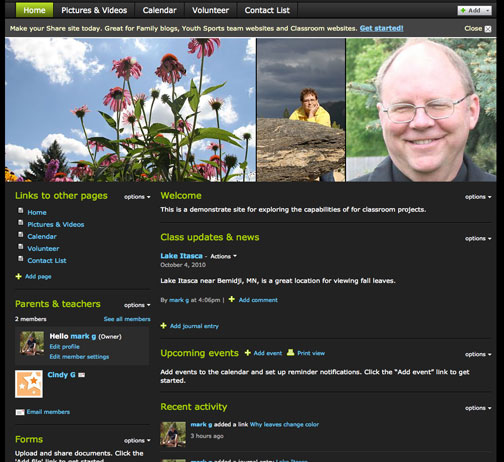
Main web page

Shutterfly album

Powered by ScribeFire.

Loading

Missing data

I read a recent post from The Blue Skunk Blog that is evidently a repost. I actually think I remember the original post and belief I responded to that post as well.

Johnson states – I would find standards in the following areas extremely helpful as I try to evaluate our district’s technology infrastructure and plan for improvement :

  • 1. Connectivity (LAN, WAN, and Internet I & II capacities)
  • 2. Security (firewalls, filters, policies)
  • 3. Tech support (technicians per computer, tech support response time, reliability rates, policies about technology replacement,)
  • 4. Administrative applications (student information systems, transportation, personnel systems, payroll systems, data mining systems, home-school communication systems, online testing)
  • 5. Information resources (e-mail, mailing lists, blogging software, online learning software, commercial databases, library automation systems)
  • etc.

As I understand this portion of Doug Johnson’s post on standards, he would like to know just what resources schools should have available in order to provide effective educational experiences for students.

I develop resources to prepare future teachers and part of what I attempt to do is to offer descriptions of the situations they may face in the schools they will eventually enter. My interest is in the variability in such situations. Perhaps this is also what Doug Johnson is looking for – what are the standards that educators should be able to expect and what are the typical means and standard deviations for some of these indicators. In other words – how does my school compare, what should be expect to be able to provide?

I think locating good data on technology in schools – what is there and how it is used – has become increasing difficult. I know that good data on what technology exists is there, but these data are collected by businesses that intend to sell the information to vendors. I can’t afford access and evidently neither can the libraries I use. I used to use the National surveys conducted by Henry Becker and the Technology Counts annual publications to locate such data. Technology Counts abandoned the state to state comparisons. Perhaps some states were embarrassed and resisted offering up information. The vast differences among the states was pretty clear evidence that students had very different experiences.

I am thinking researchers found it difficult to secure funds to actually conduct quality surveys and this has cut off on-going, independently collected descriptions of what is typical in this area. The best resource I can find is offered by the National Center for Education Statistics (Teachers’ Use of Educational Technology in U.S. Public Schools: 2009 ). Still, even on the descriptive level, I do not think the data are complete enough. Wouldn’t you like answers to some of the descriptors Johnson identifies?

Loading

Which end of the pool?

Which end of the pool? This is a question that occurred to me because of Carr’s book “The Shallows“. This book seems another example of a new genre which seems to imply that most of us have a tendency to turn potentially useful opportunities into experiences focused on immediate gratification and in the long term diminish our cognitive potential. Other examples – The dumbest generation; Infotopia; iBrain. If these books do not interest you, try Carr’s original article in the Atlantic. Carr and the others are proposing that our use of the Internet has changed the way we prefer to take in information perhaps at the biological level. Even though the potential might be there for deep contemplation, the experiences we select tend toward brief encounters. We have lost the ability for prolonged focus as might be the case when reading a traditional book.

I have been trying to write today and in preparing I have been reviewing data on how adolescents use the Internet. For years I have followed what some have called the participatory culture. The generative potential of media creation seemed to have great educational potential. However, recent data appears to indicate that the style of participation is drifting toward the shallows. For example, the most recent PEW data on social media and young adults indicates that the proportion of young adults who blog has been halved between 2006 and 2009. Use of Twitter started slow, but has begun to increase in this same age group.

If we are models for the use of technology are many of us being sucked into the same pattern? Perhaps it is too easy to get into Twitter and stop blogging. Perhaps many folks just pass resources around with few actually reading the resources. Hard to fake it when you attempt to author in long form. Pretty easy to assume you have accomplished something when the system limits you to 140 characters. Here – you read it. I don’t have time.

Powered by ScribeFire.

Loading