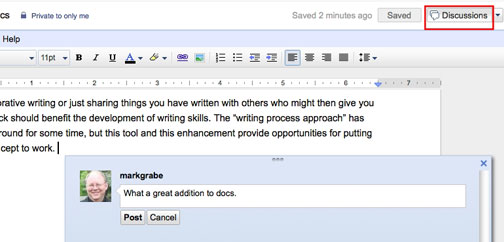
Google has improved the commenting system available in docs. You can now carry on a discussion with collaborators while working on a document. The feature should be available now, but you will not see it (red box in image shows the way to access the feature) unless you create a new document.
This would seem an effective way to leave comments an author might either implement by changing the document or respond to as part of what Google would like to call a discussion.
When we write about potential projects for the classroom, we typically like to use local examples from teachers we know. It seems a good strategy to assure practicality. Sometimes we have something in mind and simply cannot find an example. When this is the case we like to experiment with the tools and techniques ourselves. We learn a lot and have a sense of the options that would be available for teachers.
So, we have been thinking about the GPS as a way to “fit information to location” (just made that phrase up but I like the way it sounds). Geocaching would be a possible example but we wanted something a little new. Cindy came up with the idea of mapping local historical sites. I was going to map houses for sale in the neighborhood. I liked her idea better.
A little Internet research revealed that a list of sites, addresses and GPS coordinates already existed. This made the activity pretty easy – I had hoped I could find a list of locations by address and we could then find the GPS coordinates to see if we could map buildings to Google street view. I guess you would not have to give out the coordinates.
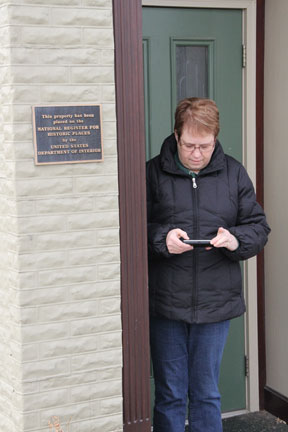
We located buildings using the maps available on our cell phones and with a Garmin Nuvi 1300 I received as a Christmas present. This Garmin can be used in a vehicle or on foot. The plan was to locate a building, switch to “where am I mode”, write down the coordinates, take a picture of the building and then put everything together once back home.
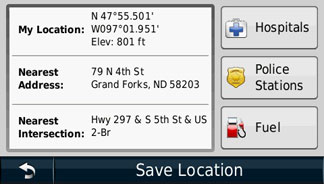
We learned something quite interested about the Nuvi by accident – it is capable of screen captures (also storing personal photos just in case anyone could possibly think of a reason for showing family photos on his or her GPS).
So, one of us would walk up to a building a record the coordinates by taking a screen shot.
We would take a picture of the building.
We would store the coordinates using the Garmin Nuvi.
Now, you can use the coordinates above to see how well this works. Enter 47 55.501 – 097 01.951 in Google maps (see this GPA converter to understand a little more about GPS coordinates).
I had to spin the street view around –
But there was the same building I had recorded with my own camera.
BTW – the link to buildings on the list of historic places also provides access to information about the history of building. I would certainly have students read this content and also take additional photos to represent features of the buildings identified in these descriptions.
According to the documentation included with the request to declare this building a landmark:
Architecturally, this building is an outstanding example in original condition of the turn-of-the-century brick commercial style with classical detailing. Although architectural plans could not be located, the building was most likely designed by John W. Ross or Joseph Bell DeRemer, both of whom were practicing in Grand Forks at the time and actively designing commercial buildings in this style.
We did test this system in a way that involved a little more risk taking. We drove 40 miles into the country using GPS coordinates searching for a round barn (#17 on the list of Grand Forks County sites). But, that is another story.
Cindy and I had a brief argument over coffee this morning. It turns out I had skimmed an editorial in the GF Herald (I mean, really, who reads the Herald carefully). The source was an opinion piece written by Tom Dennis concerning the differences between the way North Dakota and Wisconsin have addressed teacher concerns (my comments on teacher unions can be found elsewhere). Dennis makes the point that ND continues to allow public sector unions to exist. This is what I focused on and probably the point at which I went back to reading on my iPad.
She was right – the Dennis position is a little convoluted, but here is the next section that I did not read carefully enough:
Because North Dakota law keeps public-sector unions comparatively weak. That has kept public-sector wages and benefits, including pensions, below the national average — sometimes far below.
And that, in turn, has kept the heat of resentment against the public-sector workforce and state government turned down very low.
…..
Because North Dakota voters still think they get value for their tax dollar. And it really is as simple as that.
Let me begin with this – imagine yourself trying to process this as a college student with some academic talent. Is this the kind of message that would encourage you to focus on education as a career and on North Dakota as your destination?Imagine trying to process this as a parent of a college student knowing your kid has the aptitude to do well in whatever major he or she decides to pursue.
Imagine this when applied to another profession that draws on students with comparable service-oriented values – “come to North Dakota, we pay our nurses less.”
So, the issue with teacher salaries is not just that the salaries can be poor, it is also about the public attitude toward those who teach. I encountered this post from a well-known education blogger in Texas. This is what I was reading on my iPad.
How about this – tell a teacher you are sorry we take advantage of them. Use “we are cheap” as an excuse if you can think of nothing else.
This is the video that started me thinking about about open source textbooks. In trying to determine if David Wiley had more concrete recommendations on this submit, I was able to locate his site. There I found links to several businesses focused on open source. Note – open source is not exactly the same as free. I was most interested in Flat World Knowledge. For purposes of evaluation, I looked for psychology and found an Intro Psychology book. I happen to be teaching this college course at this time.
It appears that this is a scribd publication – the pdf version bears this label. The author makes some money if the book is printed or purchased, but not viewed online – I assume the same is true for the distributor. I was interested in cost – $2.50 to print a chapter, $25 to print the book, $35 to purchase a black and white version, $25 for the ebook version.
So, just some thoughts. I am assuming this resource is of equal quality to the text I am presently using – hard to say if this is true and I am betting the established authors are still going with publishers. I use a custom print from Cengage that contains 10 chapters. The $200 figure Wiley quotes must be for books in chemistry or something. I think most educators realize that a $200 book cost would statistically atypical. Because I will use the Intro text I assign again, the student can sell this book back for half value. The students this semester are using a new black and white custom printed book for a little over $50 (actual cost after reselling). See my post on the “beer money ploy” for an explanation of how to interpret the real cost of textbooks. So, my interpretation is that the real cost comparison would be $35 + postage vs. about $50 at bookstore with return (I am assuming there is no practical way to return the $35 version for half your money back).
What would it cost the student to self-print? Not sure – I can’t really tell how many pages would be generated. That would be $25 + cost of printing. This has to be more expensive than purchasing the book for $35 unless you actually do not pay for the paper and printer supplies.
I think the ebook version might be a good deal. There does not seem to be much of an advantage for printed versions. The real cost savings here is to view the content online. Of course, the author gets nothing in this case and must hope that most students will opt for a print version. There must be data on viewing vs buying. It would be nice if these data were available. What do you think would happen if the online viewing option was not included?
Perhaps some of these numbers will be helpful. I think my numbers are realistic and take into account several variables that are typically not included.
I have been thinking about doing a couple of posts focused on educators assumptions regarding the cost of instructional materials. So, in the spirit of using someone else’s work to create the background for our discussion, I would like you to read this NY Time article by David Carr. The author describes the sale of the Huffington Post to AOL for a reported $315 billion. The post is partly about who generates the content. The short version – much of the content is generated by bloggers who receive nothing. They are kind of upset.
The funny thing about all these frothy millions and billions piling up? Most of the value was created by people working free.
Most of the news on the site is rewritten from other sources, then given a single link to the original. Many media companies, used to seeing their scoops get picked off by HuffPo and others, have decided that legal action isn’t worth the bother. They might feel differently now.
First, I understand the reaction of the bloggers. Second, this notion of not understanding the difference between original sources (not necessarily primary by the normal definition) and rewriters needs to be appreciated. This is clearly a continuum, but where along the continuum the content you want to consume is located should be a significant issue.
Back to the issue of the bloggers – the individuals who really built the reputation of the site, not the infrastructure, were mostly people contributing their labor for free. So, why if they did what they did without compensation are they upset. One of the problems with free is that others seem to assume they have a right to decide how free will be used.
BTW – just in case you think my reference to the Carr piece represents some form of hypocrisy , I would encourage you to investigate the micropayment plan available through Readability.
I will get around to explaining the title near the end of this post.
In my previous post, I introduced an interesting idea I read about in MacWorld. The MacWorld article described a new service, Readability, and interesting mechanism for supporting content creators proposed by the company that created Readability.
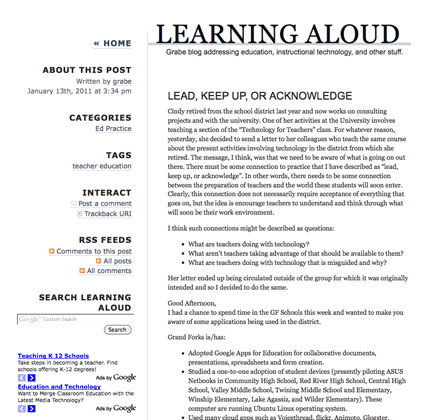
So many of us make heavy use of products that organize and archive online content created by others. We use tools such as Diigo, Evernote, my current favorite Instapaper, or similar products to organize and archive resources. In a way, Readability does the same and is very much like Instapaper. It identifies the core content on a web page and archives this content without the “clutter” surrounding the content of interest. If you compare the following two images (reduced in size), it is pretty easy to see what I mean by reducing clutter. The core content is certainly presented in a way that is more readable.
What the developers of Readability noted was that what I have described as clutter may contain things, such as ads and links, the authors of content want you to see. Much in the same way we may skip over the ads in television content by using a TiVo or similar recording device, we have access to tools that allow us to ignore services that content developers may be counting on to support their commitment of time. The Reading people have proposed an alternative funding model. You put in $5 a month (or more). The money is collected by Amazon. The company creating Readability keeps 30% and distributes 70% to participating content providers. So, if you few the full pages you see the ads. If you avoid the ads by using Readability and sign up for “the plan”, you contribute with clicking through ad links.
So, I am giving it a try. I have committed my $60 AND I have signed up as a content provider. It is kind of an experiment. I wonder if this idea will go anywhere. It assumes people will be willing to make a contribution to support online content. You get to see how your $3.50 is allocated each month. I think it will be interesting to see who participates.
I am thinking it must be very early. The Readability web site describes apps for mobile devices and as far as I can tell, these apps are not yet available. There is also a predicted collaboration with Instapaper that I think has yet to actually be put into play.
Back to my title. I am coming to the conclusion that “the short form” is not enough. By this I am making a distinction between blog posts and books, between conference keynotes and courses, etc. I am certainly not implying that posts and presentations are not interesting or useful, I am suggesting that they are not sufficient as educational resources. We have access to the stuff that is relatively easy to create, but not to resources that offer the big picture and tie things together. It takes far more work to offer long form content and this is what I am predicting we lose when we ignore and even circumvent ways to encourage author/developers to focus their time on larger products.
To provide the best experiences, we use technologies like cookies to store and/or access device information. Consenting to these technologies will allow us to process data such as browsing behavior or unique IDs on this site. Not consenting or withdrawing consent, may adversely affect certain features and functions.
Functional
Always active
The technical storage or access is strictly necessary for the legitimate purpose of enabling the use of a specific service explicitly requested by the subscriber or user, or for the sole purpose of carrying out the transmission of a communication over an electronic communications network.
Preferences
The technical storage or access is necessary for the legitimate purpose of storing preferences that are not requested by the subscriber or user.
Statistics
The technical storage or access that is used exclusively for statistical purposes.The technical storage or access that is used exclusively for anonymous statistical purposes. Without a subpoena, voluntary compliance on the part of your Internet Service Provider, or additional records from a third party, information stored or retrieved for this purpose alone cannot usually be used to identify you.
Marketing
The technical storage or access is required to create user profiles to send advertising, or to track the user on a website or across several websites for similar marketing purposes.



You must be logged in to post a comment.