Trolls and Mutually Assured Destruction

Educators may have limited awareness of the patent battles that now plague technology industries. Everyone seems to be suing everyone. Educators are more likely to be aware of copyright. They tend to understand that the whole sale duplication of content generated by someone else (music, text, video, images) is prohibited. What you may also recognize is what you can do. Perhaps you have heard this described as you cannot copyright an idea. Hence, you cannot copy and distribute what I have written, but you can identify key ideas in what I write and express them in your own words.

The problem with patents appears that you can protect an idea and the idea can be expressed in vague terms. A great piece on this problem has been generated by This American Life (listen or read). The concern is that common functionality of most Internet and phone functionality is described in these general patents even though a general function can be accomplished in many different concrete ways (kind of the opposite of copyright). Supposed to be a breakthrough and not necessarily a common sense good idea. Supposed to be. In other words, an invention and a patent are not necessarily the same thing. For example you might be surprised to learn that a 2000 patent for thermal refreshing of a bread product could also be described as “toasting” or perhaps “microwaving” (an example provided the This American Life). Clearly, multiple ways for refreshing a bread product predated the patent.

That battles among major companies further complicate the patent problem in a different way. They did not necessarily contest a given patent but purchase a huge collection of patents themselves in order to attack any company willing to challenge what they are doing by claiming the complaining company violates a different patent that they hold. It is not even about attempting to get to the point of understanding true ownership, but a threatened battle of attrition that mostly benefits lawyers and mostly fought based on the patent portfolios of the various companies. This situation is sometimes referred to as “mutually assured destruction”.  So, with many ambiguous patents that can be picked up by the thousands if you have billions, you can basically keep the other big companies at arm’s length, but threaten or force any small company out of business.

It is pretty difficult to interpret this situation as protecting the rights of inventors, bettering the economy, or assuring that consumers have access to the best products and services possible. Like the lack of regulation that led to the recent stock market and banking crisis, this seems to be a failure of oversight that would seem best placed under the control of the government. There appear to be secondary businesses that built on the need to protect the legitimate rights of inventors but rather function primarily to take advantage of broad patents to make money for the companies rather than the inventors.

Example of technology patent battles


Loading

Professional < > unbaised

A recent interview by Steve Hargadon (Future of Education) featured Douglas Rushkoff (Program or Be Programmed) (also see this etsy post). The simple version of the message, I think, is that we should participate now to shape how our digital tools are used because these tools will end up defining our future. I admit to not having this book on my reading list at this point, but some of the ideas did seem interesting.

The author’s response to a particular question caught my attention.  The question directed at Rushkoff pretty much amounted to “Why do some who produce content deserve to be paid for their efforts and others do not?” So, the questions is being asked of a multi-book author who is compensated for his writing activities. And, the question is related to the premis offered by that author that we need to understand the technologies we are creating because our experiences and our assumptions end up being shaped by these creations. Part of the background for the question was related to participatory culture (e.g., bloggers) and the opportunity for so many to offer their opinions and how such opinions may influence others.

The author’s response focused on journalism and argued that journalists should be compensated while bloggers possibly should not because of the preparation, evaluation, and integration that went into the products generated by journalists, but not necessarily the products generated by bloggers.

This got me thinking about the topic of “what are we willing to pay for?” I agree with Rushkoff that we may fail to appreciate expertise when a technology system offers no apparent way to differentiate the process that went into the generation of an information product. On the surface Rushkoff’s position makes some  sense, but it occurred to me that while one might conclude that the processes of preparation, evaluation, and integration warrant compensation should one necessarily conclude that those who are paid have engaged in these processes?

We typically pay someone else for services we are either unable or would rather not perform for ourselves. A journalist potentially has access to information sources the rest of us do not have and has the time to carefully evaluate these sources in order to provide a more concise and accurate account for us to consider.

However, the confabulation of payment with a title can lead to other problems Rushkoff did not identify. Perhaps we are now at the point where definitions of “the press” and “journalism” are somewhat ambiguous and assumptions associated with these terms problematic. “Gets paid” seems an agreed upon characteristic of both the official “press” and the occupation of “journalist”. What about characteristics such as “objective” or “critical”? How about “entertaining” and “agenda supporting”?

I completely agree with Rushkoff’s argument that we need to pay attention as technologies evolve because our technologies end up shaping us. Blogs are the least of our problems. We should have been more aware as cable television allowed the creation of “channels with a perspective”. We now think we are being informed by paid professionals who remain employed by a broadcasting company because they can take a given event and interpret it to conform to the philosophy or bias of the channel that employs them.

I think we need some kind of rating system that better defines the basis for the analysis that goes into the preparation of the content we consume. The disclaimer “the views expressed here do not necessarily reflect the position of this station” needs to be reworked for certain programming. Perhaps the statement should read “the views expressed here reflect the predictable bias of this station”. Keeping the spin going in the same direction may take considerable talent.

Loading

The legend steps down

Most probably expected today’s announcement from Apple Computer and Steve Jobs was coming. Mr Jobs was obviously in failing health and even with access to the best health care available his appearance seemed to indicate that he was struggling.

Jobs has always been a personal hero despite what seemed to be an obnoxious personality in more recent times. Perhaps this is what intensity and a refusal to settle for less look like close up.

Watch the video by Walt Mosberg at the end of this piece

Loading

Are expectations for learner activities inside and outside of the classroom changing?

There seems to be a kind of anti-lecture or anti-presentation meme arguing that we use face to face time (class time) differently. This argument has popped up in many places – my wife just sent me this example from ReadWriteWeb, but I have also read the proposed use for the Kahn Academy content explained in this way (watch the video and we will discuss in class). The Thayer method used at the US Military Academy works pretty much the same way.

Here is my analysis – this position seems to argue that there are two components necessary for organized learning – information exposure and information processing. Information exposure has often been accomplished via lecture, but the “new model” seems to suggest that this is a boring (maybe the motivation component need not be invoked) and unproductive use of class time. Information exposure could happen outside of class (read a book, watch a video, listen to a lecture with slides). If students came to class already having done the background work, class time could be spent in discussion, clarification of uncertainties, etc. In other words, class time could be used for collective “processing” of information.

Here is why this model challenges my existing mind set. My research interests mainly focus on what I call “study behavior”. Maybe studying is an out-dated concept, but it seems to me to be a traditional way to understand the information processing requirement I note above. There are some formal definitions of studying but one of the core arguments (a constructivist position really) is that learning is a personal experience – each of us creates a personal understanding of newly encountered ideas by applying cognitive and metacognitive processes to integrate new information with what we already know. External forces (written explanations, a teacher) can facilitate these processes, but we must complete the core tasks as individuals. This position does not say that one should not use class time to “study”, but perhaps that is a useful way to understand what is being proposed. I often explain a major difference between high school and college learning as the extent to which the teacher “studies” with the students. Students spend less time in class in college, but are expected to study more as individuals (or at least in ways that are self initiated).

I think this is question of efficiency. At the level of the individual student and recognizing that activities inside (see the RRW article) or outside of the classroom can be structured and facilitated with technology, what is the best way to spend class time? Since we have little data on the trade-offs here, I am just proposing an alternative position. Why is it that we assume grouping several hundred people together and asking that they do a similar thing to process information is efficient or effective?

Are proposals regarding the use of class time advocating for something that is new?

I am certain there have always been instructors at all levels who used class time for interaction. Check the “Paper Chase”  and Prof Kingsfield for an old model (you can stream from Netflix). A key issue in this movie and in most classrooms is also whether or not students come to class prepared to interact.


Loading

Longevity of Tech Companies

The Economist, on the one hundred birthday of IBM, offered an interesting article attempting to identify factors that determine longevity in the tech sector and speculating regarding which present companies offer these characteristics. Before you look, make your own predictions.

It is an interesting topic and one that we might examine from our own personal experiences. No one reading this post has a one hundred year view, but we all have certain watched as popular tech products and the companies that back them have come and gone. We can see the end on the horizon for certain products – e.g., the harddrive, the keyboard, but this is not the same as predicting that the companies offering these products will end with them.

What about predictions regarding education? Will textbooks go away? Some are even describing a “higher education bubble”. If that commonly offered example of someone from the distant past visiting an operation room and a classroom holds true, it might be predicted that the practice of education and the systems that provide it are resistant to change.

The Economist article ends by speculating whether the Economist will survive.

Loading

Are email and email lists (listservs) in decline?

I don’t know if this is a weird thing to wonder about or not. I started thinking about this because I am doing some writing and I was updating a section concerning the educational use of email lists. I wanted to provide an example. I have been a long time subscriber to wwwedu and I thought this might make a good example. I had always consider the list to be influential. When I took a look at the list, I realized that nearly all of the recent posts to the list were contributed by a single individual. The posts were of high quality but the lack of a community of contributors concerned me. If wwwedu can’t make it among educators, is there still a place for a discussion list (listserv or whatever term is now in vogue)?

If you  search on the decline of list participation you do find some who believe this is or has happened. List administrators talk about the “old days” in which the list received a much higher level of traffic than is now the case – Open Source Paleontologist; UK Web Focus. Maybe it is the old-style email only lists that are falling out of favor. A Google Group, for example, can be used as a listserv, but it is more versatile (for input) and more diverse (for content). Perhaps we want social sites offering greater diversity with email participation offering one method of participation.

As far as email goes, there are always counter examples. Some companies offer services that build on email – Posterous, for example, allows a user to generate a blog by emailing content to an email address. Social services such as Fickr allow users to submit photos making through emails.

So, I would like to know what the trend here is or if the trend matters.

Powered by ScribeFire.

Loading

First Impressions of Chromebook

I can’t resist a new gadget. However, I must have a way to convince myself that I am doing research of some type to make the purchase. I had convinced myself that I needed to purchase some type of android tablet, but after my wife’s iPad 2 arrived I decided that there was no way to meet even my minimal requirements that an alternative xPad of some type needed to be explored. Maybe in a year or so. Now, the chromebook seemed a different matter and I now own a Samsung (series 5), wifi online chromebook. This is the $429 machine (if this helps keep the following comments in perspective) and I must have a wifi source available to use this device (I do – and can use my mifi when nothing else is available). I am quite aware of the connectivity issue with any device and given the cost of a data plan (so much for the “unlimited” plans) is the reality check, in my opinion, in any case for mobile student technology devices. Netbook, chromebook, smartphone – whatever the device – the usefulness of the device depends heavily on getting to the Internet.

Anyway – back to the Chromebook (Samsung version). This device (not sure what to call it) has the feel of a real computer. I am certain less expensive chrome devices will be available, but the Samsung version feels solid, is larger than some of the netbooks I purchased, and has a keyboard with great “action”.

I tend to evaluate devices according to whether or not I can do real work with them. So, mostly, I need to do Internet research and write. Internet research implies more than just reading online – I need to organize resources, download documents, etc. So, tools like Instapaper and Evernote are important to my work flow.

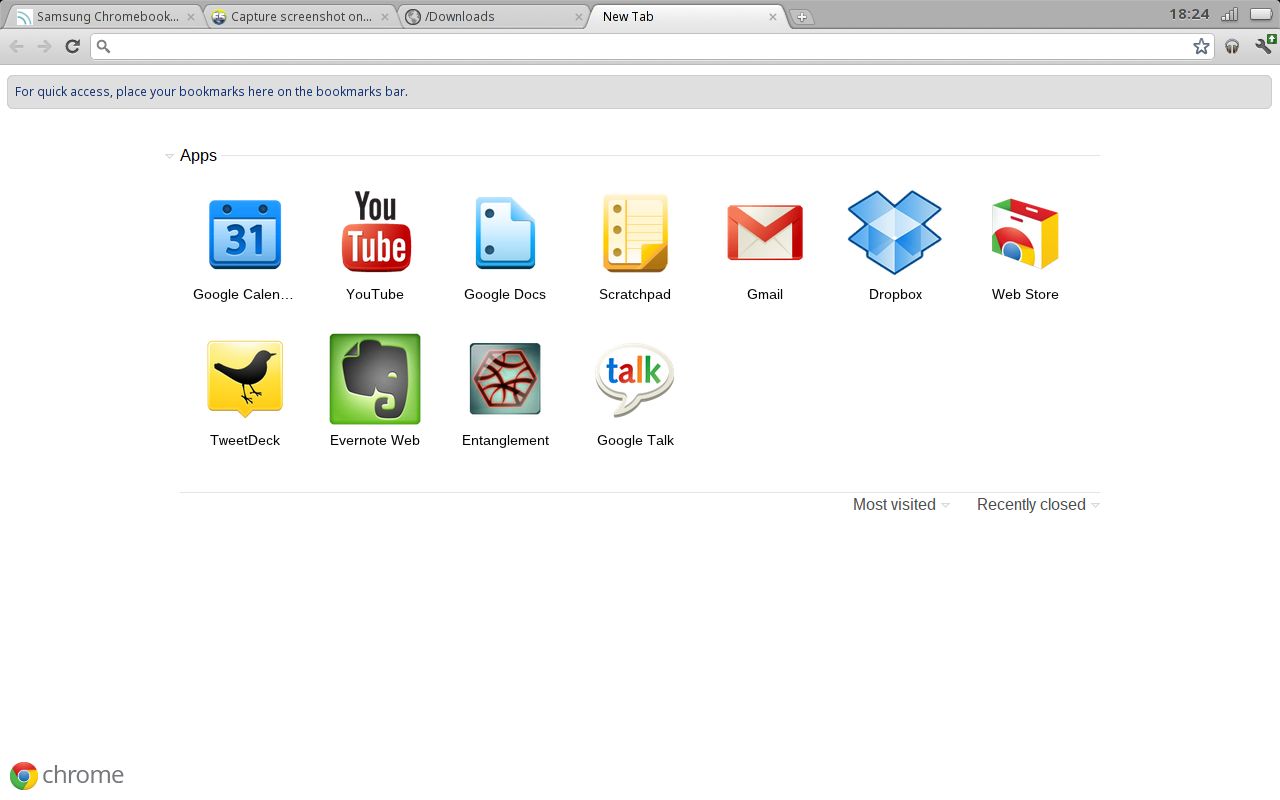
If you have not worked with the Chrome browser, think of it like this (or at least here is how I understand it). When you open a tab, you can use this tab to connect to a web site OR you can use the tab to select from various services (apps) you have purchased (often for $0). So, for example, I can use services such as Instapaper or Evernote in this way from within the browser. Chrome already assumes I am going to use Google apps (documents, calendar, etc.).

Learning to work within the browser environment takes some exploration and some work arounds (at least it seems this way). For example, I wanted show the apps tab in this post. Working on a “traditional” computer I would know how to do this. I would capture the screen and then upload the file (perhaps after modifying the size of the image) to my blog. How to do this from within a browser. It turns out that a) there is a way to do screen capture and b) the chromebook can store files.

In addition, there is are USB slots and external devices can be accessed. Here is where it gets tricky. Assume I am writing on one device, I have generated a doc file, I have stored this doc file on a flash drive, and I want to edit this file on the chromebook. I can see the files on the flashdrive from my chromebook, but I cannot open the doc file. To edit the file, I must connect to Google docs, upload the file, and then the file within Google docs is available for modification. I guess this makes sense within the world of chrome.

Yes, I did write this on the Chromebook. AND – no I have not received an invitation to Google plus so I cannot comment on the Plus environment within Chrome. Maybe my wife will invite me.

Loading