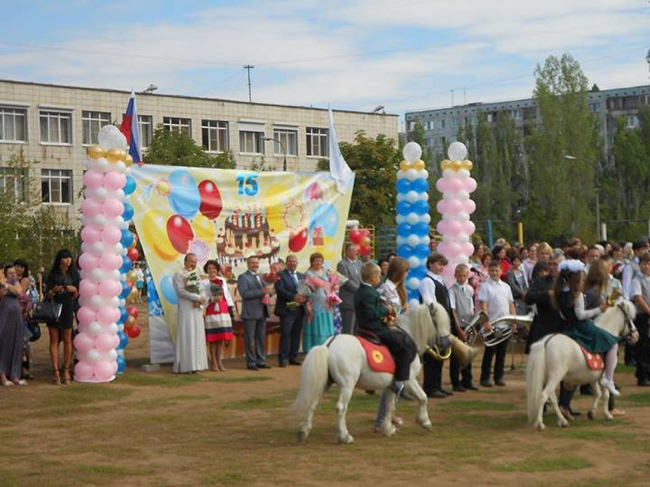
Cindy received email from her Russian teacher friends today. It was their first day of school and it was party time. They call the celebration “Day of Knowledge” and the focus is likely a little different than we might emphasize here. The event honors the teachers and it is their commitment to the learning of their students that is celebrated. Interesting to consider the difference in perspective.
We like models of complex phenomena. If we are academics, we may spend considerable time creating models and arguing for the benefits of our model versus competing models. It is cool to be recognized as the creator of a given popular model. You might be paid to explain your model at conferences or through a book. My wife and I had a discussion recently about two models many involved in educational technology may recognize – TPACK and SAMR. I have no idea why models are presented as abbreviations but the acronyms are short for Technological, Pedagogical, Content Knowledge (TPACK) and substitution, augmentation, modification, redefinition (SAMR). Looking at these labels written out, I guess I have answered my own question regarding the acronyms. Neither the short nor full version has an obvious meaning.
Anyway, our discussion concerned whether future educators should be “taught” these models. What might be the benefit of taking time to present, study, and evaluate understanding of such models for a future or practicing teacher? She was not an advocate of presenting such models to her students.
I have continued to think about this topic, because I recognize that I use models (not the models I mentioned) in my own class. For example, I spend time presenting and explaining the cognitive information processing model (including updates that identify various long term memory structures) in my educational psychology courses. Why? I think understanding this model helps explain issues that teachers face. For example, students who struggle with word recognition are likely to have poor comprehension because the focus on word recognition is using up the capacity available in working memory. While word recognition can be developed in various ways, comprehension is unlikely to improve until the more basic skill has been improved. Students with poor background knowledge will find it difficult to “understand” content. Effective long term memory depends not just on storage, but also on the development of links with existing knowledge. etc. etc. Models can help us understand phenomena we must deal with and suggest possible sources of action.
So in thinking about models, I propose advocates consider the following questions:
What kind of a model is this? – descriptive, causal
What does the model predict and has the prediction been tested?
Who would most benefit from knowing and understanding this model?
I probably cannot speak for those who have spent great amounts of time devoted to SAMR or TPACK, but I have opinions.
What kind of a model?
SAMR seems descriptive. TPACK seems more causal.
What is predicted?
TPACK seems to predict how teachers end up using technology in their classrooms. It is suggested that various types of knowledge are required to use technology in given ways. Has this been tested? I do not really know. I also may now disagree with my claim that this model is causal. This would assume that the development of a specific type of knowledge would lead to a different classroom practice. I am guessing data that exists does not yet demonstrate this forward linkage – perhaps I am wrong.
Who benefits?
I think I agree with my wife. I see little present benefit to teachers in spending much time with these models. I see those of us who prepare teachers finding possible benefit in the models? Are these models accurate descriptions? Can predictions based on those models be tested? What curriculum modifications might be implemented if we want teacher classroom behavior to change? What knowledge and skills should be emphasized?
I have long been intrigued by location based data. Location provides a context that allows one to better understand data. Often, we know something more when we identify a location and this extra information allows better understanding of an event that happened at that location.
Here is an example that may help explain this abstraction. A specific attribute of the camera on most cell phones is the geolocation capability. Exactly where was that picture taken? The capability is now usually there, but the default seems to be to have this capability turned off. I suppose this is because there is some concern regarding privacy. We are willing to share photos, but seem concerned that we would also share the location where the photo was taken (e.g., this was taken in my home and this is where my home is located). I think the location data can have many useful educational applications so learning to turn the recording and sharing of the location data associated with images on and off could be an important skill to have.
Anyway, I noticed a blog post that explained how to map a collection (set) of images stored in Flickr to Google Earth. We recently returned from a three-week adventure in Russia and we took a large number of pictures while we were there. One of the problems I always have with such picture collections is that I lose the context over time if I do not do something with the pictures immediately. I like to explain this problem based on the experience that “a month later, one mountain looks a lot like another”. With the Russia adventure, this problem might be explained as “after a month, one statue or palace looks like another”. I tend to take pictures on trips with a reasonably high quality camera, but I have also learned to take some of the same pictures with my phone (turn off your data plan). The geotags captured by the cell phone when cell phone images are mixed with the digital camera images by date and time allows some context (location) to jog my memory for events. The technique for mapping to Google Earth just provides an interesting way to display your pictures AND to view pictures taken by others at the same location.
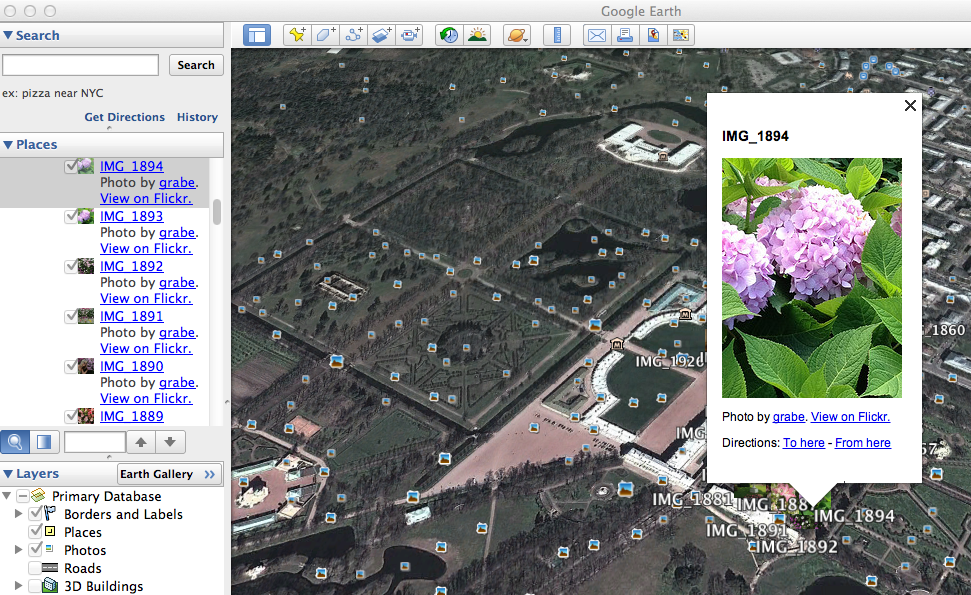
The blog post provided by Adam Franco explains the method which amounts to loading the images of interest into a Flickr set and then executing a script that generates a KML file on the address for this set. The KML file is than loaded into Google Earth to display the location of specific pictures.
You can kind of see how this works in the image above. The KML file links to the pictures in Flickr and shows the location on the map. Other images are represented on the map and these also can be viewed.
If you would like to explore our iPhone collection (actually I did not have the settings on my new Samsung S4 set to record geotag data, but Cindy did have the setting turned on), I have placed the KML file in the public folder of my DropBox Account. Download this file and open with Google Earth.
By accident, I included a photo taken in Wisconsin with the images taken in Russia. Watching Google Earth move to accommodate the different locations is interesting. The detail in the maps is also interesting and the accuracy of the image location is impressive. Creating collections that are geotagged offers some interesting possibilities.
The Common Core State Standards provide a consistent, clear understanding of what students are expected to learn, so teachers and parents know what they need to do to help them. The standards are designed to be robust and relevant to the real world, reflecting the knowledge and skills that our young people need for success in college and careers.
Perhaps “new thing” is the wrong descriptor. The Common Core standards have been around long enough to be both lauded and criticized.
I cannot decide if I am for or against the standards. I am not against preparing students for success. As I understand the focus is on math and reading, I am concerned that many important skills are not recognized and may receive less attention until a more well-rounded set of expectations are developed. Perhaps we need better agreement on what skills are at the educational core.
Secondly, I think we have had perfectly acceptable standards previously and the concern that these standards ignored “21st century skills” (substitute your own favorite phrase here if you are not a fan of 21st century skills) were often inaccurate. When I began looking more carefully at various discipline specific standards about 10 years ago, I found many skills one advocacy group or another claimed was not being developed was actually included in the standards. Hence, it seemed and it still seems to me that focusing on goals (broad or specific) is not the actual problem. Somehow, the process of getting from the goals to the achievement of the goals breaks down.
When I was reviewing the topic, I learned a new word – alignment. The idea when applied to standards argues that various stake holders might adapt to the standards. Teachers must implement classroom activities consistent with the standards. Resource developers (e.g., textbook companies) must offer resources consistent with the standards. Those selling evaluating instruments must offer tests consistent with the standards. Perhaps most important learners must meet the goals established by the standards in the time allowed.
Simply put, alignment is usually not perfect and when reality sets in things begin to fall apart. If only certain skills and content areas are emphasized on high stakes tests, the activities required by teachers and the subset of the resources provided by developers actually used shifts. I would also argue that the emphasis being placed on specific students, but this is a subtopic and would take too long to develop here. If only the M of STEM is evaluated, you may find no science lessons in the Spring of the year.
We returned from Russia yesterday, but I have several half completed posts that I will try to get out over the next week or so.
We spend much of our time in Russia with a group of individuals who were refugees from the Chechen war. These individuals were from the city of Grozny and ended up in other parts of Russia with very few possessions and little assistance. Their self-reliance and success in rebuilding their lives are traits most of us cannot adequately appreciate.
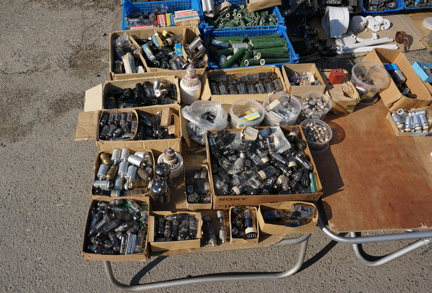
While we were in Volgograd we visited various “markets”. When the intent was to secure meat, fruit or vegetables, the markets were similar to what many of us have experienced on a smaller scale as a “farmers’ market”. There were other markets. One I visited in search of a popular cup for drinking tea. This market, some might describe as a “flea market”, offered a wide variety of odds and ends. You could find plumbing supplies, bicycle or car parts, and electronic components (see image). I can fathom why someone may want a PC circuit board, but vacuum tubes? Who could possible have a device and has been searching for a specific vacuum tube to get it working again. I am guessing many folks who may read this blog have no idea what a vacuum tube is. Frankly, much of what folks were trying to sell looked like junk to me, but they must have thought there was some chance of a sale to sit all day with their goods spread out in front of them.
For whatever reason, the market made me think of makers. I have been reading about the maker culture (e.g., Chris Anderson’s Makers) and the educational potential of maker opportunities (Martinez & Stager’s Invent to learn). What I experienced in Russia was a true maker culture. People built or rebuilt their homes. They gardened at their dachas for food (and build a shelter so they could enjoy weekends out of the city). They repaired their cars. These commitments are a matter of survival.
I can appreciate past or present interests of my own that may qualify me as a maker. What I still struggle with is the notion that maker experiences can be integrated into mass education.
I think there are assumptions that have yet to be verified:
Is there a general motivation among adolescents to commit to the deep exploration of a topic? No doubt there are interesting examples, but education requires a model that applies to all.
Should the motivation be there, the methods and resources for developing knowledge and skills from such experiences have yet to be demonstrated.
Good idea or not, a commitment to making and tinkering is largely unproven within the masses. I wonder what we really know about the free choice activities of children – what proportion are really makers, tinkerers, even readers? Putting all this rhetoric aside, do the play a activities of adolescents really support the argument. Do most want to learn to make music or watch MTV? Do they want to program games or play games?
Someone should do a study.
Some thoughts:
Perhaps schools are not the place for what I prefer to call “hobby learning”. This does not imply that hobbies are not valuable in developing knowledge and skill or that parents should not commit to help their children pursue hobbies.
I still think we need a better way to think about maker activities within school settings. I like the 20% time idea taken from high tech companies of recent years. You have one day a week to work on a project of your own definition that has some potential value (I added the final part about potential value, but I think this is a useful way of explaining that the employee should be able to argue some connection between the activity and the mission of the company). As a higher ed person, I prefer the idea of “special topics” or “readings”. These are courses that a student proposes and seeks a faculty member to supervise. However, what I have observed from personal experience is that over the years fewer and fewer students seek the opportunity to develop their own topic or readings course. Opportunities of interest to some cannot be assumed to be an approach that will work for all.
I would not describe Volgograd as a visually beautiful place. Certainly, there are many, many impressive monuments and there is the mighty Volga. However, there are not the manicured and lush lawns that are familiar to many of us. Open areas seem dry and weedy. Then, there are the roads. I would have found the roads difficult to imagine – broken up with an amazing numbers of potholes. Drivers must constantly swerve about to avoid the deep and frequent obstacles. Still, they seem to be able to manage an impressive and often dangerous speed. The buildings also are nondescript. Mostly dull looking and repetitive in design.
Given this outward appearance, what lies within might not be predicted. The flats (apartments) are very nice and comfortable. For those of us interest in technology, the Internet is very fast and there are plenty of iPhones, iPads, and big screen televisions.
In speaking with people I have met, it seems the difference between the outside and the inside is a matter of control. What individuals feel they can influence lies behind the steel doors of their flats. They may be frustrated by what is outside, but believe factors beyond their control determine what happens there. What happens within is different. This they can control and this is where you find individuality and creativity expressed.
There is probably a larger lesson here. Perhaps it is that when we want others to respond to external expectations we must convey some opportunity for control. Without allowing a sense of ownership, it can be difficult to get a glimpse of the potential that lies within.
We are in St. Petersburg trying to get our bodies to accept the time difference. The hotel is within walking distance of the airport and in an industrial area so we have seen little. At this point it is difficult to appreciate we are far from home or exactly were we are. English is not a problem in the hotel.
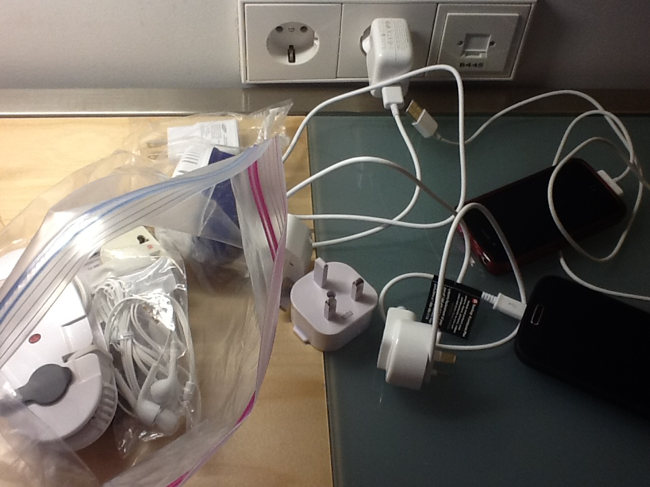
However, you do find immediate differences. The hotel beverage service seems to rely on instant coffee and I am trying to figure out how to recharge my gadgets without frying them.
The outlets look different. I understand this is 220. To me that translates as the power source to my stove. I know Apple products work well from previous trips. I am not certain about other devices. It must be some combination of a plugin and a converter. The various items I brought to deal with electrical issues list countries on them. I suppose this is to prevent my from experimenting. I do not see Russia listed. More later if I do not burn out my equipment. 😉
Manage Consent
To provide the best experiences, we use technologies like cookies to store and/or access device information. Consenting to these technologies will allow us to process data such as browsing behavior or unique IDs on this site. Not consenting or withdrawing consent, may adversely affect certain features and functions.
Functional
Always active
The technical storage or access is strictly necessary for the legitimate purpose of enabling the use of a specific service explicitly requested by the subscriber or user, or for the sole purpose of carrying out the transmission of a communication over an electronic communications network.
Preferences
The technical storage or access is necessary for the legitimate purpose of storing preferences that are not requested by the subscriber or user.
Statistics
The technical storage or access that is used exclusively for statistical purposes.The technical storage or access that is used exclusively for anonymous statistical purposes. Without a subpoena, voluntary compliance on the part of your Internet Service Provider, or additional records from a third party, information stored or retrieved for this purpose alone cannot usually be used to identify you.
Marketing
The technical storage or access is required to create user profiles to send advertising, or to track the user on a website or across several websites for similar marketing purposes.


You must be logged in to post a comment.