I read a lot of Kindle books. My wife and I have written a book available for the Kindle. The “Kindle model” offers some capabilities that are under appreciated and often unknown to many readers.
For example, I am interested in the potential of sharing highlights and annotations. I have taken the time to highlight and annotate our own book and the books I assign for me graduate classes.
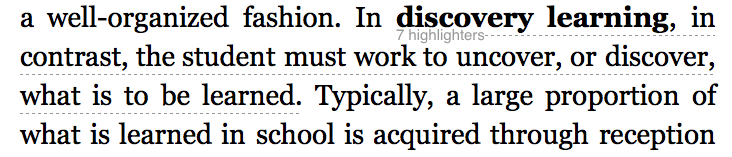
I have a new fascination. I was searching our Kindle book for a specific references and discovered that I can now view the most frequently highlighted passages by readers. Do the readers highlight the same content as I highlight? Do they highlight what I think are more applied content or content I would describe as conceptual and likely to be unfamiliar. There must be something here for deeper analysis. I had thought shared highlights was something I could share or readers could share with each other, but now I see value in the annotations as feedback to the author.
Old folks are supposedly famous for reacting to their younger peers by responding to their new ideas claiming “we already tried that and it did not work”. Sorry if some of my comments seem to fit this description. However, …..
The limited time available within the school day is limited and interested parties seem to be arguing that their content be given a larger portion of the pie. I accept the value of advocacy and I consider myself relatively neutral. I become critical when it seems to me the positions taken go beyond what I think can actually be delivered. I agree that not everyone really needs what everyone gets and, that when practical financially, greater flexibility be provided. However, when it comes to innovation, two positions that cause me to react with skepticism claim a) all students need this new experience, and b) this new experience develops general skills/knowledge in ways not now accomplished by the existing curriculum. Here is where I want to see some evidence so education does not given in to the fad of the year.
Presently, there seems to be interest in something called “computational thinking.” I have no idea if this is really new or a rebranding of an earlier idea. I remember reading Papert years ago and he proposed a computational way of understanding geometry. I admit when I first thought of the way he proposed understanding “circle” I thought there was something unique about his perspective. Of course, I knew the definition of circle – a closed, plane figure consisting of all points equidistant from a point, but being able to generate this definition was not really understanding. Now, if you imagine yourself as the LOGO turtle standing on a point and you walk forward a given number of turtle steps, lower your pen and walk one more step, raise the pen, then backup the given number of steps +1, you have created a point at a given distance from a point. Turn right one unit, repeat, turn right one unit, etc. You have a circle.
I admit this is my one example. However, the difference between my ability to offer the definition of a circle and create a circle via coding has influenced my understanding of understanding. Is this reaction unique to programing or is the capacity to execute a construct through action a more general way to achieve understanding? I understand what I can do.
Flash forward to the present and recognize that computational thinking has experienced a renaissance. What I mean by this is that some in education are again promoting the value of learning to program, but also proposing more general benefits for these experiences. Clearly, those of us who have developed programming skills (now sometimes called coding) have experienced vocational advantages. Programming seems a skill for the 21st century based on the larger role digital devices play in all aspects of our lives. While I agree with the value of this particular skill as important in multiple vocations, I balk at the argument that it is a skill for all or that what students might learn through programming courses goes beyond the skill of programming.
My concern is that those in various disciplines argue too broadly for the benefits of their discipline. If a particular discipline happens to be in favor for one reason or another (STEM seems to be the in thing at the moment), there seems a tendency to embellish a bit and to argue that a skill is more than just a skill.
So, just to make a point, I think I can make the same case for several disciplines not typically considered as being broadly beneficial. For example, consider what could be learned from history. Yes, yes, I understand about important names and dates, knowing where we came from, and not repeating mistakes. However, historians should argue there is the potential to teach far more. What historians do is not what you likely learned from taking history courses. You learn what historians learned, but you do not learn how they learned it. Historians piece together accounts from multiple, primary sources. Since sources were generated by individuals with different perspectives, i.e., biases, piecing together an account of what likely happened is a great exercise in critical thinking. There is also great value in appreciating that individuals experience history from different perspectives and with different personal outcomes so the consequences of historical events is complex and multifaceted. Anyway, when explained in this manner, there is the potential here to develop very important higher order cognitive skills and such skills are exactly what reformers contend are missing as a consequence of typical educational experiences. Think like a historian.
I do promote a given activity both as useful for all and as a way to develop thinking capabilities more generally. My personal recommendation for an alteration of typical practice would be to place a greater emphasis on writing. Yes, students are taught to write, but I think they should write more as part of all classes they take. There are limits when you learn to write by writing to practice writing. Beyond the basics, you learn to write by writing to communicate. Students should write for their parents and they should write for their peers. They should write for themselves. Mostly, they should write about they learn. This seems more purposeful than writing about an arbitrary topic assigned in English class. The effort in putting something down on paper leaves far less room for the assumption of understanding than does just studying. There is something about that blank sheet of paper or monitor screen that challenges the illusion of knowing. Call it “Writing to learn” or “Writing across the curriculum”, the flexibility of writing would be my recommendation for an activity required of all and offering higher order advantages.
It appears to me that some of this most popular sessions at many educational technology conferences are the x apps in x minutes (30 in 30) and the “shoot out” (tech “experts” have a brief period of time to describe apps, devices, and services audience members are unlikely to have seen – sometimes with a winner based on the most impressive presentation) sessions. I must admit that I am a sucker for these sessions and am always curious to see just how many of the supposed novel examples I have already seen or own. The unique, the funny, and the obscure seem to earn extra points.
When I step back and think about my reaction and what must be the reaction of many since audiences seem to be large, I wonder just what participants feel they have gained. Consider that a common mantra among tech facilitators goes something like this – “it is not about the technology, it is about the learning.” This priority could not apply in the cases I describe – many examples have no utility for students and most examples are similar to existing examples already widely known to the rest of us.
Here is my concern. Any new app or service takes some investment of time to become reasonably proficient. This learning time must be subtracted from the time available for application. Of course, we want to use powerful and effective apps, but each time we find something new we must also evaluate just what the value added of the presumed advantages might be. How many times will the better app be used and will there be a cumulative advantage over what would have been used should the educator not have encountered the new opportunity.
What would be cool would be sessions based on multiple, creative ways to use a given app – 10 ways you can use Explain Everything, the versatility of PowerPoint, 20 suggestions for the educational use of the camera in student smartphones. Of course, these sessions do exist, my comment concerns the popularity of the pure “impressive me with your technology” sessions. I am making no argument that any given app or service has limited educational value. I am suggesting that “one time” uses be avoided.
Apple has always done very well in the education market, but I am concerned the company has become complacent. There is a diminishing return on the value of more elegant and powerful hardware and the number of apps in the App Store. Cloud-based approaches treat hardware as an appliance and increase the importance of cost. The number of apps may be less important than the number of app categories. You really only need one good app per category.
Recent announcements by Google and Amazon are attempts to target other weaknesses.
Google
Google Play for Education (see the video) is separate from Google play and offers apps, video and books organized in ways that will be useful to teachers (e.g., subject, grade level, standard). The store provides an approach consistent with the ways schools invest in content – purchase orders and bulk purchases. Educators can then send specific content to specific students.
Amazon
Whispercast (not to be confused with whispersynch) will work on any device – Kindle or running Kindle software. Push commercial content from Amazon and content created by teachers to specific students. Some unique arrangements were described at FETC – lower prices on books available for a limited period of time. Efficient ways for schools to manage the distribution of this content.
My wife proposes that these companies seem to have carefully analyzed the frustrations of educators in implementing learning with apps in a school setting and attempted to design solutions.
What should Apple do?
Offer a less costly tablet.
Improve (drastically) the quality of cloud services.
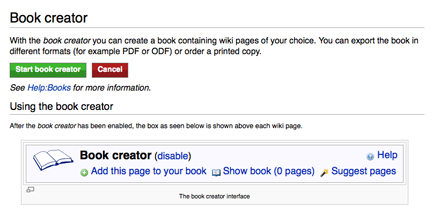
This is something I learned at the FETC conference. You can make your own book from wikipedia content. Unlike collecting content from other sources, this is not a copyright violation and facilitated by wikipedia. The process works like this.
1) Open wikipedia content you want to add to your book and find the create a book option under Print/export in the left column of the wikipedia display. 2) This link will reveal the book creator screen. 3) At this point, you select “add this page to the book”. The idea is that you identify different wikipedia resources and assemble a book from these resources.
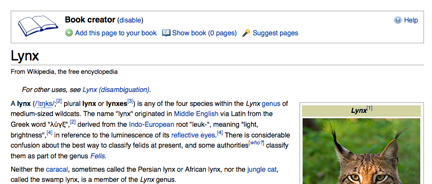
4) The resources will be accumulated in this fashion,
5) When finished, you download the collection as a pdf or book.
6) The appearance of the book is shown below. The book includes a detailed summary of sources and authorship for the material selected.
How might this capability used in an academic context. Have students assemble their own book on a topic (e.g., large mammals of Wisconsin). Projects can then be based on student study of this content. These is an interesting opportunity here to evaluate the selection of content and the connection between the content and the project. Students might also share their resources with each other.
We are headed off to Florida for FETC (Florida Educational Technology Conference) this weekend. It will be a good break from the weather in North Dakota.
I am certain that “maker” sessions will be popular at FETC. My suggestion for the best session available to you will not be held at the convention center. If you have the time, visit EPCOT and pay the extra charge to participate in the “Behind the Seeds Tour”. The tour provides a behind the scenes look at the “Living with the land” exhibit. There are multiple greenhouses and on-going research programs.
I have long felt that school gardens and habitat projects have a great deal to contribute in terms of hands on learning. The tour provides a look at some of my favorite topics – hydroponics, small space gardening, drip irrigation, construction of growing containers. The guide we had explained how they repurpose PVC pipe and styrofoam containers to grow fruits and vegetables. I remember there being handouts and make sure to bring your camera. There is a charge but I remember it being quite reasonable for the duration of the experience.
The District of Columbia Court of Appeals just ruled that the FCC’s position on net neutrality sometimes also called the open Internet was not warranted. Net neutrality concerns a service provider’s authority to control the rate at which specific content can be sent through the system they provide users. They can prioritize some content over others. I continue to search for a way to explain what this is like and am always in danger of misrepresenting what is actually the case. As an analogy, I think it is fair to contrast the present situation with a toll road. With an open system, the price charged for a car or truck is set. If the new rules could be applied to the Internet, a toll road going through Detroit might allow American made cars to drive at 70 while limiting foreign cars to 45. Or, perhaps, there would be 10 toll booths for American made cars and 1 for foreign cars. The idea is that the self interests of the provider could come into play in influencing business opportunities that would likely be considered going beyond providing a service and making a profit on that service.
Positions on situations such as this are often spun in different ways. The providers wanting greater control point to what is argued as a misuse of the present system. For example, the proportion of Internet traffic that now is taken up by companies such as NetFlix has been used as an example. The providers argue they do not benefit in trying to keep up with the demand that is generating profits for a small number of content providers. A similar argument is made claiming that a substantial proportion of bandwidth is used by services that provide a conduit to what is often stolen content (music, video).
I am not certain I understand the first argument. I know that to connect a server to even an individual a provider expects a higher monthly fee. The content provider also pays a differential fee depending on the amount of content served. Part of the issue seems to be the concern that the provider could prioritize certain providers over others and who would determine when this was appropriate? For example, Internet services come to use from two likely categories of providers – phone companies (DSL) and cable television companies (cable). These two categories of providers have several income streams – there is the Internet access and there is either typical phone services (telephone calls, perhaps SMS) or content (television programming, pay per view content). There are potential conflicts of interest here – the phone company may see VOIP as a competitor (facetime, Skype) and the cable company may see free or commercial video (e.g., NetFlix) as a competitor.
There are other issues. The “right” of a company to offer services as it sees fit is often justified arguing that customers not finding the service acceptable can simply take their business elsewhere. However, many of us have only one option (and often not a good one) for a connection to the Internet. This has been a long standing issue with phone and cable services and regulatory mechanisms have been put in place over the years to deal with such monopolistic situations. In fact, to return to my original analogy, the government at some point created the interstate highway system because access to ways to move physical goods was considered a right for all citizens.
Anyway, how Internet access is made available is a challenging and politicized issue. The issue was first raised in the 2007 – 2008 time frame and I wrote about it at that time. My concern was not as a user, but as an advocate for students. I assume that government subsidies such as the e-rate will support school use, but the increasing reliance on online resources out of school will contribute to the to existing problem of income-based inequities. I am also concerned as an educational content provider. I personally subsidize the resources I provide, but I am concerned my server costs will increase. Sometimes I am concerned that my perspective is self serving. I am pleased when I see a similar position taken by others.
Manage Consent
To provide the best experiences, we use technologies like cookies to store and/or access device information. Consenting to these technologies will allow us to process data such as browsing behavior or unique IDs on this site. Not consenting or withdrawing consent, may adversely affect certain features and functions.
Functional
Always active
The technical storage or access is strictly necessary for the legitimate purpose of enabling the use of a specific service explicitly requested by the subscriber or user, or for the sole purpose of carrying out the transmission of a communication over an electronic communications network.
Preferences
The technical storage or access is necessary for the legitimate purpose of storing preferences that are not requested by the subscriber or user.
Statistics
The technical storage or access that is used exclusively for statistical purposes.The technical storage or access that is used exclusively for anonymous statistical purposes. Without a subpoena, voluntary compliance on the part of your Internet Service Provider, or additional records from a third party, information stored or retrieved for this purpose alone cannot usually be used to identify you.
Marketing
The technical storage or access is required to create user profiles to send advertising, or to track the user on a website or across several websites for similar marketing purposes.








You must be logged in to post a comment.