Personalize lessons in Google forms

I have been exploring approaches that might be used by teachers and students to individualize student progress through a sequence of learning experiences. I am interested in approaches that might allow a mastery model; i.e., students move ahead at the rate they are able to demonstrate mastery of instructional goals. Recently, I have been exploring a model called the Modern Classroom Project and I have been thinking about some of the practical requirements for implementing this model.

Approaches that individualize student progress need a way to communicate the sequence of tasks to individual students and to locate competency checks within this sequence of tasks. If I were going to do this, I would probably create a document (probably Google docs) that linked to a series of web pages to present content and layer these content pages using InsertLearning. InsertLearning would allow me to add prompts, questions, and discussion items to the content pages (which would consist of text, images, and video). I could use the questions to encourage processing of the content and also as a competency check at the end of each content page. The nice thing about InsertLearning for this type of approach is that it collects student responses to questions and I would use these responses to evaluate understanding of the content presented within a page. These responses would enable me to provide feedback to students telling them if they can move on to the next unit and to identify students I might want to spend time with to help them sort out difficulties they seem to be having.

InsertLearning is not a free service ($8 per class per month or $40 a year) so how else might a similar goal of sequencing learning be accomplished. Many educators have probably heard of hyperdocs. The term hyperdoc was coined to refer to creative use of Google tools (docs, forms, sheets, and slides) to create content delivery, learning experience, and evaluation tasks by teachers for their students. Often, this would be done in place of traditional curriculum materials which I would describe as placing classroom educators into the role of an instructional designer. One of the challenges I see in this approach is creating a simple way to allow multiple students through the sequence of an instructional unit at different speeds. My guess is that the authors of the Hyperdoc Handbook would do this through a combination of Google docs and Google forms. You can do a lot with docs because you can both present content (text, images, video) and require responses within the same shared document. The problem for me if relying on docs would be individualization. You would possibly have to create a unique copy of each doc for each student if you wanted to evaluate performance on tasks with the material to be examined added within the doc. 

What follows is my attempt to use Google forms as an alternative. Forms are crude in comparison to docs, but forms have the advantage of writing the response to embedded questions to a spreadsheet. The collection of data is the primary function of a form. The link for the same form can be sent to many different individuals and inputs to questions in the form are stored separately in a spreadsheet. I think of trying to use forms for the task I am interested in as trading data collection for the sophistication of content presentation. I have come up with a few ideas in the use of forms others may find useful.

Here is a summary of the issues and my ideas. You can present text, images, video, and questions in forms, but to combine them you have to be creative. The biggest challenge is to combine text with anything else. I use WordPress as my blog platform (this blog) and WordPress now uses what are called blocks. There are blocks for lists, text, images, embeds, quotations, video, etc. and you create posts by adding blocks and then adding content to each block. Forms works in a similar way, but allows far less flexibility in how blocks can be combined.

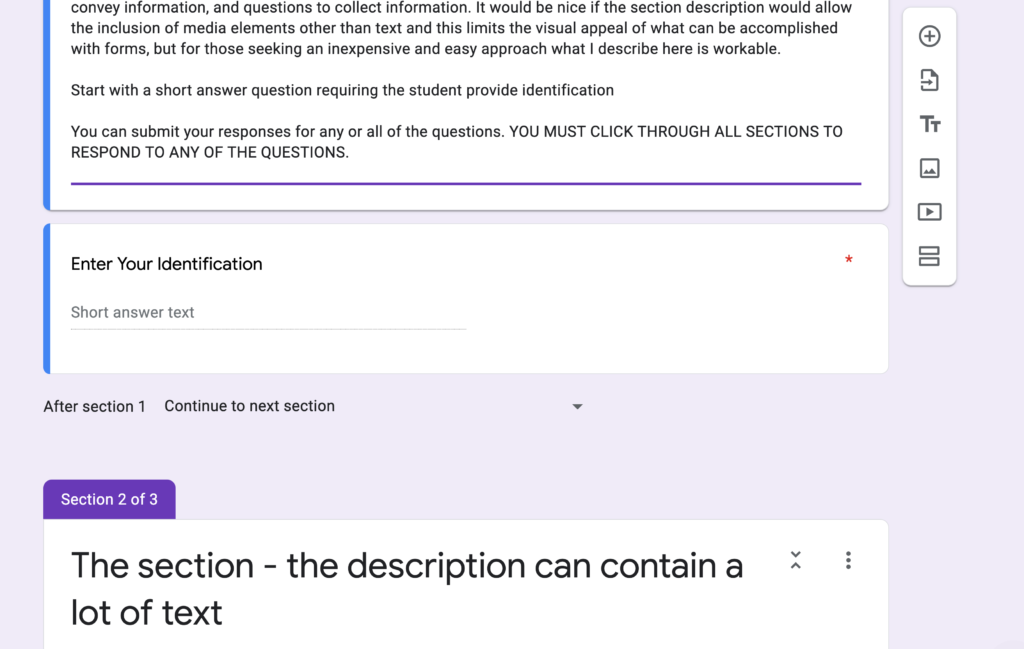
With forms, it helps to think in terms of sections. There is the title section and sections that follow. Below each section heading, there is an opportunity to add text. You can add as much text as you want, but this is the only place within a section that text can be added. You can add multiple images, videos, and questions below this body of text. The questions are of many types, short answer, paragraph, multiple choice, etc. The responses to these questions are written to a spreadsheet that will appear in the same Google drive account that stores the form.

Here are a few images to give you an idea of what this looks like. The following image shows two sections – the title section and a second section. You can see text that has been inserted under the title. Again, this is the only place text can be added to this section. Below, the text you can see a question. You will need to associate an identification (name) with each response from students. So, the form I created begins with the request for a name. Questions either require a response or not. I want students to be able to complete parts of this unit (consisting of multiple sections) in stages and I want to record any input generated during that visit to the site. I require a response to the name question, but not to any questions that follow. A student can then respond to questions associated with other sections or not and I will also store these responses associated with the name or other form of identification. The student must move through all sections for the form to send any data added to the spreadsheet. This is not ideal and I am sure some students will forget to do this and no work they have completed will be recorded. There is no way to change this in a form with multiple sections. The image below shows the beginning of a second section with again allows a heading (title) and then the one opportunity to add text.
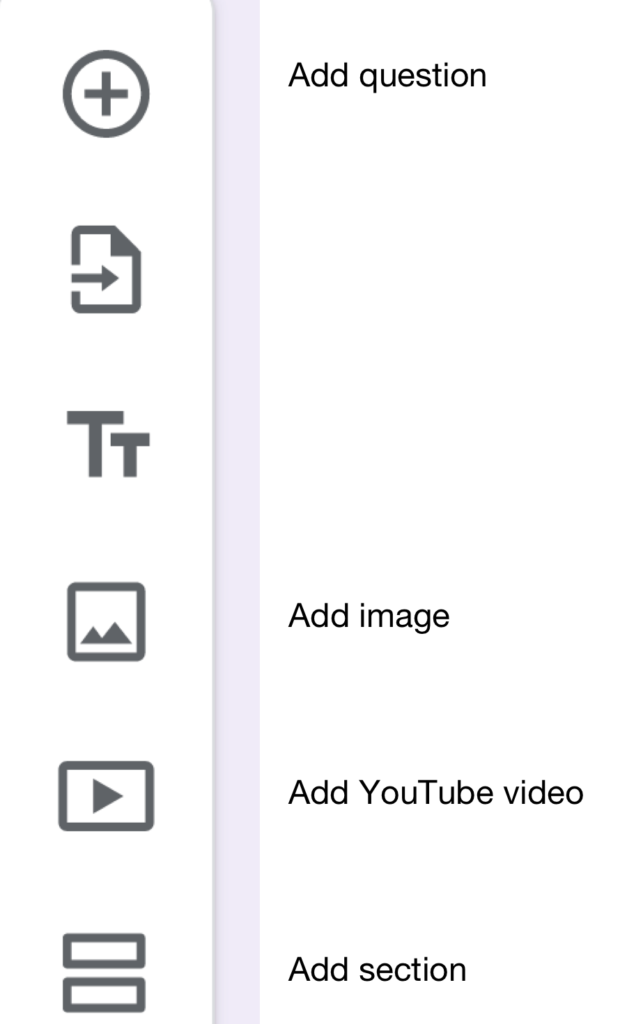
The following image shows the form tools. The tools have been labeled. There are options associated with the different tools (e.g., for questions – what type of question and will a response be required).
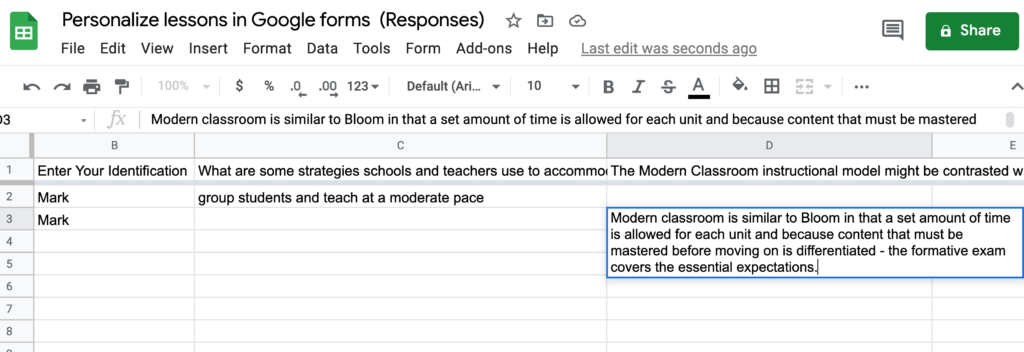
The following image shows what the spreadsheet with responses looks like. Long responses distort the shape of the spreadsheet, but clicking within a cell makes the content submitted far easier to read.
If you are interested in examining the demo form I created for this tutorial, you can view it using this link.

Loading

North Dakota will facilitate K12 mastery learning opportunities

My past couple of posts have returned to a topic I have addressed several times over the years – technology can made practical the benefits of personalized mastery learning. To conclude this focus and offer an example to justify my claim of practicality, I want to bring attention to legislation recently passed in the state of North Dakota. I spent a good part of my working life as an academic in North Dakota. I don’t regard North Dakota as a progressive state for educational innovation, but perhaps that is my point. Innovation can be a function of the efforts of individual innovators as administrators or educators with administrative support and such individuals can be quite influential. 

North Dakota just passed legislation makes it easier for districts wanting to institute personalized approaches to pace and the demonstration of competence in meeting graduation requirements. In addition, the state will facilitate the development of a learning continuum as a resource for those schools wanting to offer students an alternative to the more traditional time-based definitions of courses and progress.

Shall facilitate the development and implementation of a North Dakota learning continuum in collaboration with the department of career and technical education, upon the recommendation of the kindergarten through grade twelve education coordination council.

Here are a couple of resources explaining the intent of the legislation.

Statement from the Office of the Governor.

Wording of registrations

My point in this post is to offer the suggestion that the concepts and procedures identified in the two previous posts about standards for hybrid learning and plans for personalization instruction through what I refer to as mastery methods are being implemented in locations and this activity may not be familiar to many educators. 

Loading

Mastery Updated

Mastery learning is described in some detail in previous posts over the years. Here are a couple of important topics for this post. First students vary significantly in what might be called “learning rate”. The word “aptitude” would be my personal preference, but this term is less descriptive. While the origins of differences in learning rate are perhaps disputed (e.g., is it what was traditionally called intelligence), I don’t think any practitioner would dispute that students acquire knowledge and skills at different speeds. An important issue is whether the instruction that students receive accommodates these differences. If instruction moves on to new material before a student has learned the present focus of instruction, students at best would have a knowledge or skill gap and at worse would be missing the background to learn something new that is based on or assumes other learning has been accomplished. Over time, these gaps accumulate, increasing the variability of learning rate. The frustration students experience in dealing with demands they are ill-prepared to master only magnifies the problem.

There have been attempts to deal with the variability in the rate of learning through practices such as ability grouping (tracking) and tutoring. Ability grouping comes with multiple difficulties such as labeling and equity issues and tutoring while very successful is prohibitively expensive. 

Mastery instructional techniques have been investigated for years. My personal study of this topic begins with publications in 1968 – Bloom’s group based mastery and Keller’s personalized system of instruction (PSI). I provide greater detail on these approaches elsewhere. Interest in such approaches seemed to wane likely because of practical issues and because the systems required alterations in traditional educational practices rather than because of lack of effectiveness. The potential of technology for taking on some of the components of mastery instruction increasing efficiencies and changing attitudes of educational practice may encourage reconsideration of mastery approaches possibly with different terminology and different variations on the components of a mastery approach.

I consider the components of PSI and Bloom’s group-based mastery strategies to be – a) clearly stated and integrated objectives/goals, b) small units of instruction, c) mastery before progress, d) multiple, nonpunitive assessments, and e) remediation keyed to individual needs. When I work with graduate students on this topic, I typically ask them to explain how these components appear in PSI and Bloom’s group based mastery, but also in new instructional approaches that mention a commitment to typical mastery goals.

Briefly, here are a couple of examples of more recent instructional approaches with mastery characteristics. The Kahn Academy is a recent example of a technology-enabled approach that Kahn began to label as mastery (e.g., see One World Schoolhouse). My focus is not on the Kahn Academy here, but it seems to me to be similar to PSI when implemented as a full-blown system (using the short videos, competence checks, and hierarchical linking of learning units). 

A second example I want to highlight is called the Modern Classroom Project. The modern classroom model is based on three components – blended instruction, self-paced learning, and mastery evaluation. Blended instruction proposes that educators replace face-to-face lectures to a group with short videos – think flipping the classroom. The idea is lecture involves limited interaction so why waste valuable face-to-face instructional time when videos can be viewed whenever a learner wants. Keller had the same idea in 1968 which he captured in the title of his paper – Goodbye teacher …  The title might be misinterpreted if the paper is not actually read. What Keller noted was that lecturing to a group was not productive when students could read (back in the day when reading the textbook was assumed preparation for class). Reading could be completed whenever and to give Keller credit for an important insight reading was under the control of the learner – content could be reread if necessary and at the pace required by the learner. 

Self-paced learning in the Modern Classroom to me is similar to Bloom’s group-based method of instruction. Bloom did not employ a pure mastery system absolutely requiring mastery before progress, but divided content into units often of two weeks. At a point during this time, students completed a formative assessment (you may have heard this term – this is where it comes from) on essential content. Those who passed this check were often moved on to self-guided supplemental activities while the teacher worked on the most essential skills with those not meeting the expectations of the assessment. A summative unit concluded the unit and all moved on. The Modern Classroom includes content identified as must do, should do, aspire to do. Students have great flexibility when they attempt to demonstrate competence of the related skills with the instructor keeping an eye on things and working with the students most needing assistance. 

Mastery assessment is pretty much what it sounds like. Performing at the expected level of the knowledge/skill checks. While this is the only use of the work mastery in descriptions of the Modern Classroom, I hope that you can see the system applies other of the core mastery components I have identified under other labels. Technology plays a second role in the Modern Classroom in tracking goal accomplishments and helping the teacher identify those most in need of help. 

Advocates of the Modern Classroom urge creativity in educators applying the core concepts they have identified. So, examples of implementation come in many different shapes and sizes. 

The Modern Classroom Project is an organization offering resources and mentorship to interested schools. A free tutorial on the core concepts is available. 

Loading

Kahn Academy for teachers

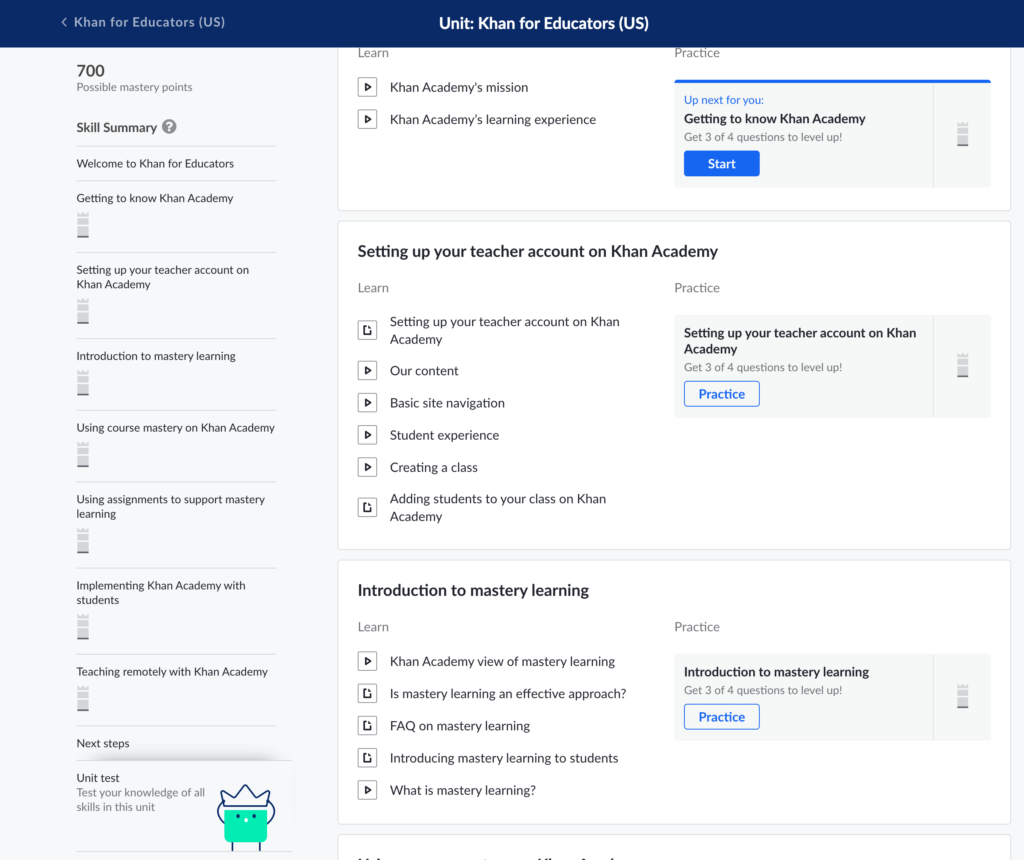
The Kahn Academy has created a summer course for educators. The proceed at your own speed course (what else would you expect from the Kahn Academy) takes you through how the Kahn Academy works, what the teacher does, what the student sees, the principles that guide the full approach, mastery learning, and using analytics to improve instructions. The course is a combination of videos and activities.

I have been a fan since first watching Kahn’s TED talk and assigning his book (One World Schoolhouse) in a class. I was a fan of mastery learning long before Kahn had anything to do with education. As Kahn’s efforts have matured, his content and delivery system have advanced to the point of becoming a bit intimidating. This course is well worth the time if you are interested in using the system with your students.

Loading

Blended, hybrid and other ideas

As the COVID pandemic resurges I am growing more convinced K12 education will look a lot different in the fall. I encountered this post offering some new proposals for models that cut classroom attendance in half in order to allow distancing. For whatever reason, my imagination had become stuck on a model in which half of the students came to the physical school on one day and the other half came on the next. I had imagined that Wednesdays would be devoted to teacher time for planning and going through student written assignments, projects, maybe a few personal contacts. The major downside I saw with this model was the double duty teachers would have to serve when half of the students were face to face and half were joining for at least part of the time online.

One of the ideas in the content I reviewed described a different approach in which half of the students attending in the morning and half in the afternoon one day and then all students were working remotely on the next. Again, Wednesday might be a time for planning and the other teacher tasks I mentioned above. The advantage in this divided day model would be the elimination of the double duty load each day. My perspective which I admit probably imagines working with older students would focus on more intense instruction for a shorter amount of time which I tend to see as more tolerable than what would seem feasible when engaged with students for an entire day.

Loading

Mastery – a personal history

Academics often change their interests as new issues their training is suited to address change. To some extent this is also true of me. However, I can also identify interests that have remained core to my thinking over what is now more than a 40 year career.

When I was in graduate school I read from two sources both published in 1968 that influenced my thinking to this day. These sources from Benjamin Bloom and Fred Keller focused on ways that education could address the needs of individual learners and these ideas for me will always be described as mastery learning. The core idea of mastery learning is 1) that individuals learn at different rates and 2) if these different rates are not taken into account learners will be less efficient in what they could accomplish or more dangerously will fail to accomplish. If allowed to accumulate the knowledge and skills that accumulate serve as the basis for increasing barriers to new learning . Focusing on those with greater learning struggles, over time, this means that learning capabilities begin to differ from others both in terms of requiring more time because of aptitude AND existing knowledge.

The solutions offered by Bloom and Keller were to individualize learning in an attempt to prevent what might be described as prerequisite knowledge deficits. As a graduate student some of my earliest publications (1978 and 1981) focused on research another graduate student and I conducted with a Professor teaching the introduction to biology course at Iowa State.

The core idea of mastery also influenced some of my research nearer to the end of my career. At this point, I was interested in study behavior and how technology supported study might offer feedback to learners to influence the extent of effort they must invest to achieve higher levels of performance. In some ways this research effort quantified the reality of the different amount of time required and demonstrated over and over that it was the more accomplished students who invested in the use of the tools designed to assist students struggling to succeed. A way to succeed is intended to increase motivation, but the reality of what it takes appears to swamp the incentive to use such systems. Perhaps, the university is far too late to begin emphasizing a focus on trading effort for achievement.

I part of the heavy emphasis I invested in the role of technology in education might be described as the opportunity technology seems to offer for individualization. My thinking on this potential was agin motivated by the work of one of the pioneers I credit for kindling my original interest. Bloom conceptualized what I think of as the 2-sigma challenge. He proposed that the upper limit for the potential of educational research was likely identified in the work of tutoring. Tutors working with individuals or very small groups offered a way to respond to individual needs and the advantage demonstrated in the degree to which tutoring augmented the achievement for group-based instruction. To me, well-designed technology supported tactics provided what might be described as a “poor man’s” approximation to tutors. I don’t see technology, at least in the near future, being the equivalent of a gifted and dedicated tutor, but I also don’t see how the finances of providing human tutors as practical. Teachers working with classes of 25+ in elementary and multiple sections of this number at higher levels certainly can’t provide this level of attention.

I am writing about mastery learning again because the idea has resurfaced in the present circumstances of mandatory technology-supported, distance education. Sal Kahn began describing mastery as a way of thinking about what he was trying to accomplish with the Kahn Academy. Another great adaptation I think offers this type of individualization would be Newsela. Reading the same content at different levels is a way to individualize skill levels of reading assuming that background knowledge relevant to the content is not an issue.

I offer details on mastery in other content I have generated. This writing/video includes specific references to key articles. The citations below are what I described related to early and late efforts on my part.

Historical reference:

Latta, R. M., Dolphin, W. D., & Grabe, M. (1978). Individual differences model applied to instruction and evaluation of large college classes. Journal of Educational Psychology, 70(6), 960.

Grabe, Mark, and R. Michael Latta. (1981). “Cumulative achievement in a mastery instructional system: The impact of differences in resultant achievement motivation and persistence.” American Educational Research Journal, 18, 7-13.

Grabe, M. (1982). Effort strategies in a mastery instructional system: The quantification of effort and the impact of effort on achievement. Contemporary Educational Psychology, 7(4), 327-333.

Grabe, M., & Flannery, K. (2010). A preliminary exploration of on-line study question performance and response certitude as predictors of future examination performance. Journal of Educational Technology Systems, 38(4), 457-472.

Loading

Still good ideas

I have written several posts on my ideas for a new type of textbook. In retirement, some of these ideas make less sense for me to act on so I thought I would summarize them here.

There were basically three interrelated ideas. I will expound on the final of these ideas here.

  1. Textbook authors after proving themselves should write on a small retainer and continuously. The process of scrambling every three years to generate a new edition in a few months is not the best way to generate the best product. Content can be posted online as it is developed offering current work to those who purchase the present book and can be worked into the next edition when it is approved.
  2. A paper book is not the best way to get content to learners. It is important to remember I write books related to educational technology. Differentiating content that is basic and stable from content this is likely to change on a regular basis can be the basis for a shorter and less costly book in combination with online content. Placing some content online allows for the provision of current content intended for the next edition (see point one) AND resources that may be useful for some, but not all courses using the book. This second idea is a way to assure greater flexibility.
  3. Textbook users (professors and learners) have insights and experiences that should be shared as benefits to the author of the book they use and to each other.

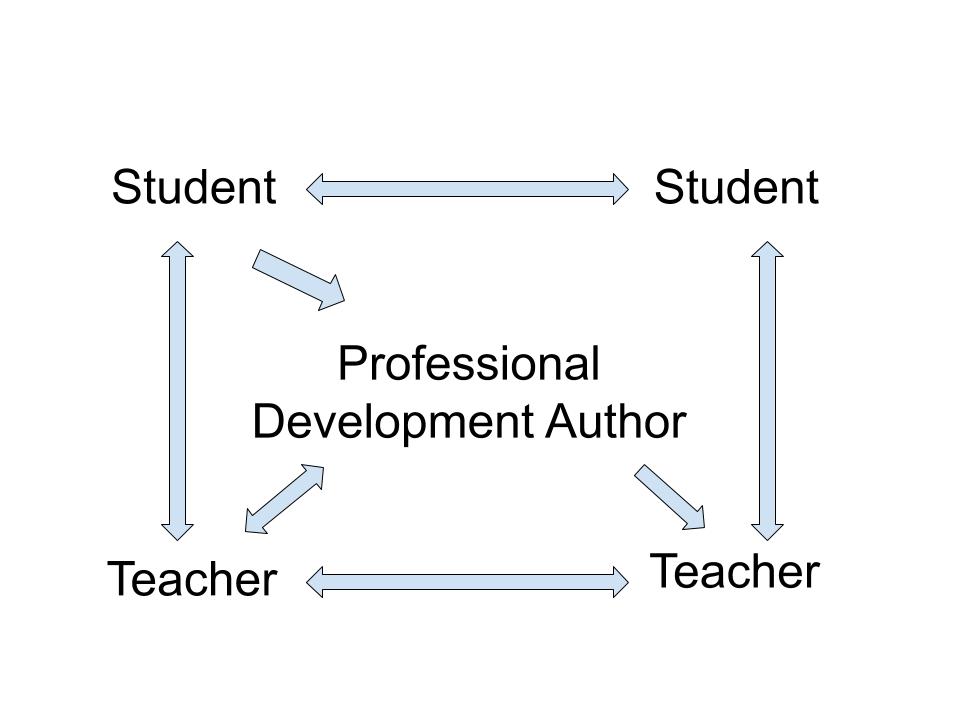
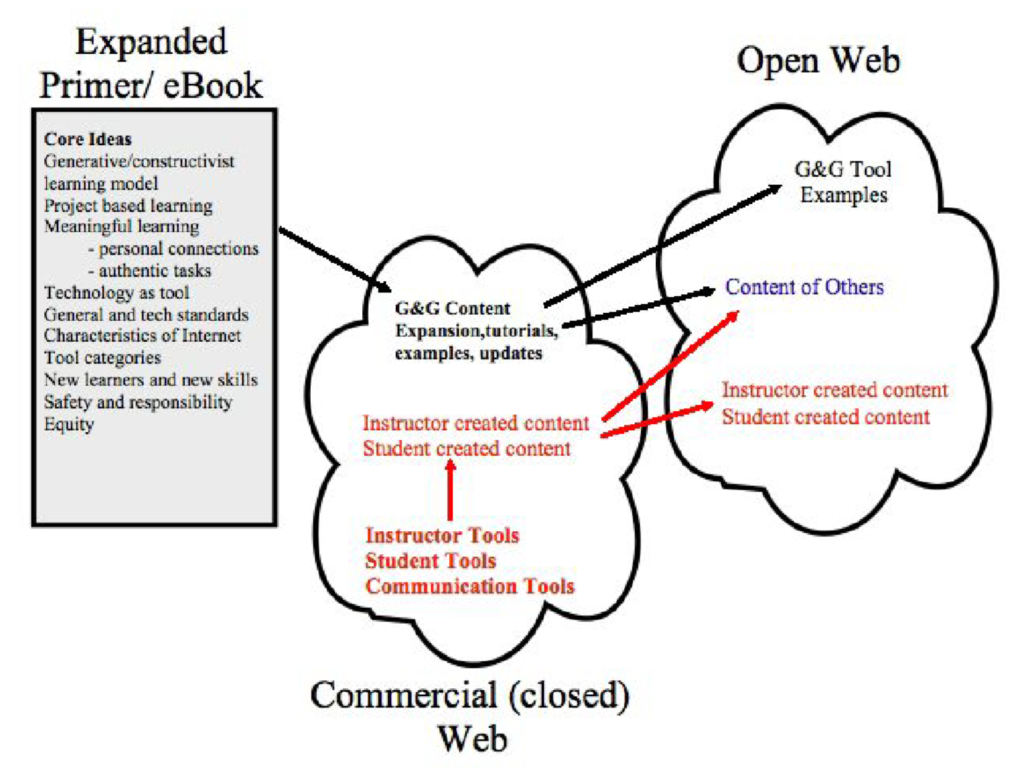
I decided to write this post when going through old content I had stored in Google docs. I found my original proposal and a couple of images. When I prepared to explain my ideas to the commercial publisher of our fifth edition, I made a couple of attempts to explain the third concept I list above as diagrams. I ended up using the second, but the first may make this third idea clearer.

The authors, instructors, and learners using a given textbook are connected. They share a common component of instruction whether they selected this component or not. What I was interested in based on my experience and our way of interacting with classroom educators was a way to take advantage of these connections. We worked with classroom teachers before and during our experience as textbook authors. We used projects with permission we observed in our writing. I used to search online for the title of our book and found some syllabi of instructors using this book. It was always interesting to see what other reading was referenced in these syllabi and what assignments were required of students. What seemed reasonable was to attempt to create such relationships on a larger scale. What if the hybrid system used to offer a textbook (book and Internet) also allowed teachers to share with each other (syllabi and perhaps examples of classroom assignments) and students could also share their projects with each other. These sharing would be voluntary and if monetization was involved it would be based on ads placed on the sources offered by teachers, students, and authors.

Our publisher decided they could not implement the first two of my ideas and we ended up writing a Primer and online content on our own (see the cover in the left-hand column of this web site). We now have less interaction with teachers because we are retired. I still think my ideas make some sense, but these ideas run contrary to the total ownership needs of publishing companies.

Loading