The relative value of social contributions

I tell my class that while they may not be personally interested in the research process they should appreciate that researchers perform a valuable service. Whatever the outcome of their studies,  researchers take the vague terms that we all use and throw around and translate (operationalize) these terms in a form that can be measured. It is not necessary that we agree with how this is done. Whatever is offered gives others a starting point for conversation because they can agree or disagree.

Educators must do a similar thing. They present students a task and then evaluate performance on this task in order to indicate the degree to which the performance meets expectations. Typically, educators must be able to communicate the system that has been used.

In both cases, externalizing something vague in a concrete form is challenging, but necessary.

So, as an instructor, I have asked myself how I would evaluate the contributions to a social learning community over a two week period. For what contributions would I give points and how many for each contribution. I am assuming the purpose of this social learning community is to promote personal learning and the learning of others in the group. Remember – this assumes a two week time period.

  • Membership1 point a day for being a member of the community. Why – membership encourages the participation of others.
  • Valuing – +1, like, etc. – 1 point for each selection with a 5 point per day limit. Why – valuing encourages the contributions of others. While valuing is more active than membership, it requires little time once involved and can be applied multiple times during a short session. Valuing has less generative value for the individual offering recognition.
  • Share link (content created by someone else) – 5-10 points each – sharing the work of others does bring important content to the attention of others. The range of points here would relate to the “value added” of additional personal comments. Sharing a link – 5 points. Sharing a link with reaction – up to 10. I think there should also be maximum value on this variable. There is a diminishing return to a group if many only share. So max of 10 points a day.
  • Comment5-10 points each – comments encourage the contribution of others and engage both the contributor and the commenter in generative activity. 5-10 points per comment depending on the depth of the analysis. Max of 20 points a day.
  • Share original content10-15 points – original content provides benefits to both the audience and the author. 10-15 points depending on the quality. Max of 30 points a day.

So, I see the maximum benefit when content is generated and discussed within a group. A group that simply shares work created elsewhere without comment looks active but accomplishes little.


Powered by ScribeFire.

Loading

Recognizing the divide

Internet content related to topics that interest me seem to surface in cycles. Sometimes I try to figure our why and sometimes I don’t. The digital divide seems to be trending at the moment. I think this is reactionary – other problems dominate the news and then advocates remind us that some of cuts involved programs that helped people needing help. This is only waste in the way some folks think about government spending.

So, here are some of the sources you might explore.
1) Nice overview from Edutopia – I am likely to use this as a source for other sources sometime down the road. My present annoyance is the short sightedness of the BYOD concept.


2) This from the Digital Divide Initiative (new to me). An attempt to explain the long term cost of the digital divide (again the way we address immediate problems keeps setting us back in meeting long term needs). Included are data from some states (Minnesota was the only regional state for me).

3) Finally, there was a recent report from Common Sense media regarding the “screen time” of children before the age of 8. Of course, the topic of screen time goes both ways with both concerns and educational benefits. The report devoted a section to inequities. Check the contrast total media use and technology use by income (you have to explore several sections) – sad – too much passive and not enough active.

OK – there you have it, reading assignments from the “need to share” perspective. Taxes can be good – someone needs to care.

Loading

Highlighting

I have always highlighted the content I read and I have always been interested in highlighting. Way back when, I even tried to do research on highlighting. I have been more successful in publishing studies related to note-taking, but highlighting has many similar characteristics.

Recently, I have found the public highlighting feature of the Kindle app quite interesting. If you turn this service on, Kindle will show you the most frequently highlighted passages in a book. Wouldn’t this kind of feature be of value to students?  What if a similar feature could be enabled for digital textbooks and students could see what other students highlighted and annotated.

It turns out that a service something like this exists. There have been similar ideas (e.g, sidewiki – just dropped by Google I think). Highlighter.com is closer to what I have in mind and offers a service involving “social” highlighting. I am not completely satisfied with the way this works (if you highlight a page, your highlights should be visible the next time you visit), but the concept of group highlighting is being explored and you can access your previous highlights in another way.

A reality check – social highlighting requires the cooperation of the author. I can see both sides of this issue. I guess as an author I would want to have some control when the capabilities of the services allow content to be moved (which is different than taking a collaborator to a site and having previous highlights be visible). I am never certain of the limits. For example, if I highlight an entire chapter on the Kindle will the online page showing my highlights now contain a digital version of that chapter for me to take?

As an author wanting to make highlighting.com available for your content, you have to add a short script to the html above the </body> tag. This will probably scare some people away.

I have added the script to a sequence of web pages I wrote about online safety and responsibility. You can give the highlighting service a try if you are interested. Highlight a section of text and a miniature menu will appear near the content. Also look in the upper right-hand corner of the browser window for a menu that allows access to Highlighter.com.

Loading

It is still a great idea

We got into the book publishing game by being rejected. Our original idea was to repurpose topical coloring books as digital files and provide them to teachers/students with some project ideas. Houghton-Mifflin liked our focus on technology projects for the classroom and offered us a book deal for a more general product.

I still think the thematic clipart idea was great.

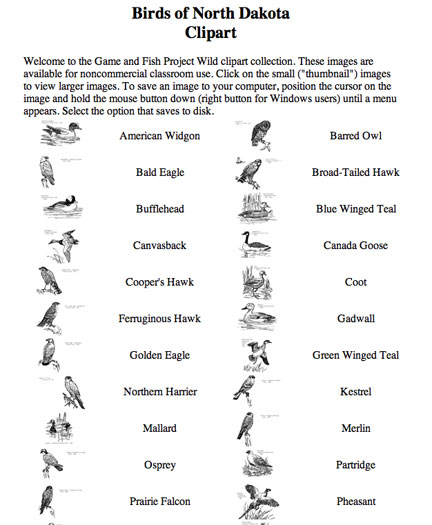
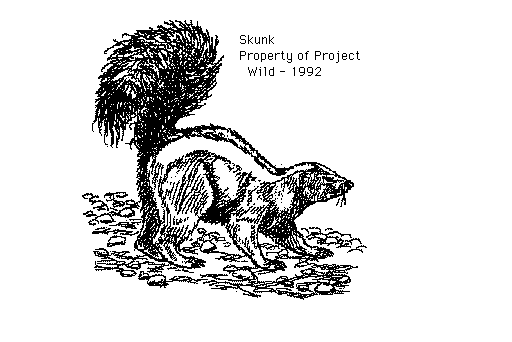
We came to this idea from developing and distributing a clipart collection for North Dakota Game and Fish. I just happened to think of this clipart collection again today. You can still reach the site and download the clipart. We received funding from ND Game and Fish to develop this clipart in 1992 and placed the images on our server in 2001. We originally distributed the images on disk. Images for reptiles, birds, mammals and fish are available.

These are gif files (remember the time frame here) but it should be easy to download (right click on the images) and use a “paint” program of some type of convert to jpg files. The files could be transfered to an iPad and used a wide variety of ways. These files are intended for noncommercial use only (I guess I need to say that).

Loading

Told you so

In several posts over the years, I have wondered aloud about what I thought was a poorly conceived connection between NCLB and politicians concerns with the capacity of the U.S. to compete economically. While getting a higher proportion of students to a minimum level of proficiency is a worthy goal, I have suggested that this goal seemed to me to be different from the goal of generating the creative and advanced types needed to move the economy forward. If resources are limited and fixed and if the goal was to focus on education as economic development, wouldn’t it make more sense to focus more resources on gifted education?

Research just released appears to support my prediction that NCLB would be detrimental to more capable students.

The point is we have so many goals for education and we are cutting rather than increasing resources. I still like what my wife has proposed as a motto – “move every child forward”. It appears that where we focus our limited resources does matter.

Loading

Glean

I have written on several occasions about the problem of finding what you look for rather than what you should see. This is my way of describing what Eli Pariser calls the Filter Bubble (also the name of his book). 

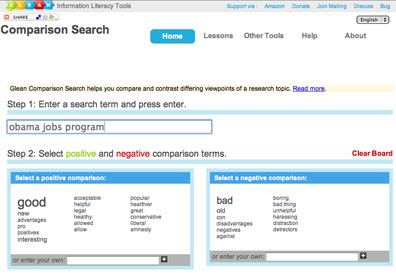
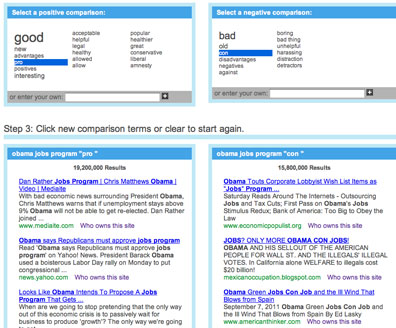
For educators, thorough online exploration is part what might be called digital literacy. Public Learning Media has introduced Glean – an interesting tool for exploring the variety of reactions to a given issue one might find online. You first identify a topic – say Obama jobs program. You then select terms that might describe different positions on the initial search phrase – say “pro” and “con”. The search tool returns hits offering these different perspectives. Pretty cool!


Glean Input

Glean compare


Loading

Trolls and Mutually Assured Destruction

Educators may have limited awareness of the patent battles that now plague technology industries. Everyone seems to be suing everyone. Educators are more likely to be aware of copyright. They tend to understand that the whole sale duplication of content generated by someone else (music, text, video, images) is prohibited. What you may also recognize is what you can do. Perhaps you have heard this described as you cannot copyright an idea. Hence, you cannot copy and distribute what I have written, but you can identify key ideas in what I write and express them in your own words.

The problem with patents appears that you can protect an idea and the idea can be expressed in vague terms. A great piece on this problem has been generated by This American Life (listen or read). The concern is that common functionality of most Internet and phone functionality is described in these general patents even though a general function can be accomplished in many different concrete ways (kind of the opposite of copyright). Supposed to be a breakthrough and not necessarily a common sense good idea. Supposed to be. In other words, an invention and a patent are not necessarily the same thing. For example you might be surprised to learn that a 2000 patent for thermal refreshing of a bread product could also be described as “toasting” or perhaps “microwaving” (an example provided the This American Life). Clearly, multiple ways for refreshing a bread product predated the patent.

That battles among major companies further complicate the patent problem in a different way. They did not necessarily contest a given patent but purchase a huge collection of patents themselves in order to attack any company willing to challenge what they are doing by claiming the complaining company violates a different patent that they hold. It is not even about attempting to get to the point of understanding true ownership, but a threatened battle of attrition that mostly benefits lawyers and mostly fought based on the patent portfolios of the various companies. This situation is sometimes referred to as “mutually assured destruction”.  So, with many ambiguous patents that can be picked up by the thousands if you have billions, you can basically keep the other big companies at arm’s length, but threaten or force any small company out of business.

It is pretty difficult to interpret this situation as protecting the rights of inventors, bettering the economy, or assuring that consumers have access to the best products and services possible. Like the lack of regulation that led to the recent stock market and banking crisis, this seems to be a failure of oversight that would seem best placed under the control of the government. There appear to be secondary businesses that built on the need to protect the legitimate rights of inventors but rather function primarily to take advantage of broad patents to make money for the companies rather than the inventors.

Example of technology patent battles


Loading