I think of summer as an opportunity for teachers to try some things that may be useful during the time when they work with students. Here is an easy recommendation. Try the Brave Browser.
Brave can be installed on any device and is based on chromium so anyone who has used Chrome will know pretty much everything there they need to know to use it. I have yet to find an extension I use on Chrome that will not work with Brave.
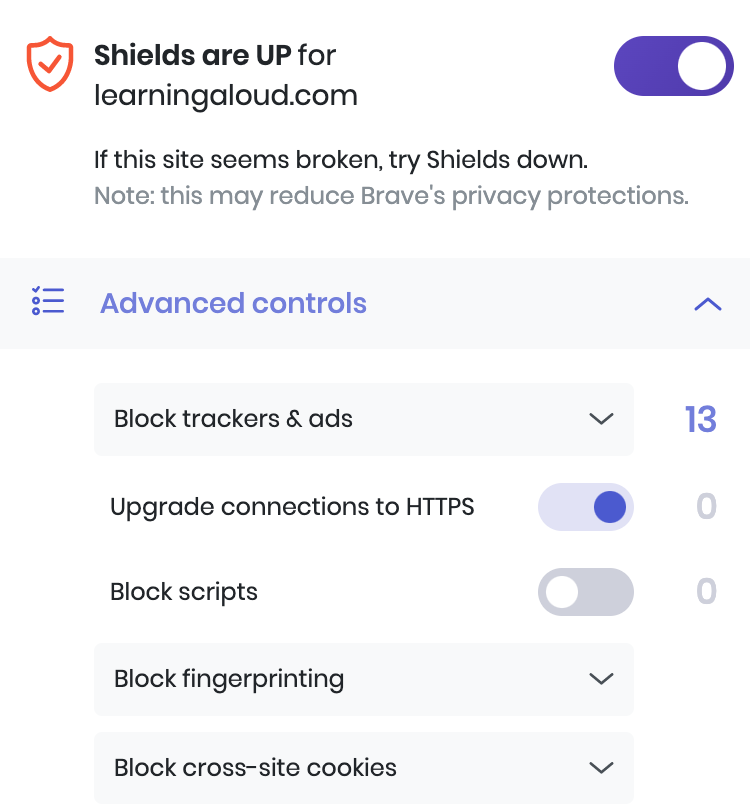
I recommend Brave for two reasons. First, it blocks ads, cookies, and scripts. I have few concerns about ads, but the collection of information about me and my online behavior through cookies is a concern. Brave can block all of the intrusion and turn capabilities back on for specific sites if necessary. I have found a few sites that require cookies for full functioning.
As I said, I am not concerned with ads per se and I understand that ads are a legitimate source of revenue that supports content creators and infrastructure providers. Brave is part of an ecosystem that provides a solution. If you are willing to view ads provided by Brave, you will be compensated with BAT for viewing these ads. BAT (basic attention token) is a type of cryptocurrency. Rather than keep this incentive, I suggest you use it to provide micropayments to the sites that register with Brave. This is a way to compensate content creators and online infrastructure services that rely on ad revenue.
The system is still evolving and has some obvious limitations. First, many service and content providers have not registered with Brave. In some cases (e.g., Google) there is a conflict of interest. Second, the ads shown seem dominated to cryptocurrency-related companies. I suppose this is because Brave is associated with a cryptocurrency and users may be more open to this means of exchanging revenue. I believe there is a chicken and egg situation with advertisers. The audience brings interest in advertising and too many shy away because they don’t understand crypto. You don’t have to understand or invest yourself to use Brave. I think of the system as a type of micro-payment system. If there was a similar service that allowed me to dole out a few pennies here and there based on my online behavior, I would it a try as well.
I was by trade a research-focused academic in the fields of educational psychology and educational technology. I conducted research and generated publications based on the data my studies generated. I also wrote and continue to write instructional materials (books, blog posts) for educators based mostly on the research of others. Scientific research builds on itself and you fashion the explanation of your findings from your data, your methodology, and the positions and findings of other researchers. Writing to educate relies heavily on the analysis of existing research and you make your case by summarizing and referencing multiple articles authored by others. There is a tremendous amount of reading that is involved in both types of activity.
Aside from the reading, this type of work requires the storage, organization, and retrieval of information. There is also the challenge of searching the nearly limitless trove of existing work for publications that are relevant to your specific interests. You have to do the work of reading and understanding content, but you can use technology to make the related tasks (storage, search, organization, retrieval) easier. Many of us who do this work are constantly searching for such tools and this quest also ends up being an area of investigation. I have written multiple posts on this blog about tools for taking and organizing notes.
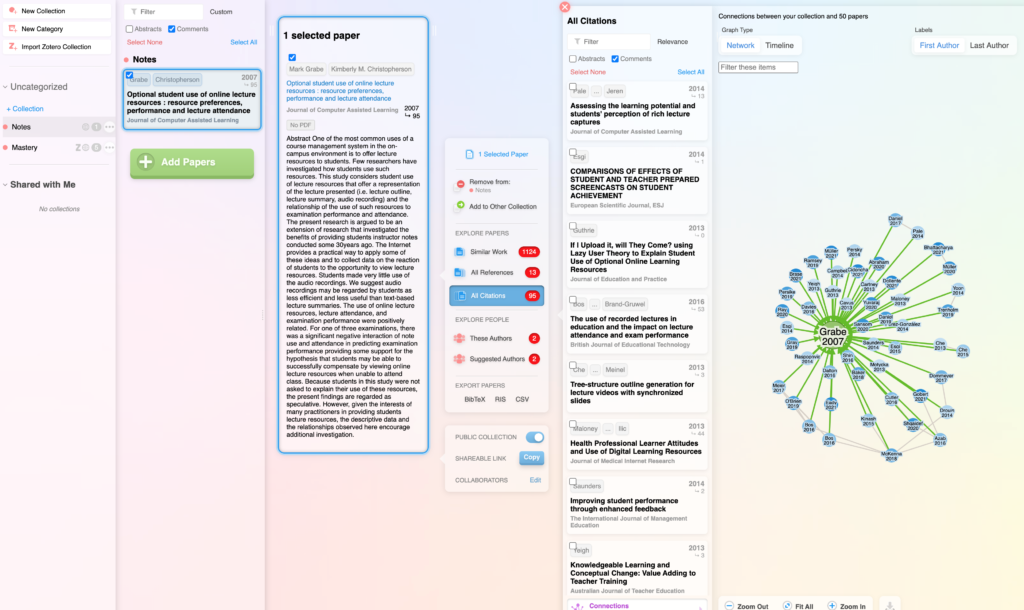
This post is focused on a tool for locating relevant content I should read. There are lots of ways to search (e.g., Google Scholar) for relevant content, but Research Rabbit goes further and builds on the web of citations that exists among published research. Rather than being limited to the citations included as part of a given source, Research Rabbit reveals the web of sources that spread among individual papers – the citations in one paper point to other papers and the citations in these papers point to other papers, etc.
This web is interesting to explore. As is often the case with search, I started by searching myself. Quite a few years ago, I was conducting research on the consequences of distributing lecture notes in large lecture classes. There are interesting related questions. Do students skip class if notes are available? Do students who use these notes perform better than students who use only their own notes? These topics have received more attention lately as educators consider what online resources to make available to students. I began my search with a paper on this topic I published in 2007. From this paper, I can locate papers that cited my work. I can collect the information I need to locate and read papers that offer abstracts that interest me. I can see what papers these authors cited and who now cites them. I can build topical collections of papers and I can offload these collections to another tool better suited to generating and organizing my personal notes after having read some of these papers (see second image showing a collection of papers on Mastery Learning brought into Zotero).
These tools are free and available online. You don’t have to be a researcher to use such tools (see the YouTube video). Find the title of a paper that interests you and you can then locate related content by entering the title of this paper in Research Rabbit.
Independence for creators and readers has become a significant issue with online media. Creators want to retain control of the content they create rather than giving their content to a social media site like Facebook or Medium. Readers want control of the content they consume rather than having the content prioritized by an algorithm the reader cannot control.
The RSS system provides a way for a reader to locate the multiple content providers they want to follow and to make the process of having new content from these providers identified so they can access this content without visiting many individual sites. When enough readers use RSS, content creators can be assured that the good content they create will be accessed while they retain full control of this material.
Inoreader is a powerful RSS reader that is easy to use. It is free with limited features and capacity that should meet the needs of most readers. With experience and commitment to the product, it is easy enough to switch to a paid version.
The following video demonstrates the basic features of Inoreader.
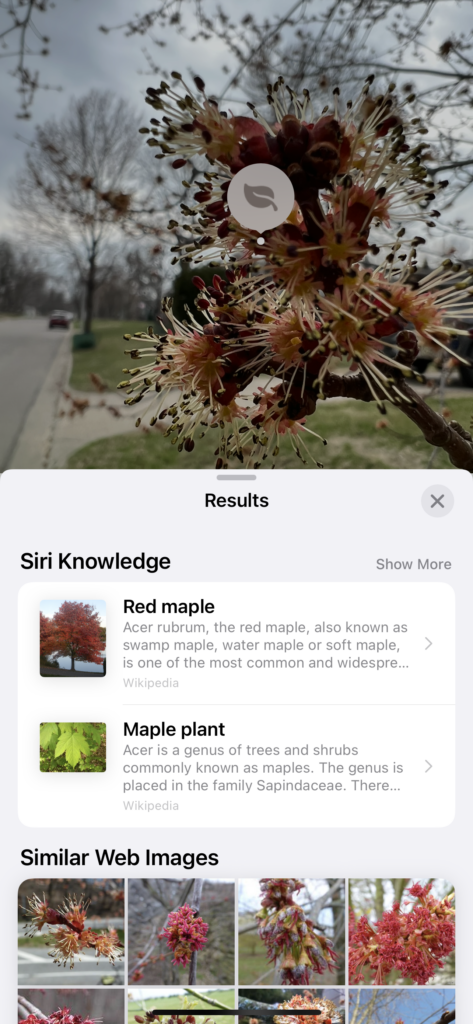
Apple appears to be closing the gap with Google when it comes to visual identification (Google Lens). I was taking a walk today and came across an interesting structure as a tree budded out. I was curious what Apple could do with the image I captured.
Apple Photos (iOS) has added the capacity of image identification for certain types of objects. MacRumors says landmarks, plants, and pets, but give it a try for other objects as the capability expands.
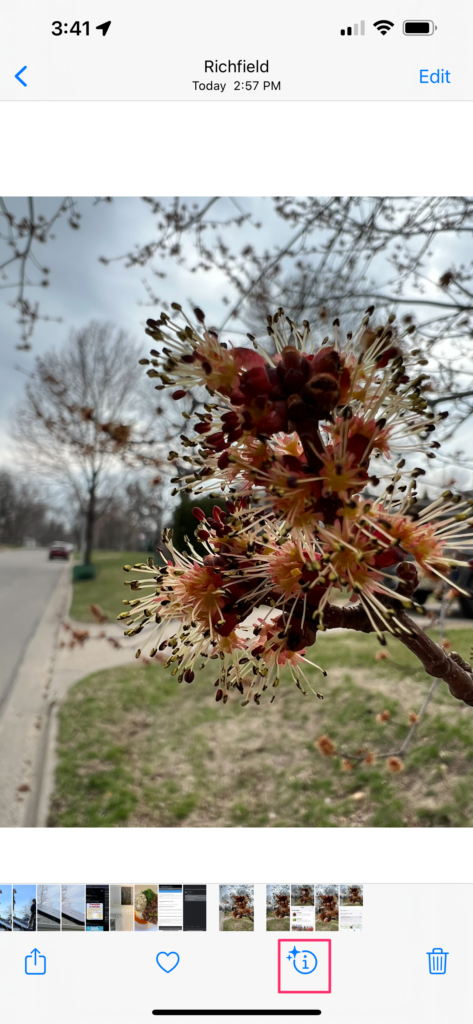
I will take you through the process. Here is the image I captured. Below the image note the Info icon. It has stars around it meaning the system thinks it may be able to identify the image.
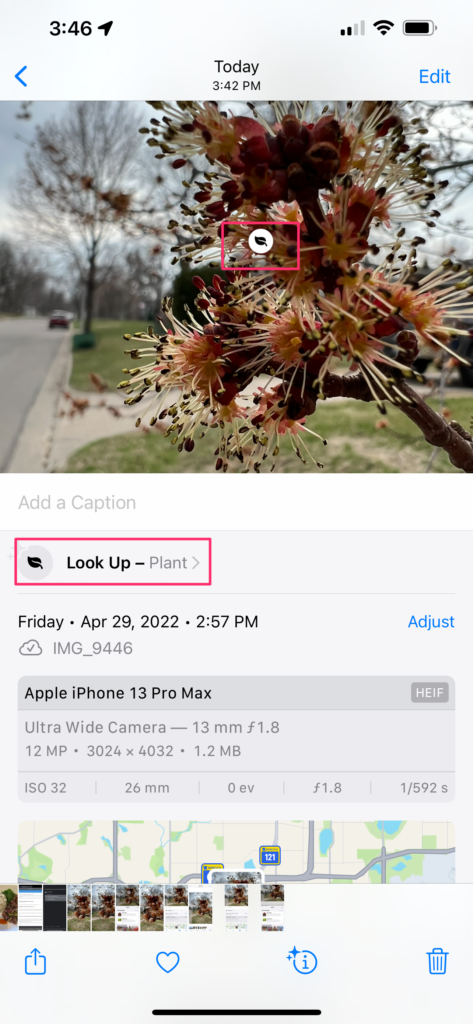
If you select the Info icon, the system adds a small leaf to the photo and asks if you want to look up what it knows to be a plant (see red boxes).
Lookup offers several comparison images and links to sites the system assumes verify the identification. In this case, the “guess” is a red maple. The similarity to the comparison image leads me to accept this as correct.
Google lens still seems more advanced. The following video offers some of my explorations with Google lens.
If you are reading this, you are a financial participant in the economic system that supports the Internet. This claim is not intended as a reference to the fees you pay for your phone data plan or the connection you use at your home or business. The money we all pay to access the Internet is another issue and beyond access has nothing to do with supporting the service providers and the content creators that make the Internet worth using.
Beyond the money paid for general Internet access, many spend no more money for the services they receive. They don’t use a check or credit card to compensate Google for searches, Facebook for social interaction, or the writers and videographers for the content users access. Others may pay for a few services, but also use many others without spending a cent.
I am guessing you understand and see in your own online experiences that your willingness to view ads is how you compensate someone for the valuable experiences you receive. I am assuming you are not among those who block ads as this action would violate the trust the free services put on you to understand that the services you receive are really not free for them to provide. Internet ads interest those who pay to have them posted largely because these ads can be targeted to the interests of viewers and thus are more valuable than ads they could have placed on television, radio, or in your daily paper (if you get a print copy). Of course, this means that to receive targeted ads companies have collected information about your online behavior to make educated guesses about your interests. Just to be clear, ads cover a wider variety of targeted information than most of us probably recognize. Ads may attempt to interest you in a specific car or brand of laundry detergent, but also a political candidate or cause. You may not recognize that those who want to convince us of specific facts or fallacies may also send information or disinformation our way based on what they can learn about you. It is this hidden effort at persuasion that is of concern, but part of the financial incentive opportunity that supports the Internet.
The hidden incentives that encourage Internet service providers have drawn the attention of politicians and this attention may eventually result in some restrictions. Of course, any time politically mandated restrictions are mentioned, other politicians will resist and legislation becomes very difficult to pass.
Allow me to propose a solution you might try while we all wait for legal guidance.
I think that Internet users should pay for the services and content they receive. I think this is the only commitment that makes long-term sense in terms of saving the open Internet. There are several ways to do this without relying on the collection of personal information and targeted ads. Some form of micropayments makes the most sense. You pay a small amount when you visit and use content or a service. Just to be clear, I am describing a system that replaces the types of access now funded by ads and not the services that are behind a paywall (another issue not addressed here).
What I recommend is that you explore and use the Brave Ecosystem. I have no official connection with Brave, but have used this system as my primary way to work online for a substantial amount of time. Brave is a browser that is based on chromium. The Brave browser should be an easy transition for anyone familiar with the Chrome browser.
It is an understanding of the ecosystem behind this browser that is what I am promoting. This ecosystem could be used in what I consider an unethical way, but the system is designed with the potential to compensate participating online services and content creators. The Brave browser allows you to block ads and the collection of personal information. If this is all you use it for, I regard your behavior as unethical. Brave allows you to support the online community by contributing money to the ecosystem that is allocated to online resource providers based on which sites you visit and how much time you commit to specific sites.
In addition or as an alternative to contributing money, you can also commit to viewing ads on Brave. Those wanting to advertise on Brave pay just like those wanting to advertise through other online ad systems, but these ads are not shown based on information shared back to the ad companies. Brave uses a system that resides on your devices to categorize you in a way that determines the type of ads you will see. You can keep the money you receive OR you can allocate these funds to compensate the providers associated with the sites you visit. These funds work just as well for compensation as funds you send Brave out of your pocket.
Brave is not perfect, but I support this model and have participated since the early days of its development. Like so many ideas associated with the Internet, the value of an idea grows with the number of participants. More participants would attract more companies to have their ads included and more participants among resource providers. The success of Brave would also encourage other companies to try similar models.
I hope the following video provides a concrete look at how Brave works.
I try to come up with a useful post for educators as we approach earth day. Earth Day offers a great day to highlight the challenge of climate change which is so easy to forget in the midst of other concerns. In the long run, the urgency of addressing climate change at this time is possibly greater than other concerns that preoccupy our political processes and our attention.
There are plenty of only Earth Day resources for educators, but I will offer a few for those who have not had the opportunity to search.
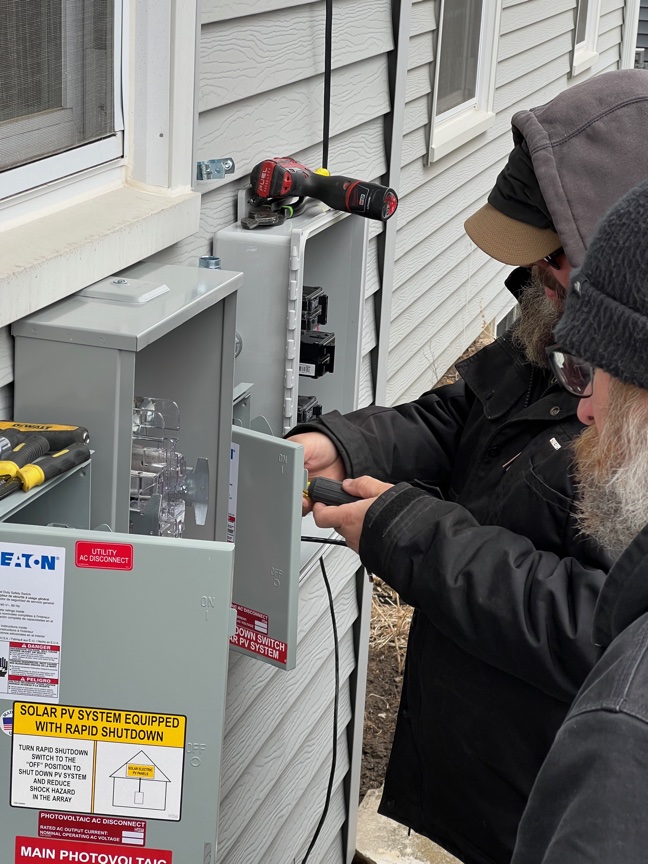
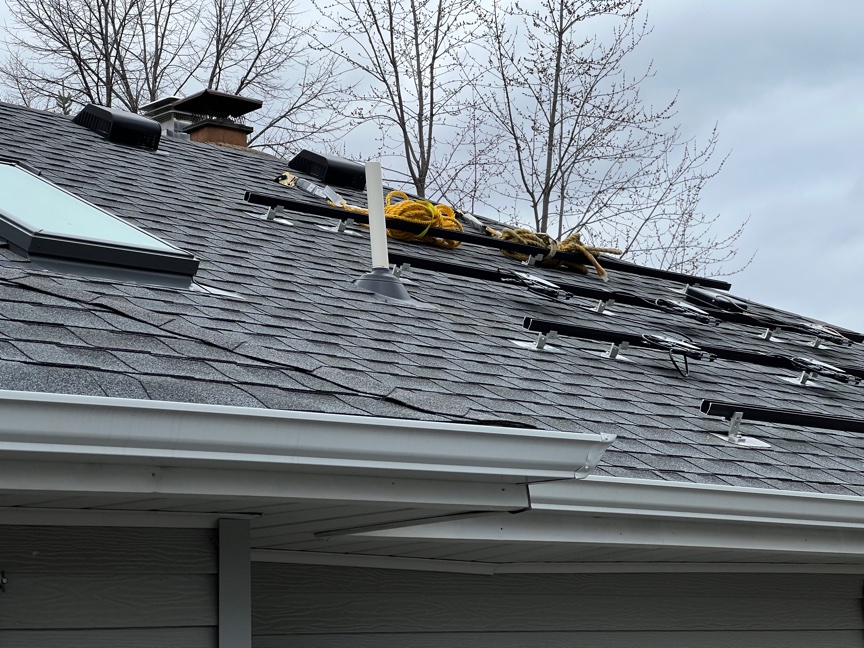
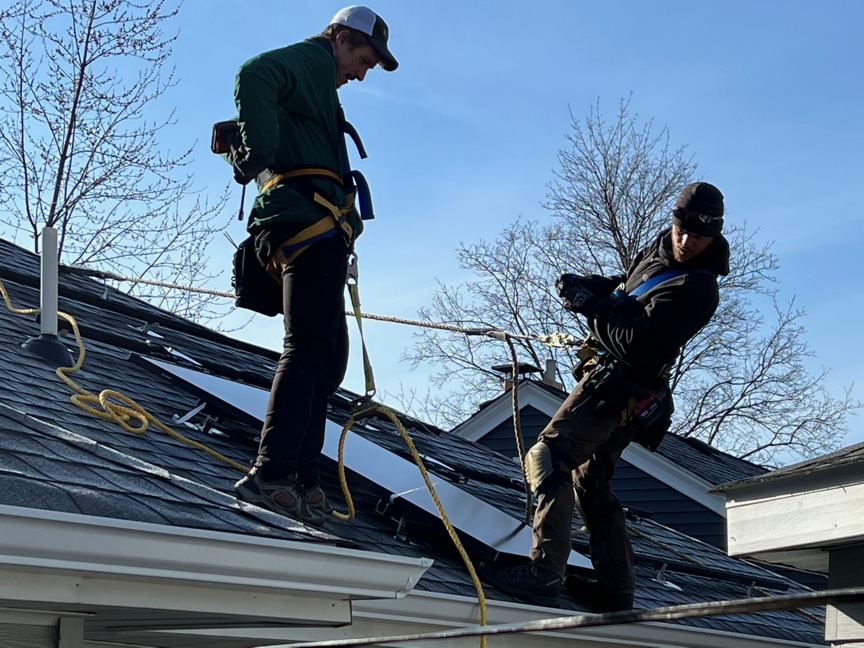
By chance, I can offer something a little more personal this year. I have been interested in solar panels for some time. We decided to move beyond my small-scale explorations and add solar panels to our home. The process has stretched over a couple of years. By chance, the process was completed this week. We now have our panels installed, know they work, but still must wait for our power company to approve the installation and make the connection.
The delays or the past year or so involved 1) needing to replace our shingles which had some hail damage and were old (you don’t want to pay for panel installation if you will have to pay for their removal and reinstallation within a year or two) and 2) waiting for the solar panel subsidy to be renewed in a new year. We were told that our investment would not actually cover the cost because our electrical bills were low. We use natural gas for heating our home, cooking, and heating our water. These commitments are new and we won’t change for some years. I suppose air conditioning is our largest use of electricity. Maybe we will add an electric vehicle within a couple of years. We installed solar because we wanted to be involved in alternate energy production.
I have decided to cross-post some of my blog content to Medium. Medium offers content creators the potential for revenue based on the amount of traffic you generate once you accumulate 100 followers. When you get to this level you are eligible to earn money based on views of your content that you are willing to put behind a paywall. Of course when you place content behind the paywall only Medium paid members can view this content. This is the point at which you may have to decide whether you are interested in reader attention or some small amount of income. At some point, I hope to have to make this decision.
You pay $50 a year for full access to Medium as a reader.
There are plenty of ways a writer can make content available on the Internet. I have had a blog since 2002 and I created other web content at an even earlier date. I have always either run or leased a server to post my content (see previous post about running a server). There are some technical challenges in controlling your own server, but purchased hosting can now rely on scripts that automatically update software and databases so you don’t have to keep your own software current. This blog and others I run make use of WordPress and use a MySQL database backend. It is great not to have to continually patch this software yourself. For the curious, I pay about $200 for server rental and domain registration per year through a company called Bluehost. This amount allows me the opportunity to host multiple blogs and other content.
I have never thought of my online content as a way to make money. If I have ever had a motive beyond that of an interesting hobby, the motive would have been to bring attention to the textbooks I have and continue to publish.
There are some interesting issues some consider when deciding where and how to offer the content they create. Here is an example. You may spend some of your time making contributions to and reading the contributions of others on Facebook. As a content creator, you receive no compensation from Facebook for the content you create. You do benefit from a free service that allows others to read your content. The argument is that while this is a benefit, you are already compensating Facebook through your attention, the sharing of your personal information, and the view of the ads Facebook posts. Content creators may take their elsewhere for this and other reasons.
Other situations involve different considerations. For example, this blog does not require me to allow a service such as Facebook to use my content at no expense and I can show ads on the blog as a source of revenue. There is that $200 that the hosting site makes and the reality that the ads I show generate maybe $15 a year, but at least I own and control my own content.
Here is the complicating issue. Revenue is one personal benefit, but so also is the attention of others. I may have benefit from this attention (e.g., interest in my books) or just the satisfaction of offering a service others find valuable. Whichever it might be, the reality seems to be that reader interest in personal blogs seems to be on the decline. Competition with information sites that offer all you can read or view content (Facebook, Instagram) and large commercial information sites (e.g., Google or Apple News) provide an easy one-stop shop that satisfies the needs of most readers. The decline of the use of RSS readers by which a reader could set up a feed providing them with any updates from multiple blogs they designate is associated with this change. It is hard to know if this decline is a cause or consequence. I do know that much of my blog traffic now comes from Twitter (a tweet is generated when I generate a new post) or searches. Much less comes from subscriptions to an RSS feed. Twitter works great as a referrer, but the impact is limiting to the number of Twitter followers I have.
Medium offers an interesting middle ground. It consolidates content from many writers providing the potential for the discovery of content from new writers. It does not show ads or collect data from readers and it is free to a point for readers. Medium supports itself by taking a cut of the $5 a month or $50 a year all you can read readers pay. Medium allows cross-posting and makes this process fairly easy so there is not a need to make the choice between a blog and Medium. I would not shut down my blogs under any circumstances. I have too many years (decades) of investment in the body of work I have built up. I have just decided to experiment to see if an expansion of outlets will expand my reader base.





You must be logged in to post a comment.