Google has prepared a production guide for YouTube Creators. This guide is available as a pdf (here is the link to the pdf). You may be one of those who refuses to read the manual, but sometimes it is helpful to have it on the shelf.

Google has prepared a production guide for YouTube Creators. This guide is available as a pdf (here is the link to the pdf). You may be one of those who refuses to read the manual, but sometimes it is helpful to have it on the shelf.
Some years ago I remember a cable channel (Channel One) providing educational content was criticized because the content contained ads. I remember my reaction. If content a student viewed at home contained ads, why would content they viewed at school have to be different? At least the educational content was educational.
Today Google announced (see Google comment, EdWeek description) there would be no more ads in the free GAFE opportunities for students. I guess I understand the issue – parents may have a position on whether they want their children to be exposed to ads and schools using Google services may not be sensitive to the parents position. I do think it is more complicated than this. Google did provide a way to turn off the ads. Most parents probably don’t care because they allow their children to watch television which offers no on/off switch for ads. I often describe the reality of education vs. interesting ideas as the challenge of taking ideas that make sense for individuals and struggling to determine how to apply the ideas to a group. Typically, I am describing an idea someone has about a specific instructional idea (coding, making, etc.) that are ideal for some. It seems to apply to what and how we are willing to pay for education as well.
I wonder if anyone ever thought – we should say thanks to Google for allowing our students/children to use these valuable services without compensating Google. Do we somehow think we deserve such opportunities? Why? (Reminds me of the Chris Anderson book – Free: The future of a radical price).
I realize that I not a digital native and may be out of touch with this technology stuff, but this morning’s visit to the dentist brought a new learning opportunity. I was scheduled for x-rays and instead of sticking that small piece of “film” in my mouth the technician inserted what I suppose was some type of CCD device connected to her computer. She said it saves having to have a patient stick around to see if the x-rays show what they want to see. I told her it sounded like a digital camera. She seemed surprised I knew about digital cameras.
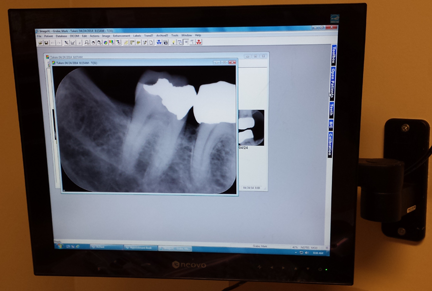
Evidently one of these teeth requires a crown. Growing up on a farm without flouride in the water has resulted in life-long consequences.
The technician seemed surprised when reclining in the chair I pulled my phone out of my pocket and took this picture. Evidently, no one had ever done that before. I was primed for the opportunity. I had a MRI to determine whether I had a concussion after a bad fall on the ice and I regret not capturing the moment of looking at my brain on screen. A picture of a couple of my teeth will have to do. I probably violated some HIPPA rule, but I was too fast for the technician and she was too surprised to stop me.
Thinglink allows the sharing of tagged and annotated images (see link by positioning cursor over image). Thinglink works across platform and device allowing users to work from a variety of devices. In an educational setting the opportunity to work from handhelds in contrast to a camera would offer some advantages as students could annotate images as the images were collected.
If you identify yourself as a teacher when signing up for a channel, Thinglink allows you create channels (see instructions). Channels (see example) offer a way to organize images into albums. As you see from the image below images or channels can then be embedded in other outlets (this is an example of an embedded image).
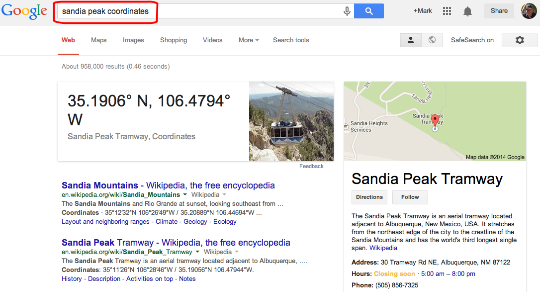
Here is another Google search feature that was new to me (credit to Daniel Russell for the tip). You can determine the latitude and longitude for a location of interest by search for locationname coordinates. I find the ability to geotag images of personal and educational benefit so this feature caught my attention. I have a very nice camera that takes great photos, but does not record coordinates. A cell phone will often collect such data and I commonly combine phone and camera photos for this reason.
Here is a demonstration for the location Sandia Peak (the search would be Sandia Peak coordinates).
The search results:
Here is a photo at the top of the peak captured with my phone (the exif data are provided). The data are difficult to read, but are very similar.
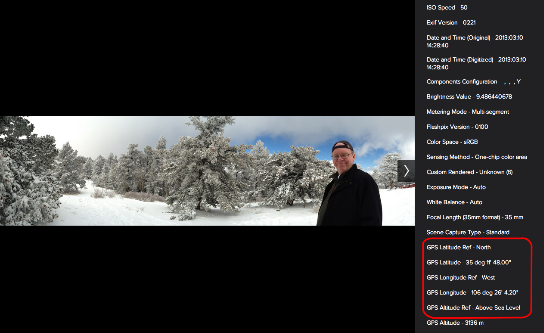
I see this is a post production tool useful in some situations for “mapping” digital camera photos.
Apple does not have a great reputation for cloud services, but it keeps trying. I discovered by accident today that Apple now offers browser-based apps for Numbers, Keynote, and Pages. Work that you have done on your iPad or your desktop can now also be modified using a web browser. I guess this is interesting, but it took me a while to see what advantages the web version might offer. Perhaps you do not want to pay for the desktop apps, but want to continue work you have started on your iPad (since the desktop apps cost $20 and the iOS versions are free this might be one use case). I do still like working on the desktop for bigger projects and the cross device capabilities with the iPad may be helpful.
The web version allows collaboration in real time. I admit I have never collaborated in real time when this was possible (Google), but it does sound interesting.
Google, Apple and Microsoft now have slight different versions of the same cross device / web model. Competition is good.

One of my motives in moving from a commercial textbook company to writing through Amazon was the desire to write on a continuous basis. My frustration with the commercial approach was that you ignored your work for three years and then worked feverishly for 3-5 months in order to generate the next edition. I saw there were two problems in this approach. First, hard copy textbooks are out of date when first published (at least when addressing technology) and it made sense to me to take an approach that would allow me to continue to offer new content (online) as soon as the content was relevant. Second, the hectic pace of meeting a deadline does not allow for the best analysis and writing. This was particularly the case for me as my academic job means I have the most open time in the summer and this was not the time frame during which the work had to be done. The commercial folks never disagreed with my analysis, they just did not want to pay any amount for a future edition and would not offer an advance.
You may or may not understand how textbooks are financed. After the first edition for which you should be able to secure an advance on sales, the company decides whether or not a future edition will be offered and does not offer an advance. Since you, as the author, do not own the copyright but share it with the company, you are not free to suggest that a different company might be more willing to support the authoring model you propose.
Anyway, we have now exclusively held our copyright for several years and I have been offering resources based on this approach. We have a web site offering “supplemental” content to our book since it was released and I plan to rework the core book based on this content this summer. Since, the release of the latest edition the topic of “computational thinking” (programming or coding to many) has kind of returned to favor among practicing educators. You may be aware of this trend or perhaps interest in the “maker movement” which often incorporates programming skills. I have prepared a chapter and supplemental resources for our the next revision of our book. Rather than wait until this summer to make the “chapter” available, I am offering the draft of this chapter on our web site. This content will be available from the site until the revision of the book is complete. If you are interested in computational thinking and would like to review my take on the topic, access to our web site is available at no cost.
Beta content – http://learningaloud.com/grabe6/code/index.html

You must be logged in to post a comment.