Dark ads

The prominence of “fake news” has gained a lot of attention in the wake of the recent election. It may have been even worse than this. I could argue that you bring fake news on yourself. You receive fake news from a site such as Facebook or Twitter because you follow someone who posted the fake story. You contribute to the problem if you retweet or reshare. You may end up as a victim of such falsehoods, but at least, in this case, you can blame the individual you followed for leading you astray. It may eventually be possible to flag suspect stories much in the way Wikipedia now includes notices with stories that fail to satisfy certain standards.

What you may not realize is that you may be targeted in an effort to manipulate you in some way by a completely independent source. Facebook allows what are called “dark posts“. As I understand the dark post, it is essentially an ad the source sends to a subset of users. What is allowed as an “ad” appears to be much more open to interpretation than you might expect.  This NYTimes opinion piece by McKenzie Funk claims dark posts were used by the Republican presidential election committee to “micro-target” users either to encourage a vote for their candidate or to discourage those opposing their candidate from voting. The detail in the Funk article is helpful in explaining how this was done. This wmicro-targeting was based on a massive database accumulated on millions of us by Cambridge Analytica. Forbes takes a similar position. The Forbes article provides greater detail on the different approaches taken by the Democrats and Republicans, but while noting the greater use of micro-targeting by Republicans provides less information regarding how this was done.

I assume must of us recognize that the social media ads we see are based on our own behavior. In theory, we supposedly see ads we want to see. The dark-ad feels different to me. I wonder what disclosure is required and if you or I received these ads whether we realized the source. That message that is required at the end of television ads is certainly absent or less prominent when we are targeted online. Without an awareness of the source we have less information to interpret intent.

So, as educators, we attempt to develop critical thinking skills in preparing students for what they will encounter in the “less friendly” real world. How distrustful should we assume we must prepare future citizens to be?

Loading

Free speech should require you say something

Shortly after the conclusion of the uniquely contentious 2016 Presidential election, Buzzfeed released a disturbing report on the prevalence and popularity of fake stories related to the election.

You may have seen this chart somewhere.

sub-buzz-441-1479332078-1

The chart describes the shares, reactions, and comments for the top twenty fake election stories and the top 20 stories originating from actual news services in the run-up to the election. In the critical period before the election, fake stories generated more “engagement” (the term Buzzfeed used to describe their composite variable). A large proportion of the popular fake stores were pro-Trump or anti-Hillary (17 of 20) and this disparity in combination with the contentious election led to public outcry directed at Facebook and concern that the public has been manipulated by the content they encounter online. Take a look at the article for links to some of the fake articles.

In an era in which social media has become a major part of the battlefield for politics, the credibility of content raises serious questions related to how voters make decisions (a similar NYTimes story on twitter bots and fake information). Given the outlandish comments made by the candidates, perhaps no one should be surprised. Social media promises to open political conversation to everyone at low cost, but more and more the opportunity for individuals is overpowered by the promotion of falsehoods.

Social media users are partly at fault. Some months ago the Washington Post described a study demonstrating that approximately 6 of 10 individuals posted a story consisting of gibberish. The implication posted stories are often not read by the individual recommending the stories. Consider this in combination with the Buzzfeed study and consider how this works. As the election neared more and more individuals made their personal decision and were attempting to influence others. It seems likely it was assumed more extreme stories would be more persuasive. The titles of articles were likely as far as many so motivated to influence got and sharing is so easy. No fuss, easy, and completely fabricated. It is difficult to know if anyone really read these articles, but the titles may have provided the message.

Facebook and other services question whether popular fake news had any impact on voting behavior, but promise to address the problem. Fake news may be protected as free speech, but some ad providers say they will not honor ad revenue from the sites.

As educators, we go on and on about the importance of information literacy. We try to teach learners what to look for and how to be critical thinkers. Here is what I think is a new concern. The issue with social media is a little different than the issue with search. It is one thing to find resources on your and then evaluate the credibility of these resources, but this is different from the challenge of encountering resources endorsed by someone you may trust. I wonder if this difference between found and endorsed resources has been considered.

I am beginning to develop a personal perspective on this problem. I think sharing is far too easy. Amazon has a thing with product reviews that indicates whether the reviewer is known to have actually purchased the product. It is too bad that there is no way to indicate whether a shared source has actually been read. My recommendation would be to avoid any recommendation that does not include some message of justification from the individual promoting a resource. Free speech should at least require you say something yourself.


Loading

Layering guidance

I have been thinking about a way to support learners processing of online content. I have decided to describe this as layering guidance. I like the physical imagery of adding information on top of information with the intent of guiding a learner.

I decided this concept applies to a number of services educators can utilize. in the video that follows, I attempted to use Hypothes.is and DocentEDU to demonstrate what I mean.


Loading

Educational funding slow to recover from economic downturn

Some years ago we were visiting friends who live in an Atlanta suburb. They were describing the conditions in their local public school and to us they sounded horrible. I remember thinking that the strategy seemed to be to put as little into public schools as possible and allow the wealthier parents to spend money to send their kids to private schools allowing these parents to invest directly in their own kids.

My personal experience has always been with the way state-supported higher education is funded. I also think issues related to the cost and support of higher education get more attention. The results of this attention are now always positive (from my perspective), but various positions are argued in public. The funding models are also obviously different. State funds from tax revenue provide some support for institutions at both levels, but k12 support relies mostly on local property taxes and higher education on tuition and contributions for the rest.

Recovery from the economic collapse has been painful. I was less aware of how K-12 budgets have suffered. Both government and local support have been slow to respond to the needs of students. Schools have been asked to meet higher standards with fewer resources.

Both articles linked from this post focus on the politics of this lack of support. The U.S. News and World report article contains this statement highlighting the heavy burden placed on funding for education.

“When families face tough budget choices, parents’ first priority is to protect the kids,” First Focus President Bruce Lesley said in a statement. “But Congress is actually cutting funding for children more than twice as fast as spending overall.”


Loading

Explain Everything Expands

Explain Everything has long been a personal favorite when it comes to recommending a general-purpose authoring tool for K-12 students. I have not paid attention to more recent developments for this product line. This is my effort to catch up.

Explain Everything was originally a product specific to the iPad. There was a tool for using Macs to render projects into video, but authoring activities were unique to the iPad. The number of platforms able to author with this product has now been expanded. Users can now create using Windows, Chrome or Android.

Offerings have also been differentiated as the basic version (iOS only) that allows externalization via a video for sharing and a product with additional features including real-time collaboration (promised) and hosting (the Discover Portal).

explainfeatures

pricing

I must try to separate my personal use of the tool from the potential for the classroom (multiple users). Here are a couple features/issues to consider. First, how do you think about purchase vs. lease of a product. If you teach with iPads, you can still own Explain Everything. A teacher with iPads could also use the leasing option ($2.67 per user per year – minimum of 5 users). The leasing option is required of Windows, Chromebook and Android users. Does this matter? I am not certain how to analyze the situation in order to respond. Try this – say you assume you would use a purchase for three years. Multiple the lease price by three and the total is very close to the cost for purchasing the more capable version of the iPad app. For those not using iPads, I would say leasing makes sense. However, these folks really have no options. The real decision must be made by educators who use the iPad. Is the difference between the classic and more featured version meaningful to these teachers and how strong is their commitment to the product? For occasional use, the classic version probably makes the most sense.

Finally, what about a functional version for Macs?

Loading

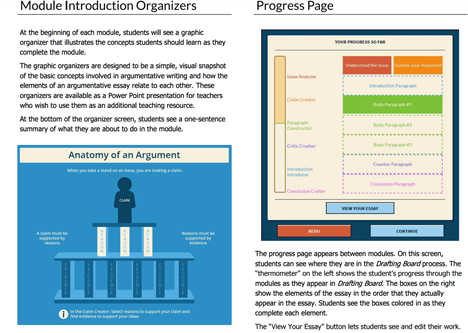
Drafting Board

Argumentation and the value of argumentation in developing critical thinking skills has been a favorite topic. Every time I watch coverage of the present presidential race with all of the charges, counter-charges, and fact checking, I think about what it takes to digest all of this and make an informed decision. Most of my previous commentary was based on the research of Deanna Kuhn and what to me seems like debate.

iCivics takes a different approach with a focus on argumentative writing. They have developed an online tool called Drafting Board that takes scaffolds the process of developing a sound argument. A variety of possible issues and background material are also provided. iCivics is a free resource (they would appreciate contributions).

draftingboard

Loading

Tour Builder

Google describes Tour Builder as a web-based storytelling service. My expanded description would be – place-identified, web-enabled storytelling service.

tourbuilder

The  service is easy to use. You enter a location and if the location is identified by Google you tag that location. If the location is not identified, you can place the tag manually. Once a location is identified, the tour builder can add a narrative and add images. The tour can be shared (our example).

Educators or their students could use this service in many ways. Yes, it is a way to show what you did last summer, but the trip complete with commenting could trace a historical route (Lewis and Clark).

Loading