I must respectfully disagree

I hate to begin the new year by complaining, but I find that I must. Perhaps I should suggest that my comments are intended to offer a different perspective. I guess you are free to interpret my remarks as you will.

This post was prompted by a recent post on the 21st Collaborative blog concerning intellectual property. I do not intend to single this blogger out – the post just happened to be the trigger for these comments.

I respectfully disagree with the position that “our kids” are being limited because copyright law is too restrictive. In my opinion:

  • It is inappropriate to decide what you have a right to do with the property of someone else (digital or not). It is especially troubling when educators take this position. The notion of entitlement in education is very dangerous.
  • Those who advocate the use of the content of others often target a specific type of material making artificial distinction between situations/formats in which it is acceptable and unacceptable to use the work of others. I find it especially troubling when some advocate the use of the digital objects created by others while assuming they personally should be compensated for the delivery of information in other circumstances or in a different format (e.g., paid for teaching, paid for presenting).
  • The argument that someone else has made enough money on a product cannot be an excuse. If you object to the cost of a ticket do not attend. If you object to the cost of a CD, do not purchase. While you can probably get away with appropriating digital content, the income a talented individual has generated hardly seems a reasonable justification for theft. To me, there is something wrong with acting on this premise in some circumstances (digital content), but assuming you cannot in others (sneaking into a theater because the movie is too expensive, stealing the book because it is over priced).
  • I think a sound argument can be made that creating your own digital objects is the best learning experience. Write your own material. Take your own pictures. Converting the ideas of others into your own method of representation is a superior learning experience to relying on the creativity, talents, and physical representation of someone else. If the focus on the “polish” or impressiveness of the product encourages the use of music, video, computer code, artwork, etc. created by those with greater skill, the focus on personal learning has been lost.

Blogged with Flock

Tags: ,

Loading

Time – Top 50 of 2007

The end of the year typically brings many “best of” lists. Time offers a list of the best 50 websites of 2007. The categories (e.g., art and leisure, web services) do not include a grouping focused on education, but as is often the case with web resources many of the sites are suited to multiple uses. In fact, sites that are what I would describe as tool or service sites appear to dominate the selection process. In addition to the list (and a page of information devoted to each site on the list), you can listen to a podcast debating the selections, examine a list of the worst sites (MySpace and Second Life appear here), and a list of long-time favorites.

The top pick? It was mozy.com – an online backup site (with 2 gigs of storage for free).I must admit that many of these sites, including Mozy, were new to me. So – it is worth a look just to see what is out there.

P.S. Since I am on the topic of lists for 2007, here is a suggestion. NPR: All Songs Considered offers a podcast consisting of the top 25 songs of the year as selected by listeners. In total, it is about 1:40 of music from last year. If you want, you can download the episode from the iTunes music store (under podcast locate NPR and All Songs Considered – it is the program for 12/20). Thanks to daughter Kim for this suggestion.

Loading

Geeks on Holiday

We have gathered with our family and friends at a rented cabin in Wisconsin. It is a beautiful location and we have enjoyed the opportunity to relax and view the great scenery.

Olive Holiday 2007

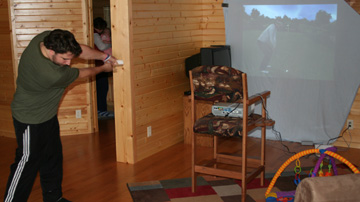
Eventually, we revert to our natural tendencies. We gave Wiis for Christmas. During a trip to MSP in the fall, we heard that Target had the Wii. We stopped at Targets along the way back to Grand Forks and were able to purchase 4. Coming up with one for each family in December would have been impossible. We have set up a projector and a sheet in the basement. Let the games begin.

Jim and Wii

Enjoy the season.

Blogged with Flock

Loading

And now, a word from Scrooge

Many, including those in the education sector who take advantage of free services, have benefited from the many free Web 2.0 resources that are available at no cost. Some analysts are now predicting that a major funding source for such ventures, advertising, may be reaching a saturation point. As more and more ventures are launched, the array of services may reach the point at which very few generate enough funding to keep going. Consumers may follow new developments leaving existing services without the attention to generate necessary revenue.

The options at present appear to be advertising or creating a service that will be purchased by Google/Yahoo/Microsoft. Perhaps 2008 will surface a new option.

Loading

A proximal/distal view of politics

We are in Iowa for a few days attempting to visit my mom. I say attempting because my mom lives in a nursing home and Cindy and I both have bad colds. Because of the delicate conditions of the residents, you are not supposed to enter if you are ill. I guess that makes sense.

I have been following the race for the presidency, but I now realize that I have been following the process at a distance. The experience is very different in Iowa. This morning while watching Charles Osgood’s Sunday news program I saw the same seasonal Obama ad three times – it is the one that ends with a slightly different intonation of the the phrase “I approve THIS message” and his two kids say Merry Christmas and Happy Holiday. I am guessing Barak wishes you a Merry Christmas too, but he may not be able to afford the greeting as frequently where you live. I didn’t notice the same repetition with ads from other candidates but nearly every ad spot was for a candidate. I do not watch a lot of television, but I had viewed none of these ads before.

The Sioux City Journal, the local paper here, has endorsed Obama and Romney. I think the Des Moines Register, a more influential paper, endorsed Clinton and McCain. I am thinking my fascination with the Iowa political scene will wane about the time I leave the state in a couple of days. The opportunity to move in and out of this political preoccupation has been weird.

Hey, in case I am off-line for a few days, Merry Christmas from Cindy and me.

Loading

Maybe blogs were just the next, not the best thing

We are on the road somewhere in southern North Dakota making the long car trip to Iowa to visit my mom. I have a new tech toy to play with on the trip. The rest of my family are power cell phone users and they purchased a multiple-purpose cell phone for me in the hopes I would participate. After a year on months in which my minutes accumulated to less than an hour, I have been cut off. I now have a simple cell phone (no Internet), but I received a “wifi stick” for my laptop in trade. I prefer email and I have Internet access I can use from nearly anywhere. This was a good investment.I just read Will Richardson’s recent post lamenting the lack of group focus among educational bloggers. It is a valid observation and I would agree. Blogs are such flexible tools and the variety of purposes blogs serve is one source of the difficulty. My analysis of my own behavior is that I use this blog to store bits and pieces of info I pick up (hence the title of this blog). I do this for myself, but share if anyone else is interested. I read a few blogs written by others, but I don’t see myself participating in a group enterprise.Consider how blogs differ from other “tools”. Perhaps there are too many access points. With a wiki or a listserv, everything cycles through a common point even when different topics are addressed. With blogs there is no leader, no one to initiate or integrate for others, and an independence that encourages self absorption. You can use a blog like a listserv, but different tools afford different opportunities. Blogs are personalized publishing tools. Other tools are probably better if a group focus in desired.

Loading

PEW Report on Adolescent Use of Social Media

The PEW Internet and American Life Project has released another report on Teens and Social Media. The report released just a few days ago is based on data collected in 2006 and allows comparisons with similar surveys from 2004 and 2000.The report indicates:

  • 93% of adolescents report using the Internet (hence the data reported on “Internet users” need be adjusted downward only a bit to reflect general adolescent use)
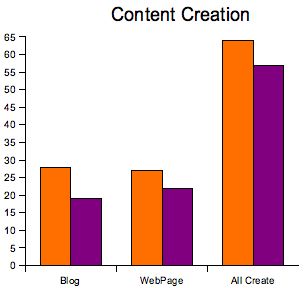
  • 64% of 12-17 year olds participate in at least one content-creation activity
  • 39% share artistic creations (including photos)
  • 28% have created a blog
  • 27% maintain a personal web page
  • 55% have a profile on a social networking site (mostly MySpace)

In general, participation has increased since 2004 (see chart)

2006 PEW data

One of the points the authors argue is that content creation is often a way to start conversations. Teens report a high proportion of their media receive comments.With the exception of video, girls are more likely to produce content (e.g., 35% vs. 20% for blogs).There is some evidence of an awareness of safety issues. For example, uploaded photos are offered to only some potential observers (restricted access) most or some of the time (77%).

There are data on contact with strangers in a separate document describing the survey and offering question by question data. If PEW keeps to past practices, there will be a later report on online safety.

I found some of the data in available in the description of the questionnaire to be of interest. Here are a couple of items not included in the report.

Location of access:

I find this variable of interest partly in reaction to filtering that often occurs in schools. If students access from locations outside of schools, it might be argued that filtering access within schools ignores issues students are likely to encounter elsewhere.

Access at any time:

  • 89% from home
  • 75% from school
  • 70% from home of friend or relative
  • 50% from library

It seems strange that 25% claim not to access the Internet at school (this % has increased since 2004 – school is less likely to be an access point).

Location of most frequent access:

  • 77% from home
  • 18% from school

I wish someone was doing general studies of school technology use like Becker did a decade ago. The PEW data are very general and leave many of my questions unanswered.Issues raised the data cannot answer:Very little really provided about educational use.

  • Was access from school related to a class assignment or is it more likely the school provides access used to meet nonacademic needs?
  • How frequently was access from home related to a school task?
  • What proportion of the content creation was related to school assignments/activities?

It is reported that blog activity is quite common.

  • What is the post frequency?
  • How frequently is blog activity located within a social networking site.
  • What topics do adolescents address in their blogs?

Lenhart, Amanda, Mary Madden, Alexandra Rankin Macgill, and Aaron Smith. “Teens and Social Media.” PEW Internet & American Life Project.

Loading