An interview with Clay Shirky, author of “Here comes everybody”, is available from Will Richardson (Weblogg-ed). Shirky, a college prof, has some interesting things to say about the future of education – structured and personal learning. There are some interesting comments about the mismatch between what we want schools to do and what we presently are measuring.
This is not an iPhone promo. I live in North Dakota. I promised Cindy an iPhone for her last birthday, but we do not have access to ATT. 70 countries, but not ND.
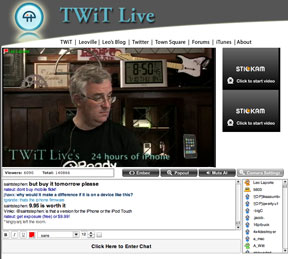
Anyway, I became fascinated with the live stream (http://twitlive.tv). The feed presently has over 6000 viewers and has maxed out. Quality of the feed is amazing. Also interesting to watch the chat window.
I have written several posts based on my reading of Tom Friedman’s The World is Flat. Friedman’s analysis has had an impact on educational thinking – partly in comparing different educational systems and partly in recognizing economic challenges that have educational implications. Friedman’s books have had a place on my iPod for several years and I have reviewed The World is Flat several times.
If you are an educator and have not read or listened to the World is Flat, I can now suggest an alternative. I encourage you to follow Ted Koppel’s Discovery Channel series on China. The series began this evening. The Discovery Channel web site offers some information on the series. The themes in the Koppel series and Friedman’s book are very similar.
I am recording the Koppel series with our Tivo. This is serious stuff and worth reconsidering.
I was listening to the evening news and one of the stories described Texas oil man T. Boone Pickens’ plan to reduce dependency on foreign oil. The plan (as I understand it) is to
increase wind power to generate electricity which
reduces the use of natural gas to produce electricity which
allows natural gas to be used as a fuel for automobiles.
Pickens argues that his plan is the most practical way to reduce oil imports in a reasonable amount of time. Pickens is promoting his plan on a web site created for that purpose.
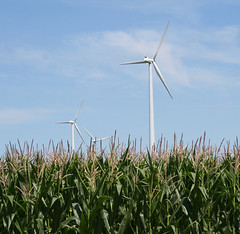
It made me think of the pictures I took almost exactly a year ago while driving through my home state of Iowa.
I now live in North Dakota and I have always assumed there was plenty of wind here. You only have to experience a few winter days to understand the true meaning of “wind” chill. I did find a source indicating ND has “utility grade wind“. I suppose the downside of ND as a source is that the distance energy must be moved to major population areas is great.
Grand Forks is home to a LM Glassfiber plant which produces the giant blades that are used on the large turbines. We frequently see these blades heading down the interstate one blade per semi.
I am writing this post after spending some time with my bloglines. A post by Will Richardson caught my attention. Richardson has a tendency to go sour from time to time. The world does not always spin in the direction that it should. What is the use? etc. The problem now seems to be that technology leaders are not adapting web 2.0 tools to innovative educational ends. Perhaps we are waiting for some well developed examples from the consultants. Actually, I thought the poster sessions offered many examples of classroom activities. Perhaps the NECC experience depends on whom you think will inform you. My problem with NECC is that I have read enough blogs/books to predict the outline of most “major” presenters (e.g., Surowiecki). This is not a criticism because I understand my background and profession requires and allows a different daily focus. I am also frustrated by the lack of what I regard as quality research. Again, I understand there are different conferences for this purpose. Our personal perspectives allow each of us to find fault in a situation that must attempt to meet the needs of thousands.
Today, I decided talking about wind energy was more important than worrying about how many teachers blog or engage their students in authentic projects. Anyone care to argue this priority?
One nice thing about NECC is that many presentations are available after the convention has ended. If this opportunity is new to you, you can locate these resources at http://www.kzowebcasting.com/necc/.
I have been taking advantage of this opportunity for the last several days. Today I watched Chris Dede and colleague describeEdtags. Edtags is a social bookmarking site for educators. The primary focus is on tagged links to educational content, but some additional services are available.
I have operated my own bookmarking site for several years. It made sense to me to create a core of focused educational resources for a target audience and then allow this audience to expand this list. My site began as a resource to extend our books, but I have expanded the purpose to include resources of more general educational value. My site and the Harvard site are both built on an open source project named Scuttle and we have each modified the open source resources to extend services.
I would recommend the NECC session available through the link above as a way to understand some of the key ideas behind these sites and what makes them different from general purpose bookmarking sites.
Free wifi is a good thing. I carry a wireless USB stick, but the connection is slow.
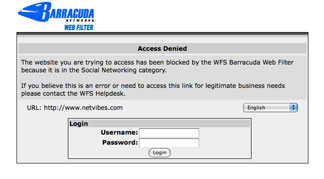
I was pleased to see that the San Antonio airport has free wife, but then I discover that “social networks” are blocked. Evidently the “work” I do is not considered a “legitimate business need”. What is that supposed to mean. Perhaps this is how the kids feel.

You must be logged in to post a comment.