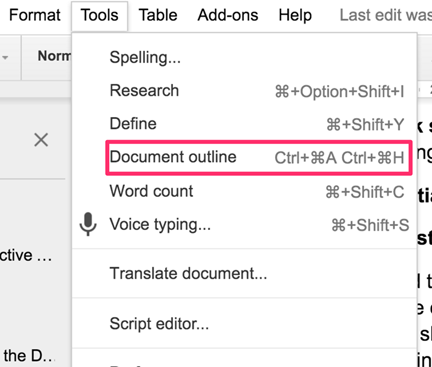
Google has added another capability to the popular Google docs word processing tool. Google Outline automatically creates an outline from an existing document.
You can turn this capability on under the tools header.
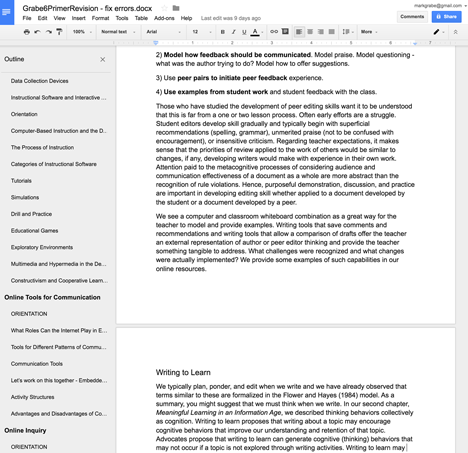
The outliner was already turned on in my account and I was surprised to see an outline appear when I began working on the revision of our textbook.
At present the outliner is mostly a navigation aid for long documents (the document I was working on is 90,000 words in length). So, it is not a tool for sketching out a plan and then working out the details. Instead, it allows you a way to find that segment in chapter 5 you were working on last night. There is certainly some value in this convenience.
I do have to admit the algorithm Google has developed for identifying the structure of a large document is rather clever.
Today we made the trip to the Univ. of Minnesota Landscape Arboretum for the orchid show and then decided to take a walk around the grounds. The loop is 3 miles so the step count will be good today.
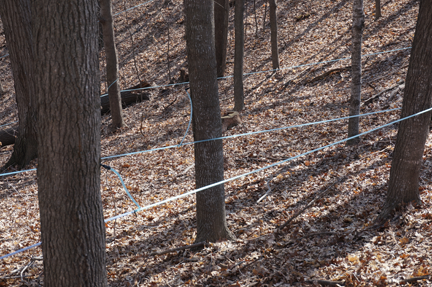
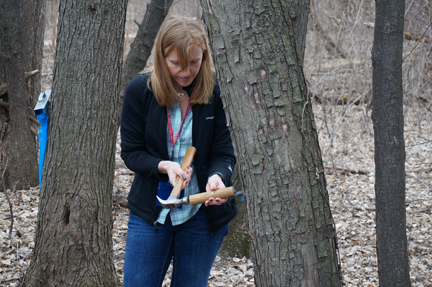
It is approaching Maple Syrup time at the Arboretum and the trees have already been tapped. We first worked in New York state and sugar time was the cause for a festival or two. I remember the system working a little different at that time and place. Trees were tapped with individual buckets for the sap. The Arboretum uses a system in which plastic tubes wind their way from the top of the hill to the bottom. Smaller tubes feed into these main tubes and the sap is collected in a central location at the bottom of the hill. I read it takes 43 gallons of sap to make a gallon of syrup.
Early March is not the season for flowers in Minnesota, but we did see some peeking through the snow and dead leaves.
– – – – –
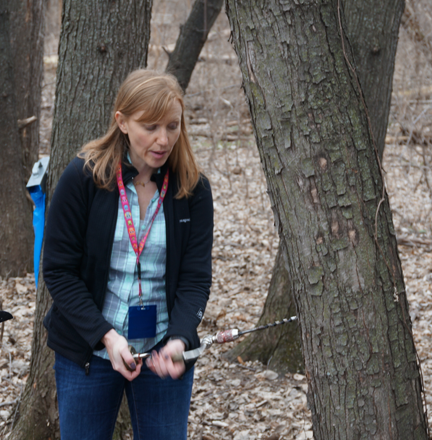
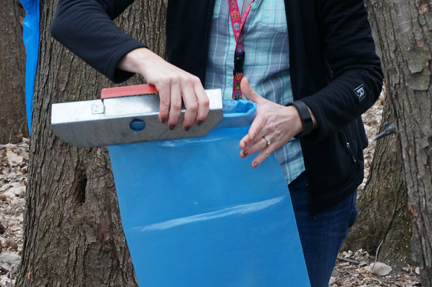
The following week we spend some time at the Wood Lake Nature Center which happens to be located near our home. The maple sap was running at the nature center as well, but the approach to harvest is more old school (the method we experienced last week is more for commercial operations).
I learned a couple of new things this week.
It is the movement of temps above and below 32 degrees that is key to the flow of sap.
Once the buds “pop” the season is over.
When the sap flows, it comes faster than I expected (see final picture).
Why is it social media seems to surface some ideas more effectively than others? Put another way, can it be assumed that good sources will be discovered? I began thinking about these questions in the aftermath of a recent grad class. A group project required students to compare and contrast an online curriculum site with the Kahn Academy. I did not expect that I would be familiar with all of the sources students identified, but I would think I would be aware of similar services of comparable quality. I have been at this for many years and still spend considerable time reading a wide variety of content from many sources.
One group of students focused their analysis on CK-12. It was this example that got me thinking about this issue. CK-12 was unfamiliar to me and yet is of high quality and in many ways similar to the Kahn Academy. Without in any way disparaging the work of Salman Kahn, it was my lack of awareness of CK-12 that challenged my confidence in my own knowledge. With all of the reading I do and all of “influencers” I follow, how had I missed this resource? In fairness, I did spend some time searching the resources provided by some in what others would refer to as my PLN and I must acknowledge that Richard Byrne has posted about CK-12 several times.
I certainly acknowledge some personal responsibility for my own knowledge, but I still stand behind the position that sources of equal quality somehow are not equally visible. Individuals associated with resources may simply be better promoters. Kahn has an interesting book, has been a featured TED presenter, and has attracted prominent backers (e.g., Bill Gates). I have thoroughly reviewed these opportunities to learn about Kahn’s work and have shared these same sources as a way of informing others.
I think the issue I raise cannot be explained so simply. It seems possible that most social media inputs may recirculate the same content and few contributions are actually original. There is an “illusion of knowing” generated by this repetition.
Anyway – I will offer some original comments on CK-12 when I have had the time to do a more thorough exploration.
My experience with technology in K12 going way back is based on a model in which individual schools or at least associations of schools provide mentoring, coaching or some form of assistance to educators attempting to engage their students with technology. My model for how this assistance is provided was pretty much informed by the long career my wife had as a technology facilitator. She started in this type of role many years ago so I must admit I am surprised when this type of assistance is lacking. I recognize the importance of having access to someone with considerable skill with multiple technology tools and instructional strategies. The questions I am raising concern whether what I have described is atypical and whether there is a need for an additional level of mentoring/support.
I may have already clouded the issue by failing to differentiate the various forms professional development might take. As a college professor, my courses should be considered a form of professional development. However, the issues I present and discuss and the level on which these issues are applied for individual learners in a class is very different from the type of interaction my wife provided. I am likely to offer what the research suggests about a particular practice and discuss both the pros and cons of engaging students with a type of activity. I am indifferent to a learner’s commitment to using a specific strategy and feel they should understand that some with good intentions question that strategy. I pick examples from categories of technology tools and may not pick the specific tool from a category you have available in your classroom.
My wife would have been more responsive to individual teachers in her work. I would also describe what she did as starting from what the teacher wanted to do. It would follow that she would not feel a background of strengths and weaknesses of a given strategy was necessary and that suggestions would focus on the tool the teacher wanted or had to use.
Is there another level? Sure. My wife would have had varying degrees of familiarity with the content area the teacher wanted to implement. She had greater experience with elementary and middle school learners, but worked across grade levels. Because her role was full time she was also more of an observer of teacher practice rather than working from personal experience with the application of a specific strategy within a specific grade and content level. As I understand the proposal explained in the link provided above, some feel there is a need for this greater depth. I can see the argument, I just wonder about the feasibility of the business model.
Strategies for involving teachers in lesson analysis have always made sense to me. Some would likely make more meaningful contributions to such activities than others, but the question is whether compensation should be required or can be provided. One thing about new ventures based on a new model is that someone is willing to take the risk to see how it goes.
Here is my proposal that educators diversify their reading lists. There is an expression “Think global, act local” that pretty much summarizes the concern encouraging my suggestion. Every educator faces certain day to day issues and it makes sense that they seek ideas relevant to these daily challenges. So, whether you want to speak like a pirate, hack, code or develop mindsets, there is a book and possibly an app for that. Without meaning to imply a lack of value, these are “flavor of the month” proposals that encourage a different way of thinking about daily practice that may or may not be rehashes of previous ideas. Any trend that encourages reflection is likely a good thing and some variation in classroom activity refreshes the daily experience.
Core problems facing educators are deeper and more systemic.
I am more concerned that public education is being expected to take on problems that originate elsewhere (not a new thing) such as poverty, inequity, and national economic prosperity, blamed for being slow or ineffective in addressing such expectations, and then targeted by politicians and business opportunists with schemes that degrade the great majority of professional educators and divert funds. This sequence creates a downward spiral that feeds on itself and offers justification to those critics unwilling to follow the path of cause and effect.
Here are a couple of recommendations I would encourage for book study and social media comment:
Russakoff, The prize: Who’s in charge of American schools (you will recognize familiar settings and people – Chris Christie, Cory Booker, Mark Zuckerberg – the problem with New Jersey schools and the political solution)
Goldstein, The teacher wars: A history of America’s most embattled profession.
I have long disagreed with the unique focus on STEM, the actual STEM needs that should be addressed, and the identification of the issues limiting getting those with potential into STEM careers.
This NYTimes article by Queens College professor Andrew Hacker arguing that the expectation for advanced math courses in high school is misguided encouraged me to combine and restate some of the arguments I have already made. Trends tend to feed on themselves, but education is close to a closed system so what is offered in one area is subtracted from another. It is important to be careful when jumping on a bandwagon.
When I consider what I feel are the most significant problems facing humanity, I am not convinced that many or perhaps even most are issues that will be solved by math, physics, chemistry, biology or coding. The inequities that exist in society, the corruption in the finance sector and our ineffective political system are not STEM problems and require far greater attention. Challenging future generations with the critical thinking, problem solving, and creativity necessary to deal with these core issues is being neglected.
There is no doubt that the science and math problems of our time need individuals of great talent and dedication. Addressing these issues whether as a matter of national competitiveness or human need requires a different approach than “more STEM for all”. A broad focus on STEM is inefficient and does not focus educational opportunities on the individuals best suited to these careers.
I agree with Hacker, the number of students taking advanced math is unnecessary. A greater focus on statistics and research methods (quantitative reasoning) would have far more general value. The general public needs to have the mental tools necessary to interpret the data that we all encounter daily. These quantitative skills are ignored in the main line STEM courses.
Perhaps we should be asking why talented students ignore STEM careers. Why are women so underrepresented in computer science? Why do so many talented college students pursue an MBA rather than a science major? These are the real problems and these issues have more to do with values and social acceptance than the number of courses available. But again, recognizing root causes do not follow from a STEM perspective.
I first became interested in Nuzzle as a way to track the links provided by the Twitter users I followed. I am not a big Facebook users so my experience was limited to Twitter. Nuzzle would provide me a list of the most frequent links included in the Tweets of this group.
This approach made great sense but was not particularly useful for me. The problem was mostly a matter of scale. I did not follow enough individuals to get a benefit from the service. The most frequent links from my friends might total 3 or 4 for a given day. There was little differentiation among the more popular links and I would probably note these links on my own by scrolling recent tweets in my feed and so did not benefit in the way someone who would miss thousands of tweets might benefit.
The folks at Nuzzle probably understood this issue and now offer some new possibilities. Using their “Discover” feature, I can offer a topic I want to explore (say educational technology) and receive a list of “influencers” and popular recent links. Either offers an interesting approach to discovery (as opposed to search). As I understand the role of “influencers”, these individuals might represent individuals with a more productive friend list than my own and I would be able to share what this larger or more prolific group might surface.
Nuzzel offers many existing categories, but I find using search to identify my interests to be more useful.
So here, I locate stories and influencer feeds I can follow on the topic of educational technology.






You must be logged in to post a comment.